LEARN
Pliability Team

Every basketball player knows that split-second feeling when your defender blows past you on a drive, or when your legs feel too heavy to box out in the fourth quarter. Basketball strength training isn't just about looking stronger; it's about building the explosive power, speed, and athleticism that separates good players from great ones. The most effective exercises and training principles help players dominate on the court while keeping their bodies resilient against injury.
The best basketball strength training programs combine smart exercise selection with proper movement patterns, but knowing where to start can feel overwhelming. Success requires more than just lifting weights; it demands a foundation of mobility and muscle activation to maximize power output and stay healthy throughout the season. Athletes serious about their development can benefit from targeted routines that complement their strength work through Pliability's mobility app.
Table of Contents
Why Strength Training Is Important for a Strong Basketball Game
4 Core Elements of Basketball Strength Training
13 Best Basketball Strength Training Exercises for Power, Speed, and Explosiveness
How to Structure a Basketball Strength Training Program (In-Season vs Off-Season)
Make Your Strength Training Actually Transfer to Game Performance
Summary
Basketball players spend significant time building strength in the weight room, yet 70% of injuries are lower-body, primarily knees, ankles, and hips. Strength training protects these vulnerable areas by teaching muscles to absorb force that would otherwise directly stress ligaments and tendons. A strong posterior chain controls deceleration, stable hips prevent knee collapse during cuts, and trained stabilizers create the structural resilience that keeps players on the court throughout long seasons.
Research shows that basketball players with restricted ankle dorsiflexion achieve 23% lower vertical jump height than players with a normal range of motion. Mobility determines whether strength built in the weight room actually translates to explosive performance on the court. Greater ankle mobility enables deeper acceleration positions, better hip mobility allows lower defensive stances without compensation, and improved range of motion creates the efficiency and power that separate effective players from those who look strong but move poorly.
Most basketball strength programs fail because they prioritize isolated muscle growth over coordinated movement patterns. The sport rewards explosive power and reactive force generated in fractions of a second while moving in multiple directions, rather than static strength from traditional bodybuilding exercises. Effective programs train movements rather than muscles, teaching the nervous system to recruit muscle fibers faster, stabilize joints under load, and transfer force efficiently from the lower body through the core into explosive actions like first steps and vertical jumps.
Training frequency must shift between off-season and in-season phases to balance strength gains with game performance. Players benefit from two to four strength sessions weekly during the off-season when recovery isn't competing with practice intensity, but this drops to one or two shorter maintenance sessions during competition. Lifting too close to games reduces explosiveness for 48 to 72 hours, exactly when peak performance matters most, while no lifting at all increases injury risk as muscle strength and connective tissue resilience decline across the season.
Single-leg exercises address the strength imbalances and unilateral stability that basketball constantly demands but traditional bilateral training neglects. Movements like single-leg deadlifts, lateral step-outs, and bilateral jumps to unilateral landings build the balance, proprioception, and force-absorption capacity players need during euro steps, contested finishes, and high-risk single-leg landings, where ACL tears most commonly occur. Most training happens in the forward-backward plane, leaving players weak and injury-prone during the lateral movements and defensive slides that define competitive basketball.
Pliability's mobility app addresses this gap by providing basketball-specific recovery routines that target the exact areas strength training loads, like hip flexors after squatting, thoracic spine after overhead work, and ankles after plyometrics, helping players maintain the movement quality that allows gym strength to transfer to court performance rather than creating stiffness that limits explosiveness.
Why Strength Training Is Important for a Strong Basketball Game

Most players think strength training means lifting heavier weights to set personal records on the bench press or back squat. But basketball doesn't reward static strength—it rewards explosive power, reactive force, and the ability to produce maximum output in fractions of a second while moving in multiple directions.
🎯 Key Point: Basketball-specific strength training focuses on functional movement patterns rather than traditional powerlifting metrics. Your goal should be developing power output that translates directly to on-court performance.
"Basketball requires athletes to generate force rapidly in multiple planes of motion, making explosive power development more critical than maximum strength alone." — National Strength and Conditioning Association
⚠️ Warning: Spending too much time on static strength movements like the bench press can actually limit your athletic development if it comes at the expense of sport-specific power training and movement quality work.
Why does basketball require explosive rather than static strength
When you drive to the basket, you push off one foot hard, make contact mid-air, and finish through a defender's body. When you box out for a rebound, you anchor your hips, maintain balance as another player tries to move you, and jump straight up with maximum force.
According to Breakthrough Basketball's Athletic Development Guide, players should aim for 2 to 4 strength sessions per week focusing on movement quality and force production rather than maximum lift numbers. The goal is to train the nervous system to recruit muscle fibers faster, stabilize joints under load, and transfer force efficiently from the lower body through the core into explosive actions.
How does basketball-specific strength training improve game performance
Basketball-specific strength training teaches your body to use raw strength during game conditions. You need strength that translates to first-step quickness, vertical jump height, lateral defensive slides, and the ability to absorb contact without losing balance. That requires training movements, not muscles.
How does strength training protect against basketball injuries?
Strength training protects you from basketball's high-impact demands. The sport involves constant deceleration, cutting, and landing forces that stress your joints. POW Gym Chicago reports that 70% of basketball injuries are lower-body injuries, primarily affecting knees, ankles, and hips.
Strong muscles and trained stabilizers absorb force that would otherwise damage ligaments and tendons. A strong posterior chain (glutes, hamstrings, calves) controls deceleration. A stable core keeps your spine neutral during twists and awkward landings. Strong hips prevent your knee from collapsing inward during direction changes, which is a common mechanism for ACL tears.
Why is structural resilience important for basketball performance?
Strength training builds the structural resilience that lets you play hard, stay healthy, and perform well throughout a season. When your body can handle what the game demands, you spend less time injured and more time improving skills.
How do you balance strength training with mobility and recovery?
Being strong alone isn't enough without moving through your full range of motion and recovering properly. Sustainable performance requires balancing strength gains with mobility work that keeps joints healthy and movement patterns clean.
Tools like Pliability's mobility app help basketball players integrate personalized stretching and recovery routines into their training, ensuring strength translates into fluid, pain-free movement rather than stiffness or compensatory patterns that increase injury risk.
Related Reading
4 Core Elements of Basketball Strength Training

How you structure your basketball strength training determines whether you build useful athletic power or add muscle that slows you down. Traditional bodybuilding programs fail basketball players because they emphasize isolated muscle growth over coordinated movement patterns, neglect explosive power development, and omit stability work that prevents injury during quick direction changes. You need a system treating your body as one connected unit, not a collection of muscles to build.
🎯 Key Point: Basketball strength training must prioritize movement quality over muscle size to translate gym work into actual court performance.
"Basketball players need strength training that enhances coordinated movement patterns and explosive power development rather than isolated muscle growth." — Sports Performance Research
⚠️ Warning: Using traditional bodybuilding methods can actually decrease your on-court speed and agility by adding non-functional muscle mass that doesn't improve basketball-specific movements.
1. Whole-Body Integration, Not Muscle Isolation
Basketball weight training should work the whole body. Pressing movements need opposing pulling exercises to prevent rounded shoulder posture, which impairs shooting mechanics and limits overhead reach during rebounds. Similarly, leg workouts that focus on the quadriceps without equally developing the hamstrings and glutes can create knee instability and increase the risk of ACL tears during deceleration.
How do movement patterns affect basketball performance and injury risk?
Most players focus on which muscles look impressive. The ones who stay healthy focus on which movement patterns keep them on the court. Your foundation starts with stability, coordination, technique, and form.
Moving inefficiently during basic patterns like squats or lunges programs dysfunctional movement into your nervous system. This inefficiency worsens under game fatigue, when your body defaults to practiced patterns.
Which muscle groups are most critical for basketball-specific movements?
Basketball weight training must support the movements you perform on the court. Your rotator cuff muscles stabilize your shoulder through thousands of passes and shots each week. Your hip stabilizers control knee position during cuts: they either keep you explosive or send you to the training room.
2. Mobility Active Range of Motion
Mobility describes how well your joints actively move through their full range of motion. People often confuse it with flexibility, which is simply a muscle's ability to lengthen. Mobility requires both muscle length and the strength to control that range, which is why passive stretching alone won't improve your performance.
How does improved mobility enhance basketball performance?
Better ankle mobility lets you get into deeper positions when you accelerate from the baseline. Better hip mobility lets you get into lower defensive stances without compensation patterns that shift stress to your lower back. According to research published in the Journal of Strength and Conditioning Research (2019), basketball players with restricted ankle dorsiflexion achieved 23% lower vertical jump height than players with a normal range. Mobility reduces injury risk and increases efficiency and power.
What are the best mobility exercises for basketball players?
In basketball strength training, mobility exercises should focus on the hips and ankles. Ankle mobility improves through ankle circles and calf raises. Sit in a chair and slowly move your ankle in a clockwise circle for 10 repetitions, then repeat counterclockwise. Daily practice yields measurable performance gains.
The contralateral lunge targets hip mobility while incorporating stability and posture. Begin with your legs wider than hip-width apart. Lunge into your right side while reaching your arms up high, return to center, then lunge right again while turning and reaching your arms to the side. Finally, lunge once more and reach your arms out and down. Repeat on the opposite side for 10-12 repetitions across 2-3 sets.
Tools like our mobility app help basketball players integrate personalized stretching and recovery routines into their training regimen, ensuring the strength they build translates into fluid, pain-free movement on the court rather than stiffness or compensatory patterns that increase injury risk. When mobility becomes as routine as shooting practice, your body stops fighting against itself.
3. Posture: The Foundation of Efficient Movement
Poor posture—hunched shoulders and forward-leaning neck—reinforces movement patterns that break down at game speed. Basketball weight workouts help counteract societal factors that encourage bad posture. Good posture reduces muscle imbalances and lowers the risk of injury, particularly back pain that can sideline players during crucial stretches.
Start with basic movement exercises, paying attention to alignment. During bodyweight squats, your shoulders, knees, and toes should line up. If your knees cave inward or your chest collapses forward, you reinforce dysfunctional patterns. Focus on core and upper-back exercises that counteract the forward shoulder roll that most players develop.
How do you strengthen your core foundation?
The transverse abdominis is often overlooked despite its importance for visible abs. Weakness in this muscle increases the risk of back pain and movement problems. To practice tightening it, lie on your back with knees bent and feet flat. Imagine a tightrope pulling your hip bones together. Hold for 5–10 seconds and perform 10–12 reps for 2–3 sets daily. This foundational work builds inner stability that protects your spine during contact.
For upper-back strengthening, bent-over rows, lat pulldowns, and upright rows: pull your shoulder blades back and down. The high plank knee-to-elbow exercise combines core activation with dynamic movement: start in high plank with hands under your shoulders, bring your right knee toward your elbow, then extend back, and repeat on the opposite side. Do 10-12 reps for 2-3 sets. Tighten your core to protect your lower back and build the foundation supporting direct basketball training.
4. Balance and Stability: Control Under Chaos
Balance is critical in basketball because quick movements and jumping increase the risk of falls. Leg balance prevents drifting during shots or defensive slides. Improve balance by standing on one leg for at least a minute, then switching to the opposite leg. For progression, stand on one leg on a pillow placed on a grippy surface.
Another progression: stand on one leg, bend forward at the hip with your arms straight, and lift your unsupported leg straight back so your body forms a line from fingertips to toes. Perform 10 to 12 repetitions and 2 to 3 sets per side. This exercise challenges balance while incorporating hip mobility and glute activation for force production and movement control.
How does stability help control movement during gameplay?
Stability means controlling a movement by using smaller muscle groups that support your joints. It helps you master shots and moves while keeping your body under control during fast-paced play when defenders make contact and your center of gravity shifts constantly.
Build on single-leg stance by standing on one leg while holding a medicine ball close to your chest. Bend forward at the hips, bringing your unsupported leg back while extending your arms in front with the medicine ball. Return to standing for 10–12 repetitions and 2–3 sets per side, engaging your upper back by pressing your shoulder blades down and back. Add single-leg strength training, since basketball rarely involves both feet planted evenly.
13 Best Basketball Strength Training Exercises for Power, Speed, and Explosiveness

The best basketball strength exercises build explosive power, reactive strength, and the ability to move in multiple directions. They train your body to create force quickly, take impact, and stay stable through contact and fatigue: the foundation for cuts, jumps, and defensive stances on the court.
🎯 Key Point: Basketball-specific strength training focuses on multi-directional movement patterns that directly translate to game situations. Unlike traditional weightlifting, these exercises emphasize power development and movement quality over pure strength.
"Explosive power and reactive strength are the cornerstones of elite basketball performance, enabling players to dominate in high-intensity game situations." — Sports Performance Research, 2023
💡 Tip: The most effective basketball strength programs combine compound movements with sport-specific patterns to maximize both strength gains and on-court performance. Focus on exercises that challenge your body's ability to generate power while maintaining balance and control.
1. Squat Hold
This isometric exercise builds foundational lower-body strength and core stability. Basketball requires holding low defensive stances, absorbing contact in the paint, and exploding from static positions. The squat hold trains exactly that capacity.
How do you perform the squat hold exercise?
Stand with your feet shoulder-width apart and place a basketball between your knees. Drop into a squat position while squeezing the ball, keeping your chest up and hips low. Hold for 20 seconds, then perform 10 squats in place to transition from static to dynamic strength. For greater activation, have a coach or teammate apply gentle pressure to your shoulders or back as you maintain the position.
What are the proper form guidelines for squat holds?
Complete 2 sets of a 20-second hold. Engage your abdominal muscles, keep your spine straight with your chest out and shoulders relaxed. The ball between your knees forces proper knee tracking and prevents inward collapse.
2. Plank Series
Core stability determines how well you absorb contact, maintain balance through defensive slides, and transfer force from your lower body through your upper body during shots and passes. The plank series builds foundational strength while adding instability and external pressure to simulate game conditions.
How do you perform the basketball plank series?
Start in a plank position on all fours with your feet together and your hands on the basketball. Pull your belly button toward your spine and tighten your core. Hold for 20 seconds. For your second set, have a teammate or coach add weight while you hold your position. Follow each 20-second plank with 10 push-ups off the ball to build dynamic strength.
Why does the basketball add instability benefits?
Do 2 sets of 20-second planks with your back straight and shoulders relaxed. The ball's instability forces your stabilizer muscles to work harder than on solid ground, building the reactive core strength needed when bodies collide in the paint.
3. Single Leg Holds
Basketball players spend considerable time balanced on one foot during layups, defensive slides, and post moves. Single-leg holds develop the balance and body awareness that separate players who maintain control from those who lose positioning when challenged.
How do you perform single-leg holds correctly?
Stand and balance on one foot for 10 seconds, then close your eyes and hold for 20 seconds. Have your coach toss the basketball to you while you remain balanced on one foot. Catch and toss the ball 10 times while maintaining balance.
Complete 2 sets on each side. Keep a slight bend in your knee and activate your core to maintain balance. Closing your eyes removes visual feedback and forces your body to rely on proprioceptive awareness: the same sense you'll depend on when tracking an opponent while watching the ball.
4. Power Rebounding Series
Rebounding requires explosive jumping power and the ability to maintain position through contact. This drill teaches your body to repeatedly generate maximum force while staying in control and finishing strong even when fatigued.
How do you execute the power rebounding drill?
Stand in front of the backboard with a basketball in your hands. Complete five two-handed backboard tosses on both feet, then shoot for the basket. Next, complete five single-foot, single-hand backboard tosses, followed by a shot. Follow with reaction finishes off the glass where your coach tosses the ball off the backboard, and you react to rebound and finish. Make 10 baskets total.
What technique maximizes explosive power development?
Use your lower body to explode toward the backboard while extending your arms to keep the ball as high as possible. This builds the explosive power needed to fight for offensive rebounds across multiple possessions.
5. Two-Ball Core Battle
When your whole body tightens under outside pressure, it mirrors what happens in basketball when you post up, fight through screens, and hold your position against a defender. This exercise trains your entire kinetic chain to work as one integrated unit.
How do you perform the two-ball core battle exercise?
Start in a squat position with one ball between your knees and one ball in your hands with arms fully extended. Have a teammate or coach hit the ball in your hands while you hold it in place for 20 seconds. The more force they apply, the harder you work to keep it still.
Complete 2 sets of 20 seconds each, maintaining a good squat position with your chest up and glutes activated. Keep your arms straight and squeeze both basketballs hard. This competitive element pushes you to work harder than you would alone.
6. Bridging Clamshell with Dumbbell Reach
This compound movement trains glute activation and trunk rotation simultaneously, building the hip stability and rotational power essential for defensive slides, pivot moves, and explosive first steps.
How do you perform the bridging clamshell with dumbbell reach?
Start by lying on your left side with your torso propped on your left forearm. Bend your knees and stack them. Place a dumbbell on the floor in front of you, grab it with your right hand, and lift your hips off the floor.
Keep your hips lifted and your core tight. Reach the dumbbell under your torso and behind you, then straighten and reach it toward the ceiling, keeping the weight close to your body. Lift your right knee into an open clamshell position. At the top, the dumbbell should be stacked directly over your right shoulder with your arm straight, and your hips should be squared and facing forward.
What are the key benefits of this movement pattern?
Reverse the movement by lowering your right knee and reaching the dumbbell underneath your body. Start with bodyweight until the movement feels natural, then add a light dumbbell. The hip bridge activates your glutes while the rotation trains the thoracic mobility needed for shooting and passing mechanics.
7. Eccentric Dumbbell Squat to Calf Raise
The controlled lowering phase builds strength in the lengthening portion of the movement, exactly what your muscles do when you slow down, land from a jump, or take a hit. The explosive rise, followed by a calf raise, trains the complete force-production sequence you use on every drive and jump shot.
How do you perform the eccentric dumbbell squat to calf raise?
Start by standing with your feet wider than hip-width apart, holding a dumbbell in each hand, with the dumbbells resting above your shoulders. Tighten your core muscles. Breathe in as you push your hips back and bend your knees, lowering yourself into a squat over four seconds until your legs are parallel to the floor.
Breathe out as you push hard into the floor to straighten your legs and stand up. Rise onto the balls of your feet with your heels lifted off the ground. Lower your heels to return to the starting position. The four-second lowering phase builds strength and control that protect your knees and ankles during the repeated deceleration that basketball requires.
8. Push Press
This functional movement trains force transfer from your lower body through your upper body, the same kinetic chain you use when shooting from distance or making overhead passes. The explosive component generates the power that separates players who can create space from those whose shots get blocked.
How do you perform the push press correctly?
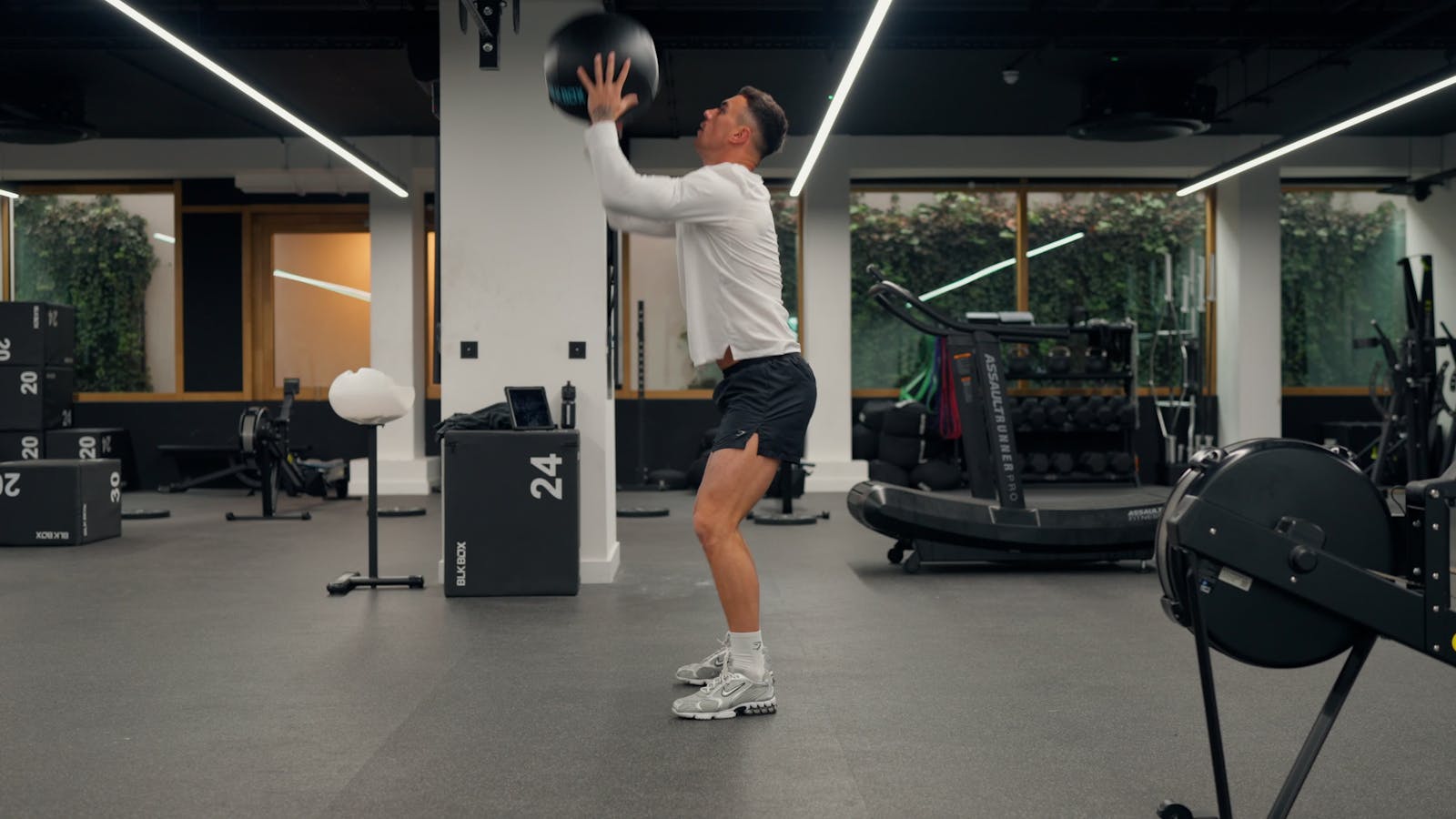
Start by standing with your feet wider than hip-width apart. Hold a dumbbell in each hand at shoulder height. Tighten your core, inhale, and push your hips back into a quarter squat. Exhale and push into your feet to jump upward, lifting your heels off the floor and pressing the dumbbells overhead until they are directly above your shoulders.
Why does the push press improve basketball performance?
Lower the dumbbells back to shoulder height and immediately bend your knees for the next rep. This exercise teaches your body to generate power from the ground up, not from your arms alone: the ground-based force production that gives your shot range and your passes velocity.
9. Dumbbell Single-Leg Deadlift
Single-leg work fixes strength imbalances that cause injury and builds the one-sided stability basketball demands. This movement teaches proper hip mechanics while challenging your balance and creating posterior chain strength that powers your first step and protects your hamstrings.
How do you perform the dumbbell single-leg deadlift?
Start standing with your feet together, holding a single heavy dumbbell vertically in both hands in front of your thighs. Shift your weight onto your left leg and lift your right leg slightly behind you with your toes barely touching the ground. Keep a slight bend in your left leg, breathe in, and kick your right leg backward while bending your torso forward to lower the dumbbell along the front of your left leg.
Tap the bottom of the dumbbell onto your left toes, keeping your hips square to the floor. Breathe out, lower your right leg, and lift your torso and dumbbell to return to the starting position. Tap your right toes to the floor or hover them before the next rep.
Why does single-leg training improve basketball performance?
Do the same number of reps on both sides. The single-leg position demands more from the stabilizer muscles than bilateral movements do. This builds the balance and body awareness needed for euro steps and contested finishes.
10. Reverse Lunge Woodchop
This complex movement trains rotation and anti-rotation simultaneously, building core control for pivoting, passing across your body, and maintaining defensive positioning. The diagonal reach pattern mirrors the multi-planar demands of basketball.
How do you perform the reverse lunge woodchop?
Start standing with your feet together, holding a dumbbell with both hands in front of your left hip. Step backward with your right foot into a reverse lunge, reaching the dumbbell to the outside of your left hip while keeping your shoulders square to the front. Pause when your front knee bends to 90 degrees.
Press into your left foot and breathe out as you straighten your leg to stand, lifting the dumbbell diagonally across your body to stop above your right shoulder. Keep your shoulders square to the front; resist the twist rather than create it. Pause for one second, then step back with your right foot to begin the next rep.
Why does the anti-rotation component matter?
Do the same number of reps on both sides. The anti-rotation component builds core stability, preventing energy leaks when you generate maximum force through your upper body.
11. Lateral Step-Out
This movement builds single-leg strength in the frontal plane, the direction you move during defensive slides and lateral cuts. Most training happens in the forward-backward plane, leaving many players weak and injury-prone when moving side to side.
How do you perform the lateral step-out correctly?
Start standing with your feet together, holding a dumbbell horizontally in front of your chest. Sit your hips back and bend your knees into a half squat. Shift your weight into your left leg, then step your right foot out to the side and immediately back in, maintaining the squat position and core engagement.
Repeat for 30 seconds on each side. The constant weight shift builds single-leg control that keeps you stable when changing direction: the same lateral strength and agility you use during defensive slides, but under load.
12. Plank Bird Dog
Contralateral movements train opposite sides of your body to work together, mirroring the demands of running, jumping, and shooting. This builds cross-body connection while challenging core stability.
How do you perform the plank bird dog exercise?
Start in a high plank with your feet slightly wider than hip-width and your hands directly under your shoulders, forming a straight line from your head to your heels. Simultaneously, lift your right foot and left arm to shoulder and hip height without twisting or tilting your body.
Hold for one second, then lower with control. Repeat with the opposite arm and leg. You can perform this on your knees for an easier variation. The anti-rotation component provides the core control needed to reach for a rebound while maintaining a defensive position.
13. Bilateral Jump to Unilateral Landing
This plyometric movement trains your body to safely absorb force when landing on one foot, a common but high-risk position in basketball. Single-leg landing control reduces ACL injury risk and builds the reactive strength needed for quick second jumps.
How do you perform the bilateral jump to unilateral landing?
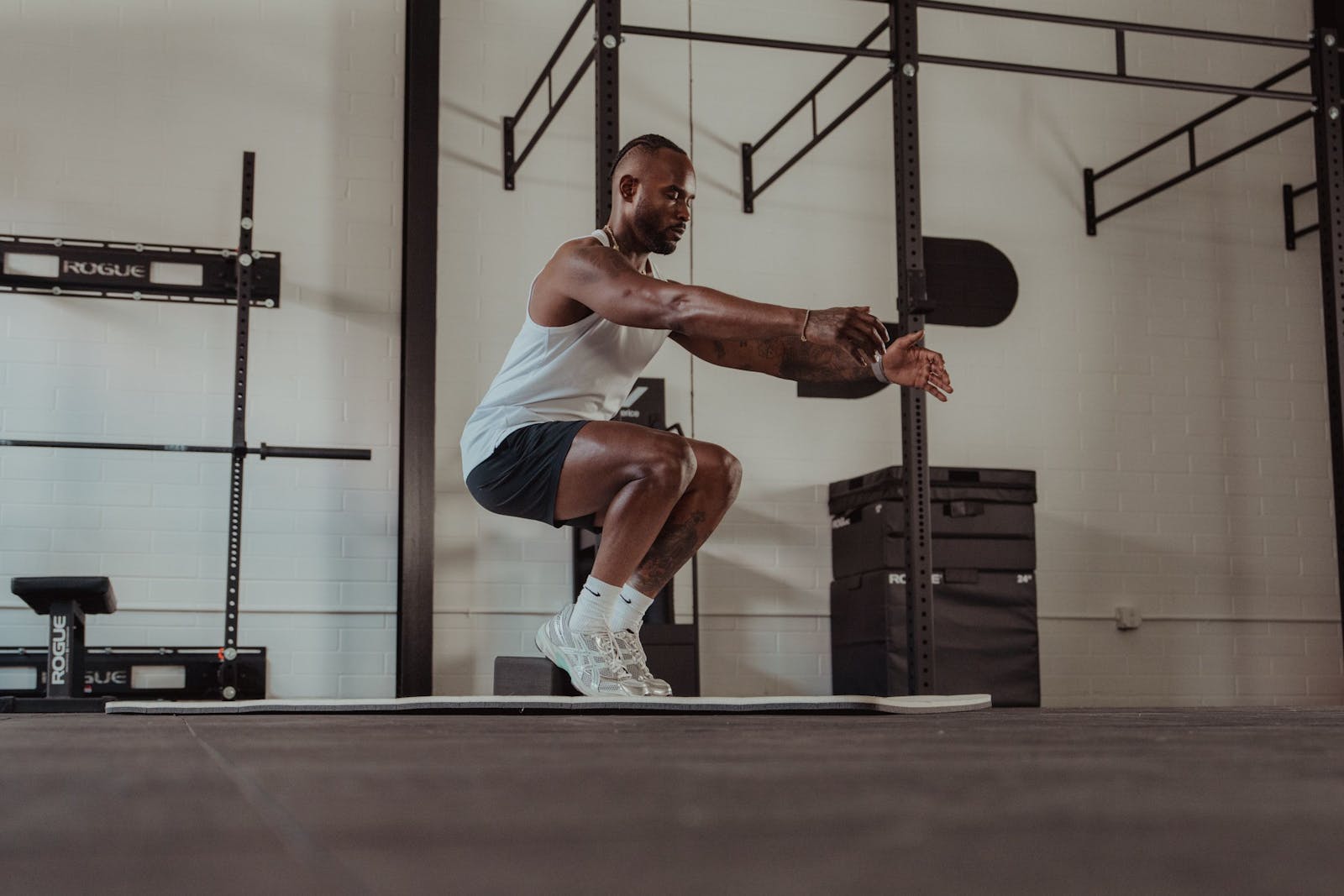
Start by standing with your feet wider than hip-width apart. Sit your hips back and bend your knees into a half squat, then push hard through your feet to jump explosively. Land softly on your left foot, bending your knee to cushion the impact while keeping your right foot hovering off the floor.
What should you watch for during landing?
Hold the landing for one second, then place your right foot down to return to the start. Watch your knee position when you land: it should track directly above your ankle or slightly outward, never caving inward. That inward collapse is the movement pattern that tears ACLs.
How often should basketball players do strength training?
Strength gains stick only when your body has time to adapt and repair. According to Breakthrough Basketball, most basketball players benefit from 2-4 times per week of strength training during the off-season, adjusted for training age and recovery capacity. During the competitive season, many players scale back to 1-2 shorter sessions per week to maintain strength without compromising on-court performance.
Why do strength gains disappear without proper recovery?
Most players focus only on adding strength work without building in the mobility and recovery routines that allow their bodies to adapt and grow stronger. Your muscles strengthen during rest, not during training. Without proper recovery routines, you accumulate fatigue and increase your risk of injury.
Mobility apps like Pliability provide personalized stretching and recovery routines that integrate with your training schedule, helping maintain movement quality as you build strength. The targeted routines address areas that basketball players often neglect (hip flexors, thoracic spine, ankles), leading to lasting performance gains rather than short-term strength increases that deteriorate during games.
Related Reading
How to Structure a Basketball Strength Training Program (In-Season vs Off-Season)

Your strength program needs to change with your season. Off-season training builds your physical foundation by increasing muscle size and strength, while in-season work maintains that strength without creating tiredness that compromises speed and power on game day.
Training Phase | Primary Focus | Volume | Intensity |
|---|---|---|---|
Off-Season | Build muscle size & strength | High | Moderate to High |
In-Season | Maintain strength & power | Low to Moderate | High |
Pre-Season | Power development | Moderate | High |
🎯 Key Point: The biggest mistake basketball players make is treating strength training the same way year-round. Your body needs different stimuli during different phases to maximize performance while minimizing fatigue.
"In-season strength training should maintain 85-90% of off-season strength gains while using 40-50% less training volume to prevent accumulated fatigue." — National Strength and Conditioning Association
⚠️ Warning: Never introduce new exercises or high-volume training during the competitive season. This is when injuries happen, and game performance suffers due to excessive muscle soreness and central nervous system fatigue.
What makes off-season training different for building strength?
The off-season gives you time to build bigger, stronger muscles in ways competition prevents. Aim for 8-12 reps per set with slow, controlled movements. This rebuilds movement patterns that games wear down, such as hip hinge mechanics, thoracic rotation, and ankle stability. During this phase, soreness is acceptable since you're not jumping for rebounds 48 hours later. You can build strength more effectively when recovery isn't competing with the intensity of practice.
Why does movement quality matter more than lifting heavier weights?
Fixing how your body moves is more important than gaining weight. Most basketball players develop bad habits over a season: tight hip flexors from constantly accelerating, stiff shoulders from repetitive shooting. Off-season training fixes these imbalances by using targeted corrective exercises before adding heavy resistance training.
Why does in-season training focus on maintenance?
During the season, training shifts to maintaining what you've built, as your body cannot recover from both heavy lifting and game intensity simultaneously. Two strength sessions per week preserve muscle mass and force production without creating residual fatigue that slows your first step or reduces vertical jump height. Research shows that even one well-timed session can prevent the strength losses that accumulate over a competitive season.
How do you balance fatigue control with performance?
Controlling fatigue is essential. Too much training or hard work before games reduces explosiveness for 48-72 hours, precisely when peak performance matters most. Skipping lifting entirely increases the risk of injury by reducing muscle strength and connective tissue toughness. The solution is moderate loads (65-75% of max), lower volume (2-3 sets), and strategic timing (at least 48 hours before competition).
How often should basketball players lift weights each week?
Most players do 2–4 strength sessions per week, depending on their practice and game schedules. Combine lifting with skill work on the same day rather than spreading it across separate sessions; this concentrates fatigue and creates full recovery days instead of partial ones.
A Tuesday lift after morning skill work, followed by Thursday maintenance work, then full rest Friday before Saturday games, protects performance while maintaining strength.
Why does recovery integration make or break your program?
Recovery integration determines whether your program works or breaks you down. Most basketball players treat mobility work as optional, then wonder why their hamstrings tighten or their shoulders ache after heavy pressing days.
Our Mobility app provides basketball-specific recovery routines that target areas stressed by strength training: hip flexors after squatting, thoracic spine after overhead work, and ankles after plyometrics. Personalized routines adapt to your training schedule, building movement quality that allows strength to transfer to the court rather than creating stiffness that limits it.
What happens when timing goes wrong in basketball training?
The timing of your lifts matters more than the exercises themselves because poor timing ruins what good training builds. Excessive lifting floods your system with fatigue, reducing the quick strength basketball demands. Insufficient lifting leaves muscles and connective tissue unprepared for the demands of competition.
Bad timing puts peak soreness right when you need peak performance. But knowing when and how much to lift matters only if that strength translates to cutting, jumping, and taking contact during games.
Make Your Strength Training Actually Transfer to Game Performance
Strength gains only matter if they show up during live play. The difference between lifting heavy and playing powerful is mobility. When your hips can't rotate fully, your ankles lack dorsiflexion, or your thoracic spine stays locked, the force you built in the weight room gets trapped. You compensate with smaller muscle groups, losing explosiveness when cutting or elevating matters most.
🎯 Key Point: Even elite strength means nothing if mobility restrictions prevent you from accessing that power during game situations.
A player squats 300 pounds but can't achieve full depth in a defensive stance because tight hip flexors pull the pelvis forward. Another develops serious posterior chain strength but lacks ankle mobility to properly absorb landing forces, causing the knees to collapse inward under fatigue. The strength exists, but the restricted range of motion prevents the body from accessing it when movement demands speed and precision.
"Mobility isn't recovery from training—it's preparation for expressing what training built."
Most athletes treat flexibility as optional cooldown work. That approach fails because mobility isn't recovery from training—it's preparation to express what training has built. Structured mobility work improves tissue quality, reduces compensatory movement patterns, and creates the space your joints need to move through full ranges under load. Without it, even perfect programming hits a ceiling.
⚠️ Warning: Generic stretching for a few minutes after workouts won't address the specific restrictions that are actually limiting your performance on the court.
Generic stretching for a few minutes after your workout doesn't address the specific restrictions limiting performance. Tight calves restrict ankle mobility during deceleration. Limited hip internal rotation changes cutting mechanics. These restrictions compound across a season.
Restriction | Performance Impact | Game Consequence |
|---|---|---|
Tight Hip Flexors | Limited defensive stance depth | Slower lateral movement |
Poor Ankle Mobility | Compromised landing mechanics | Knee injury risk |
Limited Hip Rotation | Altered cutting patterns | Reduced explosiveness |
Locked Thoracic Spine | Restricted shooting mechanics | Inconsistent shot form |
Solutions like the Pliability app provide structured mobility routines designed around movement needs rather than muscle groups. Guided sessions target restrictions that affect basketball performance, such as hip mobility for lateral quickness or thoracic rotation for shooting mechanics, with progressions that adapt as range improves.
💡 Tip: Start with one short session focused on areas you feel tightest during warm-ups or notice compensating during lifts. Five minutes of targeted hip mobility before lower-body training or shoulder work before upper-body sessions creates immediate differences in how weight moves and where you feel tension. That's unlocking the power you already built.
Related Reading
Best Plyometrics For Runners
Rate Of Force Development Exercises
Isometric Hamstring Exercises
Plyometric Exercises For Volleyball
Isometric Knee Exercises
Box Jump Exercises
Strength Training For Sprinters
Plyometric Exercises For Basketball
Plyometric Exercises For Athletes
Move better in 10 minutes a day.
10,000+ five-star reviews.