


LEARN
pliability
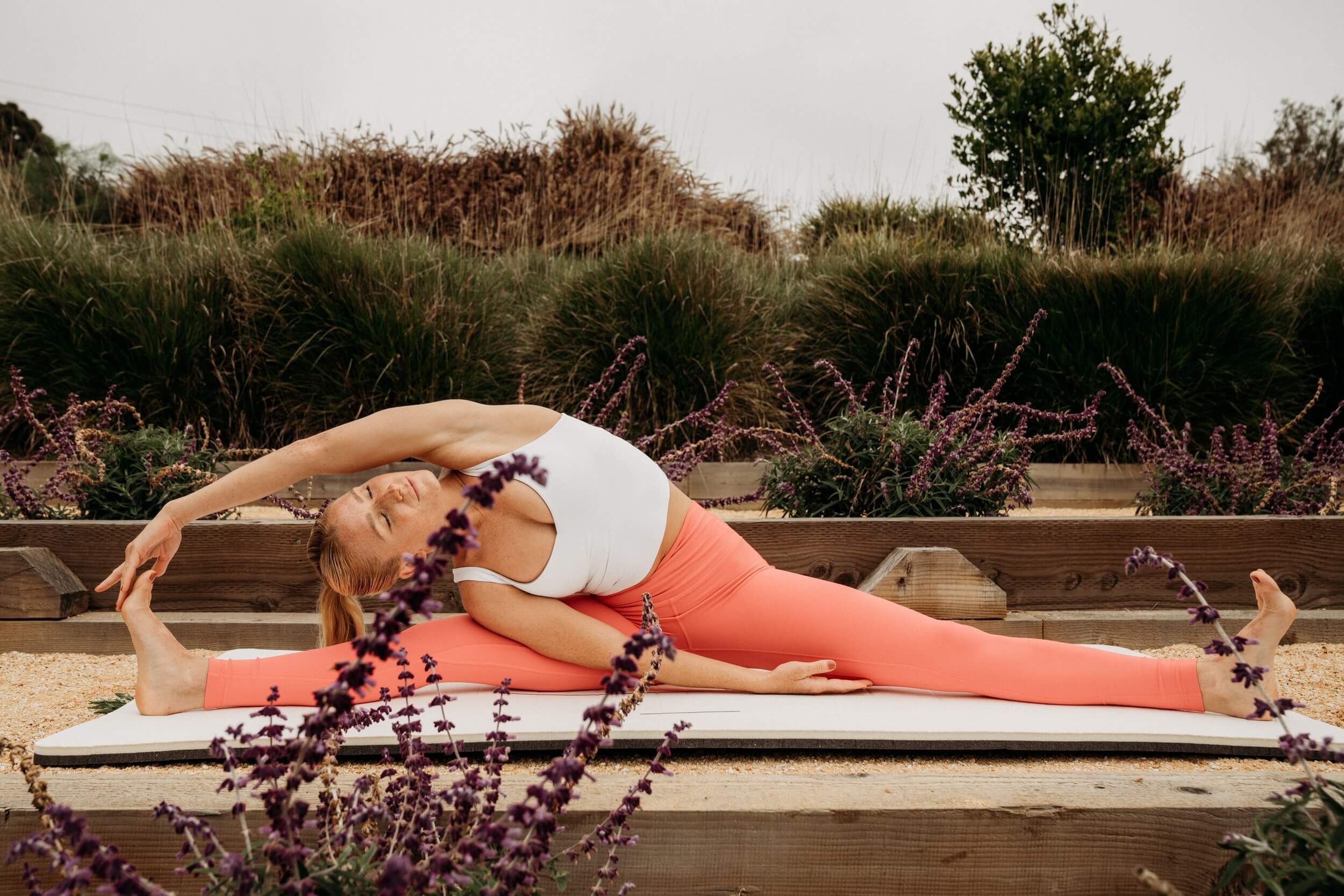
After a long day, there's nothing like sinking into a chair and putting your feet up. But what if you could extend that relief to your quads? The quads are a tight, sore, and often neglected muscle group for many of us, which can lead to discomfort during daily activities, sports, and exercise. One of the best ways to relieve quad tightness is with quad stretches. Integrating quad stretches into your flexibility routine can significantly enhance mobility, boost athletic performance, and reduce the risk of injury, and pairing them with a broader plan for how to get flexible fast can speed up the results. Let's explore how you can effectively incorporate quad stretches into your routine to reduce muscle tightness and improve overall mobility and performance.
what is a quad stretch?

A quad stretch is a movement designed to target the quadriceps muscles at the front of the thigh. It involves standing upright and lifting one heel back toward the buttocks. This exercise can also be modified to make it easier or more challenging. For example, you can use a wall for support if you struggle with balance during the stretch.
The quadriceps comprise a group of four muscles located at the front of the thigh. They are primarily responsible for straightening the knee and also play a role in hip flexion, which is pulling the leg toward the body. The four muscles that make up the quadriceps group are:
Rectus Femoris: This muscle sits in the middle of the thigh and is the only quadriceps muscle that crosses the hip and knee joints. It plays a crucial role in hip flexion and knee extension.
Vastus Lateralis: Located on the outer side of the thigh, this is the largest of the quadriceps muscles. It is primarily responsible for extending the knee.
Vastus Medialis: Found on the inner part of the thigh, this muscle helps extend the knee and stabilizes the patella (kneecap).
Vastus Intermedius: Positioned between the vastus lateralis and vastus medialis and beneath the rectus femoris, this muscle extends the knee.
These muscles are responsible for straightening and bending the knee and stabilizing it during weight-bearing activities. They also provide support during standing and activities that involve balance and help with deceleration during activities such as running and jumping.
what causes tight quads?
Tight quads can develop for several reasons, including:
Sedentary Lifestyle
A sedentary lifestyle can cause the quads to become tight. Sitting for extended periods in a shortened position, like crossed legs or at a desk, leads to tightness as the muscles adapt to that position and lose flexibility.
The increased tightness can also pull on the patellar tendon, which attaches the bottom of the kneecap to the top of the shinbone (tibia) surrounding tissues, leading to knee pain and discomfort, particularly during physical activity.
Quad-Dominant Exercises
Common quad-dominant activities, such as running, cycling, and squats, can also cause the quads to become tight due to overuse.
Not Training Your Hamstrings
Muscles work in antagonistic pairs, moving to a body part by opposing each other's actions. The most obvious example is the bicep and tricep, where the bicep (the agonist muscle) contracts to bend the elbow while the tricep (the antagonist muscle) relaxes and lengthens. The quads and hamstrings are another antagonist pair, working together to flex and straighten the knee.
Overtraining, focusing too much on your quads, and neglecting your hamstrings during strength training creates a muscle imbalance that further exacerbates tightness in the quads. Supporting work on the hamstrings is necessary to ensure they don't become weaker, which could lead to more severe injuries.
signs of tight quads
Tight quad muscles can be insidious. If you sit constantly at a desk, you may not notice the gradual reduction in the flexibility of your quads or the increasing tension in your lower back.
You may compensate by shifting positions in your chair, which will only worsen things in the long run. A thorough healthcare provider or physical therapist evaluation is the most reliable way to tell how tight your quads are. But several tell-tale signs and symptoms are common with tight quads, including:
Pain in the front of your thighs
Constant pain in your lower back
Trouble bringing the knee to the chest (hip flexion)
Trouble bending or straightening the knee without pain
Weakness in the upper leg and lower body
Poor range of motion in the hip or knee joint
complications of tight quads
The quadriceps muscles are a group of muscles located at the front of the thigh. When these muscles become short and tight, they affect the position of adjacent muscles in the hips and pelvis. One of these is the rectus femoris muscle, which starts at the lower spine and crosses around the hip. While the quads are responsible for straightening the knee, the rectus femoris muscles flex the hip, enabling movements like:
Kicking
Jumping
Running
When the quads are tight, they pull on the rector femoris muscles, causing stress that runs from the hip to the lower back. This pulls the pelvis and hips forward. To compensate, the lower spine will start to curve inward. This exaggerated curve is called lumbar lordosis (aka “swayback”). In addition to lower back pain, lumbar lordosis can make you stand with your stomach pushed out. On rare occasions, severe lumbar lordosis can cause a loss of bladder or bowel control. To reduce back pain and reverse lordosis, you must focus on your quads as much as your spine.
the benefits of quad stretches
Improved Flexibility And Range Of Motion
Regularly stretching the quadriceps enhances flexibility and increases the range of motion in the hip and knee joints. A study in Frontiers in Physiology found that knee flexion range of motion, or the degree to which the knee could be bent, increased after three 60-second moderate-to-high stretching interventions of the rectus femoris muscle. That kind of flexibility matters for performing daily activities and athletic movements efficiently and without discomfort, and it can help prevent stiffness and maintain joint health as you age.
Reduced Risk Of Injury
Flexible muscles are less likely to experience strains and tears. Regularly stretching the quadriceps can reduce the likelihood of muscle imbalances leading to joint problems and other injuries, particularly in the knees and hips. A study in the Journal of Athletic Training found a decreased incidence of muscle-tendon injury in Division III American football players after incorporating static stretching programs for the hamstrings, quads, hip adductors, and calf muscles.
Quicker Recovery After Workouts
Stretching helps you recover faster after exercise, allowing consistent training and performance improvements. One study published in Science & Sport found that static stretching helped elite freestyle wrestlers recover in a shorter period.
20 best quad stretches to boost flexibility & ease tightness

There’s no shortage of quad stretches you can do to improve flexibility and performance. However, these 13 quad stretches stand out because they target different areas of the quadriceps and can be done in various positions to accommodate different preferences and ability levels.
1. standing quad stretch
What's so great about the standing quad stretch? You can do it anywhere in the office, gym, or outside just before a long run. You can do the standing quad stretch if you can find a place to stand.
Here is How:
While standing, hold onto a countertop or chair back to assist in balance.
Bend your knee by grasping your ankle and moving your foot toward your buttocks.
Gently pull on your ankle to bend your knee as far as possible.
Maintain position for 30 seconds. Return to standing position.
Repeat exercise 3 to 5 times with each leg. Be sure to stop the stretch if you feel any sharp pains.
2. side-lying quad stretch
The side-lying quad stretch offers a great lengthening of your quadriceps. Being on the floor in a supported position can help you focus on the quad stretch.
Here's How:
Lie on your side.
Bend the knee of your top leg as far as you can, gently pulling with your hand.
Maintain position for 30 seconds. Return to starting position.
Repeat exercise 3 to 5 more times with each leg.
You can add a little iliotibial band stretch to this exercise simply by pulling your knee toward the floor with your ankle. Place your bottom ankle on your knee and gently pull it toward the floor as you stretch your quad.
3. couch stretch
This stretch gets into the hip flexors, which work closely with the quads. Try taking a dynamic approach by moving into and out of the stretch.
Kneeling on the ground, place your back shin against a wall, with your knee on the floor and your toes pointed up.
With your hips square and your back long, lean toward the wall until you feel the quad stretch, then come forward again.
Keep moving back and forth, into and out of the stretch. When you come forward, you can rotate the upper body toward the front knee to add some spinal mobility to the stretch.
Switch sides.
4. walking quad stretch
Try this dynamic stretch for a pre-workout warm-up before hopping on the bike or treadmill.
From both feet, bend one knee and grab that heel with the opposite hand.
Draw the heel toward your glutes. With your free hand, reach straight overhead.
Hold for two or three seconds, then let go.
Take a step forward and switch sides.
Repeat on each side a couple of times.
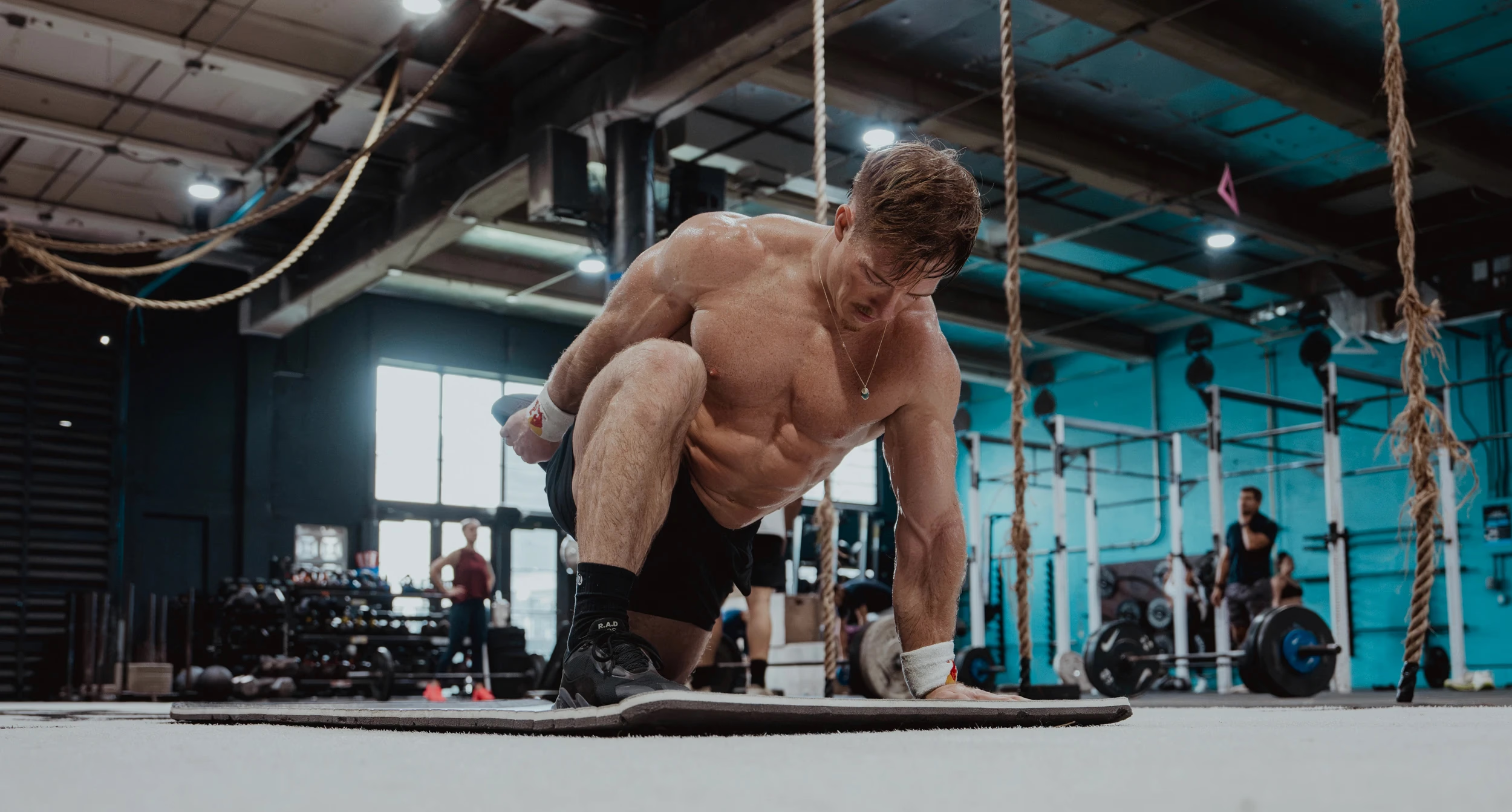
5. twisted monkey pose
There are lots of yoga movements that incorporate stretching of the quads. This pose stretches the muscle group from a kneeling position.
Get into a low lunge with both hands on the floor inside the front foot and the back knee resting on the ground.
Rotate your front foot out about 45 degrees.
Bend your back knee to bring that heel toward your glutes.
Sweep your opposite arm up and back to grab the back foot. Draw it toward your hips, allowing your spine to twist toward the ceiling.
Hold for 20 to 30 seconds, then repeat on the other side.
6. prone quadricep stretch
You can stretch your quads while lying on your stomach as well. In this position, the floor helps to stabilize your pelvis, minimizing rocking and maximizing stretch. To do the prone quadriceps stretch:
Lie on your stomach.
Bend your knee back as far as you are able. Grab your ankle to pull your foot toward your butt.
Maintain position for 30 seconds. Return to starting position.
Repeat exercise 3 to 5 more times with each leg. If you have difficulty reaching your ankle, pull your leg up, wrap a towel or strap around your ankle, and use that to pull. This can help stretch your quads effectively even if you cannot reach your ankle easily.
7. kneeling stretch
Kneel on your right knee and curve your pelvis like a “scared dog.”
Flatten your lower back and keep your shoulders and chest upright.
Bend forward from the hip to the knee to stretch the right hip and quad.
Hold for 30 seconds and then switch knees.
The kneeling stretch is especially useful for older people and pregnant women. For more comfort, a soft cushion or pillow can be placed under the knee.
8. lying pigeon progression
Some of the best quad stretches originate from yoga. This pose is an excellent way to stretch your quads and your quadratus lumborum (lower back). It's also a great hip flexor stretch and can help you progress to the pigeon and twist stretches.
Place a mat on the floor and lie face down.
Secure a resistance band around your left foot, with the excess band in a reachable area. Use a towel instead if you don't have a resistance band handy.
Grab the band with your left hand. While keeping your right leg extended, bend your left knee, keeping your toes pointed toward the ceiling.
Use the resistance band to pull forward until you feel the stretch. Hold for twenty seconds, then pull further.
Return to the starting position and repeat on the other side.
9. the frog pose
This could be a great stretching pose for you if you want to stretch out the gluteus maximus and thighs. It will also help you stretch your arms, chest, and shoulder blades.
Begin by lying on your stomach, propping your torso on your elbows.
Bend both knees and reach back to hold onto your feet. You should already feel the stretching at this point. If you lack the mobility to do this now, use a towel to fill the gap.
Adjust your fingers to point like your toes, then carefully lift your elbows to point to the ceiling.
Push your chest up as high as you can. Stop the pose completely if you feel any pain in your hip or knee. Stay here for five breaths, then relax.
10. crescent pose
Several yoga moves can help you stretch your quads. The crescent pose is popular in vinyasa yoga. This version of a low lunge is a good option for beginners who need more time to try the kneeling quad stretch.
Stand upright on a yoga mat with your feet hip-width apart and your hands at your sides.
Step your right foot forward. Bend your left knee to lower into a lunge, keeping your hips square and facing forward.
Gently lower your left knee to the floor.
Inhale and sweep your arms above your head, holding them straight above you with the palms facing each other.
Feel the stretch along your left quad. For a deeper stretch, move your hips forward, bringing your left thigh closer to the mat. Hold for several deep breaths, and then switch sides.
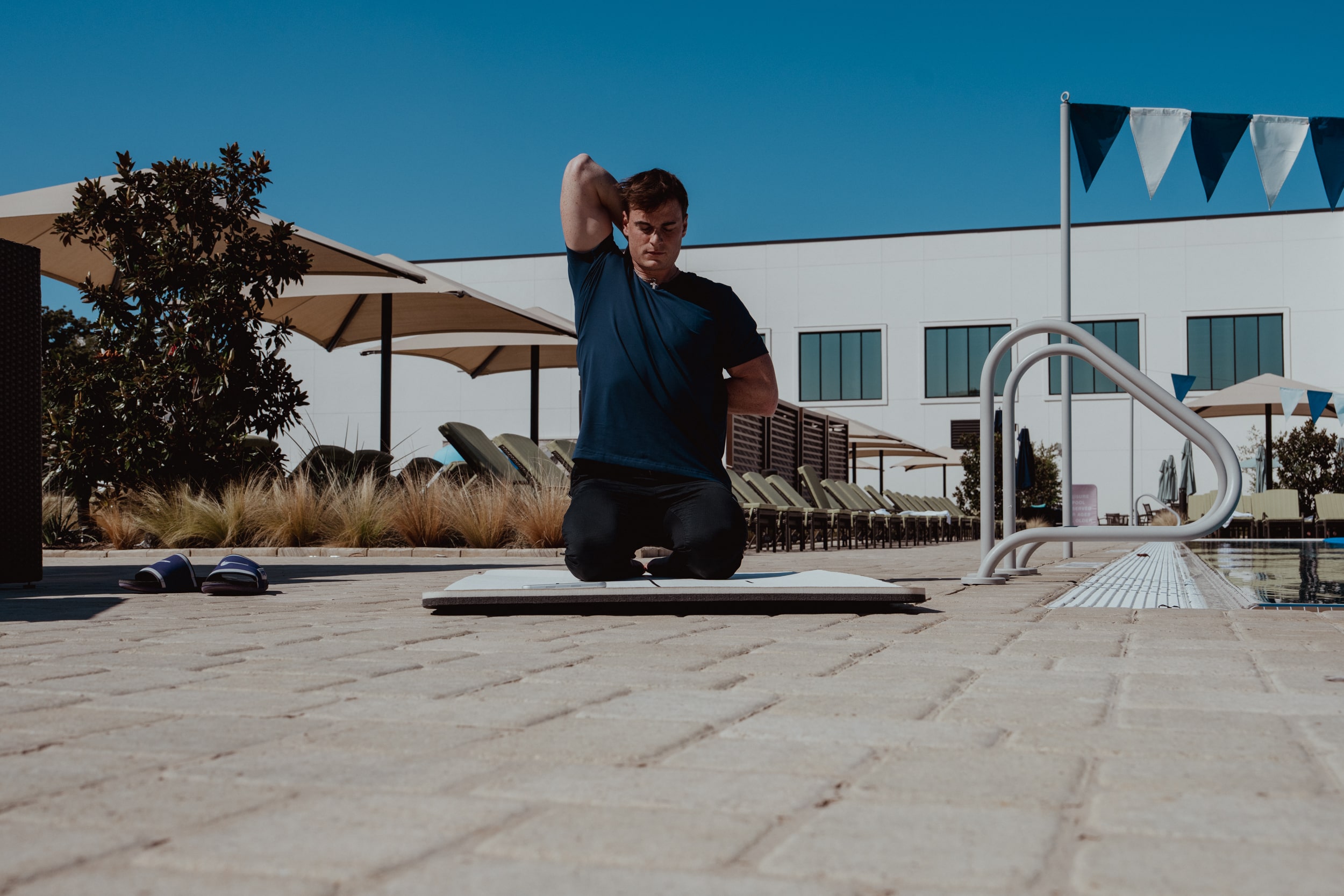
11. camel pose
The camel pose is a traditional yoga pose that stretches the quad muscles against gravity. The trick to doing it is to avoid overextending yourself. Lean back only as far as you reasonably can and hold the pose for only as long as you reasonably can.
Kneel on the ground with your knees hip-width apart and your upper body straight.
Place your hands on your lower spine.
Lifting your chin toward the ceiling, tilt your upper body back while pushing your hips forward.
Reach back with both hands and grab your heels.
Open your chest and pull your shoulder blades together.
Hold the position for as long as you comfortably can. Release your hands, pull the pelvis back, and bring your upper body back to a neutral position.
12. donkey kicks
This is a nice variation from your “typical” quad stretch because it’s completely active - no using your hands or a strap allowed.
Start in a tabletop position on hands and knees, hands underneath your shoulders, knees underneath your hips.
Keeping your back flat, extend your right leg straight behind you, then lift the right leg up so it’s at about hip height. (Higher than hip height requires arching your back, so for this exercise, aim to keep it level with your hips).
Keeping your right knee lifted behind you (trying to keep it as high as your hip), bend your right knee, squeezing your heel toward your butt. You should feel your right glutes engaging to keep the leg lifted and your hamstrings contracting to pull your lower leg toward the back of your thigh.
Extend your leg back to straight while keeping your right knee lifted. That’s one rep. Repeat for 8-12 reps to maintain a flat back and keep your knee as lifted as possible. Then, switch legs.
13. hero pose
Unlike the other quad stretches in this list, because our hips are flexed (the front of our hip is bent/creased) in this stretch, it gives our rectus femoris a bit of a break and lets you feel more of a stretch in your other three quad muscles.
Start kneeling on the floor with knees hip-width apart.
Place a yoga block between your feet and sit back on it. We aim to find a gentle stretch through the front of the quads.
If this feels challenging, add another block to sit on to make it more comfortable. If it doesn’t feel like much of a stretch, you can remove the block, or start to lean back slightly. If you feel any knee discomfort, come out of the stretch.
Hold this stretch for 20-30 seconds.
14. high knee pull
This one warms up your quads, activates your hip flexors, and improves overall stability.
How to do it:
Begin standing tall, then lift your right knee toward your chest.
Grasp your right knee and gently pull it closer to your chest.
Lower your leg and switch to the left knee.
Continue alternating sides for 30 seconds to 1 minute, focusing on keeping your core engaged and the movement fluid.
15. dynamic lunge with quad stretch
This stretch targets the quads and engages the hip flexors and glutes. By incorporating a lunge, you're aiding both flexibility and strength, preparing your muscles for the twists and turns of your workout.
How to do it:
Start by standing tall, then step forward with your right foot into a lunge position, lowering your hips until both knees are bent at about 90 degrees.
As you lower the lunge, reach back with your right hand to grab your left ankle, gently pulling it toward your glutes.
Hold this position momentarily, feeling the stretch in your quad, then switch legs.
Repeat 5 times on each side.
16. ground stretch
How to do it:
Lie on your back at the corner of your bed (where it is the firmest), ensuring your tailbone is at the edge of the bed.
Grab one thigh and pull it toward your chest. Make sure that your back is flat and not arched. Let gravity pull down on the leg that is dangling.
Relax into the stretch so as not to tense up the muscles. Hold for 1 to 2 minutes and then switch sides.
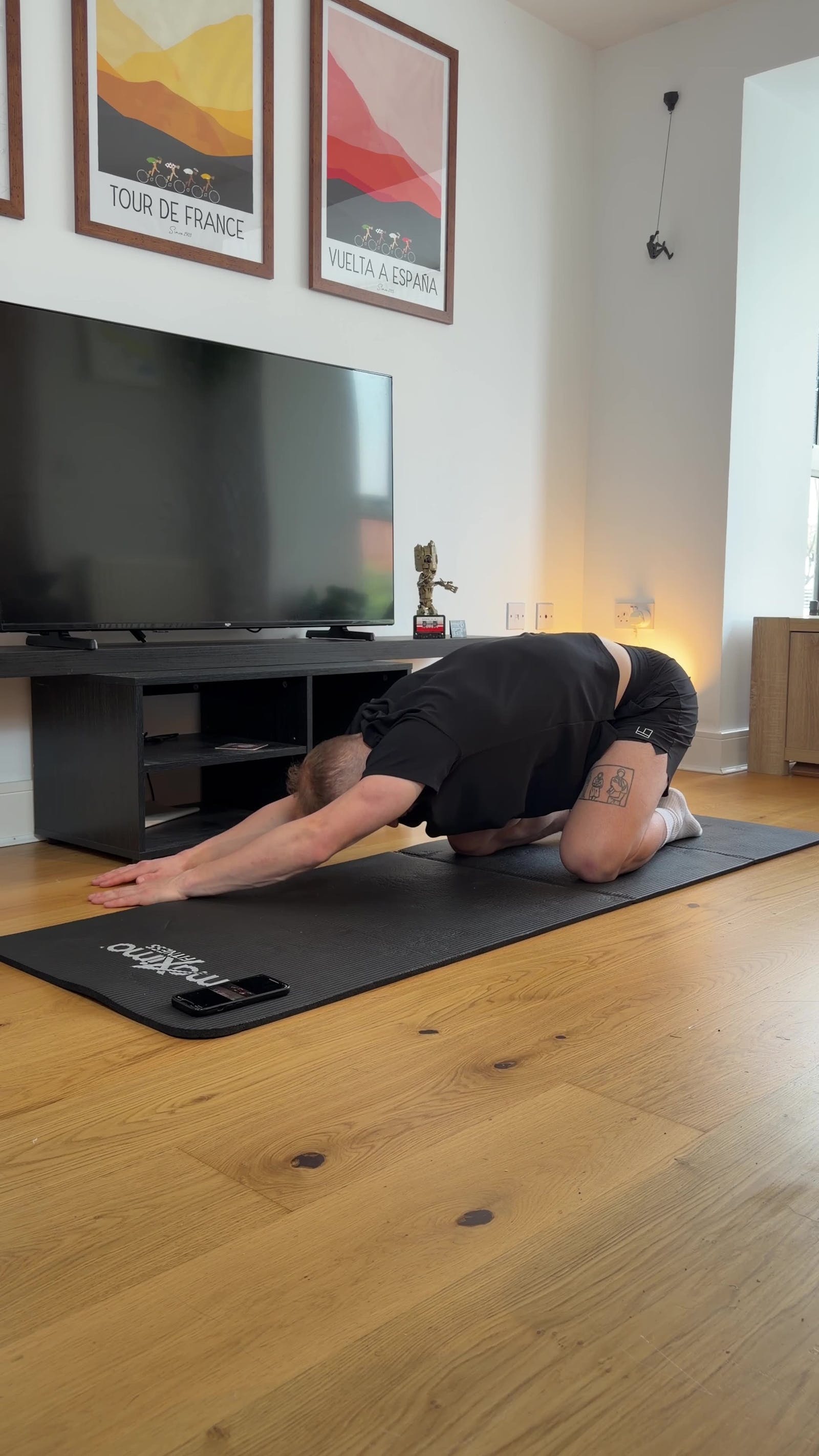
17. child's pose
Some yoga poses prove excellent for stretching tired legs. You may not have that fantastic yoga flexibility, but you can reap the benefits of this pose just as well.
How to do it:
Kneel with toes pointed behind you.
Gently sit back until you are on top of your heels.
Bring your arms forward, bend at the waist, and bring your chest towards the floor.
Reach forward with your hands flat on the ground before you and your elbows extended.
Bring your head down in between your arms while you continue reaching in your arms in front of you as far as possible.
Hold the pose for 45-60 seconds. If you have someone with you, they could gently put pressure on your lower back, deepening the stretch.
18. double quad lie back stretch
How to do it:
Begin in a kneeling position.
Lower yourself down so you are sitting on the floor between your feet.
Slowly lower your body back towards the floor behind you until you feel a gentle stretch.
Do not go back further than comfortable! Some can lie down entirely on the floor behind them, while most of us will feel the stretch with just a slight incline.
Hold for 45-60 seconds.
Ensure you feel no knee pain or back pain while doing this stretch. If so, stop immediately.
19. single leg knee hug
Since your tight quads could also be caused by other muscles pulling, we want to help reduce that load. While the primary focus of the single-leg knee hug stretch is on the hamstrings and lower back, it does create some stretch in the quadriceps of the lifted leg, particularly when you pull your knee closer to your chest.
How to do it:
Stand up straight with your feet hip-width apart.
Shift your weight onto one leg.
Bend the knee of the other leg and bring it up toward your chest.
Hold your shin or knee with both hands and gently pull the knee closer to your chest.
Maintain good posture with your back straight and shoulders relaxed.
Hold the stretch for about 15-30 seconds.
Release and switch to the other leg.
20. dynamic ninja
How to do it:
Start with your feet wider than shoulder-width apart.
Crouch down into a low position with one leg straight and the other knee fully bent. You should be up on the ball of your foot on the bent leg.
Stay low, and alternate the bent and straight leg back and forth.
Alternate legs for 30-60 seconds.
how to add quad stretches to your fitness routine

Quad stretches can be a great warm-up or cool-down for lower-body workouts. You can also do them as part of your regular flexibility training. Aim to incorporate quad stretches into your routine two to three times a week.
how do you make quad stretches easier or harder?
Quad stretches can be made easier or harder. Here's how:
Make Quad Stretches Easier
Don't hold the stretch for as long, and don't put as much pressure on it. Start with gentle stretches and take your time working up to a longer hold.
Make Quad Stretches Harder
Incorporate a band, kneel, or twist into the stretch to target different parts of the muscle and deepen the movement. Using a band lets you apply consistent tension and control, extending your range of motion more effectively. Place the band around your foot, then gently pull to elevate your leg for a controlled stretch through the quad, maintaining tension for 20 to 30 seconds.
Adjust your body position to increase the stretch. For example, elevate your back foot onto a bench or step in a kneeling quad stretch to intensify it.
In all of these stretches, keep your hips forward. Arching your back takes away from the stretch, so keep your hips square to hit the full muscle group. Also keep the working knee in line with your body; letting it drift out to the side means you're only stretching the inside of the quad instead of the whole muscle.
the importance of form
It's not just the stretches you do and the time you spend doing them that keeps your quads flexible. Proper form matters just as much: when the leg strikes the ground during running, the quads control the deceleration, and without that control you'd lose your balance. Stretching itself involves muscle fibers gliding over one another, and there shouldn't be any tearing or injury in a normal stretch. You've stretched enough when you don't feel tightness as you take your first few steps. It helps to warm up for five to ten minutes of easy walking before you stretch, and to avoid bouncing.
Good form while stretching matters as much as the stretch itself, since bad technique makes it less effective. Keep the back straight rather than arching it, since an arched back decreases the amount of stretch reaching the muscle and lets it go looser instead. The calf muscles are also involved in running and deserve about 30 seconds of warm-up alongside the quads.
build quad stretches into a consistent routine
The pliability app's Daily Sessions and Paths turn quad mobility work into a habit, with guided routines for recovering from injuries, surgeries, or chronic pain, not just one-off stretches. Build Your Program lets you structure quad and hip flexor work around your training week, a mobility test flags asymmetries between your left and right leg before they change how you move, and the Rebuild hub keeps recovery-focused sessions in one place.
You can try it with a free 7-day trial on iPhone, iPad, Android, or web, or start at pliability.com.
Related Reading


Move better in 10 minutes a day.
10,000+ five-star reviews.