


LEARN
pliability

Every athlete knows the sinking feeling of landing awkwardly from a jump or feeling their knees buckle during a quick direction change. The difference between those who move with confidence and those sidelined by injury often comes down to one skill: force absorption. Mastering deceleration mechanics and eccentric control transforms the body into a shock-absorbing system that protects joints while setting up explosive power.
Building this foundation requires more than understanding the concept. Athletes need targeted movement patterns and tissue-preparation techniques that teach muscles, tendons, and fascia to absorb landing forces efficiently. Through guided routines focused on improving eccentric strength and joint stability, athletes develop the body control needed to decelerate safely and redirect energy for explosive movements.
table of contents
Does Force Absorption Exist or Is It a Myth?
Force Absorption vs. Force Production
The Best Exercises for Force Absorption Training
How to Train Force Absorption for Performance & Safety
Move Better, Recover Faster, and Train With More Control
summary
key takeaways
Most training programs create a dangerous imbalance by prioritizing force production over force absorption. Athletes develop the ability to generate explosive power through extension, adduction, and internal rotation, but they neglect the opposing movement patterns that control deceleration: flexion, abduction, and external rotation. Muscles can absorb force at rates well above what they can produce, yet training protocols rarely reflect this capacity. The result is athletes who jump high and sprint fast but collapse under landing forces because their braking system was never developed.
Force absorption is actually a bit of a misnomer rooted in confusion about physics. What athletes experience during landings and direction changes isn't force absorption but shock absorption: the progressive damping of energy through tissue deformation and controlled lengthening. Shock absorption is best understood as the damping of applied force over time, a process that requires eccentric muscle control, regulation of tendon stiffness, and strategic joint load distribution. Calling it force absorption leads athletes to train the wrong systems, focusing on bracing and stiffness rather than on the adaptability and controlled deceleration that actually protect joints under impact.
Landing and cutting movements expose athletes to forces ranging from 2 to 8 times their body weight. Without specific eccentric training to handle these loads, athletes develop powerful but fragile movement systems that generate output but lack structural control during deceleration. This asymmetry shows up as knees caving inward during landings, spines flexing under load, and abrupt stops that ripple shock through the frame instead of dissipating it gradually. Elite athletes separate themselves not by top speed but by their ability to absorb force in milliseconds and redirect it explosively out of cuts.
Eccentric strength work bypasses the stretch reflex entirely, forcing muscles to absorb tension without help from stored elastic energy. Slow-tempo squats with four- to five-second lowering phases train the nervous system past the point where Golgi tendon organs normally shut down muscle contraction at 60% of maximum capacity. This raises the ceiling on how much force the body can handle before protective mechanisms limit performance, building the foundational capacity needed before adding speed or reactive demands to deceleration training.
Deceleration capacity develops through systematic progression from controlled eccentric loading to reactive movement patterns under fatigue. Sprint-to-stop drills, lateral shuffle cuts, and depth landings teach the body to manage momentum through proper positioning rather than rigid bracing, building deceleration skills without sacrificing movement quality or reinforcing compensation patterns that lead to injury.
does force absorption exist or is it a myth?

You hear it constantly in training circles: "work on your force absorption." Coaches say it. Rehab specialists say it. Marketing campaigns build entire programs around it. The problem? From a physics standpoint, force absorption doesn't exist. Forces aren't absorbed, they're resisted.
The term "force absorption" is a misleading concept that doesn't align with fundamental physics principles. What we really mean is force resistance and energy dissipation: forces aren't absorbed like a sponge soaking up water, they're resisted through muscle contractions, joint mechanics, and tissue deformation. Using incorrect terminology like "force absorption" can lead to a misunderstanding of how the body actually handles impact forces during training and movement.
what actually gets absorbed during impact?
What gets absorbed during impact is shock, a sudden transient pulse of energy that needs to be released, not balanced out.
why does the distinction between force and shock matter?
This distinction matters. Confusion between force and shock leads athletes to train the wrong systems. Force requires resistance: a steady push or pull that you counteract with opposing muscle tension. Shock requires damping: the gradual spreading of energy through tissue deformation, heat conversion, and controlled lengthening. When you land from a jump or slow down during a cut, you manage shock through eccentric muscle control, tendon stiffness regulation, and strategic joint load distribution.
how does language shape athletic training priorities?
The language we use shapes what we prioritize. Call it "force absorption," and athletes focus on bracing harder, stiffening joints, and resisting impact with raw strength. Call it shock absorption and training shifts toward eccentric capacity, tissue preparation, and controlled deceleration.
Shock absorption research going back to Rodgers and Cavanagh's classic 1984 work defines it as "the progressive damping of an applied force," a process where momentum changes over time through material deformation and energy conversion. It's not about strength; it's about adaptability.
Why do strong athletes still get injured?
Most people can produce impressive power: they jump high, sprint fast, lift heavy. Then they land awkwardly, their knee caves inward, or their ankle rolls because the tissues weren't ready to manage the energy returning through the system.
If your muscles, tendons, and fascia can't control eccentric deceleration, you're building performance on a foundation that collapses under load.
how does shock absorption training work in practice?
Shock happens in microseconds to milliseconds: energy enters the system faster than conscious thought can react. Preparation must be automatic, woven into how your tissues respond under stress. This requires consistent exposure to eccentric loading patterns, joint stability work, and movement variability to teach your body to distribute impact across multiple structures rather than concentrating it in vulnerable areas.
What makes mobility training effective for shock management?
Most mobility routines treat stretching as static flexibility work. Effective shock management requires teaching tissues to lengthen under tension while maintaining control, building the neuromuscular adaptability needed to slow down safely and redirect energy into your next movement.
Why does energy redirection matter after impact?
Understanding shock absorption is only half the equation; what you do after impact determines whether that energy fuels your next move or breaks you down.
force absorption vs. force production
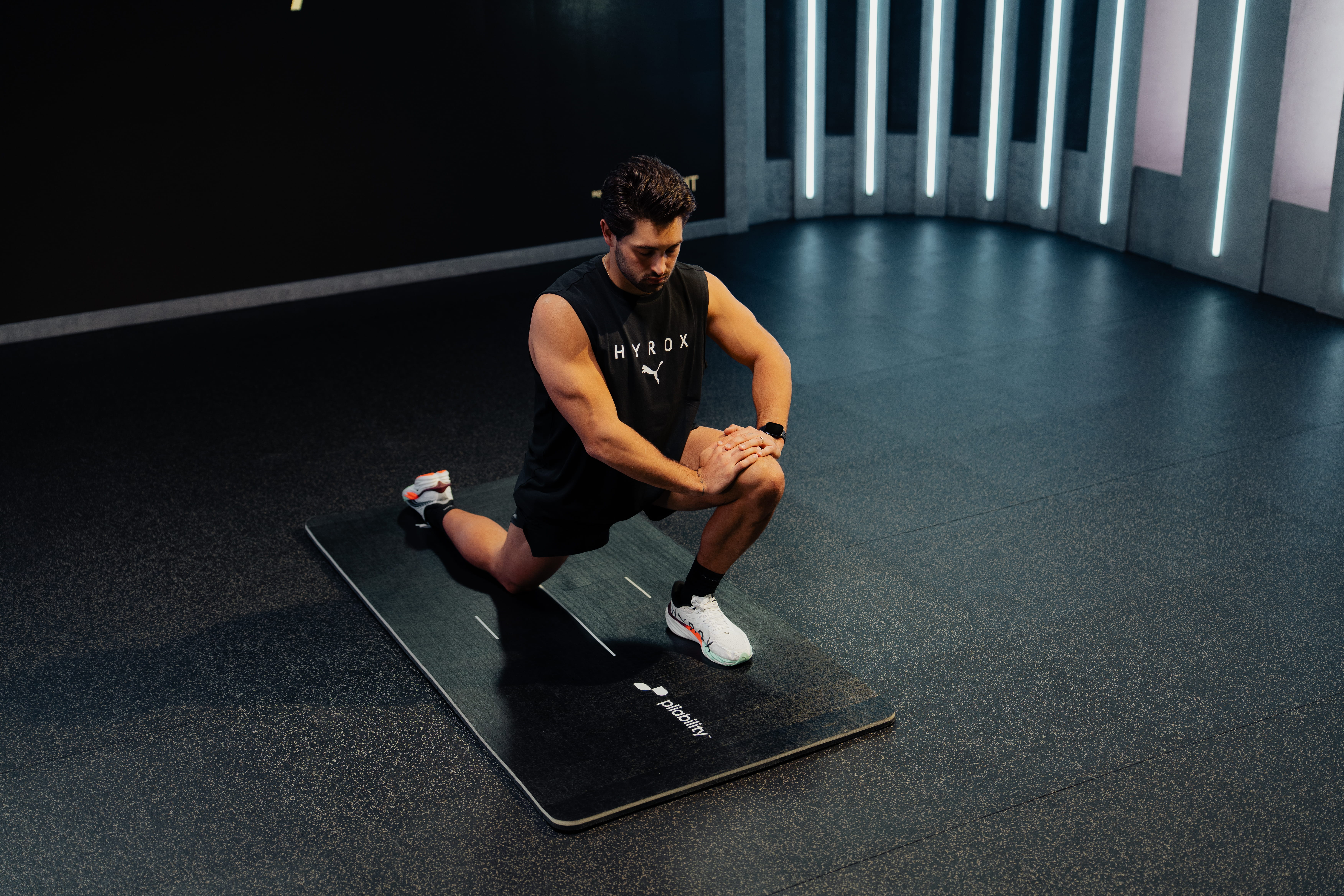
Most training programs focus on force production: squats for max load, sprints for speed, plyometrics measured by vertical jump height. The industry has built an ecosystem around making athletes faster, stronger, and more explosive. But while we focus on how much force an athlete can generate, we've overlooked the critical question: can they control it?
Force Production Focus | Force Absorption Reality |
|---|---|
Squats for max load | Landing mechanics overlooked |
Sprint speed training | Deceleration control ignored |
Vertical jump height | Impact absorption is underdeveloped |
Explosive power metrics | Injury prevention secondary |
While the fitness industry obsesses over how much force athletes can produce, the real performance differentiator lies in their ability to absorb and control that same force safely and efficiently. True athleticism isn't just about generating maximum force, it's about having the neuromuscular control to handle that force without breaking down. This shift in perspective changes how we should train and assess athletic readiness.
what creates the dangerous imbalance in athletic training?
Force production centers on three movement patterns: extension, adduction, and internal rotation, which speed you forward, drive you upward, and generate power. Force absorption requires the opposite: flexion, abduction, and external rotation, which slow you down safely, change direction, and protect joints under load.
According to the European Journal of Applied Physiology, muscles can absorb force at a rate 20-60% higher than they can produce it. Your body is built to handle impact better than it can create it, yet we train with the opposite priority.
How does this imbalance manifest in real athletes?
The consequences appear everywhere: strong athletes collapsing under deceleration loads, explosive jumpers landing with knees caving inward, and spines flexing.
It's a common sight in high school athletes: 100 box jumps in a single workout without ever learning how to land first. They could jump high, but their braking system didn't exist. When you train only extension, you lose your ability to bend, soften impact, and absorb force safely.
what separates elite athletes from everyone else?
The best athletes in the world aren't fast or explosive on their own. What separates elite, agile athletes from the rest is their ability to absorb force in milliseconds, redirect it, and explode out of cuts that would buckle most players. Load to explode: if you can't flex, abduct, and externally rotate effectively, you can't load your system. You can't store elastic energy. You can't change direction without leaking power or risking your ACL.
Why do athletes get injured despite being strong?
This imbalance creates a predictable injury pattern. Athletes develop the engine without the brakes. They can produce serious output, but their nervous system hasn't learned to manage impact when they land or slow down. The knees cave because the muscles controlling abduction and external rotation are undertrained. The spine flexes because the core can't stabilize under eccentric load. Producing force without controlling it leads to breakdowns and limits performance.
How does absorption training apply to everyday movement?
Every acceleration ends in slowing down. Absorption enables repeated output; without it, a single explosive movement leads to structural compromise. For everyday people, this principle applies when stepping off a curb, catching yourself from a stumble, or carrying groceries downstairs. Your body must handle impact efficiently, not just generate movement on its own. Training the flexion, abduction, and external rotation patterns most programs ignore builds the neuromuscular control that lets you slow down safely and move with confidence in unpredictable situations.
But knowing you need both systems doesn't tell you how to train absorption effectively or which movements build the control that keeps you intact under real-world stress.
the best exercises for force absorption training

Most athletes train to produce force but never learn to absorb it. You can add inches to your vertical jump or seconds to your sprint time, but if your body collapses on landing or your knee caves inward during a cut, all that power becomes a liability. Force absorption training controls the moment when your body transitions from motion to stillness or from deceleration back into explosive movement. A handful of exercises address this through three distinct mechanisms.
Force absorption is the missing link between raw power and athletic performance: without it, strength gains can actually increase injury risk. Start every training session with about 5 minutes of landing mechanics practice before moving to heavier force absorption exercises; this primes your nervous system for proper movement patterns.
Force Absorption Mechanism | Primary Focus | Key Exercises |
|---|---|---|
Eccentric Control | Muscle lengthening under tension | Single-leg squats, Nordic curls |
Landing Mechanics | Impact dissipation | Drop jumps, depth landings |
Deceleration Training | Momentum control | Deceleration runs, cutting drills |
eccentric strength: teaching your muscles to handle load under tension
Eccentric tempo training changes how your nervous system responds to force. When you slowly lower a weight over three to five seconds, you skip the stretch-shortening cycle, the reflex where muscle spindles signal your brain to contract when stretched.
Instead, your muscles learn to absorb force without relying on automatic bounce-back. This matters because you're training without Golgi tendon organ inhibition, which normally limits contractions at 60% of your maximum capacity. Slow eccentric squats, Romanian deadlift negatives, and tempo lunges force higher muscle contractions than normal training, yielding strength paired with control under pressure.
deceleration drills where absorption meets real movement
Force absorption matters only if you can apply it while your body is moving. Deceleration drills separate theoretical strength from functional capacity. Sprinter step-ups with deliberate slow descent teach your body to manage its own weight through a full range of motion while maintaining balance and alignment.
Low squat jumps performed continuously for 10-second intervals without letting your hips rise or drop train your nervous system to stabilize under repetitive impact. You stay on the balls of your feet, heels barely off the ground (enough to slide a sheet of paper underneath). Three sets create a metabolic and neuromuscular demand that traditional strength work cannot replicate. The goal isn't height: it's consistency of position under fatigue.
how do depth jumps teach reactive strength?
Depth jumps remain the best way to teach your body to absorb impact and quickly change direction. Depth-to-vertical teaches pure reactive strength. Depth-to-broad jump adds horizontal force transfer. Depth-to-split lunge (an advanced variation) requires you to explode vertically, reposition your legs mid-air, and stick the landing in a lunge without hip shift.
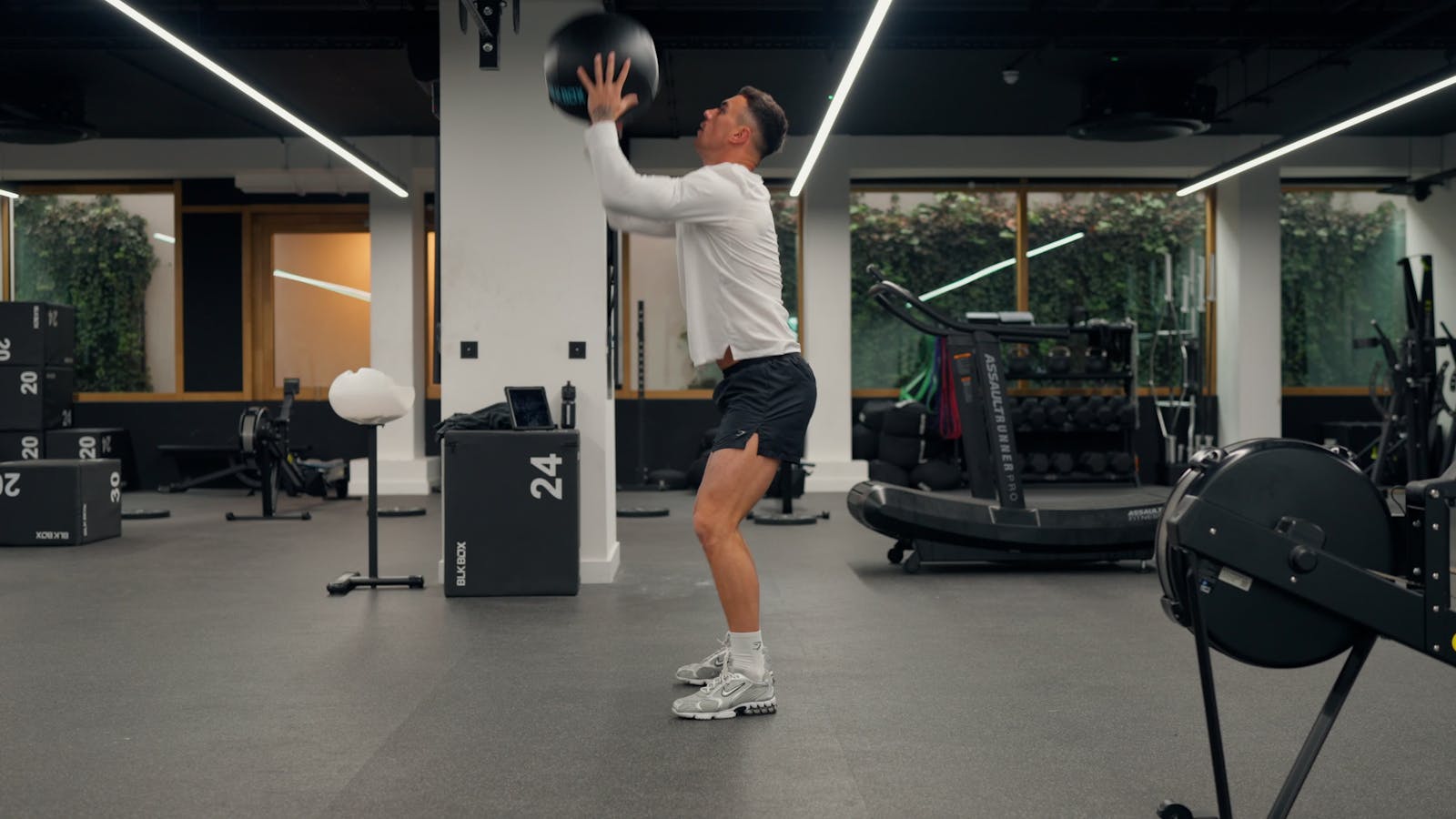
Depth-to-vertical toss layers in upper-body force transfer, requiring you to channel energy from your feet through your core and out through your arms to throw a medicine ball upward. Each variation builds a different piece of the absorption-to-production chain and exposes where your body loses control under real-world conditions.
Why does mobility preparation matter for plyometrics?
Preparing your joints and connective tissue before adding weight makes these movement patterns safer and more effective. Most athletes jump into plyometrics or eccentric training without addressing the mobility problems that prevent proper landing or controlled descent.
Improving hip rotation, ankle dorsiflexion, and thoracic extension helps your body achieve the positions required by these exercises. When your tissue is prepared, force-absorption training builds capacity rather than fighting against your own structure.
What makes these exercises build a complete system?
Low squat jumps, tempo squats, depth jumps, and sprinter step-ups are simple but not easy. Each movement targets a specific physical demand: eccentric strength, deceleration control, or reactive power. When you understand what each exercise trains and why it matters, you build a system rather than just collecting movements. The athlete who absorbs force efficiently moves with confidence that comes from knowing their body won't fail when the ground comes up fast or direction changes without warning.
But knowing which exercises to do is only half the equation.
how to train force absorption for performance & safety
Training force absorption requires building three distinct capacities simultaneously: tissue resilience under load, joint mobility to create space for deceleration, and the ability to distribute impact across multiple segments instead of concentrating it in one vulnerable area. Most programs fail by treating these as separate goals rather than interdependent qualities.
Capacity | Purpose | Training Focus |
|---|---|---|
Tissue Resilience | Handle load without breakdown | Eccentric strengthening, progressive overload |
Joint Mobility | Create a deceleration space | Dynamic stretching, range of motion work |
Impact Distribution | Spread forces across the body | Multi-segment movement patterns |
The most effective force absorption training happens when you simultaneously challenge tissue strength, joint range, and movement coordination in the same exercise rather than training each quality in isolation. Focusing on only strength or only mobility creates imbalances that can actually increase injury risk during high-impact activities.
the training gap most programs miss
Strength programs excel at teaching athletes to push harder, lift heavier, and accelerate faster. What they rarely address is the opposite skill: controlling momentum when it reverses direction, absorbing impact without compensating, and redirecting energy without structural breakdown.
What happens when athletes lack eccentric control?
Athletes experience forces ranging from 2 to 8 times their body weight during landing and cutting movements. Without eccentric training to handle these loads, athletes develop a dangerous imbalance: powerful but fragile. They generate explosive movement but lack the structural control to decelerate safely, leading to soft tissue injuries, chronic joint stress, and plateaued performance despite increasing strength.
building eccentric capacity first
Controlled eccentric loading forms the foundation. Slow-tempo work teaches tissues to tolerate tension while lengthening. A three-second descent in a squat forces muscles and tendons to manage load without elastic rebound, building the specific capacity needed for deceleration.
Isometric holds at challenging joint angles add another layer. Pausing at the bottom of a lunge or holding a deep squat conditions the tissues to stabilize under sustained tension, building resilience in the ranges where most injuries occur.
adding deceleration under load
Once eccentric strength exists, deceleration drills bridge the gap between controlled strength work and reactive sport demands. Sprint-to-stop exercises, lateral shuffle cuts, and direction changes teach the body to manage momentum through proper positioning rather than bracing. The goal is to redirect force through the available range while maintaining relative motion between joints.
A useful progression runs from basic landing mechanics to complex reactive patterns, adding speed or unpredictability only after control is established. Adding speed or unpredictability before establishing control trains compensation patterns under fatigue instead.
how can you create a sustainable mobility system?
The challenge isn't understanding what to do but creating a system that fits into your routine without specialized equipment or constant coaching. Mobility work restores joint range of motion, improves tissue quality, and reinforces movement patterns that support force absorption.
A structured, adaptable progression that fits into a routine about three times per week beats guessing which exercises matter most or how to sequence them.
How do you progressively build force-absorption capacity?
Force absorption isn't something you either have or don't have. It's a skill you build over time through eccentric strength, controlled deceleration, and movement patterns that distribute load effectively.
Train it with the same focus you give to building strength, and your body will become stronger and last longer. Knowing what to train doesn't tell you how to make it work when life gets busy.
move better, recover faster, and train with more control
Your body must access the positions where force absorption happens. Tight hips limit squat depth. Stiff ankles prevent proper dorsiflexion during landing. Restricted thoracic rotation compromises deceleration mechanics during cutting. The eccentric exercises won't help if your joints don't move through the necessary range.
Mobility is non-negotiable. Force absorption requires joint range, tissue quality, and movement control to distribute impact across the right structures. Limited mobility forces compensation: knees cave inward, spines flex under load, and ankles collapse. The system tends to break down not from weakness, but from restriction.
Component | Benefit | Result |
|---|---|---|
Strength Training | Force production | Power development |
Mobility Work | Range of motion | Movement quality |
Combined System | Force absorption | Injury prevention |
Force absorption is a capacity you build, maintain, and refine over time. Athletes who move with confidence understand that strength and mobility aren't separate goals: they're two parts of the same system. When that system works together, you control force.
Many athletes use pliability alongside their strength training for exactly this reason. Daily Sessions rotate fresh mobility and recovery work into your week, Paths run a multi-week progression to open up stiff hips, ankles, or thoracic rotation, and Build Your Program shapes a plan around the lifts and sports you actually train for. Take the mobility assessment to see which restrictions are limiting your landing and deceleration mechanics, and if you're coming back from an injury, the Rebuild hub has session series built for that. Start with 7 days free on iPhone, iPad, Android, or the web.
Related Reading








Move better in 10 minutes a day.
10,000+ five-star reviews.