


LEARN
pliability
Every basketball player knows the frustration of watching their shot get blocked at the rim or arriving a split second too late for a rebound. The difference between good and great often comes down to explosive power, the kind that lets you rise above defenders and react faster than your opponent. Plyometric exercises for basketball specifically target your lower body's ability to generate force quickly. These practical drills translate directly to higher jumps, faster takeoffs, and better performance on the court.
Building explosive strength requires more than just jumping higher. It demands proper preparation, recovery, and mobility work that keeps your muscles ready to fire when it matters most. Maintaining flexibility and muscle readiness helps you execute box, depth, and broad jumps safely while maximizing your power output during games.
why some basketball players stop improving their vertical jump
Many basketball players believe that jumping more or lifting heavier weights improves their vertical leap. While strength matters, it doesn't teach your body to produce force fast enough for basketball. Traditional training methods focus on slow, heavy movements rather than the explosive power and rate of force development that basketball demands. Vertical jump improvement requires specific training that targets power output and neuromuscular coordination, not just raw strength or repetitive jumping, and many players plateau because they keep using the same training methods that got them to their current level without addressing those specific demands.
why can stronger players still get out-jumped?
You can squat 400 pounds and still get out-jumped by someone who squats 250, because vertical leap depends on explosive power: the ability to create force in a fraction of a second.
what's the difference between power and strength in basketball?
This belief dominates most basketball strength programs. Players watch their back squat climb from 225 to 315 and assume their vertical will follow. The confusion stems from mixing power with strength: strength is how much force you can produce; power is how fast you can produce it. Basketball demands the latter.
why do athletes struggle with the speed of force development?
Research from PeerJ examining 14 male college basketball players found that drop vertical jump biomechanics revealed important differences in how athletes convert strength into explosive movement. Players who generated force quickly during the ground contact phase jumped significantly higher than those with slower force production, despite having equivalent maximum strength levels.
Your nervous system needs training that matches the speed of actual jumping. Months of slow, controlled squats without high-velocity movements like pogo jumps, tuck jumps, or weighted squat jumps mean your body never learns to fire muscle fibers fast enough for game-speed takeoffs.
What happens when training doesn't match performance demands
Athletes get stuck in a predictable pattern: adding weight to the bar each week, celebrating new personal records, while first-step acceleration feels slower despite visible muscle growth. The body adapts to what you ask of it. If you ask for slow, controlled strength, that's what you'll develop. If you never practice producing force at game speed, your muscles won't know how when it matters.
The consequences show up in performance metrics that matter. Players report being stronger but not more explosive, seeing improved squat numbers but unchanged vertical measurements. Training principles need to include both force (strength) and velocity (speed): power equals force multiplied by velocity, and neglecting either variable means neglecting half the equation.
why does maximum effort practice matter for jumping?
Maximum-effort jumping gets overlooked in specialized drills and strength protocols. Your nervous system needs to experience full-approach, maximum-effort jumps at game intensity to optimize the coordination required. Spend time doing aggressive, full-speed approach work where you jump as high as your body will let you, without overthinking form tips or rep schemes.
How do flexibility and mobility barriers limit jumping performance?
Poor flexibility and mobility create mechanical barriers that strength cannot overcome. Tight hip flexors prevent proper loading during your approach. Stiff ankles limit elastic energy storage through your Achilles tendon. Limited range of motion prevents you from accessing the positions needed to use the power you've built.
Dynamic stretching before jumping sessions and static stretching afterward improve hip mobility and calf flexibility, though most players skip this work.
What are the real causes of stalled jumping progress?
The issue is rarely a lack of strength. More often, it's a lack of explosive power development paired with mobility restrictions and chronic fatigue from overtraining. Your core transfers energy from your lower body to your upper body during takeoff, while your glutes serve as the main propulsion engine.
Neglecting targeted core work like hanging leg raises and weighted planks, or skipping glute activation drills, causes power leakage during the explosive phase. Jumping stresses your central nervous system. If you constantly jump on tired legs or play multiple games weekly without adequate rest, your neuromuscular system becomes suppressed, and your body stops adapting.
Explosive training requires fresh legs and 48 hours of recovery between heavy plyometric or lower-body sessions, but most players treat every workout like a max-effort day and wonder why progress stops. Understanding why progress stops matters only if you know what drives vertical leap improvement in the first place.
how plyometric exercises improve basketball explosiveness
Basketball performance depends on how quickly force can be produced, not how much force can be produced. Plyometrics teach you to express strength at game speed: applying force in a fraction of a second rather than through slow force production. The difference between explosive athletes and average players isn't just raw strength, it's the ability to activate that strength instantly during game situations.
what is the stretch-shortening cycle, and how does it work?
Every explosive basketball movement relies on the stretch-shortening cycle. When you land before jumping, cut before accelerating, or load before exploding, your muscles and tendons undergo rapid eccentric loading (the stretch phase), followed by concentric contraction (the shortening phase). This cycle stores elastic energy during the stretch and releases it during shortening, amplifying force production beyond what muscle contraction alone can generate. Research analyzing 11 studies with 656 participants confirms that plyometric jump training meaningfully improves vertical jump height, sprint performance, and agility in basketball players by optimizing this mechanism.
How do plyometrics improve the rate of force development?
Plyometrics train your nervous system to apply force in the very short window available during a jump's ground contact phase, a measure called rate of force development. A player might squat heavy weights slowly in the gym, but plyometrics teach that athlete to generate maximum force in minimal time. Without it, strength remains inaccessible during the split-second demands of rebounding, closing out on shooters, or exploding past defenders.
how do tendons act like springs in athletic performance?
Most athletes think jumping higher depends on muscles, but tendons are equally important. Tendons act like springs: the stiffer and more elastic they are, the more efficiently they store energy during landing and release it during takeoff, reducing energy leaks at the ankle, knee, and hip.
Basketball players with poor tendon stiffness spend too long on the ground, lose explosiveness late in games, and experience overuse injuries from repeated eccentric-to-concentric transitions.
What makes plyometric exercises build functional stiffness?
Plyometric exercises build functional stiffness, not rigidity, allowing athletes to move fast while staying resilient. When tendons are properly conditioned through controlled plyometric progressions, they shorten ground contact time and improve reactive strength index: the difference between jumping high once versus exploding repeatedly throughout a game without performance decay.
Why do explosive movements require mobility and recovery?
Explosive movements require a strong foundation of mobility and recovery. Stiff tendons need flexible joints and tissues that can handle loading demands without compensation patterns that lead to injury.
what is reactive strength index, and why does it matter?
Reactive strength index measures how quickly an athlete switches from eccentric to concentric force: how fast you get off the ground. In basketball, it shows up when jumping for a second rebound, reacting to a pump fake, closing out on a shooter, or exploding from a defensive stance. High reactive strength enables faster reactions, less wasted motion, and more explosive play. Two players may jump equally high, but the one who does it faster repeatedly wins the matchup.
How does plyometric training optimize ground contact time?
The goal of plyometric training is to jump fast, not high. Ground contact time becomes the limiting factor in real game situations where you lack a slow, controlled load before exploding. Plyometrics teach your body to minimize the transition phase, turning landing into takeoff almost instantly by optimizing neuromuscular coordination and the use of elastic energy.
Knowing these mechanisms matters only if you choose exercises that target the exact performance quality you need.
12 best plyometric exercises for basketball and what each one develops

The right plyometric exercises target specific basketball demands: reactive strength for second jumps, lateral explosiveness for defensive slides, unilateral power for finishing through contact, and multi-directional force production for unpredictable game moments. Each connects to a performance problem you face on the court. Focus on quality over quantity: perfect form with maximum explosive intent beats high-volume training with poor movement patterns.
1. mini hurdle hops
Focus
Lower limb development, tendon stiffness, reactive strength index (RSI)
Mini hurdle hops build elastic reactivity by minimizing ground contact time while maintaining rhythm and height. Perform these bilaterally and unilaterally to develop different movement patterns.
How It Works and Step-by-Step Instructions
Set up 6-8 mini hurdles spaced 2-3 feet apart in a straight line. Start with your feet hip-width apart and knees slightly bent. Jump over each hurdle with a quick, snappy motion, landing on the balls of your feet.
Spring into the next hop with ground contact that feels like touching a hot surface. Keep your arms compact and drive them forward with each jump. Complete 3-4 sets of the full sequence, resting 60-90 seconds between sets.
For single-leg variations, maintain the same rhythm while focusing on one leg at a time, with your ankle as the primary shock absorber and force generator.
Why are mini hurdle hops effective for basketball players?
Mini hurdle hops strengthen short, efficient ground contacts that directly improve your reactive strength index and ankle and Achilles stiffness, which determines how quickly you can change direction and redirect force. Unlike max-effort box jumps that quickly tire your central nervous system, hurdle hops build reactive capacity without excessive recovery time.
Basketball Transfer
You'll get better second jumps when fighting for rebounds, faster closeouts on defense, and quicker rebounding reactions when the ball bounces unpredictably. Your ability to jump again immediately after landing becomes a competitive advantage.
Progression Tips
Start with 6-inch hurdles and two-leg hops. Once you maintain a steady rhythm with quick ground contacts, increase hurdle height to 12 inches. Progress to single-leg hops only after completing two-leg sequences without losing rhythm. Add side-to-side hurdle hops to challenge front-to-back stiffness.
2. sprinter step-ups
Focus
One-sided vertical force, force absorption, and slowing down control
Basketball takeoffs rarely happen the same way on both sides. Sprinter step-ups build single-leg power while teaching your body to absorb and reapply force through the full kinetic chain.
How do you perform sprinter step-ups correctly?
Stand facing a box or bench 16-20 inches high with your right foot flat on the surface. Push through your right leg, extending your hip and knee powerfully while driving your left knee toward your chest.
Pause briefly at the top to establish balance. Lower yourself slowly back to the starting position, controlling the descent for 2-3 seconds to ensure your ankle, knee, and hip absorb the force properly. Complete 3 sets of 8-10 reps per leg.
Why are sprinter step-ups effective for basketball players?
You produce vertical force in a straight line during the drive phase, then train eccentric control during deceleration. This dual demand creates a one-sided vertical drive while improving force absorption through your lower chain and reducing limb-to-limb asymmetries that increase the risk of injury.
How do sprinter step-ups transfer to basketball performance?
Better layups when attacking the rim off one foot, stronger finishes when defenders collapse around you, and better control when planting for jump shots or change-direction moves.
How can you progress sprinter step-ups over time?
Start with bodyweight, focusing on controlled lowering movements. Add a light weighted vest or dumbbells once you master the movement pattern. Increase box height to 24 inches only after demonstrating perfect form at lower heights. Advanced athletes can add a small hop at the top to increase reactive demand.
3. skater jumps, 45-degree continuous
Focus
Side-to-side force production, front plane stability
Basketball is won and lost side-to-side: defensive slides, cutting to the basket, closing out on shooters, and fighting through screens all demand side-to-side explosiveness.
How do you perform skater jumps correctly?
Stand on your right leg with a slight knee bend. Push off to the side at a 45-degree angle, landing on your left leg. Control the landing through your ankle and hip.
Immediately push off your left leg, jumping back at a 45-degree angle to land on your right leg. Maintain a steady rhythm over distance. Perform 3 sets of 20-30 total jumps (10-15 per side).
Why are skater jumps effective for basketball players?
This exercise improves your ability to accelerate and decelerate side to side while strengthening your hips and groin: the main muscles that stabilize forward and backward movement. The 45-degree angle mimics the diagonal cutting patterns used in games, making it more transferable than side-to-side hops alone.
How do skater jumps improve game performance?
Faster defensive slides when staying in front of ball handlers, sharper cuts when attacking closeouts or coming off screens, and improved on-ball defense through better lateral stability and change-of-direction speed.
How can you progress with skater jumps?
Start with shorter distances (3-4 feet), focusing on landing control. Progress to longer distances (5-6 feet) as stability improves. Add a cone or line to jump over for visual feedback. Advanced athletes can remove the pause between jumps to increase reactive demand.
4. single-leg broad jump to a 90-degree turn
Focus
Multi-directional force production, proprioception.
This drill trains your ability to produce force forward, absorb it, and redirect it laterally in one fluid sequence: a pattern basketball constantly demands.
Mechanism and Step-by-Step Instructions
Stand on your right leg with your left leg slightly behind you for balance. Swing your arms and jump forward as far as possible, landing on the same right leg. When you land, turn 90 degrees to your left and stick the landing in a stable athletic position. Hold for 2 seconds to ensure complete control. Reset and repeat. Complete 3 sets of 5-6 reps per leg, alternating the direction of your 90-degree turn.
Variations include horizontal-to-lateral, lateral-to-horizontal, lateral-to-vertical, and vertical-to-lateral movements, all of which build your ability to quickly change direction and produce force in multiple planes.
Why is this one of the best plyometric exercises for basketball?
You're training force redirection across multiple planes while building stability in unpredictable positions. The exercise improves proprioception, teaching your nervous system to organize force production even when your body position is compromised.
Basketball Transfer
Attack closeouts by making sudden direction changes, chasing loose balls, redirecting momentum, and reacting in unpredictable game situations where you cannot set up perfectly before moving.
Progression Tips
Start with shorter broad jumps (3-4 feet), focusing on landing stability and turn control. Progress to longer jumps (5-6 feet) as balance improves. Add variations: turn the opposite direction, add a vertical hop after the turn, or chain multiple jumps and turns together in sequence.
5. rebound box jumps
Focus
Reactive strength index, vertical force production
Rebound box jumps emphasize maximum intent with minimal ground contact, making them ideal for basketball athletes who need explosive vertical power.
How It Works and Step-by-Step Instructions
Stand 6-12 inches away from a sturdy box (18-24 inches high). Drop into a quarter squat, then explode upward, swinging your arms hard. Land softly on top of the box with both feet, absorbing the impact through your ankles, knees, and hips.
Step down (don't jump down) and immediately prepare for the next rep. Focus on how fast you push off, not the box height. Complete 4-5 sets of 4-6 reps.
Why are rebound box jumps essential for basketball players?
The exercise trains quick force application by forcing you to generate maximum power in minimal time. Your central nervous system learns to recruit muscle fibers faster and more completely, improving your rate of force development.
Basketball Transfer
Better rebounding throughout, outjumping opponents who jump simultaneously, quicker second efforts after missed shots, and more explosive finishes when attacking the rim.
Progression Tips
Start with a lower box (12-16 inches) and perfect your landing mechanics. Progress to higher boxes only after you can consistently land softly without excessive knee valgus (knees caving inward). Advanced athletes can perform these from a small drop (4-6 inches) to increase reactive demand.
6. depth jumps
Focus
Eccentric strength, explosive power, vertical jump height
Depth jumps train your body to absorb high forces and immediately redirect them upward, building the specific strength pattern needed to land from a jump and explode back up.
How It Works and Step-by-Step Instructions
Stand on a box or bench 12-18 inches high. Step off and land on the balls of your feet with knees slightly bent. The moment you touch the ground, jump upward as high as you can, reaching your arms overhead. Keep your feet on the ground for no more than half a second. Land softly, return to your starting position, and repeat for 3-4 sets of 5-6 reps.
Some coaches recommend building a strong squat base relative to your bodyweight before attempting depth jumps, since foundational lower-body strength helps protect joints during high-impact plyometrics.
Why are depth jumps essential for basketball players?
Depth jumps build explosiveness that directly improves vertical jump performance, which is essential for dunking, making jump shots easier, blocking shots on defense, and grabbing rebounds over taller opponents.
Basketball Transfer
Higher vertical jump for dunking, blocking shots, and grabbing rebounds. Improved ability to jump quickly after landing in scramble situations and second-chance opportunities.
Progression Tips
Start with a 12-inch box and reduce ground contact time while maintaining proper landing mechanics. Progress to 18-24 inches only after mastering the movement pattern. Never increase box height if ground contact time gets long. Advanced athletes can jump onto a second box or platform after landing to add a vertical target.
7. squat jumps
Focus
Full-body explosiveness, vertical power
Squat jumps train your entire kinetic chain to produce maximum vertical force from a dead stop, eliminating the stretch-shortening cycle advantage.
How do you perform squat jumps correctly?
Stand with your feet shoulder-width apart, toes pointed slightly outward. Lower yourself into a full squat position with your thighs parallel to the ground or slightly below. Pause for 2 seconds at the bottom to eliminate elastic energy.
From this dead stop, swing your arms hard and explode upward as high as you can, fully extending your hips, knees, and ankles. Land softly with bent knees and immediately reset to the starting position. Complete 4 sets of 6-8 reps.
Why are squat jumps effective for basketball players?
This exercise builds explosiveness by forcing your calves, quads, hamstrings, glutes, core, and arms to generate maximum vertical force simultaneously. The pause eliminates momentum, forcing your muscles to produce power from zero velocity and training your body to jump higher without elastic energy.
How do squat jumps transfer to basketball performance?
A higher vertical jump from a standing-still position improves rebounding without a running start and enables quicker elevation when catching and shooting.
How can you progress with squat jumps?
Start with bodyweight and focus on jumping as high as possible with each rep. Once you can jump high consistently from the pause position, add a light weighted vest or light dumbbells. Never sacrifice jump height for heavier weight, and rest 60-90 seconds between sets to maintain power output.
8. plyometric bench press
Focus
Upper-body explosiveness and reactive pressing strength for passes, box-outs, and finishes through contact
How It Works and Step-by-Step Instructions
Lie on a flat bench with a spotter present, always. Grip the barbell with a close grip (hands slightly narrower than shoulder-width). Lower the bar to your chest with control, then press upward explosively, releasing it slightly at the top (1-2 inches off your hands). Quickly switch to a wider grip, catch the bar, lower it with control, and repeat, alternating between close and wide grip on each rep. Use only an empty barbell (45 pounds) at first. Complete 3 sets of 6-8 reps.
Why is this one of the best plyometric exercises for basketball?
Most upper-body plyometric drills require you to support your full bodyweight, which is difficult if you're still building foundational strength. The barbell weighs less than your body, making the movement accessible while still demanding rapid force production. The grip switch forces your nervous system to react quickly and coordinate power output with positional changes, similar to adjusting your body mid-air for rebounds or contested layups.
Basketball Transfer
Stronger chest and outlet passes, more forceful finishes when absorbing contact at the rim, physical box-outs against bigger opponents, and better ability to fight through screens while maintaining rebounding position.
Progression Tips
Always use a spotter because of the risk of dropping the bar. Start with the empty barbell and practice the timing of your release and grip switch, keeping releases to 2-3 inches at first. Once you can perform 8-10 controlled reps, add small plates (5-10 pounds) to each side. Never sacrifice control for height or add excessive weight; the goal is speed and reaction time. If you can perform plyometric push-ups with good form, they offer a safer alternative with similar benefits.
9. side-to-side hops
Focus
Side-to-side quickness, ankle stiffness, and lateral power for defensive slides and quick directional changes
How do you perform side-to-side hops correctly?
Stand with your feet together on one side of a line (the foul line or baseline), knees slightly bent. Jump sideways over the line, landing on the balls of both feet simultaneously. Spring back immediately in the opposite direction, spending as little time on the ground as possible with quick, reactive jumps. Keep your core tight and your chest upright with a stable upper body. Start with 3 sets of 10 hops (5 in each direction), landing softly and quietly, then build to 3-4 sets of 20-30 total hops (10-15 per side) as ankle stability improves.
Why are side-to-side hops essential for basketball players?
Basketball demands constant side-to-side movement for defensive slides, cuts, and repositioning. This drill trains the muscle and nerve patterns needed for quick lateral force production while strengthening the ankle complex through the frontal plane and the calves that stabilize lateral motion. The continuous rhythm also trains your nervous system to maintain power output as fatigue sets in.
How do side-to-side hops transfer to basketball performance?
Faster side-to-side movement on defense, sharper cuts when attacking or coming off screens, better ability to stay in front of quick guards and recover after getting beat, and improved ankle stability that reduces injury risk during sudden direction changes.
How can you progress with side-to-side hops?
Focus first on rhythm and consistent ground contact time, then increase jump width or reduce ground contact time as stability improves. Advanced athletes can perform these on one leg, add a weighted vest, or hop over progressively higher objects like cones or foam barriers to build single-leg lateral power.
10. single-leg lateral bounds
Focus
One-sided lateral power and dynamic balance for explosive cutting movements.
Mechanism and Step-by-Step Instructions
Stand on your right leg with your left foot slightly off the ground. Push off your right foot and jump to the side toward your left as far as possible. Land on your left foot only, absorbing the impact by bending your knee and hip. Stabilize momentarily, then push off your left foot to bound back to the right. Alternate legs for the desired number of repetitions.
Why This Is One of the Best Plyometric Exercises for Basketball
Most basketball movements happen on one leg: you plant and cut off one foot, finish layups off one leg, and slow down from sprints by loading one side of your body at a time. Single-leg lateral bounds train your body to produce and absorb force on one side, building the specific strength and coordination needed for explosive directional changes.
Basketball Transfer
This drill improves your ability to plant and explode in the opposite direction when beating defenders off the dribble, enhances your balance when finishing contested layups, and develops the eccentric strength needed to decelerate safely during fast breaks.
Progression Tips
Start with 2 sets of 6 bounds per leg, focusing on stable landings over distance. As your balance improves, reduce ground contact time between bounds. Advanced athletes can add a vertical component by reaching upward during the flight phase, which simulates the mechanics of a Euro-step finish.
11. burpees
Focus
Full-body explosive endurance that maintains power output during intense game situations.
How It Works and Steps to Follow
Stand with your feet shoulder-width apart. Lower into a squat and place both hands flat on the ground. Push your feet back simultaneously into a plank position, keeping your core tight. Perform one push-up, then jump your feet back toward your hands with power. Jump straight up as high as possible, reaching your arms overhead. Land gently and immediately begin the next repetition.
Why This Is One of the Best Plyometric Exercises for Basketball
Basketball demands repeated explosive movements over 30-40 minutes with minimal rest. Burpees train your body to generate power when fatigued, building the cardiovascular endurance and muscle stamina needed to maintain your vertical leap and first-step quickness late in games. The full-body demand mirrors the total-body coordination required during transition basketball.
Basketball Transfer
This exercise improves your ability to sprint back on defense after a missed shot, maintain your vertical jump height in the fourth quarter, and recover quickly between high-intensity possessions. Players with superior explosive endurance preserve their athleticism when opponents fade.
Progression Tips
Start with 3 sets of 8-10 burpees, focusing on smooth transitions rather than speed. As your conditioning improves, reduce rest periods between sets or increase repetitions to 15-20 per set. Modify by stepping back into the plank position instead of jumping, then progress to the full explosive version as your strength develops.
12. medicine ball slams
Focus
Explosive triple extension and core power for finishing through contact and aggressive rebounding.
Mechanism and Step-by-Step Instructions
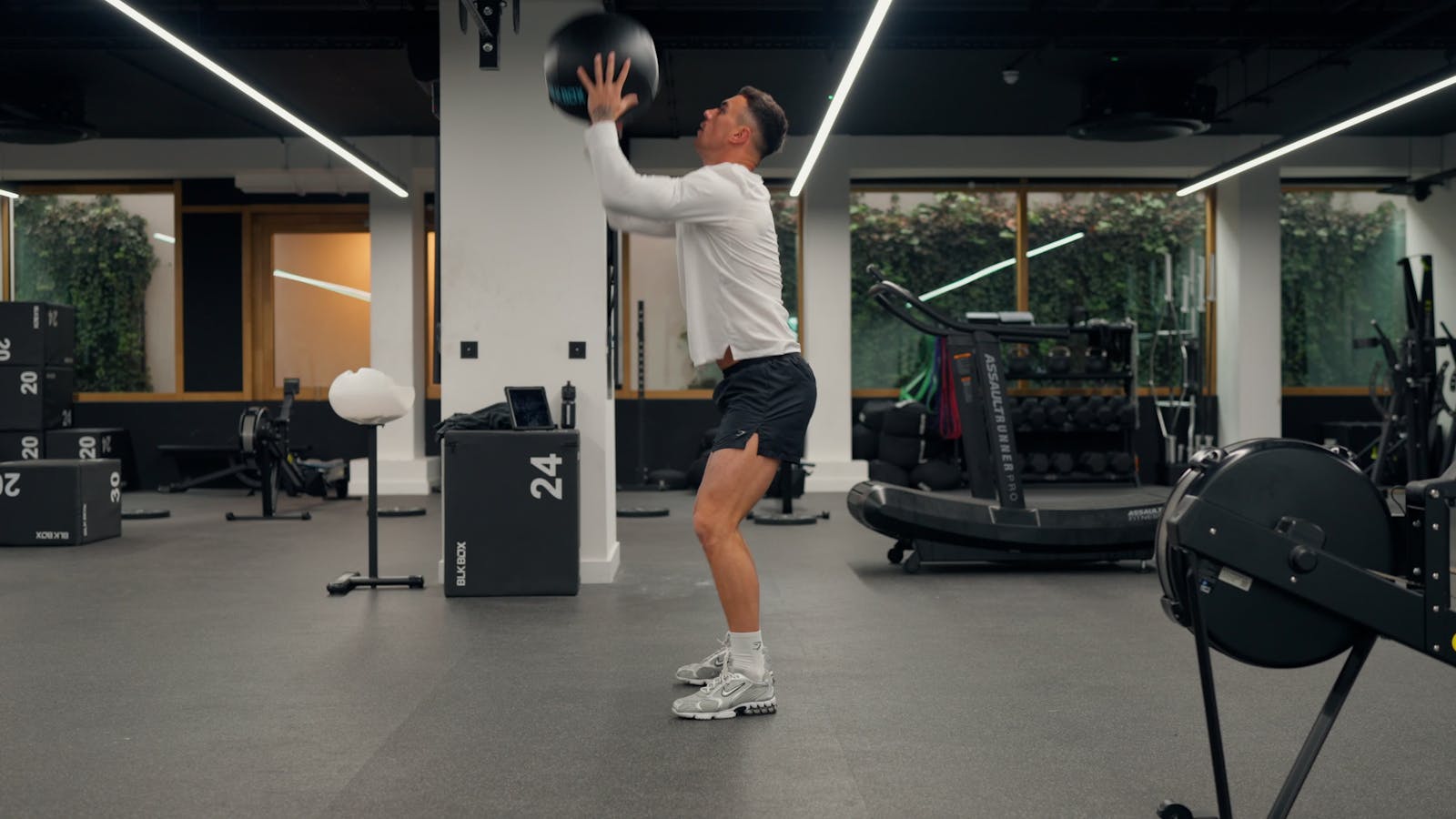
Stand with feet shoulder-width apart, holding a medicine ball overhead with both hands. Rise onto your toes while fully extending your arms to maximize the distance between the ball and the ground. Using your core, lats, and arms simultaneously, slam the ball downward with force. Allow your hips to hinge slightly as you follow through, maintaining a neutral spine. Catch the ball on the first bounce or retrieve it, then reset.
Why This Is One of the Best Plyometric Exercises for Basketball
Explosive hip extension combined with rapid core engagement generates the power needed to finish dunks, secure contested rebounds, and power through defenders in the paint. Medicine ball slams train the overhead-to-downward force production pattern used when pulling down rebounds or throwing outlet passes, while building the core stability required to maintain body control during contact.
Basketball Transfer
This drill improves your ability to finish aggressively at the rim, rip rebounds from opponents, and maintain balance when absorbing contact mid-air. Players with powerful triple extension can elevate over taller defenders and create finishing angles that seem impossible.
Progression Tips
Start with a 6-8-pound medicine ball for 3 sets of 10 slams, focusing on generating power from your entire body rather than your arms. As your technique improves, increase the ball weight in 2-pound increments. Advanced progressions include rotational slams (turning 90 degrees before slamming) or single-leg variations that challenge your stability while maintaining power output.
Why do most plyometric programs fail to deliver results?
Most plyometric programs fail because they treat these exercises as separate drills rather than connected systems. When you jump, your ankles, knees, hips, and core fire in coordinated sequences, with each joint contributing force at the right moment. Training these movements separately builds capacity, but your nervous system must learn how these patterns connect during actual basketball movements.
How does mobility work support explosive training?
Mobility work becomes necessary because explosive plyometric training stresses your tissues, especially hip flexors, calves, and upper back. Without sufficient range of motion in these areas, your body compensates by stressing other parts, increasing the risk of injury and limiting power output. Regular mobility work maintains joint function and tissue health, allowing you to fully utilize the strength you build through plyometric training.
What separates athletes who maximize their training results?
The athletes who see the greatest improvements from plyometric training balance intensity with recovery. Your central nervous system needs recovery time as much as your muscles do. Smart programming includes planned deload weeks, adequate rest between high-intensity sessions, and daily mobility work addressing the specific areas stressed by your plyometric exercises.
Building power is only half the equation. The other half, what separates players who stay healthy from those who constantly fight injuries, comes down to how well your body absorbs force.
how to add plyometric exercises to a basketball training program

How well plyometric exercises work depends more on when you do them and how much you rest between sessions than on which specific exercises you choose. Perform them after you warm up but before strength training, when your nervous system is fresh and your landing technique hasn't degraded from fatigue. Doing 2-3 sessions per week generally provides enough stimulus to build explosive power without hurting recovery or raising injury risk. Never perform plyometric exercises when fatigued, since fatigue compromises landing mechanics and dramatically increases injury risk.
when to perform plyometrics
Do plyometric work right after your dynamic warm-up, before you lift weights. Your central nervous system needs to be alert and ready, not already tired. If you squat heavy first, then try depth jumps, your landing mechanics will deteriorate, and the training focus shifts from power development to survival mode. Fatigue changes how your body absorbs force, turning a power-building session into a wear-and-tear grind.
how does training frequency vary by experience level?
Beginners generally do best with two sessions per week and a few days of rest between them. Tendons and connective tissue adapt more slowly than muscles, so increasing frequency before building structural strength can lead to tendinitis and stress reactions.
Intermediate athletes can handle three sessions weekly if one focuses on low-impact agility drills like dot work, keeping total volume manageable. Advanced players training with Olympic lifts and heavy squats can sustain 2-3 higher-intensity sessions because they've built the strength foundation that makes plyometrics effective rather than destructive.
Why does progress stall despite consistent training?
Progress stops not because the exercises don't work, but because the athlete hasn't matched training stress to recovery capacity. Athletes who've been close to dunking for six months without a breakthrough often add volume when they should refine timing or increase intensity before their bodies have recovered from the previous session.
how should you progress from bilateral to single-leg movements?
Start with two-sided movements where both feet share the load: dot drills, box jumps, broad jumps. If balance feels shaky during reactive jumps, use resistance bands attached overhead for support until your stabilizers catch up.
Once you can maintain clean landings for three sets of 20-second intervals without wobbling or compensating, progress to single-leg variations. The same exercise performed on one leg exposes asymmetries and demands ankle stability that two-sided work masks. Young athletes rushing into single-leg depth jumps before they're ready rehearse poor movement patterns under load.
What mobility foundation do explosive movements require?
Explosive movements require more than strength. Tight hips, restricted ankles, and stiff thoracic spines limit your ability to load and release elastic energy during the stretch-shortening cycle. Maintaining joint mobility and tissue quality supports clean landing mechanics across multiple weekly sessions; without that foundation, adding more plyometric volume accelerates breakdown.
But the real test isn't how high you jump when you're fresh; it's whether your body can still absorb force cleanly when fatigue sets in.
the problem might not be your power: it might be how you absorb it
The problem isn't always that you can't create force. Sometimes your body can't position itself to use the force you already have. When your ankles lack dorsiflexion, your knees drift forward during landing, shifting load from the glutes to the patellar tendon. When your hips are restricted, you lose the ability to hinge properly during deceleration, forcing your quads to absorb impact they weren't designed to handle alone. These structural limitations reduce the effectiveness of every box jump, depth drop, and broad jump.
Most athletes respond by adding more plyometric volume. But if the movement pattern itself is compromised by mobility restrictions, more reps reinforce compensations. You're teaching your body to jump and land inefficiently, leading to stalled progress or overuse injuries in the knees, ankles, or Achilles. The stretch-shortening cycle depends on optimal joint positioning to store and release elastic energy. Without it, you're leaving force on the table every rep.
build the mobility to match your power with pliability | 7 days free
Before programming another plyometric block, it is worth checking whether a movement limitation is undermining your results. The pliability mobility assessment starts with a body scan that highlights the restrictions affecting your landing mechanics, and Build Your Program turns that into a plan shaped around your training schedule. Daily Sessions keep hips, ankles, and thoracic spine moving between plyometric days, and Paths let you focus on one restricted area for weeks at a time. Try pliability free for 7 days on iPhone, iPad, Android, or the web, and find out where mobility, not power, is limiting your game.
Related Reading


Move better in 10 minutes a day.
10,000+ five-star reviews.