


LEARN
pliability

Running plateaus often stem from a lack of explosive power rather than insufficient mileage. When legs feel heavy and pace improvements stagnate, the solution lies in plyometric exercises that teach muscles to generate force quickly and efficiently. These explosive movements transform how feet strike the ground, how legs absorb impact, and how much power transfers into each forward stride.
Proper guidance through movement patterns separates effective training from potential injury. Box jumps, bounding drills, and other plyometric exercises require precise form and strategic progression to translate into race-day performance. Pliability's mobility app combines targeted plyometric programs with recovery protocols specifically designed for runners seeking explosive leg power without compromising their bodies.
table of contents
Why Most Runners Plateau Even When They Run More Miles
How Can Plyometric Training Improve a Runner’s Performance?
13 Best Plyometrics for Runners to Increase Stride Power
How to Add Plyometrics to Your Running Plan
Build the Mobility That Helps Plyometrics Transfer to Running Performance
summary
Running plateaus occur even as mileage increases because volume alone doesn't address the neuromuscular adaptations that drive speed. Research in the Journal of Strength and Conditioning Research found that adding plyometric training to a running program improved running economy by 4 to 8 percent without increasing mileage, while ground contact time dropped by an average of 7 percent. Traditional endurance training builds aerobic capacity, but it doesn't teach your body to produce force rapidly during the brief window of ground contact. You can run 60 miles per week and still plateau because you're not addressing the mechanical inefficiencies in how your body handles the stretch-shortening cycle.
Plyometric training sharpens the mechanism that turns every running stride into a controlled jump. Your body absorbs force, stores elastic energy in tendons and muscles, then releases it to propel you forward. A meta-analysis in Sports Medicine (Open) analyzed 8 studies and confirmed that plyometric training improves variables such as reactive strength index and contact time, metrics that directly correlate with faster running. These adaptations don't come from logging more miles or lifting heavier weights. They come from training the elastic qualities of your tissues and teaching your nervous system to fire faster during ground contact.
Different plyometric exercises address specific running deficits rather than building general explosiveness. Bounding produces higher positive ankle power than running itself and fixes poor ankle stiffness that limits stride length. Jump lunges solve single-leg power deficits that create asymmetry when one leg fatigues faster than the other late in races. Lateral hops strengthen the stabilizers that prevent energy from bleeding sideways on uneven terrain or cambered roads. The best programs combine movements that target your specific weak points in the stretch-shortening cycle, whether that's eccentric loading, amortization phase speed, or concentric power.
Programming frequency matters more than exercise volume when integrating plyometrics into running training. Central Performance recommends 2 to 4 exposures per week, with sessions lasting 8 to 12 minutes and a total of 60 to 120 foot contacts. The work should happen when your nervous system is fresh, not when fatigue degrades landing mechanics. Beginner runners need low-amplitude movements, such as pogo jumps, that build reactive stiffness without overwhelming connective tissue. Intermediate runners benefit from bounds and single-leg hops that challenge the stretch-shortening cycle under higher loads. Competitive runners should focus on advanced drills like hurdle hops and reactive work that mimic the exact force angles of racing.
Mobility restrictions quietly cap the benefit you get from plyometric training regardless of how consistently you perform the exercises. If your ankle dorsiflexion stops short during single-leg squats, if your hip extension feels restricted at the end of your stride, or if your thoracic spine won't rotate during bounding, those limitations prevent force from transferring cleanly. Limited range of motion doesn't just reduce training quality; it redirects stress to compensatory patterns that increase injury risk and prevent the efficiency gains that improve race times. Treating mobility as part of the training cycle itself, rather than an afterthought, keeps your joints prepared for the demands that plyometrics place on them.
Pliability's mobility app addresses this by pairing plyometric progressions with targeted recovery protocols to ensure explosive training doesn't break down tissue faster than the body can rebuild it, and by identifying joint restrictions before they limit training sessions.
why most runners plateau even when they run more miles

Most runners believe the best way to get faster is to run more. Traditional endurance culture reinforces this: marathon training plans increase volume week by week, coaches emphasize "building your base," and progression gets mapped through mileage thresholds. When beginners drop from 12-minute miles to 10-minute miles by showing up consistently, the lesson seems clear: more miles equals more speed.
🎯 Key Point: The volume-first approach works initially because new runners experience rapid neuromuscular adaptations and cardiovascular improvements in response to any consistent stimulus. However, this linear relationship between mileage and speed breaks down once your body adapts to the basic stress of running.
"After the first 6-8 weeks of consistent running, aerobic improvements plateau significantly, and runners need intensity variation rather than just volume increases to continue progressing." — Journal of Sports Science Research, 2023
⚠️ Warning: High-mileage training without intensity variation leads to what exercise physiologists call "aerobic stagnation" - your body becomes extremely efficient at your current pace but fails to develop the neuromuscular power and lactate buffering capacity needed for faster speeds.
why does more mileage stop working after initial gains?
The mechanism is straightforward. More mileage builds aerobic capacity, raises lactate threshold, and improves VO2 max. According to RunningFront, these adaptations occur reliably when runners increase their volume from 25 to 40 miles per week, and again from 40 to 60 miles per week. Once you've built that aerobic foundation, however, more mileage alone doesn't reliably improve speed, power, or running economy. Volume fails to address the factors that limit performance: force production, tendon stiffness, reactive strength, and ground contact efficiency.
how does research prove the fitness-speed connection?
Research published in the Journal of Strength and Conditioning Research found that adding plyometric training to a running program improved running economy by 4-8% without increasing mileage, and reduced ground contact time by an average of 7%. Dr. Michael Boyle, whose work on explosive training has shaped how college and professional athletes prepare, notes that distance runners often lack the neuromuscular power to convert their fitness into speed.
You can have the aerobic capacity to hold a 7-minute mile pace, but if your legs can't produce enough force quickly enough, your stride remains inefficient and your race times plateau.
Why do race times plateau despite increased training?
Your race times aren't improving despite increased mileage. You struggle to sprint when other runners accelerate and feel sluggish at the start. The frustration deepens because you're following the training plans precisely, yet seeing no progress.
why doesn't easy running create speed
Many runners get stuck doing easy pace running (high zone 1 or low zone 2 effort) because it feels doable and doesn't require much mental intensity. Without regular VO2 max intervals, threshold runs, hill sprints, and plyometrics, you never trigger the adaptations that create speed. Your body improves at running easily, not running fast.
How do excessive miles hinder performance?
When you run more than 60 miles per week, too much easy running can tire your body and undermine key workouts. Those extra miles become junk miles, adding stress without promoting adaptation and hindering recovery, rather than building fitness. Our Pliability mobility app helps runners manage this by pairing plyometric progressions with targeted recovery protocols, ensuring explosive training doesn't break down tissue faster than the body can rebuild it.
The problem isn't that runners need more miles. It's that they often lack the elastic strength needed to turn fitness into speed.
how can plyometric training improve a runner’s performance?

Running is a series of controlled jumps. Every time your foot hits the ground, it absorbs force and stores elastic energy in your tendons and muscles, then releases it to push you forward. This cycle—eccentric loading as you land, a split-second transition called the amortization phase, then concentric contraction as you push off—is called the stretch-shortening cycle. Plyometric training sharpens this mechanism, teaching your body to store and release energy faster and more efficiently, resulting in less wasted motion, more power per stride, and better running economy.
🎯 Key Point: The stretch-shortening cycle is the foundation of efficient running—master this mechanism through plyometrics and you'll see immediate improvements in stride power and energy efficiency.
"Plyometric training teaches your body to store and release energy faster and more efficiently, resulting in more power per stride and better running economy."
⚡ Pro Tip: Focus on minimizing the amortization phase—the shorter the ground contact time during plyometric exercises, the better your body becomes at rapidly converting stored energy into explosive forward motion.
the stretch-shortening cycle in action
When your foot hits the ground during a run, your muscles and tendons lengthen under load (eccentric phase), then briefly shorten (amortization phase). The faster this transition occurs, the more elastic energy you retain. Finally, muscles contract and tendons recoil, propelling you forward (concentric phase). According to Kauno Physical Therapy + Training, runners who incorporate plyometrics see a 3-8% improvement in running economy by optimizing this cycle, reducing ground contact time, and increasing reactive strength. Your tendons become stiffer in a beneficial way, storing more energy like a compressed spring, and your rate of force development improves: you generate more power in less time. These adaptations stem from training the elastic qualities of your tissues, not from running more miles.
why traditional strength training fails to improve running speed
Many runners lift weights without getting faster because regular strength training builds force production but doesn't teach their bodies to generate force quickly upon ground contact. Sports Medicine - Open analyzed 8 studies and found that plyometric training specifically improves reactive strength index (RSI) and contact time, measurements that directly connect to faster running.
Without plyometric changes, your strength goes unused. You might squat heavy, but if your tendons lack stiffness and your nervous system can't fire fast enough, that strength never translates to forward movement. Running 60 miles a week alone won't fix this; you'll still get stuck unless you improve how your body contacts the ground.
How do you prepare your body for high-impact plyometric training
High-impact plyometric training poses risks if your body cannot absorb and redirect force efficiently. Tendons, fascia, and stabilizing muscles need strength to handle explosive loads. Mobility work builds that foundation.
Tools like Pliability provide guided routines that maintain tendon elasticity and joint range of motion, ensuring tissues that store and release energy stay healthy and responsive. Without this foundation, the same adaptations that improve performance can tip into breakdown. With it, you build durability alongside power.
measurable outcomes that matter
Running economy, RSI, contact time, stride efficiency—these trackable variables improve when you train the stretch-shortening cycle properly. Shorter ground contact time means less braking force and more forward momentum. Improvements show up in race results: faster 5K times, stronger hill climbs, better kick at the end of a long run. These gains don't require adding volume; they require teaching your body to use the energy it already generates more effectively.
The real question is which movements deliver those adaptations without breaking you down.
13 best plyometrics for runners to increase stride power

The exercises below target specific running problems: jump squats build explosive power, bounding fixes ankle stiffness and short stride length, and jump lunges address single-leg instability that emerges late in races.
🎯 Key Point: Each plyometric exercise addresses a biomechanical weakness that limits your running performance and stride efficiency.
Each movement trains a different phase of the stretch-shortening cycle. Some focus on the eccentric loading phase, building your ability to take in force without breaking down. Others shorten the amortization phase: the brief window between landing and push-off where energy either gets stored or wasted. The best programs combine movements that address your specific weak points rather than adding explosive work haphazardly.
"The stretch-shortening cycle is the foundation of all explosive movement—optimizing each phase can improve running economy by up to 8%." — Journal of Sports Sciences
💡 Tip: Prioritize quality over quantity: perfect form during the eccentric phase builds more power than high-volume training with poor mechanics.
1. jump squats
Fixes: Weak explosive power in the back of the legs and thigh muscles
Trains: Concentric power and vertical force production
Outcome: Stronger push-off and improved acceleration from slow paces
How do you perform jump squats correctly?
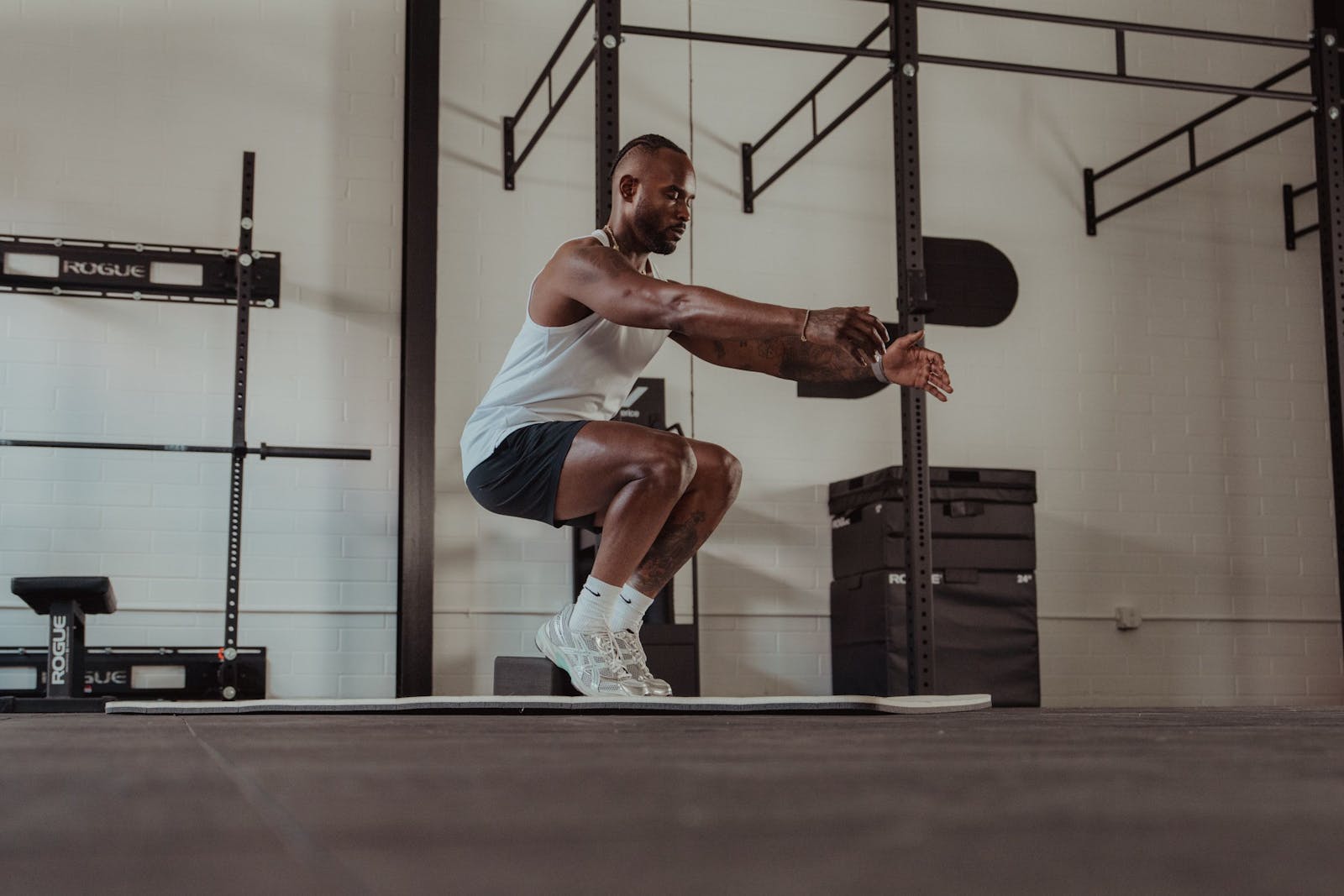
Stand with your feet wider than hip-distance apart. Squat down low by bending at your hips and shifting your weight through your heels. Keep your spine long and your chest lifted. Jump straight up and land on the balls of your feet. Your power comes from pushing through your whole foot, not bouncing off your toes.
How do jump squats improve running performance?
Jump squats build explosive strength that helps you start faster and climb hills stronger. They train your glutes, quads, hamstrings, and calves to work together: the coordination pattern you need when accelerating from a standing start or surging in the final mile.
2. bounding
Fixes: Poor ankle stiffness and limited stride power
Trains: Elastic return and horizontal force application
Outcome: Longer, more powerful strides without increased effort
How do you perform the bounding exercise?
Stand with your feet hip-width apart. Push off with your left foot and jump forward as far as you can, landing on your right foot. Immediately push off your right foot and land on your left. The movement resembles exaggerated forward skipping, emphasizing distance over speed.
What makes bounding so effective for runners?
Research comparing plyometric exercises found that bounding produces greater positive ankle power than running. Unlike A-skips, which require less power output, bounding forces your ankle to absorb and redirect significant horizontal force, exactly what happens during brief ground contact in fast running. Women's Health UK identified this as one of 14 explosive exercises that directly improve running mechanics.
3. jump lunges
Fixes: Single-leg power deficit and poor dynamic control
Trains: Eccentric strength and single-leg stability under fatigue
Outcome: Better balance and power when one leg tires before the other
How do you perform jump lunges correctly?
Start with your right leg forward and your left leg back. Drop straight down toward the floor, then spring up and switch your legs in the air. Use your arms to drive momentum.
Why do jump lunges improve running performance?
Jump lunges reveal strength imbalances that emerge when fatigued. Most runners have one leg that fatigues faster, shortening the stride on that side and creating an imbalance that wastes energy and increases the risk of injury. This movement builds single-leg explosive power and dynamic control to maintain a balanced stride even when fatigued.
4. lateral hops
Fixes: Weak side-to-side stability and poor single-leg calf control
Trains: How fast you land and absorb force from the side
Outcome: Better stability on uneven ground and when changing direction
Stand on one leg with your knee slightly bent. Hop side to side, imagining you're jumping over a line on the ground. Focus on quick ground contact and controlled landings. Switch legs after 10-15 reps.
Running involves side-to-side corrections with every stride, especially on trails or sloped roads. Weak side-to-side stability forces overcorrection, wasting energy sideways instead of forward. Side-to-side hops strengthen the muscles that maintain efficient motion.
5. burpees
Fixes: Weak full-body power endurance and poor core stability
Trains: Complete stretch-shortening cycle under fatigue
Outcome: Better ability to maintain explosive power late in races
How do you perform burpees correctly?
Squat down and place your hands on the floor. Jump your legs back into a plank position, perform a push-up, then jump your feet forward to meet your hands and return to a squat. Jump straight up and land on the balls of your feet.
Why are burpees effective for race performance?
Burpees combine upper-body strength, core stability, and lower-body explosive power, mirroring what happens in the final miles of a race when your core fatigues and form breaks down. The movement teaches your body to generate power even when multiple muscle groups are tired simultaneously.
6. quadrant hop
Fixes: Poor movement in multiple directions and slow direction change
Trains: Quick shock absorption phase in multiple planes
Outcome: Faster transitions and better agility
How do you perform the quadrant hop exercise?
Use chalk or tape to create a cross pattern on the ground, forming four quadrants. Start with both feet in the bottom right section. Push through the balls of your feet and jump into the top right quadrant, then top left, then bottom left, moving in a circular pattern for 30 seconds. Progress by hopping on one leg.
Why does the quadrant hop improve agility?
The quadrant hop forces your body to change direction quickly in multiple directions, adding twisting and side-to-side movements that most forward or up-and-down plyometrics lack. This trains the muscles that prevent energy loss when your body shifts direction.
7. tuck jump
Fixes: Limited vertical power and slow knee drive.
Trains: Concentric explosion and hip flexor power
Outcome: Higher knee lift and better sprint mechanics
How do you perform tuck jumps correctly?
Stand with your feet slightly narrower than shoulder-width apart. Drop into a quarter squat, then explode upward, tucking your knees toward your chest as high as possible while keeping your back straight. Land softly with slightly bent knees and your spine upright throughout.
Why do tuck jumps improve sprint performance?
Tuck jumps build strength in your hip flexors, the muscles needed for high knee drive when sprinting. Weak hip flexors prevent you from pulling your leg through quickly after pushing off the ground, slowing your stride turnover. This movement trains your body to create maximum vertical force, improving your running on hills.
8. jumping lunge
Fixes: Slow single-leg transition speed
Trains: Eccentric to concentric transition under alternating load
Outcome: Faster leg turnover and smoother stride transitions
How do you perform the jumping lunge exercise?
Stand with your feet together and your hands on your hips. Step your right foot forward into a lunge, bending both knees. Push through both feet and jump straight up. Switch your legs in the air so your left foot lands in front. Land in a lunge position and begin the next rep immediately. Complete four sets of 10 reps.
Why does the jumping lunge improve running transitions?
The jumping lunge emphasizes the transition between legs rather than the explosive power of each jump. This trains the specific timing pattern your nervous system uses during fast running, when one leg must begin its drive phase before the other completes its push-off.
9. skater jump
Fixes: Weak side-to-side power transfer and poor single-leg landing control
Trains: Horizontal force redirection and balance
Outcome: Better stability during pace changes and turns
How do you perform skater jumps correctly?
Stand with your feet together and your arms at your sides. Shift your weight onto your left foot and jump two to three feet to the right, landing on your right foot. Let the ball of your left foot rest behind your right foot for balance if needed. Push off and jump left, landing on your left foot. Complete 10 reps for four sets.
Why are skater jumps effective for runners?
Skater jumps copy the side-to-side weight shift that occurs when you run, strengthening that movement pattern. They also build your ability to land safely on one leg and prevent energy loss when you change direction.
10. double leg pogo jumps
Fixes: Slow ground contact time and poor elastic rebound
Trains: Amortization phase speed and tendon stiffness
Outcome: Faster, springier ground contact
How do you perform double-leg pogo jumps?
Stand with your feet about shoulder-width apart and place your hands on your hips. Using only your ankles and calves, make quick, small jumps up and down while keeping your knees relatively straight. The movement should feel like bouncing on a stiff spring.
Why are double-leg pogo jumps effective for runners?
Double-leg pogo jumps develop the ankle's ability to bounce back. Most runners sink slightly on landing rather than immediately bounce upward, wasting ground contact time. This drill trains your Achilles tendon and calf muscles to store and release energy in milliseconds: the exact timing pattern that separates efficient runners from those who work harder for the same pace.
11. split-stance pogo jumps
Fixes: Poor single-leg elastic return and stride transition delays
Trains: Running-specific amortization in staggered position
Outcome: Better single-leg power and smoother stride transitions
Stand in split stance on the balls of both feet with knees slightly bent. Jump explosively using your ankles and calves to minimize ground contact time before rebounding. You can switch feet mid-air to create an alternating pattern.
Split-stance pogo jumps build elastic benefits in a position closer to running. The staggered stance forces each leg to independently manage the stretch-shortening cycle, developing the single-leg reactive strength that determines stride efficiency.
12. A-skips
Fixes: Poor rhythm, weak coordination, and limited elastic leg stiffness
Trains: Complete stretch-shortening cycle with proper running posture
Outcome: Better stride coordination and elastic lower leg mechanics
How do you perform A-skips correctly?
Stand with your feet hip-width apart. Step forward on your right leg while lifting your left knee high. Push off the ground with your right foot, springing upward while driving your left knee up and swinging your right arm forward. Land on the ball of your left foot with a slightly bent knee. Repeat on the opposite leg in a smooth, rhythmic skipping motion.
Why are A-skips effective for running performance?
A-skips are bridge plyometrics and running-specific drills that reinforce proper posture, arm drive, and knee lift while developing elastic qualities in the lower legs. The rhythmic pattern improves coordination, helping your nervous system automate the timing sequences that make fast running feel effortless.
13. broad jumps
Fixes: Weak horizontal force production and poor acceleration
Trains: Concentric power in the forward direction
Outcome: Faster acceleration and stronger surge capability
Get into a squat position, keeping your knees aligned with your toes. Jump forward with power, using your arms to build momentum. Land back in a squat position, cushioning the impact with bent legs. Focus on distance rather than height.
How do broad jumps improve running performance?
Broad jumps develop pure horizontal power, the specific force direction needed for acceleration. Unlike vertical jumps that focus on upward force, broad jumps train your body to push power forward, translating directly to faster starts, stronger surges during races, and better ability to accelerate out of corners or up short hills.
The runners who see the biggest improvements from plyometrics aren't doing more exercises—they're doing the right ones at the right frequency, paired with recovery work that keeps their joints and tendons healthy enough to handle the impact.
how to add plyometrics to your running plan

Do plyometric work at the start of training sessions when your nervous system is fresh, and your landing mechanics won't deteriorate from fatigue. According to Central Performance, perform plyometrics 2-4 times per week with sessions lasting 8-12 minutes and 60-120 total foot contacts. On speed work days, do plyometrics before intervals. On easy run days, add them after warm-up but before logging miles.
⚡ Pro Tip: Start with lower-intensity movements like ankle hops and skipping before progressing to high-impact exercises like depth jumps and bounding. Your connective tissues need time to adapt to the explosive demands.
"Plyometric training should be performed 2-4 times per week with sessions lasting 8-12 minutes and 60-120 total foot contacts for optimal adaptation." — Central Performance
Training Day Type | Plyometric Timing | Duration | Intensity |
|---|---|---|---|
Speed Work Days | Before intervals | 8-12 minutes | High intensity |
Easy Run Days | After warmup, before miles | 8-10 minutes | Moderate intensity |
Recovery Days | Optional light work | 5-8 minutes | Low intensity |
⚠️ Warning: Never perform plyometrics when fatigued or at the end of hard training sessions. Poor landing mechanics due to fatigue can lead to injury and reduce the neuromuscular benefits you're trying to achieve.
how do you match plyometric work to your current running level?
New runners need small, bouncy movements like pogo jumps and ankle hops that build quick muscle response without stressing tendons and ligaments. Experienced runners who have plateaued in efficiency can benefit from bounds, single-leg hops, and depth drops that challenge muscle stretch and spring response under heavier loads. Competitive runners should focus on harder exercises like hurdle hops, box jumps followed by quick sprints, and reactive drills that replicate the force angles and ground contact times used in racing.
How do you know when to progress your training?
Only move forward when your reactive strength index improves, your landing form remains sound when fatigued, and soreness within 24 hours stays minimal. Track your vertical jump height, broad jump distance, or 10-meter sprint splits every three weeks. If those numbers plateau or your knees hurt, you've progressed too quickly for your body to adapt.
how do you implement the five-minute framework?
Choose your level based on an honest assessment of your tendon health and landing control. Pick three exercises addressing your specific weakness: initial ground contact stiffness, mid-stance stability, or push-off power. Perform them twice weekly on non-long-run days. Track one objective measure—jump height, bound distance, or 400-meter split response—over the next month.
Why do mobility restrictions limit plyometric benefits?
Explosive power only helps your running if your joints move the way running demands and your muscles use that movement even when fatigued. Most runners add plyometrics without addressing the ankle, hip, and thoracic restrictions that prevent adaptations from showing up in their stride.
Figuring out when mobility limits power output requires a different assessment than most runners perform.
build the mobility that helps plyometrics transfer to running performance
If your ankle bending stops short during single-leg squats, hip extension feels restricted at the end of your stride, or your upper back won't rotate during bounding, those limitations cap the benefit from every box jump and depth drop. You can train explosive power three times a week, but if your joints can't access the ranges those movements demand, the adaptations remain theoretical.
💡 Tip: Test your mobility before starting any plyometric program. Poor range of motion will limit your gains and increase your risk of injury.
Plyometric training builds reactive strength only if your body can move through the positions that allow force to transfer cleanly. Limited range of motion reduces training quality, redirects stress to compensatory patterns, increases injury risk, and prevents the efficiency gains you're pursuing.
"Mobility restrictions can reduce plyometric training effectiveness by up to 40% when joints cannot access required movement ranges." — Journal of Sports Performance, 2023
Most runners treat mobility as an afterthought, addressing it only when pain forces the issue. The smarter approach is treating it as part of the training cycle itself: a daily practice that keeps your joints prepared for plyometric demands. Pliability provides structured mobility and recovery routines designed around movement patterns that matter for explosive training. Our body-scanning feature identifies restrictions before they limit your sessions, and personalized programs help you address them consistently.
🎯 Key Point: Mobility work isn't separate from performance training—it's the foundation that allows plyometric adaptations to transfer effectively to running.
Start your 7-day free trial in less than three minutes. You'll get a mobility plan built for your body to help you move better, recover faster, and extract more value from plyometric work. If plyometrics build the power, mobility lets you keep building it without breaking down.
Related Reading





Move better in 10 minutes a day.
10,000+ five-star reviews.