


LEARN
pliability

Shin pain has ended more training blocks than bad weather ever has. One week you are stacking easy miles, the next you are wincing on stairs and rearranging your race calendar. Learning how to strengthen shins for running breaks that cycle: build the muscles that absorb impact, restore the ankle range that keeps your landing quiet, and stabilize the hips that control alignment below them. This guide covers all three with 20 exercises and the progressions to load them safely. One note first: this article is education, not diagnosis, and a clinician confirms what applies to your leg. If you would rather have the routines programmed for you, pliability's mobility app builds lower-leg strength and mobility work into a runner's week.
do shins get stronger from running?
Yes, but more slowly than the rest of you. Running signals the tibia to remodel and lay down denser bone, and shin muscles adapt to the workload like any other muscle. The catch is the timeline: aerobic fitness improves in weeks, while bone and connective tissue remodel over months. Feeling fit is not the same as being structurally ready.
That gap is where most shin trouble lives. Jump your weekly mileage or add speed work before the tissue catches up, and you are asking your shins to handle forces they have not had time to accommodate. Shins do get stronger from running, but only when the load stays inside what the tissue can currently absorb. Targeted strength work closes that gap faster, and with less risk, than miles alone.
why strong shins matter for runners
Every foot strike sends ground reaction forces of roughly two to three times your body weight through your lower leg. The tibialis anterior, the muscle down the front of your shin, lifts your toes during the swing phase and then lengthens under tension to lower your foot smoothly after heel strike, thousands of times per run. Strong, it decelerates your foot with precision. Weak, it lets your foot slap down and sends the shock straight up the tibia, while the posterior tibialis and peroneals that stabilize your arch fatigue early and pass their load to bone and to the periosteum, the nerve-rich lining around it. That is the usual slide: a dull ache after runs becomes sharp pain during them, then tenderness you notice just walking.
Strong shins also change how you run. Precise foot placement wastes less energy, ground contact time drops, and a stable ankle keeps rotational stress off your knee and hip. The runner whose form holds at mile 20 usually has stronger stabilizers than the one whose mechanics unravel at mile 10, and muscle that absorbs force now is what keeps knees, ankles, and hips running for decades.
shin splints or stress fracture? when to see a clinician
Shin splints, medial tibial stress syndrome, usually show up as a diffuse ache along the inner edge of the tibia; pain along the front outer shin is often called anterior shin splints. A stress fracture is a different problem: microdamage in the bone itself that has outpaced repair, classically painful at one focal spot you can point to with a fingertip. Only a clinician's exam and imaging can reliably tell them apart. Stop self-managing and get assessed if you notice any of the following:
Pain pinpointed to one spot on the bone rather than a spread-out ache
Pain that persists or worsens despite rest, or that hurts during everyday walking
Pain at night, visible swelling, or sharp pain reproduced by hopping on one leg
A tight, burning pressure that builds while running and eases at rest, a pattern seen in exertional compartment syndrome
A suspected stress fracture is not a project to train through; keep running on one and a small crack can become a complete fracture. For the training side of that problem, see how to prevent stress fractures from running. The exercises below build capacity and help prevent shin splints. They are not a way to push through pain.
what weakens shins in the first place
Shin pain builds from specific, fixable inputs. Strengthening without addressing them just builds muscle on top of dysfunction. The usual suspects:
Training errors: mileage or intensity climbing faster than the common guideline of about 10 percent per week, hard days stacked without 48 hours of recovery, and runs started cold.
Mechanics: overpronation and flat arches twist the tibia with every stride, overstriding brakes into your shins, low cadence raises the load per step, and leaning from the ankles instead of the hips keeps shin muscles constantly engaged.
Footwear and surfaces: midsoles lose their cushioning long before shoes look worn out, and concrete, asphalt, and long downhills raise the impact your tissues absorb.
Imbalances along the chain: tight calves restrict dorsiflexion and make the tibialis anterior fight for range, weak calves hand their share of the work to the shins, and weak hips and core let the pelvis drop and rotate the leg inward.
Structure and history: an old ankle sprain that quietly changed your gait, a leg length difference, or bone density that adapts on its own schedule all shift load in ways that compound over thousands of strides.
how to strengthen shins for running: 20 exercises
The exercises are grouped by purpose, in the order that makes sense to train them: restore ankle range, load the shins, calves, and feet directly, then stabilize the hips. You need a wall, a step, a towel, and a resistance band. Dull muscle fatigue is normal; sharp, localized pain is a stop signal. The general progression rule: after a week of sets completed with clean form, add about 20 percent to reps, hold time, or sets, and reassess your form every two weeks.
restore ankle range: 4 stretches
If shin pain keeps returning, restricted ankles are usually part of it. Each stretch should feel like a gentle pull, never sharp; forcing range works against you, and yes, you can overstretch.
1. Ankle Dorsiflexion Stretch
Without dorsiflexion, the motion that flexes your foot toward your shin, you strike toe-first and the shock feeds the tibia. 3 holds of 10 seconds per leg, building to 20 seconds over three to four weeks.
Stand about two feet from a wall and place the ball of one foot against it, heel on the floor.
Gently push your knee toward the wall until you feel the stretch in your calf.
Hold, release, and repeat before switching legs.
2. Calf Wall Stretch
A tight Achilles and gastrocnemius restrict ankle motion and push the foot into overpronation at landing. 3 holds of 30 seconds per side, building to 60 seconds by week three.
Stand three feet from a wall, hands pressed against it, and step one foot forward.
Lean into the front knee until you feel a pull down the back of the rear leg.
Keep the back leg straight and its heel down for the full hold, then switch.
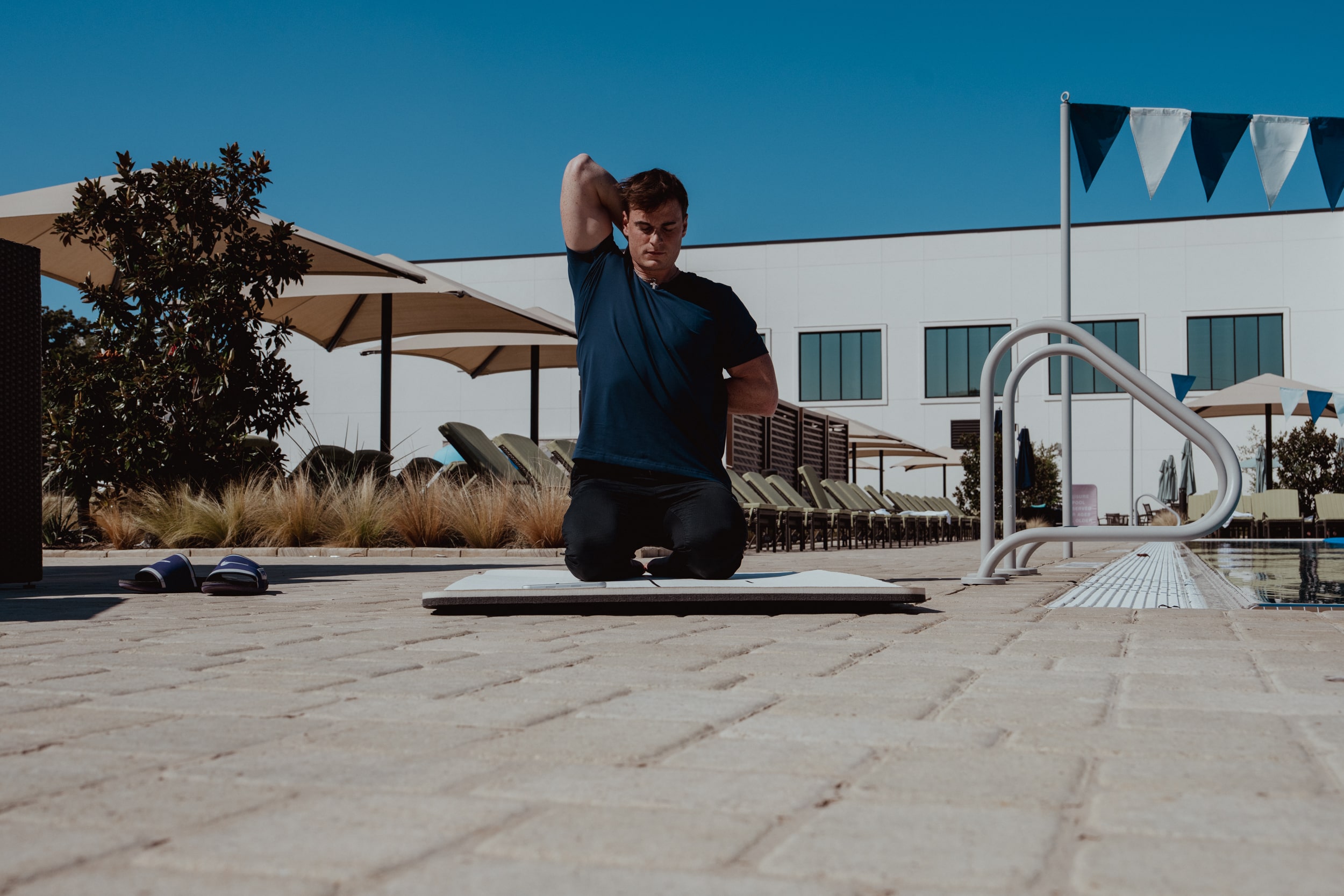
3. Kneeling Shin Stretch
A tight tibialis anterior cannot lengthen to absorb landing, so the bone takes the difference. 3 holds of 15 seconds, progressing to 30; lean back on your hands or lift one knee to deepen it.
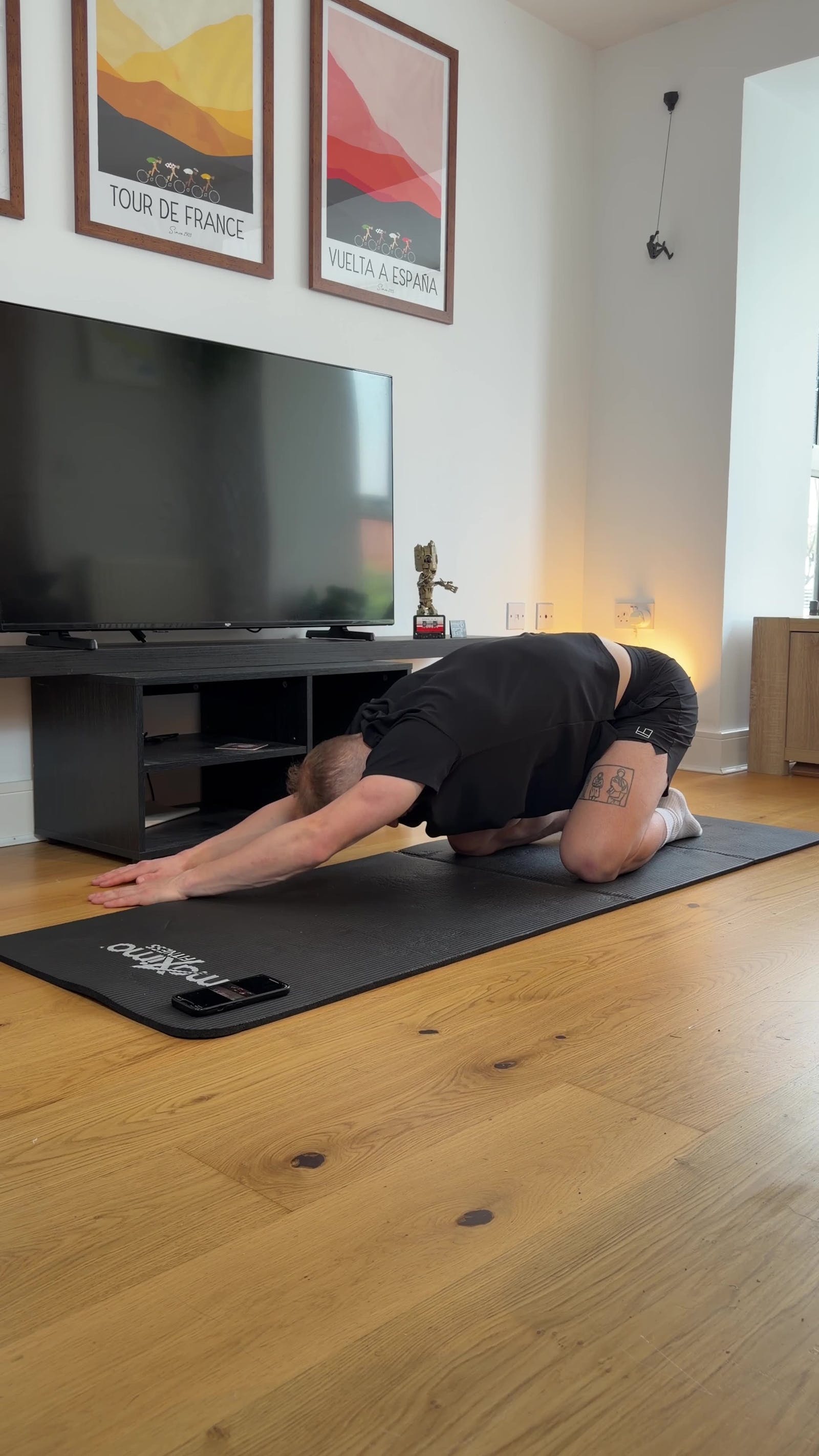
Kneel on a mat with knees and feet together, tops of the feet flat on the floor.
Back straight, core engaged, slowly sit back onto your heels.
Hold, rise, and repeat.
4. Assisted Seated Wall Stretch
A towel or band pulls the foot into fuller flexion than a passive stretch reaches. 3 holds of 30 seconds per foot, building to 60; a deep pull is right, cramping is too much.
Sit with your legs straight and loop a towel, rope, or band around the ball of one foot.
Pull gently until the foot flexes toward your shin.
Hold, release, then switch feet.
load the shins, calves, and feet: 9 strength drills
This is the direct work. On every raise, make the lowering phase slow, around three to five seconds; that eccentric control is exactly the job your shins do during running. If a recent calf problem is limiting this group, deal with it first: see how to heal a calf strain quickly.
5. Heel Walking
Directly trains the tibialis anterior. 3 sets of 25 steps, building to 40 by week three; stay near a wall if balance is shaky.
Stand tall and lift your toes as high as possible so your weight sits on your heels.
Walk 25 steps, lower your heels, and pause before the next set.
6. Toe Raises
The isometric partner to heel walking. 3 sets of 10-second holds, building to 20 seconds, with steady tension throughout.
Stand with your back against a wall, feet six to eight inches out, heels on the floor.
Raise the front of both feet toward the ceiling and hold.
Lower until your forefeet almost touch the floor, then repeat three to five times.
7. Point and Flex
Moves the ankle through its full arc while the single-leg stance quietly trains your hip stabilizers. 3 sets of 10 reps per leg, building to 20; chase full range in both directions.
Hands on hips, weight on one leg, lift the other straight out a few inches.
Flex the toes toward your shin, then point them away. That is one rep.
Complete 10, then switch sides.
8. Toe Walking
Strengthens the calves that should absorb impact before it reaches the tibia. 3 rounds, building to 40 steps per direction; start with supported heel raises at a wall if your calves are weak.
Rise onto your toes and walk 25 steps with toes pointed straight ahead.
Walk 25 more with toes turned in, then 25 with toes turned out.
Repeat the circuit twice more.
9. Calf Raises
Redirects impact into tissue built for load and adds ankle stability for uneven terrain. 3 sets of 10, building to 15; progress to single-leg once 3 sets of 15 are clean.
Stand on a step on the balls of your feet, heels hanging free.
Press up and squeeze your calves at the top for five seconds.
Lower slowly until your heels are level with the step or slightly below.
10. Standing Soleus Raises
The soleus, the deep calf muscle, carries some of the highest loads in the running stride; a bent knee shifts the work onto it. 3 sets of 10 with a three-second top hold, building to 15, then single-leg.
Feet hip-width apart, knees slightly bent, and kept bent throughout.
Rise onto the balls of your feet, hold for three seconds, and lower with control.
11. Ankle Inversions With a Resistance Band
Loads the tibialis posterior along the inner shin, the exact territory where medial pain shows up. 3 sets of 10 per foot with three-second holds, building to 15; light band first, then medium.
Sit with one leg extended, loop the band around the ball of that foot, and hold the end for tension.
Slowly tilt the sole inward against the resistance and hold for three seconds.
Return, complete 10, then switch feet.
12. Toe Curls
A strong arch is a natural shock absorber; flat feet concentrate stress on the shins instead. 3 sets of 10 scrunches per foot, building to 20; a book on the towel adds load.
Place a hand towel on the floor and step one foot onto it, heel at the near end.
Scrunch your toes to drag the towel toward you.
Complete 10, then switch feet.
13. Foot Step Holds
A slow-motion heel strike that teaches quads, calves, Achilles, and arch to coordinate. 3 sets of 10-second holds per leg, building to 20; practice near a wall at first.
Step forward and let the heel touch down without lowering the ball of the foot.
Hold for 10 seconds, step back, then switch legs.
stabilize the hips: 7 exercises that take load off your shins
Shin pain often starts higher up. When the hip abductors and glutes cannot hold your pelvis level in single-leg stance, the femur rotates inward, the tibia follows, and your shins absorb torsion they were never built to manage. The same weakness drives knee pain when running, so this group protects two joints at once.
14. Single-Leg Bridges
Aligns hips, pelvis, and knee so impact distributes evenly. 3 holds of 10 seconds per leg, building to 20; if your lower back complains, shorten the hold and brace your core harder.
Lie on your back, knees bent, feet planted, arms at your sides.
Press your heels and shoulders down and lift your hips.
Raise one leg straight up, keep the hips high and level, hold, then switch.
15. Single-Leg Glute Bridge
The moving version exposes left-right imbalances behind asymmetric mechanics. 3 sets of 10 reps per side, building to 15; hips stay level the whole way.
Lie faceup with knees bent, then extend one leg straight.
Squeeze your glutes and drive the planted foot into the floor to lift your hips.
Lower with control, complete 10, then switch sides.
16. Hip Hikes
Trains the pelvic control that prevents the drop-and-rotate cascade behind shin splints. 3 sets of 10 reps per side, building to 15.
Stand sideways on a step on one foot, letting the other hang free.
Keep the standing leg straight and lift the free hip toward your ribcage.
Hold for up to 10 seconds, then lower slowly.
17. Side-Lying Abduction
Isolates the outer-hip abductors that keep your knee from collapsing inward mid-stride. 3 sets of 10 per side with three-second holds, building to 15; an ankle weight or band progresses it.
Lie on your side with legs straight and hips stacked.
Lift the top leg toward the ceiling, keeping it straight and hips still.
Hold for three seconds, lower slowly, complete 10, then switch.
18. Clamshells
Bent knees shift the focus to the gluteus medius and deeper hip rotators. 3 sets of 10 per side with three-second holds, building to 15; a band around the thighs raises the intensity.
Lie on your side, hips stacked, knees bent and stacked slightly below your hips.
Feet together, lift the top knee without rolling your hips back.
Hold for three seconds, lower, complete 10, then switch.
19. Monster Walk
Banded walking builds the lateral stability that keeps knees and ankles aligned under fatigue. 3 rounds of one full square in each direction, building to three squares; start with a light band.
Place a resistance band around your thighs and keep tension on it throughout.
Step forward twice, left twice, backward twice, then right twice to walk a square.
Repeat the square in the opposite direction.
20. Single-Leg Bent-Knee Deadlift
Posterior chain strength plus a balance challenge that sharpens pelvic control. 3 sets of 10 per leg, building to 15; control matters more than reaching your shin.
Stand on one leg with that knee slightly bent.
Hinge at the hips, reaching your opposite hand toward the standing shin, chest and chin up.
Return to standing, complete 10, then switch legs.
how to condition shins for running: frequency and progression
Do this work three to four times per week on non-consecutive days; the tissue adapts in the roughly 48 hours between sessions, not during them. Warm up for five minutes first: two minutes of easy walking, 10 ankle circles in each direction per foot, then 10 easy calf raises and 10 toe raises. Close each session with the dorsiflexion, calf wall, and kneeling shin stretches at one 30-second hold apiece, plus about two minutes of foam rolling your calves.
Progress on evidence, not enthusiasm. Master each movement pattern, then add roughly 20 percent after a week of clean sets. Sharp pain mid-exercise means stop, then cut the intensity in half next session. Keep a simple log of dates, sets, and how each drill felt; most runners notice a real difference in shin resilience within four to six weeks. Pair the strength work with a sane mileage plan, and if you would rather not sequence it yourself, the runner-focused routines in the pliability app handle the programming and progression for you.
strengthen your shins and keep running
Durable shins are not built in one heroic session. They are built in the 10 quiet minutes after a run, repeated across a training block. pliability makes that repeatable: Daily Sessions give you a fresh guided routine every day, Paths like Mobility for Runners deliver multi-week progressions for lower-leg and hip restrictions, Build Your Program shapes the work around your training week, and the Rebuild hub holds corrective routines for working back from a flare-up. Take the mobility assessment to see where you are actually restricted, then start your 7-day free trial and give your shins the same consistency you give your miles.
Related Reading


Move better in 10 minutes a day.
10,000+ five-star reviews.