


LEARN
pliability

After an intense workout, you can expect to feel some soreness. But if you are consistently too sore to train hard or to perform the movements correctly at your next workout, you are likely doing something wrong. As an athlete, you may have heard that soreness is a sign of progress, or that you didn't train hard enough if you aren't sore after a workout. These statements are misleading at best. Soreness is a natural part of training, but it isn't something to chase after or to gauge your workouts by. This article covers the best recovery tools for athletes and answers the central question, should you be sore after every workout, so you understand precisely what muscle soreness means about your training and recovery.
what causes muscle soreness after workouts?

Getting back into a fitness routine can feel exhilarating. You meet your goals. You get a plan together. And after your first workout, you feel terrific. This isn't so bad, you think. Why have I been putting this off for so long? Fast forward to the following day when it hits you like a ton of bricks. Everything hurts. The stairs are torture, and lifting your arms to blow dry your hair is excruciating.
Good intentions can quickly die in the face of muscle soreness. Any time you work your muscles in new ways, you'll inevitably feel sore, but if you let that soreness keep you from sticking to your plan, it can be discouraging.
The good news is that muscle soreness, also known as delayed onset muscle soreness (DOMS), doesn't have to be severe or debilitating. It also doesn't have to keep you from achieving your exercise goals.
what is DOMS, and why does it happen?
As its name suggests, DOMS is muscle soreness that becomes evident six to eight hours following activity, peaking around 24 to 48 hours post-training. Symptoms will often start to diminish at about 72 hours, though the precise time course and extent of DOMS is highly variable from person to person.
DOMS is most pronounced when you introduce a new training stimulus, a new activity, increased intensity or volume, or if you're new to physical activity. That's because your body is adapting to better handle that activity the next time around. That's why on day one at the gym, after doing squats or lunges with even modest weights, you can be brutally sore the next day. As you continue training, you build tolerance, and you won't be as sore.
what causes DOMS?
While all kinds of muscular contraction can cause soreness, eccentric contraction, where the muscle lengthens as it contracts, is most often associated with DOMS. This includes running downhill, lowering weights, or lowering into a squat or push-up position. There's also some evidence that upper body movement creates more soreness than lower body exercises.
Muscle discomfort is the most common characteristic of DOMS, but there are other symptoms. According to the American College of Sports Medicine, these may include a reduced range of motion and joint stiffness, local swelling and tenderness, and diminished muscle strength. These symptoms appear gradually following exercise, not to be confused with acute pain that may arise during physical activity.
myths associated with DOMS
No pain, no gain. Lactic acid build-up. An indicator of muscle growth. These are all phrases that we tend to associate with DOMS. While you may think you know everything you need about the condition that has you waddling like a duck, you may be surprised by what's happening in your body.
Myth #1: DOMS is caused by the build-up of lactic acid.
The verdict: Not true.
During exercise, your body needs energy, breaking down molecules to get it. As a result of this metabolic process, your cells naturally become more acidic, which is what makes your muscles feel like they're burning. But that burning isn't caused by lactate. Lactate is actually a by-product of the metabolic process, serving as a buffer that slows down how quickly your cells become acidic. People produce lactate all the time, even at rest, and it clears from your system thirty minutes to an hour after working out.
DOMS is now understood to come from microtrauma in the muscles and surrounding connective tissue, which triggers inflammation. Eccentric muscle contraction, like lowering a dumbbell back down during a biceps curl, is more likely to be the culprit, because it places a higher load on your muscles than concentric contraction. It's the active lengthening of muscle fibers under load, similar to pulling on a rope with so much force that the rope starts to tear and pull apart.
Myth #2: It's Not a Good Workout Unless You Get DOMS
We often wear our DOMS as a badge of honor and believe that if we're not sore, we're not doing enough during our workouts. But that's just not true.
It doesn't mean you're getting a worse workout just because you're not crippled the next day. You should typically feel soreness 24 hours to three days after the activity. If, after three days, you try the same exercise and can't do it because you go straight to muscle failure, you've done too much.
Studies show that soreness, rated on a scale from 0 to 10, is actually a poor indicator of muscle adaptation and growth. Many factors influence how DOMS shows up in different people, and there's real variability, even between people with similar genetics and among highly trained lifters and athletes. Comparing notes with training partners is part of the process, but soreness and DOMS aren't the best gauge of how effective your workout was, or who's in better shape.
Myth #3: The More Fit You are, The Less Susceptible You are to DOMS
You will indeed start to feel less sore as your body adapts to your workouts and learns to distribute the workload more effectively across your muscle fibers. That's why you should regularly change up your exercise routine.
However, there's also a genetic component to your sensitivity to pain and soreness. Some people are no-responders, low-responders, or high-responders to soreness. If you're a high-responder, you'll experience DOMS more acutely than a no- or low-responder given the same training load. You can't change your genes, but knowing where you fall on that spectrum helps you understand how your body may respond as your workouts change.
Myth #4: Muscle Damage is a Bad Thing.
DOMS appears to be caused by trauma to your muscle fibers, but it's not a definitive measure of muscle damage. A certain degree of soreness seems to be necessary: when muscles repair themselves, they get larger and stronger than before, so the same stress doesn't damage them as easily next time. These mechanisms aren't entirely understood, but some muscle trauma does appear to be needed to stimulate protein production and growth.
Myth #5: Pre- and Post-Workout Stretching is a Good Way to Prevent and Treat DOMS.
No. A review of studies for the Cochrane Database of Systematic Reviews on the effects of stretching before or after exercise on the development of delayed-onset muscle soreness found that pre- and post-workout stretching did not reduce the effects of DOMS in healthy adults. Research has also found that static stretching before working out does not safeguard you against injury and may decrease your power and strength.
should you be sore after every workout?

Soreness after a workout doesn't necessarily mean you had a productive session. Sure, muscle soreness, and delayed onset muscle soreness (DOMS) specifically, can indicate your muscles are adapting to new stressors. But just because you're sore doesn't mean you need to be.
While DOMS is common, the reason it happens remains poorly understood. Researchers do have a few theories about what's going on. The current scientific theory is that DOMS is linked to a combination of:
Mechanical damage to the protein structure of the muscle fiber
Damage to the membrane encasing the muscle fiber
Damage to the connective tissue surrounding the muscle fibers
The body's inflammatory response, which causes further muscle protein breakdown and stimulates specific nerves that cause pain
A certain degree of exercise-induced muscle damage is necessary to help build larger, stronger muscles. While muscle damage from exercise may reduce how well muscles work after a workout, sometimes for up to two weeks, you're less likely to experience DOMS to the same degree the next time you exercise. This may also explain why people who exercise regularly don't experience DOMS as often.
regular training reduces soreness
Regular weight training, focusing on eccentric exercises such as squats, deadlifts, and bench presses, has also been shown to reduce the damaging effect of exercise on the muscles after ten training sessions. There are several reasons for this, but one is that the muscle becomes better at protecting against damage.
how often and how severe a person experiences DOMS varies from person to person
Older people may be more susceptible to exercise-induced muscle damage and DOMS, possibly because their muscles cannot recover as easily after strenuous exercise. Research has also shown that people with certain genetic makeups can recover from eccentric exercise better than others who did the same workout.
If you're starting a new exercise program and your first workout is particularly intense or long-lasting, avoiding DOMS is tricky. Adding more eccentric exercises to your training program may also lead to DOMS. But again, being sore doesn't necessarily mean you've had a more productive session; it just means you're doing something your muscles aren't used to.
soreness doesn't indicate future gains
If you regularly exercise and aren't feeling as sore later in the day or even days after your workout, rest assured your workout is still working your muscles; you've just gotten better at dealing with the damage and recovering from it.
Concentrate on progressive overload if you want to get fitter and stronger, instead of feeling like you need to work out until you're sore. This means gradually increasing your exercise each time, such as performing extra reps on an exercise or adding weight. Progressive overload is an effective way to build muscle and strength, and it may also decrease how often you experience DOMS. Even a few weeks of consistent progressive overload appears to be enough to see this effect.
measure progress with progressive overload
Instead of measuring how effective your workout has been based on how sore you are, try to gradually increase the number of reps you do each week or the amount of weight you lift. These incremental gains in fitness and strength will show you just how effective your previous workouts have been.
how to recover from delayed onset muscle soreness

There are several ways to alleviate those can't-make-it-up-the-stairs symptoms. A sports massage is one good way to reduce the effects: it increases blood flow and circulation to the area, which can help your body clear out the microtrauma in your muscles faster.
roll it out: foam rolling for sore muscles
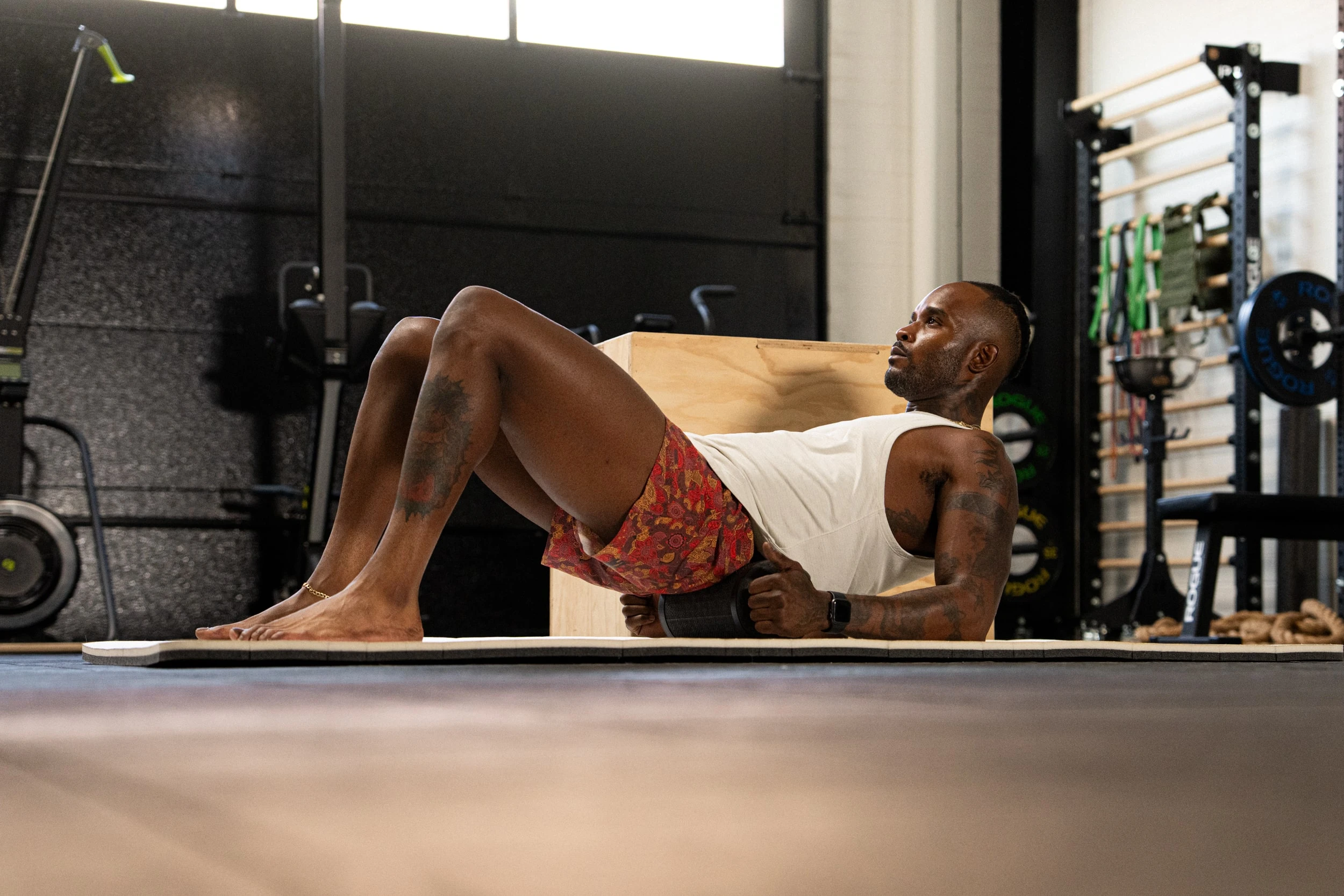
Foam rolling is another form of self-myofascial release that can help ease the pain of DOMS. It increases blood flow to sore muscles, supporting recovery, and may help reduce how severe the soreness feels. Try adding foam rolling to your post-workout routine, and keep doing it daily until your soreness subsides.
contrast showers: alternate hot and cold water
A contrast shower, alternating between hot and cold water, may also help reduce DOMS symptoms. The idea is that the temperature changes help flush out the metabolic byproducts that contribute to soreness. Research on this is still limited, but it's an easy recovery method to try. Aim for 10 to 15 minutes, starting and finishing with cold.
how warm Epsom salt baths help soothe sore muscles
Another popular recovery option is a warm bath with Epsom salts, which contain magnesium. Magnesium is thought to help reduce muscle soreness, and there's some evidence that soaking in warm water can help with DOMS specifically. Epsom salt baths may also help you relax and sleep better, further supporting recovery.
nutrition for DOMS recovery: protein and omega-3s
Nutrition can help recovery from DOMS. Getting protein in after exercise can help reduce muscle soreness and speed up recovery, since protein helps repair the microtears in muscle that occur during exercise. Aim for roughly 20 to 40 grams of protein within two hours of completing your workout. Omega-3 fatty acids may also help reduce muscle soreness, so consider upping your intake of fatty fish or walnuts following intense exercise.
just keep moving: why resuming exercise is best for sore muscles
Exercising may be the last thing you feel like doing when you're sore. But resuming exercise after a day of rest is often the best way to get past the soreness phase. As soon as you settle into a routine, the soreness response will gradually decrease over time. You might feel sore after every workout during your first week, but the more frequently you exercise, the less soreness you'll develop over time.
If you don't trust yourself to stick to your exercise plan once soreness sets in, set yourself up for success:
Define realistic goals: Trying to exercise at high intensity five days a week can feel overwhelming if you are sore after day one. Start small.
Find a partner: Choose someone at the same exercise level.
Keep your eye on the prize: Remember what you're trying to achieve long-term. Write your goal or a motivational quote somewhere that you'll see it daily.
soreness is not the same as pain: when to seek help
Muscle pain during exercise is not the same thing as soreness. Recognizing the signs of overtraining, an injury, or a more severe condition is critical to getting treatment. Consult your doctor if you experience:
Dramatic change in your strength: Significant and sudden weakness could be the symptom of an underlying issue.
Severe muscle cramps with exercise: Severe muscle cramps with exercise could indicate rhabdomyolysis, a serious condition that can eventually affect your kidneys. Severe pain while exercising and dark, bloody urine are two common symptoms.
Trouble with weight bearing: You might be injured if it hurts to put your body weight on any joint or limb.
The goal of exercising is to improve your health without experiencing injury or severe soreness. Soreness is inevitable, but when you approach exercise in a smart way, it's absolutely manageable.
recover smarter, not just harder
Knowing whether your soreness is normal is only half the equation; what you do about it matters just as much. pliability's Daily Sessions include guided mobility and recovery routines built to help you move better between hard training days, and the Rebuild hub offers structured programs when you're working around a specific issue. Take the mobility assessment to see where your own recovery and range of motion need the most support, then follow a personalized Path built around it.
Sign up today for a 7-day free trial on iPhone, iPad, Android, or the web, and give your recovery the same attention you give your training.
Related Reading



Move better in 10 minutes a day.
10,000+ five-star reviews.