


LEARN
pliability

Athletes who explode off starting blocks or launch into gravity-defying jumps share one crucial ability: their muscles generate maximum force in split seconds. Rate of force development exercises train the nervous system and muscles to produce power at lightning speed, transforming ordinary movement into explosive action. These targeted drills enhance athletic performance by improving how quickly muscles can contract with maximum intensity.
Building explosive power requires proper progression and structured programming to avoid injury while maximizing gains. The right approach prepares muscles and connective tissue for high-intensity work through science-backed routines and targeted movements that safely build the foundation needed for explosive power development.
table of contents
Why Most Athletes Never Reach Their Full Explosive Potential
What Is Rate of Force Development and Why Is it Important for Sports?
15 Best Rate of Force Development Exercises for Explosive Athletes
How to Program Rate of Force Development Exercises for Faster Results
Build the Mobility Foundation for Faster Rate of Force Development
summary
Rate of force development measures how quickly your muscles generate force in the first 200 milliseconds of movement, not how much total force you can produce. Research published in the Journal of Strength and Conditioning Research found that athletes with identical one-rep max squats varied meaningfully in vertical jump height and sprint acceleration. The difference wasn't strength; it was how fast they could recruit muscle fibers during the brief ground contact times that define athletic movements.
Traditional strength training doesn't automatically create explosiveness because the two qualities operate on different timelines. A study tracking college football players over 12 weeks found that both heavy lifting and explosive training groups increased squat maxes by similar amounts (around 15%), but only the explosive training group improved 10-yard sprint times and vertical jumps (by 8% and 12%, respectively). Your body adapts specifically to what you ask it to do, and grinding through heavy reps teaches a completely different motor pattern than generating maximum force in 90 milliseconds.
Most explosive exercises fail because athletes lack the mobility to access optimal positions quickly. Poor ankle dorsiflexion forces the knee forward during jumps, lengthening the time needed to generate vertical force. Tight hips prevent full extension at takeoff, capping power output before muscles reach peak contraction. Force leaks through compensatory movement patterns that are slower and less efficient, limiting how quickly you can produce usable power regardless of your strength levels.
Programming explosive work requires 3-5 minutes of rest between sets because adaptations in rate of force development depend on maximum intent and pristine movement quality. Once fatigue sets in, bar speed drops and jump height decreases, which means you're no longer training explosiveness. Cutting rest to 60-90 seconds to feel more productive actually trains fatigue resistance instead of the neural adaptations that create explosive power.
Loading parameters matter more than most athletes realize. Weighted jumps and ballistic exercises produce optimal adaptations in rate of force development at 30-60% of maximum strength. Below 30%, there's not enough resistance to challenge force production. Above 60%, movement velocity drops too much to maintain the explosive quality required for neural adaptation, turning speed work into regular strength training.
why most athletes never reach their full explosive potential
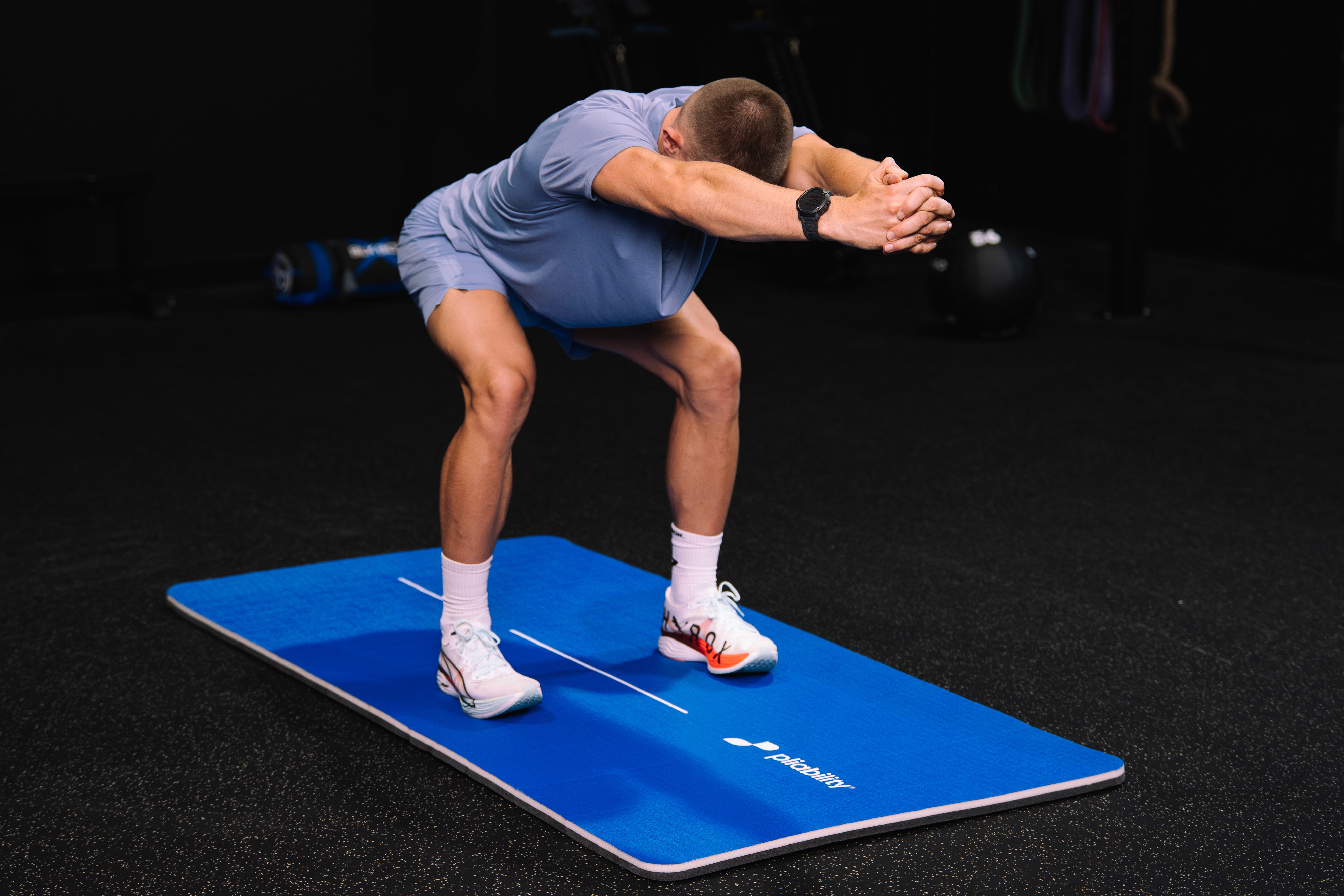
You can squat 500 pounds and still be slow off the line. Strength alone doesn't translate to explosiveness because the two qualities operate on different timelines. Maximal strength measures how much force you can produce, while explosive power depends on how quickly you generate force in the first 200 milliseconds of movement.
Key Point: Strength and explosiveness are distinct athletic qualities requiring separate training approaches.
A study published in the Journal of Strength and Conditioning Research (2018) found that athletes with identical one-rep max squats showed meaningfully different vertical jump heights and sprint acceleration times. The difference was the rate of force development.
Takeaway: Your gym strength numbers don't predict explosive performance on the field or court.
why doesn't gym strength translate to sports performance?
Most athletes assume that adding weight to the bar automatically improves speed and power. But sports don't allow three seconds to reach peak force. A sprinter's foot touches the ground for roughly 90 milliseconds. A basketball player's jump happens in less than 300 milliseconds.
If your nervous system can't recruit muscle fibers fast enough to generate force within these windows, all that gym strength stays locked in the weight room.
why doesn't strength training always improve speed?
Research from the National Strength and Conditioning Association (2019) tracked two groups of college football players over 12 weeks. Group A focused on traditional strength training with heavy loads and slow tempos. Group B combined moderate-strength work with explosive exercises targeting rapid force production. Both groups increased their squat max by 15%, but only Group B improved their 10-yard sprint times (8% gain) and vertical jumps (12% gain). Group A got stronger without getting faster.
How do muscle fiber patterns affect explosive movement?
The problem lies in muscle fiber recruitment patterns and neural drive. Heavy lifting teaches your body to push through resistance slowly, building tension until you finish the rep. Explosive movement requires maximum neural activation within milliseconds, recruiting as many muscle fibers as possible before your foot leaves the ground or your hand releases the ball. These skills require different training stimuli.
What role does mobility play in force production?
Stiff joints and poor tissue quality create another problem. An athlete might have enough strength and nerve control, but if their ankles, hips, or upper back lack mobility, power gets lost through inefficient movement. Poor ankle dorsiflexion forces the knee forward during a jump, which slows force development. Tight hips prevent full extension at takeoff, limiting power output.
Addressing this foundation with targeted mobility work that improves joint range and tissue quality lets your body access the positions required for explosive force production without compensatory patterns.
what questions should athletes ask before programming their training?
The athletes who break through aren't doing secret exercises. They're asking better questions before they program their training. What quality am I developing today? Am I training for force size or force speed? Does this exercise match the joint angles and contraction speeds I'll use in competition?
A back squat builds general lower-body strength, but it won't teach your hamstrings to fire at the exact moment your foot hits the ground during a sprint. Specificity isn't about copying sport movements with added resistance: it's about matching the neural and mechanical demands of performance.
How should athletes rotate between different training qualities?
Most training programs treat every session identically, changing exercises while maintaining the same tempo, intent, and force-time relationship. Real progress requires deliberate rotation between different qualities: maximal strength one day, explosive power another, reactive strength on a third.
Each quality builds on the others, but only if you train them as distinct skills. The body adapts to what you specifically ask it to do, not to what you hope it will pick up on its own.
Understanding these principles won't help if you don't know what rate of force development measures or why it matters more than the numbers on your barbell.
what is rate of force development and why is it important for sports?

Rate of force development measures how quickly your muscles produce force from a static position: your ability to reach maximum effort in minimal time. This quality is crucial during the starting phases of athletic movements, such as exploding off the starting line in a sprint, jumping for a rebound, or making that crucial first step when changing direction.
Key Point: RFD is the difference between athletes who react instantly and those who are always one step behind their competition.
Real-World Example: Think of a basketball player defending against a fast break: the difference between successfully stealing the ball and being beaten to the basket often comes down to milliseconds of force production speed.
Sport | Key RFD Application | Performance Impact |
|---|---|---|
Sprinting | Starting block explosion | Faster off the line |
Basketball | Vertical jump timing | Higher jump reach |
Soccer | Direction change speed | Faster cuts |
Tennis | First step reaction | Quicker court coverage |
the car analogy that changes everything
Think about the difference between a Bugatti and a Tesla. The Bugatti reaches high top speeds but accelerates slowly due to its massive engine and weight. Modern electric vehicles produce instant power, delivering exceptional acceleration from a stop. RFD represents the electric car's instantaneous acceleration, while maximum strength reflects the Bugatti's top-end power. The most successful athletes possess both qualities, but RFD often proves more valuable for athletic performance. This explains why some athletes who lack maximum strength in the weight room can still excel at their sport through superior force production speed.
fast vs. slow: the stretch-shortening cycle
RFD is most evident during the stretch-shortening cycle, which is classified as either slow (≥ 250 milliseconds) or fast (≤ 250 milliseconds) movements. A countermovement jump counts as slow-SSC (~500 milliseconds), whereas sprinting is fast-SSC with ground contact times of 80–90 milliseconds. Slow-SSC movements create higher peak forces but lower RFD due to longer timeframes. Fast-SSC exercises produce lower peak forces because it takes roughly 100 milliseconds or more to reach maximum force, but they generate large RFD through movement speed.
why do elite athletes prioritize RFD over other metrics?
Research links RFD to jumping, weightlifting, cycling, sprinting, and golf. Elite sprinters have greater RFD than well-trained sprinters, distinguishing exceptional athletes from good ones. Athletic movements rarely allow long wind-ups; athletes must react immediately to changing situations and opponents. In competitive settings, the athlete who generates force fastest in that opening window often gains the edge in explosive sports.
What foundation do athletes need before training RFD?
Most athletes train RFD through plyometrics and Olympic lifts without building the foundation required to handle those demands safely. Your connective tissue, joint stability, and range of motion determine whether your body can produce the explosive power you're developing.
Pushing RFD without adequate mobility work creates imbalances that limit performance and increase the risk of injury. Targeted mobility routines that prepare tissues for explosive movements help joints handle rapid force production while maintaining proper mechanics.
Knowing what RFD is doesn't tell you how to measure it. Without measurement, you're guessing whether your training works.
15 best rate of force development exercises for explosive athletes

Explosive power exercises fall into five categories: ballistic movements, speed strength work with submaximal loads, compensatory acceleration techniques, maximal strength training, and contrast methods combining heavy and light loads. Each targets different phases of the force-time curve, helping you select what matters for your sport.
Key Point: Understanding these five exercise categories allows you to strategically target specific phases of force development rather than training explosiveness randomly.
Tip: Most athletes benefit from combining 2-3 categories in their training rather than focusing on just one approach for maximum explosive gains.
Exercise Category | Primary Focus | Load Range |
|---|---|---|
Ballistic Movements | Maximum velocity | 0-30% 1RM |
Speed Strength | Force at high speeds | 30-60% 1RM |
Compensatory Acceleration | Intent to accelerate | 60-80% 1RM |
Maximal Strength | Force production capacity | 80-100% 1RM |
Contrast Methods | Neural potentiation | Variable loads |
1. box jumps
You jump onto an elevated platform from a standing or countermovement position, focusing on landing softly with control. Box jumps develop vertical power and teach coordination of triple extension (ankle, knee, hip) under load.
How do box jumps improve athletic performance?
Box jumps force you to create maximum force quickly to overcome gravity and reach the box height. According to research published in the Journal of Strength and Conditioning Research (2018), box jumps produced significant improvements in vertical jump height among collegiate athletes after six weeks of training.
Sprinters, basketball players, and volleyball athletes benefit most because these sports demand repeated vertical explosiveness with quick recovery between efforts.
What are the limitations of box jumps?
The limitation: box jumps don't train the landing phase as well as depth jumps, and athletes often compensate by pulling their knees up rather than driving forcefully through the ground. You can jump high without producing much force if your technique prioritizes knee tuck over hip drive.
2. broad jumps
You explode forward horizontally from a standing position, measuring distance rather than height. Broad jumps develop horizontal power production and front chain strength, particularly in the quads and hip flexors.
How do broad jumps improve athletic performance?
This exercise trains your body to convert vertical force into horizontal movement, mimicking sprinting more than vertical jumps. Track athletes, soccer players, and football players use broad jumps because horizontal force matters more for sprint speed than vertical power.
A 2019 study in Sports Biomechanics found that broad jump distance correlated more closely with 10-meter sprint times than vertical jump height.
What mobility requirements do broad jumps have?
Broad jumps require good ankle mobility and hamstring flexibility to land safely without excessive stress on your lower back. Athletes lacking sufficient flexibility often end up in unsafe positions that increase the risk of injury.
Targeted mobility work for your hip flexors and hamstrings prepares your muscles for the demands of landing.
3. depth jumps
You step off a raised box (usually 12-42 inches tall), absorb the landing, and immediately jump upward or forward. Depth jumps build reactive strength and train the fast stretch-shortening cycle, with ground contact times often below 250ms.
This exercise stresses the eccentric phase beyond normal jumping, forcing your nervous system to recruit muscle fibers faster and more completely. The amortization phase (the switch from landing to takeoff) becomes the training focus.
Why do elite athletes use depth jumps for performance?
Olympic lifters, sprinters, and jumpers use depth jumps to develop maximum force in minimal time. Research from the National Strength and Conditioning Association (2017) showed depth jumps improved early-phase rate of force development among trained athletes.
What are the volume and recovery requirements for depth jumps?
The critical limitation is the management of volume and intensity. Depth jumps create significant muscle damage and central nervous system fatigue, limiting most athletes to 20-40 contacts per session and requiring 48-72 hours of recovery between sessions.
4. medicine ball chest throws
You throw a medicine ball forward from your chest with power while standing, sitting, or lying on your back. This movement builds upper-body pushing power and trains your chest, shoulders, and triceps to produce force quickly.
How do medicine ball throws differ from traditional pressing?
Medicine ball throws skip the deceleration phase inherent in regular pressing movements. During a bench press, your nervous system slows the bar at the end to protect your joints. With throws, you accelerate through release. Fighters, baseball pitchers, and football linemen benefit most because these athletes need to generate pushing force without controlling a barbell through lockout.
What are the limitations of medicine ball chest throws?
The main limitations are that progress is difficult to measure and that weight is capped. Unlike barbell exercises, tracking strength gains requires either tools that measure speed or consistent distance markers, and most facilities cap medicine ball weight at 20–30 pounds, limiting absolute strength development.
5. shot put throws
You forcefully throw a weighted ball (usually 4-16 pounds) using spinning or straight-line techniques. Shot put builds total-body power and coordination, particularly through the hips and core, while training force transfer from your lower body to your upper body.
How do shot put movement patterns transfer to other sports?
The movement pattern copies athletic actions that require force transfer from the ground through connected muscle groups. Rotational athletes like discus throwers, baseball players, and tennis players use shot put variations to train muscle activation sequence and timing. Glides focus on linear force production while spins develop rotational power.
Why is proper technique crucial for shot put safety?
Shot put requires good coaching to be performed safely and effectively. Poor technique overloads the shoulders and lower back, reducing power and increasing the risk of injury.
6. power clean
You pull a barbell from the floor to your shoulders in one smooth motion, catching it in a partial front squat. Power cleans build explosive, total-body strength, especially in the posterior chain (hamstrings, glutes, back), and teach timing for triple extension.
How do power cleans generate explosive strength?
The movement works by coordinating multiple joints to accelerate a heavy load through space, then rapidly slowing down and stabilizing it in the catch position. Research in the Journal of Applied Biomechanics has found that power cleans produce meaningfully higher peak power outputs than traditional strength exercises at comparable relative loads. Football players, rugby athletes, and track and field competitors rely on power cleans because the movement pattern closely mimics the mechanics of jumping and sprinting.
What are the main limitations of power cleans?
Technical complexity is the main limitation. Power cleans require months of coaching to perform correctly, and poor technique (pulling with arms rather than hips, catching with toes rather than full foot) reduces the training effect while increasing the risk of injury. Wrist and shoulder mobility often limit catch position quality.
7. power snatch
You explosively pull a barbell from the floor to overhead in one motion, catching it in a partial overhead squat. Power snatches demand greater bar speed than cleans and train overhead stability under dynamic conditions.
Why are power snatches effective for explosive development?
The wider grip and overhead-catch position require greater mobility and coordination than power cleans, making snatches particularly effective for developing RFD in the early phases (0–100ms). Weightlifters, CrossFit athletes, and gymnasts use power snatches to build explosive pulling strength combined with overhead control. The bar travels a longer distance than in cleans, demanding faster force generation.
What limitations should you consider with power snatches?
Many athletes struggle with shoulder mobility, preventing them from achieving proper overhead positioning without compromising form. Learning proper technique takes longer than learning cleans, and poor technique significantly increases the risk of injury, particularly to the shoulders and lower back.
8. push press
You use a slight knee dip and hip drive to accelerate a barbell from overhead at your shoulders, finishing with locked elbows. Push presses develop lower-body contribution to upper-body pressing and train force transfer through the core.
How does the push press bridge the gap between different pressing movements?
The movement bridges the gap between strict pressing (pure upper-body) and jerks (maximal lower-body contribution). The dip-drive phase teaches athletes to generate leg drive that transfers through a rigid torso into the bar. Strongman competitors, Olympic lifters, and overhead athletes use push presses to build pressing power beyond what strict presses allow. You can typically push press more weight than you can strict press.
What are common push press mistakes to avoid?
Athletes often turn push presses into poorly executed jerks by adding a second dip under the bar, which changes the training stimulus. The exercise requires significant shoulder and thoracic mobility to achieve safe overhead positions under load.
9. hurdle hops
You jump over a series of hurdles in quick succession, spending minimal time on the ground between obstacles. Hurdle hops build reactive strength and train the fast stretch-shortening cycle through repeated rapid force production.
How do hurdle hops build power endurance?
This builds both power endurance and the ability to utilize elastic energy. Hurdlers and middle-distance runners use these extensively because the movement maintains power output despite accumulating fatigue. Research from the European Journal of Applied Physiology (2019) found that hurdle hops improved repeated sprint ability more effectively than single-effort jumps.
What happens when fatigue sets in during hurdle hops?
Ground contact time often increases throughout the set as fatigue builds, shifting the training stimulus from reactive strength to traditional jumping. Athletes need a solid baseline of strength and technique before progressing to hurdle hops; otherwise, they tend to practice sloppy patterns when tired.
10. bounding
You perform exaggerated running strides, covering more horizontal distance with each step while maintaining a steady rhythm. Bounding develops horizontal force production and teaches the force application angles specific to sprinting.
How does bounding transfer to sprint performance?
The movement pattern translates directly into sprint mechanics by training the same muscle actions and joint angles used during maximum-velocity running. Sprinters, long jumpers, and triple jumpers incorporate bounding into their regular training because it develops the specific strength needed to apply horizontal force to the ground while building single-leg stability and coordination under dynamic conditions.
What are the risks and requirements of bounding?
Bounding puts significant stress on each landing, particularly on the hip flexors, quads, and calves. Athletes with insufficient muscle and tendon strength often develop tendon problems or muscle strains when progressing too quickly. The movement requires substantial open space (at least 30–50 meters) that many training facilities lack.
11. dynamic effort squats
You squat with 50-60% of your one-rep max for 2-3 repetitions, focusing on moving the bar as fast as possible. Dynamic effort squats build strength at the start of the squat and train your nervous system to recruit muscles quickly, even when lifting submaximal loads.
How does dynamic effort training work in practice?
This method removes the slow, grinding part of heavy lifting and replaces it with explosive power. Powerlifters popularised this approach through the Westside Barbell system, using accommodating resistance (bands and chains) to maintain tension through the entire range of motion. Research on this method has found it improves early-phase rate of force development more effectively than traditional heavy squatting.
What are the main limitations of this approach?
The problem is that many athletes lack the body awareness needed to move lighter weights as quickly as possible. The weight feels light, so they slow down without realizing it, converting speed work into medium-intensity strength training. Velocity-measuring tools can help, but most training spaces lack this technology.
12. speed bench press
You press 45–55% of your one-rep max for three repetitions with maximum acceleration, often using a slight pause on the chest to eliminate the stretch reflex. Speed bench develops upper-body pressing power and trains compensatory acceleration patterns.
How does speed bench press develop explosive strength?
The pause eliminates elastic energy assistance, forcing your nervous system to generate all force concentrically. This makes the speed bench particularly effective for building pure starting strength in the chest and triceps. Powerlifters and football linemen use this method to develop explosive pressing strength that transfers to competition lifts and blocking power. The submaximal load permits a higher training frequency without the joint stress of maximum-effort work.
What are common form mistakes with the speed bench press?
Form breakdown is common because the lightweight allows athletes to compensate through shoulder elevation, excessive back arch, or inconsistent bar paths. These compensations reduce training effect and create movement patterns that fail under heavier loads.
13. speed deadlifts
You pull 50–70% of your one-rep max from the floor for 1–3 repetitions, focusing on maximum bar acceleration from ground through lockout. Speed deadlifts develop starting strength off the floor and train hip extension velocity.
How do speed deadlifts benefit athletic performance?
This exercise teaches you how to pull hard and fast at the start, building explosive strength in the back of your body, strength needed for sprinting and jumping. Strongman competitors and powerlifters use speed deadlifts to fix slow starts when lifting off the floor, while track athletes develop the hip extension power that drives sprint performance. The key is maintaining maximum effort even when the weight feels light.
What are common speed deadlift mistakes to avoid?
Athletes often confuse speed with careless form, pulling the bar off the floor with rounded backs instead of maintaining proper position while accelerating. The exercise also requires resetting between repetitions rather than bouncing reps.
14. compensatory acceleration training
You intentionally accelerate the bar as quickly as possible throughout the entire range of motion, even when using heavy loads (75-90% 1RM). CAT develops neural drive and motor unit recruitment patterns across all phases of the lift by preventing the natural deceleration that occurs during heavy lifting.
Most athletes slow the bar as it approaches lockout to protect joints and maintain control; CAT training fights this instinct, teaching maximum effort through to completion. Powerlifters and Olympic lifters use this technique constantly because competition requires maximum bar speed under maximum loads. The training effect improves RFD across the entire force-time curve, not just in early phases.
How difficult is compensatory acceleration training to master?
True compensatory acceleration requires extraordinary mental focus and technical skill. Most athletes believe they're accelerating at maximum when they're simply completing the lift normally.
Coaching cues and velocity feedback help, but the skill takes years to develop fully.
15. maximal strength training
You lift 85–95% of your one-rep max for 1–5 repetitions, which builds absolute strength capacity. This foundation determines your potential RFD, especially in later phases (100–300ms).
How does maximal strength training improve athletic performance?
Heavy strength training increases muscle size, improves neuromuscular coordination, and enhances nervous system activation of muscle fibers. A stronger athlete can produce more total force, enabling greater potential for fast force production.
Increases in maximum strength are closely associated with improvements in fast force production among trained athletes. Powerlifters, strongman competitors, and throwers prioritize maximum strength because their sports reward high force production.
What are the limitations of maximal strength training?
The limitation is specificity: maximum strength training alone doesn't teach rapid force production. An athlete can become incredibly strong while remaining slow if they don't practice quick movements. The training also requires longer recovery periods (3–5 days between sessions) due to high demands on the nervous system.
contrast training: heavy back squat to box jumps
You perform 3–5 reps of heavy back squats (85–90% 1RM), rest 2–4 minutes, then perform 3–5 explosive box jumps. This pairing induces post-activation potentiation (PAP), in which the heavy lift primes your nervous system for greater power output during the subsequent explosive movement.
How does post-activation potentiation work scientifically?
PAP works by increasing motor unit recruitment and myosin light chain phosphorylation, thereby temporarily enhancing muscle contractility. The rest interval is critical: too short, fatigue dominates; too long, the potentiation effect dissipates.
Research from the Journal of Strength and Conditioning Research (2018) found optimal rest intervals of 3–4 minutes for lower-body contrast pairs. Sprinters, jumpers, and team-sport athletes use this method to develop explosive strength that translates directly into competitive movements.
How do individual factors affect timing optimization?
How each person responds to PAP depends on training duration, muscle fiber type, and fatigue level. Some athletes perform best after resting for 2-3 minutes, while others need 5-7 minutes. Finding your optimal timing requires experimenting with different rest periods, and your best timing may change as your body adapts to training.
how does contrast training combine heavy bench press with medicine ball throws?
You press 3–5 reps at 85–90% 1RM, rest 2–4 minutes, then explosively throw a medicine ball for 5 repetitions. This pairing develops explosive upper-body strength and teaches force transfer from heavy, controlled movements to ballistic movements.
The heavy press activates high-threshold motor units that remain partially activated during throws, allowing greater force production than throws alone would generate. Combat athletes, baseball players, and football players use this combination to build pushing power that transfers to sport-specific actions.
What are the limitations of upper-body contrast training?
Upper-body PAP effects are generally smaller and shorter-lived than lower-body effects, requiring careful management of rest intervals. Many athletes also lack the shoulder and thoracic mobility needed to safely transition from heavy pressing to explosive throwing without compensation patterns that reduce training effect.
how does contrast training combine heavy deadlifts with broad jumps?
You deadlift 3 reps at 85–92% of your one-rep max, rest for 3–4 minutes, then perform 3–5 maximum-effort broad jumps. This builds power in your back and legs while teaching you to apply force horizontally.
Why does this pairing benefit sprint performance?
The heavy deadlift activates your entire posterior chain (hamstrings, glutes, back), preparing these muscles to produce more force during jumps. This pairing targets horizontal force production, which correlates more strongly with sprint performance than vertical jumping. Sprinters and team sport athletes use this method to build the specific strength that drives forward propulsion.
What are the recovery considerations for this combination?
Performing broad jumps after heavy deadlifts results in significantly more muscle damage and soreness than either exercise alone. Athletes need substantial training experience and strong tissues before attempting this combination. Regular mobility work becomes essential when combining high-force movements that involve both stretching and contracting in the same workout.
how to program rate of force development exercises for faster results

Training for explosive power requires careful planning that respects how your nervous system works. RFD depends on maximum effort and speed, so fatigue undermines effectiveness: explosive work must occur early in sessions when your nervous system is fresh and capable of generating maximum force. This demands specific frequencies, volumes, and rest periods that maintain movement quality while driving adaptation.
Key Point: Your nervous system is the limiting factor in explosive training: when it's fatigued, your RFD gains disappear completely.
Warning: Training RFD exercises when fatigued will actually decrease your explosive power and increase injury risk. Always prioritize quality over quantity.
Training Variable | RFD Recommendation | Why It Matters |
|---|---|---|
Session Timing | First 15-20 minutes | Nervous system freshness |
Rest Between Sets | 3-5 minutes | Complete ATP recovery |
Weekly Frequency | 2-3 sessions | Allows neural adaptation |
Volume Per Session | 3-5 sets maximum | Prevents quality decline |
how often should you train explosive movements each week?
Train RFD exercises three to four times per week with moderate volume per session. The motor learning component of explosive movements benefits from frequent practice, though high-volume sessions can exhaust the nervous system without yielding greater adaptations. Brief, frequent exposure yields superior results compared to infrequent, exhausting sessions.
When should you place explosive exercises in your workout?
Put explosive exercises at the beginning of your training session, right after your warm-up. Your nervous system performs best when fresh, allowing you to focus completely on each repetition. If you perform ballistic movements or Olympic lifts after heavy squats or deadlifts, you train for tired-muscle recruitment patterns rather than explosive force production.
how many reps and sets should you perform for power training?
Keep repetitions low: one to three per set for Olympic lifting, three to five for ballistic exercises like box jumps or medicine ball throws. Higher volume should come from additional sets rather than grinding through reps that degrade speed and technique. Each repetition demands maximum effort, which becomes impossible as fatigue accumulates within a single set.
What loading parameters optimize explosive power development?
Use ballistic exercises with 30-60% of your maximum strength. This range helps you produce force and move quickly. Explosive movements require force generation within about 200 milliseconds, so selecting the right load preserves the speed needed for RFD development. Heavier loads slow movement speed enough that training focus shifts toward maximum strength instead of explosive power.
why do explosive movements need longer rest periods?
Rest intervals between sets must be long enough: at least two to three minutes for ballistic exercises and three to five minutes for Olympic lifting movements. The phosphagen energy system powering explosive efforts requires adequate recovery time to restore capacity for maximum output. Shortening rest periods compromises RFD training by forcing explosive movements when fatigued.
How does patience improve the quality of explosive training?
Most athletes struggle with patience during rest breaks. Quality matters more than quantity in explosive training: five perfect box jumps done with maximum effort produce better results than fifteen jumps that progressively slow with inadequate rest. Your nervous system needs recovery time to generate the signals that drive explosive movement.
What role does tissue preparation play in explosive training?
Many athletes train explosive power without preparing their tissues for high-force movements. Plyometric landings and ballistic exercises stress joints and require an exceptional range of motion at end ranges. Targeted mobility routines that prepare tissues for explosive demands and support recovery between sessions help athletes maintain the movement quality essential for RFD development while avoiding joint stress that can lead to breakdown.
what rest interval mistakes kill explosive power gains?
The biggest mistake is treating rest intervals as wasted time. Athletes often cut rest to 60-90 seconds because it feels more productive, but explosive movements require full recovery of the ATP-PC system. Shortchanging rest between sets means each following effort produces less force, less speed, and weaker neural signals. You end up training fatigue resistance instead of explosive power.
Why does adding more volume backfire during plateaus?
Another trap is adding volume when progress stalls. More sets of lower quality won't improve RFD. If the technique breaks down or the bar speed drops on set three, you need better recovery between efforts or fewer total sets. Quality always trumps quantity in explosive training.
How does poor mobility sabotage explosive training?
Most training programs skip the foundation that makes explosive work effective. Without sufficient joint mobility and tissue quality, your body compensates during ballistic movements, shifting force production to less efficient patterns. Structured mobility work that maintains range of motion and movement quality supports safe, effective explosive training.
Consistent mobility work (at least 3x per week) reduces injury risk and allows you to generate more force through optimal positions.
build the mobility foundation for faster rate of force development | get 7 days free on any platform
The exercises in this guide work only when your body can perform them as designed. Restricted ankles during box jumps, tight hips limiting broad jump distance, or limited thoracic rotation reducing power transfer through Olympic lifts all prevent you from expressing force as quickly and efficiently as your nervous system can generate it.
pliability is a mobility app built for performance-oriented individuals and athletes working on exactly this kind of restriction. Pick a Path built around explosive power or your sport, use Build Your Program to shape Daily Sessions around your training week, and take the in-app mobility test to pinpoint the ankle, hip, and thoracic restrictions capping your force output. If you are working around pain or an injury, the Rebuild hub is built for that.
Sign up today for 7 days free on iPhone, iPad, Android, or the web, and start closing the gap between the strength and power you've built and the mobility needed to express it.
Related Reading





Move better in 10 minutes a day.
10,000+ five-star reviews.