


LEARN
pliability

You check your blind spot and your whole torso turns with your head. A stiff neck is one of the most common complaints of desk life, and the fix is usually not dramatic: consistent, gentle neck mobility exercises done in a pain-free range, most of them possible right at your chair. This guide covers 16 of them, grouped by purpose, plus the habits that keep the stiffness from coming back. One note first: this article is education, not a diagnosis, and a few symptoms deserve a clinician before any exercise plan; we name those below. pliability builds this same work into short guided routines that also train the body awareness to notice tension before it locks in.
what neck mobility is, and why you lose it
Your neck is a stack of seven vertebrae, joints at every level, and layers of muscle on the front, sides, and back that support your head and steer it through rotation, tilt, and nod. Neck mobility exercises are movements that maintain or restore the flexibility and range of motion of the neck, stretching those muscles and increasing blood flow to the area.
The reason most of us need them is posture. Hours of sitting with the head drifting forward loads the cervical spine, tightens the scalenes along the side of the neck and the suboccipitals at the base of the skull, and lets the postural muscles that should hold your head up go quiet and weak. The result is the familiar loop of neck stiffness: less movement, more tension, even less movement. Mobility work interrupts that loop from both ends, stretching the tight tissue and strengthening the support system.
when a stiff neck needs a clinician first
Gentle movement helps most stiff necks, and generally beats total rest, even after an injury like whiplash. But exercise is the wrong first move in a few situations. See a clinician before starting this work if:
Pain radiates out of your neck into an arm, or you have tingling or numbness in your arms or hands
The stiffness follows trauma, such as a car accident or a fall
Neck pain comes with fever, chills, night sweats, or unexplained weight loss
The pain is severe, getting worse, or has not started easing after about a week of self-care
Those cases are not a self-management project. For the ordinary stiff, creaky neck the rest of us carry, the exercises below are a sensible starting point. Work only in the range that stays pain free, and stop if anything feels sharp.
16 gentle neck mobility exercises, grouped by purpose
The list runs easiest to most demanding: gentle range-of-motion work first, then posture and strengthening, then the shoulder and upper back moves that support everything above them. Fourteen of the sixteen need no equipment; two use a light resistance band. You do not need all 16 in one session. Pick two or three from each group and rotate.
start gentle: range of motion and release
If your neck is cranky or you are new to this work, these are the gentle neck mobility exercises to do first. For some people, they are the whole program.
1. neck range-of-motion exercise
The foundation move: take your neck through every direction it owns.
Sit up straight, shoulders back, neck neutral.
Slowly turn your head to the right as far as it comfortably goes, then to the left.
Slowly look up toward the ceiling, then down toward the ground.
Pause at the end of each motion and stay in your pain-free range.
Do 5 reps in each direction.
2. neck rotations
A slower, held version of turning your head, for necks that resist rotation.
Sit or stand with your back straight and shoulders relaxed.
Slowly turn your head to the left, looking over your left shoulder.
Hold 10 to 15 seconds, return to center, then repeat to the right.
Do 2 to 3 reps per side.
3. look to the right, then the left
The quick-hit variation of the rotation above, with the shoulder blades set to keep the movement in the neck.
Pull your shoulder blades gently back and together.
Rotate your head from side to side, stopping the moment anything feels uncomfortable.
Keep the pace slow and the range honest.
4. chin up
A simple stretch for the muscles on the front of the neck.
Keep your shoulders back and as still as possible.
Raise your chin toward the sky without tilting your head back.
Hold up to 5 seconds, or until you feel the front of your neck stretch.
Return to neutral. Do 10 reps.
5. upper trapezius stretch
The upper traps run from the base of your neck across the shoulders, and when they are tight they drive stiffness and headaches.
Sit up straight and anchor your left hand under your left thigh to keep that shoulder down.
Place your right hand on the left side of your head and gently pull your head to the right.
Feel the stretch along the left side of your neck and upper shoulder. Stop if you feel pain.
Hold 30 seconds. Do 3 to 5 reps per side.
6. levator scapulae stretch
The levator scapulae runs down the side of the neck into the shoulder blade, and it is a classic culprit in the stiff neck you wake up with.
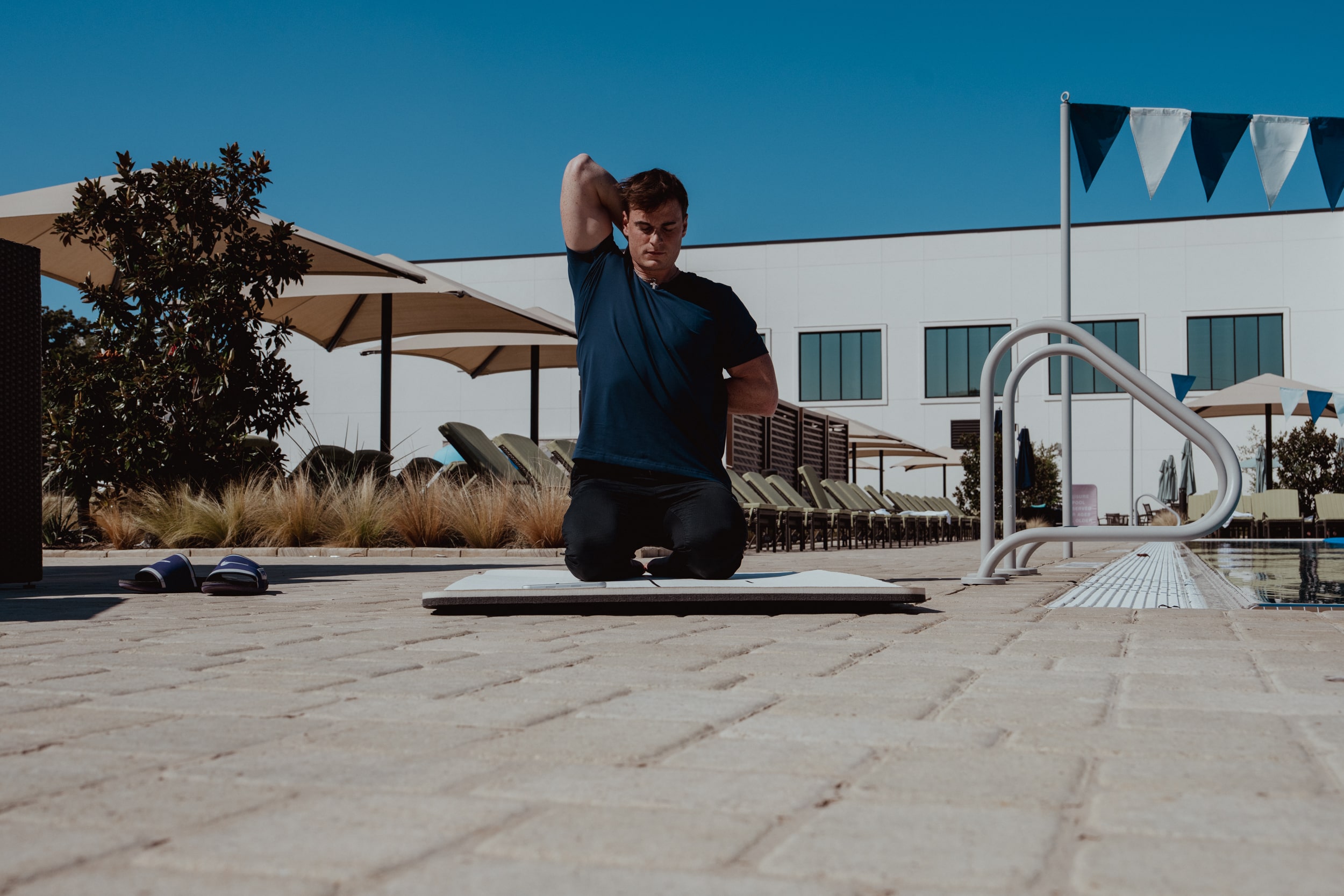
Stand tall. Place your right hand behind your head, elbow pointing up.
Gently guide your head down at an angle, chin toward your right armpit.
Hold 30 seconds, then switch sides. Do 3 to 5 reps per side.
build control: posture and strengthening exercises
Range you cannot control comes back as stiffness. This group strengthens the deep neck flexors and postural muscles, which is how you increase neck mobility that lasts.
7. chin tuck
The single best habit for forward-head posture. If you sit at a computer all day, this one belongs in your daily routine.
Stand or sit tall, shoulders back, neck neutral.
Place two fingertips on your chin and gently press, guiding your head straight back into a tucked position.
Hold 2 seconds, then release.
Do 1 to 2 sets of 10 to 15 reps.
8. the cellphone drill
A repeating glide version of the chin tuck, named for the forward-jutting chin position it corrects.
Draw your chin straight back until you feel a double chin form. That is the corrected position.
Let your neck glide slightly forward again, then draw it back.
Repeat the glide to build comfortable forward-and-back motion.
9. slide from side to side
Lateral glides are the trickiest direction for most necks, which is exactly why they are worth practicing.
Keep your eyes level and slide your neck from side to side, keeping your head as level as you can.
A few quiet crunches are common at first; sharp pain is your signal to stop.
Expect this one to take practice before it feels smooth.
10. isometric neck exercise
Isometrics wake up all the neck muscles without moving the joint, which makes them one of the gentlest ways to build strength.
Stand tall, shoulders back, neck neutral.
Press your head into your right palm without letting either move. Hold 10 seconds, then repeat on the left.
Press your forehead into both palms, no movement, for 10 seconds.
Press the back of your head into your palms, no movement, for 10 seconds.
Do 5 to 10 reps in each direction.
11. head lifts
Head lifts build strength through the front of the neck while the back of the neck lengthens.
Lie on your back and lift your head slightly off the ground.
Lower your chin toward your chest and look toward your knees, feeling the back of your neck lengthen.
Keep your mouth closed and lift slowly, just off the mat.
Hold 10 to 30 seconds. Aim for 3 rounds to start.
12. neck lifts using resistance
Adding a band strengthens and tones the neck and upper back further. Skip this one until the bodyweight moves feel easy.
Place a resistance band behind your head and hold both ends out in front of you.
Push your head gently back against the band to create tension, without retracting your head or neck.
Focus on lifting and lengthening the neck against the resistance.
13. tabletop
The most demanding move on the list, working the neck, shoulder blades, and upper back together.
Kneel on hands and knees in a tabletop position.
Wrap a resistance band around the back of your head, holding the ends under your palms on the floor.
Slowly draw your head up and back against the band.
Lengthen your neck and pull your shoulder blades back as you move.
support the neck: shoulder and upper back exercises
Tight shoulders and a stiff upper back force the neck to compensate, which is why shoulder and neck mobility exercises belong in the same session. If your stiffness lives in both places, the companion neck-and-shoulder stretches below target both at once.
14. shoulder rolls
The simplest tension release on the list, and doable mid-meeting.
Sit or stand with your back straight and shoulders relaxed.
Roll your shoulders up toward your ears, then back and down in a circle.
Repeat 10 times.
15. wall angels
A physical-therapy staple for neck and upper back tension.
Stand with your back against a wall, feet slightly in front of you, hips, back, and head in contact with the wall throughout.
Place your arms against the wall at shoulder height, elbows bent, hands pointing up.
Keeping everything on the wall, slide your arms up as high as you can while straightening them, then slide back down.
Do 10 reps.
16. open books
A rotation stretch for the upper back that lets the neck follow along gently, like opening the pages of a book.
Lie on your side with your head on a pillow, knees bent just below hip level.
Raise your top arm and rotate it open behind you, letting your head turn gently with it.
Breathe deeply and rotate until you feel a stretch. Hold 1 to 2 seconds.
Do 10 reps, then switch sides.
releasing tension in the neck and shoulders together
When the tightness spans your neck and shoulders at once and the muscles across the tops of your shoulders feel like a permanent knot, these companion stretches work both areas in one move. None need equipment, and they pair well with the shoulder group above. Move slowly, breathe through each hold, and stay in the pain-free range.
thread the needle
Releases tightness across the shoulders, the base of the neck, and the upper back while improving rotation.
Start on all fours, hands under shoulders and knees under hips, spine neutral.
Reach your right arm under your left, palm up, until the right shoulder and the side of your head rest toward the mat.
Feel the stretch through the upper back and rear shoulder, and breathe slowly for 20 to 30 seconds.
Return to all fours and repeat on the left. Do 2 to 3 rounds per side.
cross-body arm stretch
Targets the rear shoulder and upper trapezius, the tight neck and shoulder muscles that pull your posture forward.
Stand with feet hip-width apart, torso facing forward.
Bring your right arm across your chest at shoulder height.
Use your left hand to press the right arm closer at the elbow, keeping the shoulder down away from your ear.
Hold about 10 seconds, then switch sides. Do 5 to 10 reps per arm.
overhead side reach
Lengthens the side of the neck, the upper trapezius, and the ribs, easing the tension that builds from sitting.
Sit or stand with feet hip-width apart.
Rest your right hand by your hip and reach your left arm overhead.
Lean gently to the right until you feel a long stretch up the left side, and let the neck soften.
Hold 10 to 15 seconds per side, 2 to 4 times.
doorway chest stretch
Opens the chest and front of the shoulders, which relieves the forward-shoulder posture that overloads the neck.
Stand in a doorway and place your forearms on the frame at shoulder height.
Step one foot forward until you feel a gentle stretch across the chest and front of the shoulders.
Keep your ribs down and breathe. Hold 20 to 30 seconds, repeat twice.
cat-cow
Mobilizes the whole spine and releases the neck and upper back through a slow, breath-led flow.
Start on all fours with a neutral spine.
Inhale, drop your belly, and lift your chest and gaze slightly for the cow position.
Exhale, round your spine, and tuck your chin to your chest for the cat position.
Flow between the two for about 10 slow cycles.
how to increase neck mobility: make the work stick
The exercises are simple; the results come from how you run them. Consistency beats intensity: five minutes daily moves a stiff neck further than one long weekly session, and short movement breaks every half hour of sitting protect the gains in between. Stay inside the pain-free range every rep, since forcing range makes the neck guard harder, and breathe slowly through the held stretches. Expect change over weeks, not days. When you are ready to progress past this list, our library of cervical mobility exercises picks up where these leave off.
everyday habits that protect your neck
Exercise undoes stiffness; habits stop it from rebuilding. Set your screen near eye level, keep your keyboard and mouse level with your forearms, and avoid craning your chin toward the monitor. Check your sleep setup too: head, neck, and shoulders should stay roughly aligned, which usually means a supportive pillow, not a tall stack. For a flared-up neck, cold in the first day or two calms inflammation, then heat, including a warm shower, brings blood flow back to the tight muscles. A massage can release what the exercises have not reached yet.
keep your neck moving with pliability | get 7 days free on any platform
A list gets you moving today. What keeps a desk-bound neck loose is a short routine you actually return to, and that is what pliability is built for. Daily Sessions give you a calm, guided reset between meetings, sessions like the 5-Min Neck and Shoulder Release cover this exact territory, the Deskbound Reset Path works on the sitting posture that feeds the stiffness in the first place, and Build Your Program lets you plan a week around your neck and shoulders specifically. No equipment, no perfect poses, just a few quiet minutes your neck will notice by Friday. Try pliability free for 7 days on iPhone, iPad, Android, or the web.
Related Reading





Move better in 10 minutes a day.
10,000+ five-star reviews.