


LEARN
pliability

Stiffness can make everyday tasks, like reaching for an item on a shelf or getting up from a chair, feel incredibly challenging and exhausting. Fortunately, when it comes to improving mobility, yoga is a low-impact and accessible exercise that almost anyone can participate in. Does yoga help with mobility? In this guide, we'll explore how yoga can enhance your range of motion, alleviate tension, and help you move more freely in daily life.
does yoga help with mobility?

Yes, yoga can help with mobility. Regular yoga practice can improve range of motion and functional movements, such as squatting or reaching overhead. Strengthening exercises built into yoga poses can help reduce pain and stiffness in the joints and muscles, leading to improved movement, and the breathing techniques used throughout yoga encourage tight muscle groups to relax, improving both flexibility and mobility.
understanding mobility and flexibility
Mobility refers to the ability of your joints to move freely through their full range of motion. This involves not just flexibility but also muscle strength and coordination. Flexibility is the capacity of muscles and tendons to stretch without injury, and improving mobility can help prevent injuries and enhance athletic performance. A few key factors are involved:
Joint health: regular yoga can improve joint lubrication
Muscle strength: stronger muscles support joint stability
Injury prevention: increased flexibility reduces strain on muscles
yoga's role in enhancing range of motion
Yoga incorporates postures and breathing techniques that are essential for enhancing your range of motion. Specific poses promote elongation and flexibility of muscles and connective tissue around the joints. Regular practice can lead to notable improvements in:
Joint lubrication, as movement circulates synovial fluid, supporting joint health
Muscle elasticity, since stretching increases the length of muscles and tendons
Balance and coordination, since many poses require focus that builds overall bodily awareness
increase flexibility and range of motion
Range of motion refers to how far you can move a body part or joint, and it varies slightly from person to person. You should be able to move your joints within a healthy range for optimal mobility. Research indicates that an impaired range of motion may negatively impact balance, increasing the risk of falls in older adults. Yoga enhances mobility by combining stretching and controlled movements that increase flexibility, improve joint range of motion, and promote overall physical agility. Combining yoga with your regular stretching routine tends to build more flexibility than relying on post-workout stretching alone.
improve joint health and reduce stiffness
Do you often wake up with stiff joints that cause discomfort? For many people, joint stiffness is a common consequence of aging. Regular yoga practice can help improve joint health and ease that discomfort: the gentle, controlled poses in yoga help circulate synovial fluid inside your joints, letting them move more easily and helping prevent stiffness and pain. Yoga is also associated with less pain and morning stiffness for people managing osteoarthritis.
enhance balance
You use balance constantly, whether you notice it or not. Standing from a chair, walking, and leaning over to tie your shoes all require it, and your ability to balance tends to decline as you age, increasing your risk of injury. Many yoga poses require balance, forcing you to strengthen this skill, so practicing regularly can enhance your balance regardless of your age.
focus on mindful movement and breath control
At first glance, yoga may seem like just a series of stretches, but how you breathe while practicing is just as important as how you move. Conscious breathing throughout your practice helps improve your mind-body connection, which helps your muscles relax so you can stretch deeper. Breathing exercises can also help improve spinal mobility and correct posture problems.
importance of proper alignment
Alignment refers to positioning your body in poses for optimal safety and effectiveness. Practicing proper alignment helps prevent injuries and enhances the benefits of each posture. There are general alignment guidelines for every pose, but everyone's body is different, and a good yoga instructor will tailor their approach to your body and ability level to help you find the best alignment for you.
incorporating active and passive stretching techniques
Active stretching involves actively moving one muscle to stretch the opposing muscle. Passive stretching relies on external forces, like a partner, a prop, or a wall, to achieve a good stretch. As with most things in fitness, a multifaceted approach beats focusing on just one style, so combining passive and active stretches into your yoga practice can help you build a well-rounded routine for mobility.
what types of yoga can help with mobility issues?
Not all yoga styles suit everyone. Here are a few gentle forms worth trying:
1. Chair Yoga
An excellent option for people who have difficulty standing or are confined to a wheelchair. Chair yoga involves performing simple yoga poses while seated in a chair or using it for support.
2. Restorative Yoga
This style focuses on relaxation and stress relief, using props like blankets, blocks, and bolsters to support the body in gentle poses held for extended periods.
3. Hatha Yoga
A gentle form of yoga involving a series of simple poses held for a few breaths each, and a great way to build flexibility, balance, and strength.
4. Yin Yoga
A slow-paced, meditative style that involves holding poses for several minutes at a time, great for improving flexibility and reducing stress.
is yoga good for stretching?
Yes, yoga is good for stretching. The poses in a yoga practice move your joints through a full range of motion and hold key positions long enough to release the muscles around them, and the breathing and pacing built into the practice make it a safer, more controlled way to stretch than rushing through static holds on their own. Taken as a whole, the asanas stretch nearly every muscle in the body, and many work as isometric stretches: positions held long enough to double as strength-building exercises.
why stretching matters in the first place
Muscles need regular stretching to stay flexible and support a healthy range of motion in the joints. Without it, muscles shorten and become tight, and when you call on them for activity, they can't extend all the way, raising your risk of joint pain, strains, and muscle damage. Sitting in a chair all day, for example, leaves the hamstrings tight, which makes it harder to extend your leg or straighten your knee. Regular stretching keeps muscles long and flexible, so exertion doesn't overload them, and healthy, flexible muscles also help people with balance problems avoid falls.
does yoga lengthen muscles?
Not in the mechanical sense, and that's true of stretching in general. The best-supported explanation for why stretching increases flexibility is a change in sensation, not a physical change in the tissue. When you first move into a stretch, your body treats the sensation as a warning and sets what it perceives as a safe endpoint. Hold the position, and the sensation fades: your nervous system stops treating the stretch as new information, a kind of desensitization, and lets you move further. This effect shows up after a single session and builds over stretching programs lasting several weeks, with comfortable holds producing measurable increases in joint range even when the intensity of the stretch never increases. Yoga's long, breath-paced holds suit that process well: you settle into a pose at a comfortable intensity, breathe, and let your body turn down the alarm.
yoga vs. static stretching: when to use each
Stretching on its own is best for targeting specific muscle groups around a workout: dynamic movements like walking lunges before training to prepare your body, and static holds afterward for recovery. Yoga works mobility and flexibility at the same time, mixing poses that move joints through their range with holds that release tight muscles and build strength. Think of a full session as roughly equivalent to a strength workout: slot it in place of one, or use it on a recovery day. You don't have to choose between the two. A 10-minute flow before bed and a five-minute dynamic warm-up before your next run complement each other, and after a few weeks of both, you may notice your lower back complains less and you sleep better.
25 top yoga poses for mobility

1. downward-facing dog
This classic pose stretches your calves, lengthens your hamstrings, and boosts circulation. Start on all fours on your mat, hands shoulder-width apart and knees in line with your hips. Lift your knees off the floor as you push your hips up to create an inverted V shape. Keep your arms straight and stretch your chest towards your feet, bringing your head to a comfortable position between your arms. Take a few deep breaths, bend your knees, and return to the starting position. If this feels challenging, use blocks under your hands, a rolled-up mat or towel under your heels, or bend your knees slightly for more comfort.
2. cobra pose
This pose strengthens the back, can help reduce back pain, and improves spinal posture, alignment, and circulation. Lie on your stomach, bend your elbows, and place your palms on the mat on either side of your chest. Inhale as you lift your chest off the mat, facing forward. Hold for three seconds, then lower yourself to the starting position. Repeat 3-5 times.
3. cat/cow
This pose promotes mobility in the neck, shoulders, and spine. Start on all fours. Breathe in as you drop your stomach towards the floor and raise your tailbone towards the ceiling, looking up as you hold the position for several seconds. Exhale and round your back up, pointing your tailbone down towards the floor. Transition from one pose to the other 5-6 times.
4. standing forward fold
A relaxing posture that helps stretch tight hamstrings, hips, and calves. Start standing, raise your arms overhead, then bend forward, bringing your hands to the floor or elevated blocks. Let your head hang heavy and keep a slight bend in your knees to avoid locking them.
5. triangle pose
A standing posture that stretches the spine, hip flexors, and shoulders while promoting flexibility and balance. Start standing with your feet wider than shoulder-width apart, right foot pointed forward and left foot at a 45-degree angle. Extend your arms to your sides, then reach your right arm forward and bend at your hip joint, bringing your right hand to the inside of your right foot or a block on the floor. Extend your left arm toward the sky, forming a straight line with your arms and shoulders. Hold, then repeat on the opposite side.
6. child's pose
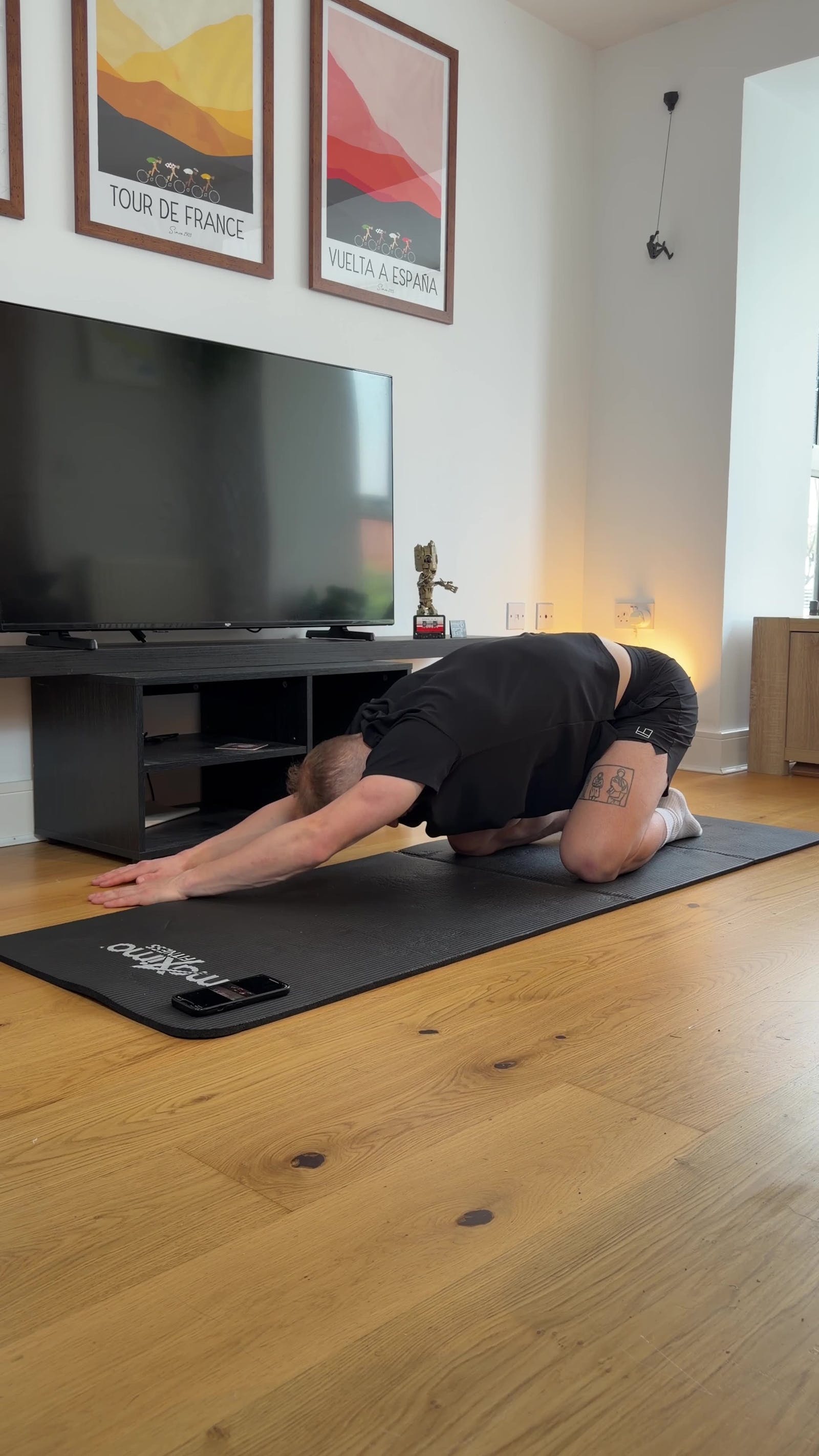
Often used as a resting posture, this pose helps relieve tension in your back, shoulders, and chest. Start on your hands and knees, bring your toes together, and spread your knees as wide as your mat. Sit your hips back and rest your stomach between your thighs, bringing your forehead to the mat, palms facing down and arms stretched out in front of you.
Once you've mastered the basics above, you can begin incorporating more advanced poses that challenge your body in new ways and promote deeper flexibility and mobility. Practice these under the supervision of a trained instructor before trying them at home, to make sure you're performing each movement properly and reducing your risk of injury.
7. wheel pose
A backbend that opens your shoulders, hips, and chest while improving spinal mobility. Backbends like this are typically performed toward the end of a yoga class, once your body and spine are properly warmed up. Lie on your back with your knees bent and feet planted hip-distance apart. Place your hands by your ears, fingers pointing toward your shoulders and elbows pointing up. Press your palms into the mat and lift your shoulders off it, bringing the crown of your head onto the mat. Press into your hands and feet, lifting your hips and head off the mat, and straighten your arms fully, pushing your chest upward.
8. bird of paradise pose
A challenging pose that tests your balance and improves flexibility in your hips, hamstrings, and arms. Stand with your feet slightly wider than hip-distance apart. Shift your weight onto your left foot and come onto the ball of your right foot. Place your right hand on your right calf and tuck your right shoulder under your right knee. Wrap your hands behind your back, binding them together, then slowly stand, balancing on your left leg. Once standing, open your shoulders and straighten your right leg. Hold, then repeat on the opposite side.
9. one-legged king pigeon pose
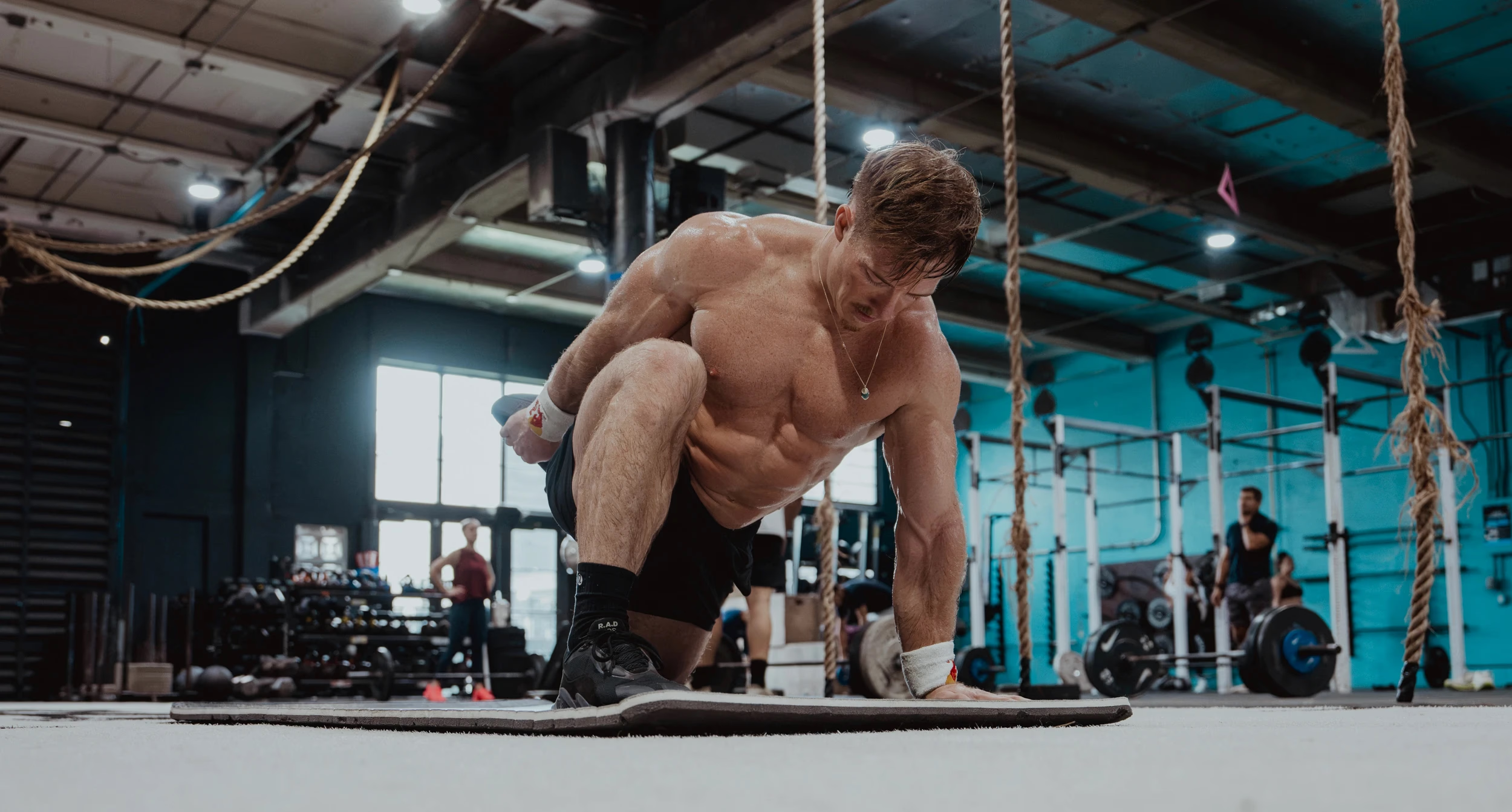
Tight hips can affect anyone, from serious athletes to people who spend their days sitting at work. This pose helps by stretching your hip flexors, groin, and thighs. Start with your left leg straight back behind you and your right shin parallel to the floor, palms flat on the mat and torso upright and straight. Bend the left leg and place your left foot in the crook of your left elbow. Reach your right arm back and grasp your left hand. Open your chest and gaze up. Hold, then repeat on the opposite side.
10. compass pose
A seated posture that stretches your obliques, shoulders, chest, and hips. Start in a comfortable cross-legged position, hug your left leg close to your body, and place your right hand on the floor. Place your left arm on the inside of your left leg, grasping your left heel with it. Cross your right hand over your body and hold the outside of your left foot, so your left hand ends up on the floor behind you. Shimmy your left knee over your shoulder and extend your left leg until it's straight. Keep your chest upright and look toward your right arm. Hold, then repeat on the opposite side.
11. intense side stretch (parsvottanasana)
This forward bend stretches your spine, hips, and legs, and also benefits posture, balance, and digestion. Stand with your left foot in front, facing forward, and your right foot back with toes turned out at a slight angle. Square both hips to face forward and place your hands on your hips. Bend at your hips to fold your torso forward, tucking your chin into your chest, and drop your hands to the floor or a block. Hold for 30 seconds to 1 minute, then switch the position of your feet and repeat on the opposite side.
12. head to knee (janu sirsasana)
Suitable for all levels, this pose helps improve flexibility in your back, hips, and thighs, increases blood flow in the lower abdomen, and can be a great stress reliever. Sit on the ground or a mat, extend your right leg, and press your left foot into the inside of your thigh. Inhale and raise your arms overhead, then exhale and bend at your hips to fold forward toward your outstretched leg. Place your hands on the floor or hold your outstretched leg or foot. Hold for 1 to 2 minutes, then switch legs and repeat on the opposite side.
13. bow pose (dhanurasana)
This intermediate pose stretches many of the muscles used when sitting in a chair, and can help increase flexibility in your core, back, chest, glutes, and legs. Avoid this pose if you have pain or discomfort in your neck, shoulders, or back. Lie on your stomach with your arms alongside your body. Bend your knees and reach back with your hands to grasp the outside of your ankles. Try to lift your shoulders and chest off the ground without pushing beyond what feels comfortable, keeping your head looking forward and taking long, deep breaths. Hold for up to 30 seconds, then release. Repeat 1 to 2 times.
14. thread the needle (parsva balasana)
This pose works on both shoulder and thoracic mobility, which matter for posture and most sports, including golf, running, tennis, and volleyball. It helps increase thoracic rotation and posterior shoulder mobility. Start in a tabletop position on your hands and knees, wrists underneath your shoulders and knees underneath your hips. Reach your right arm out to the side and slide it underneath your left arm, palm facing up, twisting through your torso until your right shoulder comes down to the mat; you can rest your right ear or cheek on the mat as well. Hold, then repeat on the opposite side.
15. garland pose (malasana)
Also known as the "deep squat," this pose targets the hips, groin, knees, ankles, and torso, and can help improve flexion mobility through the hips, knees, and ankles, as well as extension mobility through the torso. Standing on your mat, bring your feet slightly wider than hip-distance apart. Bend through the knees, bringing your buttocks toward the floor into a squat, toes facing slightly outward. If your heels lift off the ground, add a prop or towel underneath them to help you relax. Bring your forearms to the insides of your thighs and, with your hands in a "prayer" position, press your forearms into your thighs for a deeper stretch through the groin.
16. gate pose (parighasana)
Primarily a stretch for your side body, including the intercostal muscles between your ribs, the obliques, and the latissimus muscles, this pose can help improve core stability and mobility throughout the spine. Start in a kneeling position and extend your right leg to the side, keeping your foot flat on the ground. Reach your left arm straight up toward the sky and slowly lean to the right over your extended leg, palm facing the right side. Use your right hand as support for your right leg to maintain balance. Hold, then repeat on the opposite side.
The poses below round out the list with staples from everyday stretching flows. Most are beginner-friendly, so mix them into your practice wherever they fit.
17. high lunge and warrior I
Lunge positions build flexible hips and strong legs, and these two are especially good for opening the front of the hip flexors and the shoulders. Stand over the long side of your mat and rotate your hips and torso toward your right foot. Exhale and bend your right knee so it stacks over your right ankle, keeping your left leg strong as you root down through the outer edge of your left foot. Raise your arms overhead, keeping a slight tuck of the tailbone so you don't over-arch your back. For Warrior I, plant your back foot on the floor nearly parallel to the front of your mat, which creates more external rotation in the hips. Repeat on the other side. If your front leg fatigues, lower your back knee to the floor to lessen the intensity.
18. warrior II
Known for increasing strength and stamina, particularly in the legs and arms. Stand tall with your feet about 3 to 4 feet apart and lift your arms parallel to the floor, palms facing down. Turn your right foot to face the front of the mat and angle your left foot 45 degrees. Bend your right knee until it sits directly over your right ankle, checking that it aligns with the arch of your back foot, and hold your gaze over your right hand. Step back and repeat on the other side. If holding the pose is difficult, slide a chair beneath your front thigh for support.
19. warrior III
The most demanding of the warrior poses for balance and coordination, and great for strengthening the ankles, legs, and upper back. Stand with a pair of blocks in front of your feet. Exhale and reach for the blocks, then extend your right leg behind you so your spine and leg form one line, actively pressing through the heel. As you feel steady, raise your arms until they align with your extended leg. Hold, then repeat on the other side. Make sure the blocks sit at a height that lets your legs and back stay in one line, or press your lifted heel into a wall behind you to check your alignment.
20. mountain pose
It might feel like just standing, but performed intentionally, Mountain Pose improves posture, makes a great reset between poses, and can even firm up your abs and glutes. Stand with your big toes touching and heels slightly apart. Lift and spread your toes, place them back down, and rock gently in every direction until you settle into stillness. Contract your thigh muscles and lift your kneecaps, pinch your shoulder blades together and draw them down, raise your sternum without flaring your lower ribs, and tuck your tailbone slightly as you draw your belly button toward your spine. Keep your arms by your sides, palms facing forward, head in line with your spine, and hold a soft gaze. Practicing against a wall is a great alignment check; just don't rest the back of your head on it, which compromises your neck position.
21. tree pose
This one-legged balance stretches the groin, thighs, torso, and shoulders while sharpening your ability to balance. From standing, shift your weight onto your right foot and place your left foot against your calf, ankle, or inner right thigh, avoiding the knee joint itself. Fix your gaze on an unmoving point and bring your hands to a prayer position at your chest, or raise your arms overhead for an extra balance challenge. Repeat on the other side. If bringing your foot to the inner thigh is a struggle, the calf or ankle is fine, or rest the toes of the lifted foot on the floor for support.
22. bridge pose
A fantastic glute strengthener that also opens the chest and shoulders, and a natural precursor to the Wheel Pose covered earlier. Lie on your back with your knees bent and feet on the ground, heels as close to your glutes as possible. Exhale, squeeze your glutes, and lift your hips off the floor, keeping your knees over your ankles. Clasp your hands beneath you, pinch your shoulder blades together, and press your pinkies into the ground as you hold. If holding your pelvis up is too hard, rest a block beneath your sacrum.
23. seated forward bend
A floor-based forward fold for more flexible hamstrings and a healthy spine. Sit with your legs straight in front of you, hands on the ground by your hips, pressing your heels forward as your thighs settle into the floor. Take a deep inhale, then exhale and lean forward from the hip joints, grabbing your big toes or the outsides of your feet. You can start with your knees bent and slowly straighten them as you relax into the posture; never force your body further than it wants to go. If your hamstrings are tight, loop a strap around your feet instead of reaching for them, and place a folded blanket under your glutes for added support.
24. half lord of the fishes
A seated twist that aligns the spine, stretches the shoulders, hips, and neck, and stimulates the digestive organs. Sit with your legs straight in front of you, then bend your knees and slide your left foot under your right leg to the outside of your right hip. Cross your right foot over your left leg and plant it near the outside of your left hip, right knee pointing toward the ceiling. Exhale and twist your torso toward your right thigh, keeping your right hand behind your sit bones for support and your left arm outside your right leg, just below the knee. Look over your right shoulder, lift your sternum with each breath, and twist a little more every time you exhale. Repeat on the other side.
25. low lunge (anjaneyasana)
Ideal for all levels, this pose lengthens the spine, opens the hips, and builds muscle strength. Kneel on the floor on your left knee, then bend your right knee and place your right foot flat on the ground in front of you. Lengthen through your spine and out the crown of your head, lift your torso and arms, extending them to the side perpendicular to the floor, and gently push into your right hip. Hold for at least 30 seconds, then switch legs and repeat on the opposite side.
practical tips for safe and effective yoga practice

To practice yoga safely and effectively, consider your skill level and use techniques tailored to your needs. Proper alignment and breathing can make a real difference in your mobility training, especially if you lead a sedentary lifestyle.
adapting yoga for different skill levels and abilities
When starting out, choose modifications that suit your skill level. Beginners should focus on foundational poses, gradually increasing complexity as confidence grows; in Downward Dog, for example, it's fine to bend your knees slightly for comfort and stability. Props like blocks or straps can assist with balance and alignment and make certain poses more accessible. Listening to your body is crucial: if a pose causes pain or discomfort, adjust your position or consult your instructor. The goal is to improve mobility without risking injury.
incorporating breathing techniques and proper alignment
Breathing plays a pivotal role in yoga, influencing your focus and flow within each session. Practicing deep, diaphragmatic breathing throughout your postures enhances oxygen flow, providing energy and promoting relaxation.
Maintaining proper alignment is equally vital, since misalignment can lead to strain and injury and undermine your progress. Use mirrors in your practice space to self-check, or ask for feedback from an instructor. Focus on key alignment points, like making sure your knees don't extend beyond your toes in poses like Warrior. Regular adjustments improve your technique and deepen your range of movement over time.
yoga props for better mobility
Modifications and props make yoga accessible to practitioners of all levels, from total beginners to experienced yogis, and incorporating them can help you perform poses more safely and effectively.
Yoga Blocks
Blocks help make poses more accessible by bringing the ground closer to your body for a more comfortable, stable position. If you struggle to reach the ground in a standing pose, a block gives you an elevated surface to reach for instead. Most studios provide blocks in class, and they're easy to find in stores or online for home practice.
Yoga Straps
Straps help deepen stretches and extend your range of motion. If you can't reach your toes in a seated forward fold, loop a strap around your feet and hold each end instead. Like blocks, most studios provide straps to students.
Yoga Bolsters
Bolsters are popular in restorative-style classes, letting you get a deeper stretch without straining your muscles or joints. You'll often see them used in poses that stretch your hips and open your chest, and studios running restorative classes typically provide them.
Chairs
If you struggle to transition from standing to seated postures, working a chair into your practice can help. Chair yoga is a modified practice performed while seated, and while not every studio offers it, plenty of resources exist to guide a home practice.
build mobility with pliability
Yoga is one of the most effective, accessible ways to build mobility, and pliability gives it structure. Our mobility assessment flags where you're actually restricted, so your Daily Sessions and Paths can target those specific areas instead of a generic flow. If you want more control over your own routine, Build Your Program lets you build one around the poses that matter most to you, and the Rebuild hub offers structured programs when you're working around pain or a past injury.
Sign up for a 7-day free trial on iPhone, iPad, Android, or on our website, and start moving with more freedom today.
Related Reading


Move better in 10 minutes a day.
10,000+ five-star reviews.