


LEARN
pliability

Waking up the day after a tough WOD with legs that feel like concrete is a familiar experience for most CrossFit athletes. That soreness, known as delayed-onset muscle soreness, is a normal response to intense training, but how an athlete manages it determines whether they stay consistent or end up sidelined. Smart CrossFit recovery reduces soreness, protects the body from overuse, and keeps performance sharp across every session.
Recovery does not have to mean rest days spent guessing which muscles need attention. Structured mobility work, proper timing of nutrition, and adequate sleep all play measurable roles in how quickly the body bounces back after high-intensity training. Athletes who want guided, targeted recovery sessions tailored to their schedules can explore the pliability mobility app to move better and train harder without burning out.
table of contents
Why CrossFit Leaves Your Body So Beat Up
The Biggest Recovery Mistakes CrossFit Athletes Make
How to Recover Faster After CrossFit Workouts
How to Build a Recovery Routine That Keeps You Performing
Build a Smarter CrossFit Recovery Routine with pliability
summary
CrossFit's injury rate reflects how uniquely demanding the format is on the body. A study published in the International Journal of Environmental Research and Public Health found that 70.4% of CrossFit athletes reported sustaining at least one injury during training. That number is largely driven by the convergence of technical movements, competitive urgency, and inadequate recovery, rather than by the training itself.
Soreness is a misleading recovery signal because it only measures muscle damage. The American College of Sports Medicine identifies neuromuscular fatigue and glycogen depletion as separate recovery variables, each running on its own timeline. Athletes who rely on soreness alone to gauge readiness will consistently return to training while their nervous system and connective tissue are still in repair mode.
Sleep deprivation is one of the most underestimated risk factors for injury in athletic training. Research from PMC/NCBI found that athletes sleeping fewer than 8 hours per night are 1.7 times more likely to be injured. No recovery tool, percussion gun, compression boot, or infrared sauna closes that gap when the foundation of sleep and nutrition is missing.
Active recovery is more effective than passive rest for clearing metabolic byproducts after high-output sessions. Research on the CrossFit Karen benchmark workout found that lower-body power, measured by jump height, drops sharply immediately after the session, showing how much a single high-output WOD taxes the neuromuscular system. Low-intensity movement in the hours after training accelerates metabolite clearance without adding new training stress.
Post-workout nutrition has a measurable impact on how quickly the body rebuilds. Getting 20 to 40 grams of protein and moderate amounts of carbohydrates within 4 hours of training supports muscle protein synthesis and glycogen resynthesis. Consistency across sessions matters more than perfect timing on any single meal.
Manual therapy applied close to training has a documented effect on the duration of soreness. Massage soon after a workout can meaningfully reduce delayed-onset muscle soreness in the days that follow. That positions soft tissue work as an active intervention rather than a passive comfort measure.
pliability's mobility app bridges the gap between knowing what recovery requires and consistently doing it by providing guided stretching, breathwork, and targeted recovery routines tailored to an athlete's specific training demands.
why CrossFit leaves your body so beat up

CrossFit combines heavy lifting, gymnastics, sprint intervals, and high training volume in a single 20-minute window. That combination taxes your nervous system, depletes glycogen stores, strains connective tissue, and forces joints through extreme ranges of motion simultaneously. No other training format stacks those demands the same way.
Key Point: It's not the individual movements that break athletes down: it's the simultaneous stacking of neurological, metabolic, and structural demands inside a single compressed session.
"70.4% of CrossFit athletes reported sustaining at least one injury during their training" (Risk Factors for Injury in CrossFit, International Journal of Environmental Research and Public Health)
The failure point arrives when intensity meets fatigue. As a WOD progresses, movement quality gets worse fast. A clean thruster at minute two becomes a compromised, spine-loading grind at minute twelve. According to a Risk Factors for Injury in CrossFit study published in the International Journal of Environmental Research and Public Health, 70.4% of CrossFit athletes reported sustaining at least one injury during their training, a direct result of technical movements colliding with competitive urgency and inadequate recovery.
Warning: The real danger isn't the workout at 100% capacity: it's the workout at 60% capacity when your form collapses, but your ego doesn't.
Takeaway: With more than 7 in 10 athletes getting hurt, CrossFit injury risk isn't a fringe concern: it's a defining feature of the format that demands intentional recovery strategies.
Demand Type | What It Stresses | Recovery Need |
|---|---|---|
Heavy Lifting | Connective tissue, joints | 48–72 hours |
Gymnastics Movements | Tendons, grip, shoulders | 24–48 hours |
Sprint Intervals | Nervous system, glycogen | 24–36 hours |
High Training Volume | Full-body fatigue accumulation | Ongoing mobility work |
why is soreness such a misleading recovery signal?
Soreness is a poor recovery signal. Most athletes use it as their main measure of recovery, but soreness only shows muscle damage. It reveals nothing about whether your central nervous system has reset, whether glycogen is restored, or whether tendons and ligaments have caught up. The American College of Sports Medicine identifies neuromuscular fatigue and glycogen depletion as independent recovery variables, each operating on its own timeline, neither of which manifests as physical soreness.
A common pattern among dedicated CrossFitters is training five or six days a week while treating rest as a scheduling inconvenience. Connective tissue adapts far more slowly than cardiovascular fitness or muscular strength. Athletes feel ready to train because their lungs and legs feel fine, while tendons are still repairing micro-damage from three sessions ago. That gap between perceived readiness and structural readiness is where overuse injuries develop.
what does real recovery actually require from your body?
Most athletes rest when tired, then return to full intensity. This reactive approach leaves nervous system restoration, connective tissue repair, and glycogen resynthesis unaddressed. Structured, active recovery changes that equation. Tools like the pliability mobility app replace guesswork with targeted mobility routines built around your specific training demands, making recovery a daily practice rather than an emergency response.
Recovery involves four systems: the muscle, the nervous system, glycogen, and connective tissue. Each recovers at a different rate and responds to different inputs. Nutrition restores glycogen. Sleep resets the nervous system. Mobility work addresses connective tissue and range of motion. When athletes treat recovery as a single checkbox, they address one system while ignoring three others. Research from the National Strength and Conditioning Association shows that accumulated fatigue across multiple physiological systems, not muscle soreness alone, reduces power output, slows strength adaptation, and eventually forces athletes off the floor.
Yet knowing all of this doesn't protect most CrossFit athletes from the mistakes that do the most damage.
the biggest recovery mistakes CrossFit athletes make

Most CrossFit athletes don't have a training problem: they have a recovery structure problem. Training is deliberate, programmed, and tracked. Recovery is whatever happens afterward.
Warning: Treating recovery as an afterthought is one of the most costly mistakes a CrossFit athlete can make. Without a structured recovery plan, even the best programming will eventually lead to burnout, injury, or stalled progress.
Tip: Start treating recovery with the same intentionality as your WODs: schedule it, track it, and optimize it just like any other performance variable.
Training | Recovery (Typical Athlete) |
|---|---|
Deliberate & programmed | Unstructured & reactive |
Tracked with metrics | Rarely measured |
Coached & optimized | Left to chance |
Prioritized daily | Squeezed in when possible |
mistake 1: training hard, recovering randomly
The failure point is predictability. Athletes who log every split time and track every PR treat recovery as a suggestion rather than a system. When recovery is unstructured, the body receives noise instead of consistent adaptation signals. Compounded over weeks, this noise manifests as plateaus or overuse injuries that seem to appear suddenly.
mistake 2: chasing soreness, ignoring fatigue
Soreness is visible. Fatigue is invisible. That difference explains why athletes keep making this mistake. A training session can leave your legs feeling fine on Monday while your central nervous system is still substantially fatigued. Athletes who use soreness as their only recovery metric will keep loading a compromised system, pushing the adaptation they're chasing further away. The real signal isn't how your muscles feel: it's how your nervous system, sleep quality, and movement patterns respond across the week.
mistake 3: buying recovery gadgets, ignoring nutrition and sleep
Athletes often spend money on percussion guns, compression boots, and infrared saunas while eating in a caloric deficit and sleeping six hours a night. Research on sleep and athletic performance has found that athletes who sleep less than 8 hours per night are 1.7 times more likely to get injured. No gadget closes that gap. Nutrition and sleep form the foundation; passive tools work at the margins.
How does a structured daily recovery practice replace guesswork?
Most athletes add recovery accessories without assessing what their routine lacks. A mobility app like pliability replaces guesswork with structured daily routines built around breathwork, targeted stretching, and movement science. The app transforms recovery into a daily practice with measurable outcomes rather than a post-workout afterthought, improving results.
mistake 4: skipping recovery after "easy" workouts
Easy sessions have a hidden cost that athletes often overlook. A workout that feels easy still stresses tendons, fatigues the nervous system, and depletes glycogen. The "warm-up effect", where discomfort fades during the session, can be misleading. Athletes skip recovery work because the workout didn't feel demanding. Weeks later, they're managing a tendon problem that developed gradually beneath sessions that seemed too easy to warrant special attention.
mistake 5: believing more training always equals more progress
Doing more training without enough recovery builds up tiredness instead of making you stronger. Massage soon after a workout can meaningfully reduce delayed onset muscle soreness in the days that follow. Athletes who understand this stop asking "how do I train more?" and start asking "how do I recover well enough to make my training work?"
Knowing about these mistakes is one thing; knowing exactly what to do instead, in the right order, at the right time, is where most athletes still fall short.
how to recover faster after CrossFit workouts

A recovery coach helps you stay consistent, but only if you understand what you're recovering from and why each recovery strategy works.
Recovery Strategy | Primary Benefit | Timing |
|---|---|---|
Sleep Optimization | Muscle repair & hormone reset | 7–9 hours nightly |
Nutrition Refueling | Glycogen restoration | Within 30–45 minutes post-WOD |
Active Recovery | Blood flow & soreness reduction | 24–48 hours after intense effort |
Tip: Work with your recovery coach to personalize each strategy: what works for one athlete may not work for another.
Warning: Skipping post-workout recovery protocols is the most common mistake CrossFit athletes make: it leads to burnout, overtraining syndrome, and preventable injury.
recovery strategy #1: sleep
Getting 7-9 hours of sleep per night is recommended for optimal CrossFit recovery. Deep sleep is when your body releases most of its growth hormone, the main driver of tissue repair and muscle adaptation. Skipping this window undermines the training stimulus you worked to create. Sleep also consolidates motor patterns and skill work into durable movement memory: your snatch technique and double-under timing improve while you sleep. Protect it like a training session, because physiologically, it is one.
recovery strategy #2: program design
The failure point is usually not effort; it is programming. When every session is treated as a maximum-output session, the body never gets the low-intensity work that flushes fatigue, repairs connective tissue, and restores the nervous system. A well-designed program purposefully mixes intensity: hard days followed by moderate days, strength cycles that manage volume, and built-in deload periods. Your body cannot out-recover bad programming, regardless of supplements or sleep quality. If you follow a generic box program, track your output, and own your intensity dial.
recovery strategy #3: nutrition and hydration
Hard training creates tiny damage to your muscles and depletes your body's energy stores. Recovery nutrition provides what your body needs to rebuild and strengthen. Your post-workout window lasts about four hours: focus on consuming protein and moderate carbohydrates during this time. Drink water consistently before, during, and after training, not only when thirsty.
recovery strategy #4: post-workout nutrition timing
Eating 20-40 grams of protein within 30 minutes after your workout helps your muscles repair faster. Pair this with fast-digesting carbohydrates to replenish glycogen stores and accelerate repair. Keep a protein source and a simple carb in your gym bag so you can decide what to eat before fatigue clouds your judgment.
recovery strategy #5: active recovery and metabolic clearance
Lactate buildup and other metabolic byproducts accumulate in muscle tissue after hard work, contributing to soreness and reduced performance in your next session. Active recovery (a slow Airdyne ride, a 400-meter walk, or gentle yoga) accelerates the clearance of these compounds without adding training stress. Low-intensity movement drives blood flow without causing further breakdown, which is why most athletes who skip this step underestimate its effectiveness.
recovery strategy #6: soft tissue work
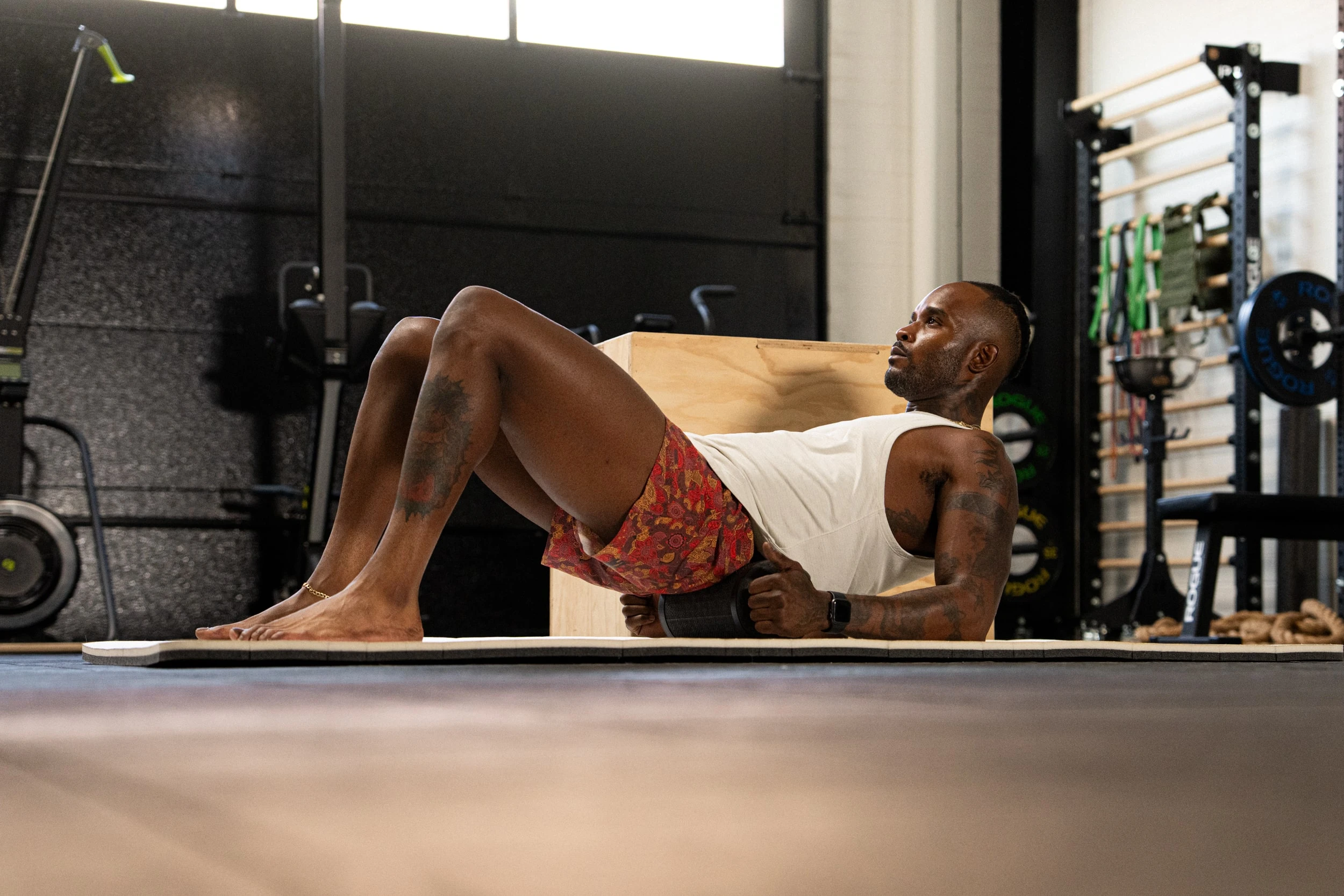
Your muscles do not work by themselves. Fascia, tendons, and ligaments absorb training stress and tighten without proper attention. Foam rollers, lacrosse balls, stick rollers, and handheld massagers provide direct access to these tissues for targeted relief.
Research supports performing soft-tissue work right after a workout, when tissue is warm and blood flow is high. Keep a roller or massager in your gym bag to make this part of your routine. The fastest-recovering athletes treat post-workout tissue work as part of the workout, not as optional.
recovery strategy #7: post-workout mobility
Gentle static stretching while your muscles are warm improves your range of motion and maintains movement quality for your next workout. Research on whether it reduces soreness is mixed, but its effect on flexibility and joint health is consistent.
Most athletes skip mobility work after their workout when short on time or fatigued. This accumulates over time, causing tightness, limited movement, and increased risk of injury. Our mobility app provides guided sessions targeting the areas CrossFit stresses most, making consistency easier.
recovery strategy #8: structure and discipline as recovery tools
Structure is a recovery tool most athletes overlook. Tracking reps, logging weights, and maintaining consistent training standards create a feedback loop that prevents both undertraining and overreaching. Visible output over time enables smarter decisions about when to push and when to back off.
The discipline CrossFit builds in the gym carries over directly to recovery habits outside the gym. Long-term thriving athletes aren't those with the highest pain tolerance; they're those who apply the same focus they bring to a barbell to their sleep schedule, post-workout meals, and rest days.
recovery strategy #9: physical healing and mental resilience
When you push through a workout that felt impossible at the halfway mark, you build evidence that you can tolerate discomfort without running away from it. That evidence accumulates and changes how you respond to difficulty in every other part of life.
According to Frontiers in Physiology, jump height, a marker of neuromuscular fatigue, drops sharply immediately after the CrossFit Karen benchmark workout in trained men. Even experienced athletes tax their nervous system heavily in a single session. Respecting that demand demonstrates discipline.
recovery strategy #10: community as a recovery mechanism
Being alone slows recovery in ways that eating well and sleeping enough cannot fully compensate for. Stress, disconnection, and lack of accountability raise cortisol levels, which impair muscle repair and immune function. Community membership produces the opposite effect.
How does the CrossFit gym environment accelerate recovery?
The CrossFit gym environment helps athletes recover faster through a sense of belonging. When progress is celebrated, effort matters more than the final result, and showing up consistently earns respect. This keeps athletes engaged longer and helps them recover with greater purpose. Social accountability is measurable: it keeps athletes training for years instead of burning out within months.
How do you make recovery strategies stick when motivation is low?
The harder question is not which strategies to use, but how to make them stick when motivation is low and soreness is high.
how to build a recovery routine that keeps you performing

Routine is the key word. Information about sleep windows, protein timing, and rest days only turns into better performance when you do them over and over again. The athletes who recover best aren't doing anything unusual: they're doing the right things in the right order, consistently enough that their bodies learn to expect them.
"The athletes who recover best aren't doing anything unusual: they're doing the right things in the right order, consistently enough that their body learns to expect them."
Tip: You don't need a complex recovery protocol: you need a repeatable one. Consistency beats perfection every single time.
Recovery Pillar | Why It Matters | Consistency Goal |
|---|---|---|
Sleep Windows | Regulates hormones and tissue repair | Every night, same schedule |
Protein Timing | Maximizes muscle protein synthesis | Within 2 hours post-training |
Rest Days | Prevents overtraining and burnout | At least 1–2 per week |
Warning: Knowing about recovery strategies and actually building them into a daily routine are two completely different things. Don't mistake information for implementation.
Takeaway: Your body adapts to patterns, not one-off efforts. The most effective recovery routine is the one you repeat consistently, not the one that looks best on paper.
morning: signal that recovery is active, not over
The first 20 minutes after waking set the tone for how your body feels for the rest of the day. Gentle movement and five to ten minutes of focused mobility work on what you trained the day before, combined with deliberate breathing, signal your nervous system to shift from repair mode into readiness. Skip this, and you carry stiffness and residual tension into your next session, which alters how you move under load before you even touch a barbell.
training: protect the window before and after
The workout itself is only part of the equation. What happens in the thirty minutes before and the hour after determines how much effort translates into adaptation. The same muscle group generally needs 48 to 72 hours between training sessions to fully repair. If you're squatting on Monday and Thursday but adding heavy accessory work on Tuesday, you're not giving your legs a rest day; you're giving them a disguised training day.
post-workout: the repair window is real, but brief
Your body is more ready to use protein and carbohydrates right after training, and this window closes faster than most people think. Getting 20 to 40 grams of protein post-workout helps with muscle repair, which aligns with broader CrossFit research. If you miss this window repeatedly, you start each new workout behind.
Most athletes grab whatever is easy after their workout and skip mobility work because they're tired. A mobility app like pliability removes the guesswork with guided routines that combine targeted stretching and breathwork: exactly what your body needs when exhaustion sets in.
evening and rest days, where adaptation actually happens
Evening recovery speeds up your body's adaptation. A ten-to fifteen-minute wind-down routine with parasympathetic breathing and lower-body mobility helps you move into deep sleep stages faster, where growth hormone peaks and muscle rebuilds. Rest days work similarly: low-intensity movement (walking, light mobility, breathwork) maintains blood flow to recovering tissue without adding stress. Athletes who treat rest days as active recovery consistently perform better in the next session, not from doing more, but from letting the previous session finish.
This framework reduces soreness and ensures you arrive at each session with a prepared body. That difference, between occasional peaks and consistent performance, separates athletes who plateau from those who keep building.
build a smarter CrossFit recovery routine with pliability
Building consistency in CrossFit is less about training harder and more about recovering smarter. The gap between athletes who keep progressing and those who stop improving lies in the structure of what happens between workouts, not during them.
"The difference between athletes who keep progressing and those who plateau is almost always found in what happens between workouts, not during them."
Key Point: Your recovery routine is not optional; it is the hidden engine behind every performance breakthrough.
An informal recovery plan leaves measurable performance on the table. pliability offers a structured daily practice built around your body's specific mobility limitations, combining guided stretching, breathwork, and recovery science into routines that take less than 5 minutes to start.
Recovery Approach | Key Feature | Time to Start |
|---|---|---|
Unstructured / Informal | No guidance, inconsistent | Varies |
pliability Daily Routine | Guided stretching + breathwork | Under 5 minutes |
pliability Targeted Practice | Body-specific mobility focus | Under 5 minutes |
Tip: Give your recovery the same intention you bring to every WOD: try pliability free for 7 days at pliability.com and start closing the gap.
Takeaway: Small, consistent gains in mobility are not a minor thing: they are the kind of compounding advantage that separates athletes who plateau from those who keep breaking personal records.
Related Reading




Move better in 10 minutes a day.
10,000+ five-star reviews.