


LEARN
pliability

Knee pain has a way of shrinking your day. Stairs get negotiated, curbs get planned around, and a low chair becomes a two-step production. Rest alone rarely fixes it, because most knee stiffness traces to the joint capsule and the muscles above and below the joint. Knee mobility exercises work on exactly that: the bend, the straighten, and the control your knees need for everything you do standing up. This guide covers 29 of them, grouped by what each one does, plus a simple way to combine them into a routine that makes your knees more flexible without aggravating them. Treat it as education, not diagnosis. If your knee is swollen, newly injured, or painful at rest, get it assessed before you start loading it. And if you want the full-body picture first, start with our guide to mobility exercises.
why knee mobility matters
Knee mobility is your knee joint's ability to flex, extend, and rotate slightly through its full range. That range is the price of admission for ordinary life: walking, sitting down and standing up, squatting to pick something up, climbing stairs. The knees are the largest joints in the body and they carry multiples of your body weight with every step, so when one stiffens, you feel it everywhere.
Mobility and stability are different jobs, and healthy knees need both. Mobility is how far the joint moves; stability is how well the muscles around it control that movement. Picture a squat: if your knees track over your toes on the way down, the stabilizing muscles are doing their job. If they cave inward or drift out, you have a control problem, not just a flexibility problem. That is why this list includes strength and balance work alongside stretches.
Stiffness is also self-reinforcing. The knee is a hinge that lives between two more mobile joints, and it often pays for their restrictions: when the knee, hip, or ankle stops moving well, the body borrows the missing motion from somewhere else, and the extra stress lands on the knee and the ligaments around it. Gentle, repetitive movement breaks that cycle. It circulates the fluid that lubricates the joint, improves blood flow to the area, and teaches tight tissue to let go. Think of mobility work as a movement vitamin: small daily doses, one to five minutes at a time, do more for your knees than an occasional marathon session.
what limits knee mobility, and when it needs a clinician
Your knee is three bones (thighbone, shinbone, kneecap) held together by ligaments, tendons, and two wedges of cartilage called the meniscus. Any of those parts can be the reason your knee will not bend or straighten the way it used to. Common culprits include:
Muscle tightness: stiff quads, hamstrings, and calves are the most common and most fixable limiter, and the one this guide targets.
Bursitis: inflammation of the fluid-filled sacs that cushion the joint, usually from repetitive stress or direct impact.
Arthritis: joint inflammation that brings pain and stiffness, especially first thing in the morning or after sitting.
Tendonitis: an overworked tendon complaining about repetitive load, common in jumping sports and physical work.
Meniscus and ligament tears: cartilage tears from twisting or squatting under load, and ligament injuries like ACL tears from cuts, sudden stops, and awkward landings.
Tightness responds well to the exercises below. Suspected tears, significant arthritis, and anything traumatic are not a self-management project: a clinician confirms what is actually injured and what your knee can safely do. Stop exercising and get assessed if you have severe pain or swelling, a knee that locks, clicks painfully, or gives way, an inability to put weight on the leg, or no improvement after a few weeks of consistent work. If you twisted the knee and it swelled up, read our guide to how long a sprained knee takes to heal for the general patterns, then let a clinician confirm the grade. And if your pain lives around the kneecap and shows up on runs, our runner's knee stretches guide covers that specific problem in depth.
29 knee mobility exercises to make your knees more flexible
These 29 exercises are grouped by purpose, in the order that makes progress stick: restore the joint's range first, lengthen the muscles that cross the knee, then build the strength and balance to control what you gained. You do not need all 29 in one session. Pull a few from each group, move slowly, and let mild tension be the ceiling. Where no count is listed, 10 slow reps or a 30-second hold is a solid default.
range of motion drills: restore the bend and straighten
Start here, especially if your knee feels rusty in the morning or after sitting. Repetitive, gentle motion lubricates the joint and reclaims range without demanding much from the muscles. The last drill works the hips, because knee position is downstream of hip rotation; if that one exposes real stiffness, dedicated hip mobility exercises are worth a slot in your week.
1. Heel Slide
Takes the knee through repeated bending and straightening, which lubricates the joint and eases it into more range.
Sit on a couch, bed, or the floor with your legs straight in front of you.
Loop a towel around the bottom of your target foot.
Use the towel to take some weight off the foot as you slide it toward your hips, letting the knee bend.
Bend as far as comfortable, then slide back to the start.
2. Knee Extension
Fully straightening the knee is a range you use to walk, bend down, and get up off the floor, and it is often the first range a stiff knee loses.
Sit comfortably in a chair.
Raise your foot toward the ceiling until the leg is straight.
Keep the back of your thigh on the chair and hold briefly.
Lower your foot back to the floor.
3. Hamstring Curl
The mirror of knee extension: bending the knee against gravity while the back of the thigh does the work.
Stand with both hands resting on a sturdy table or chair.
Lift one heel off the floor and bring it toward your glutes.
Squeeze the back of your thigh while you hold the position.
Lower your foot back to the floor.
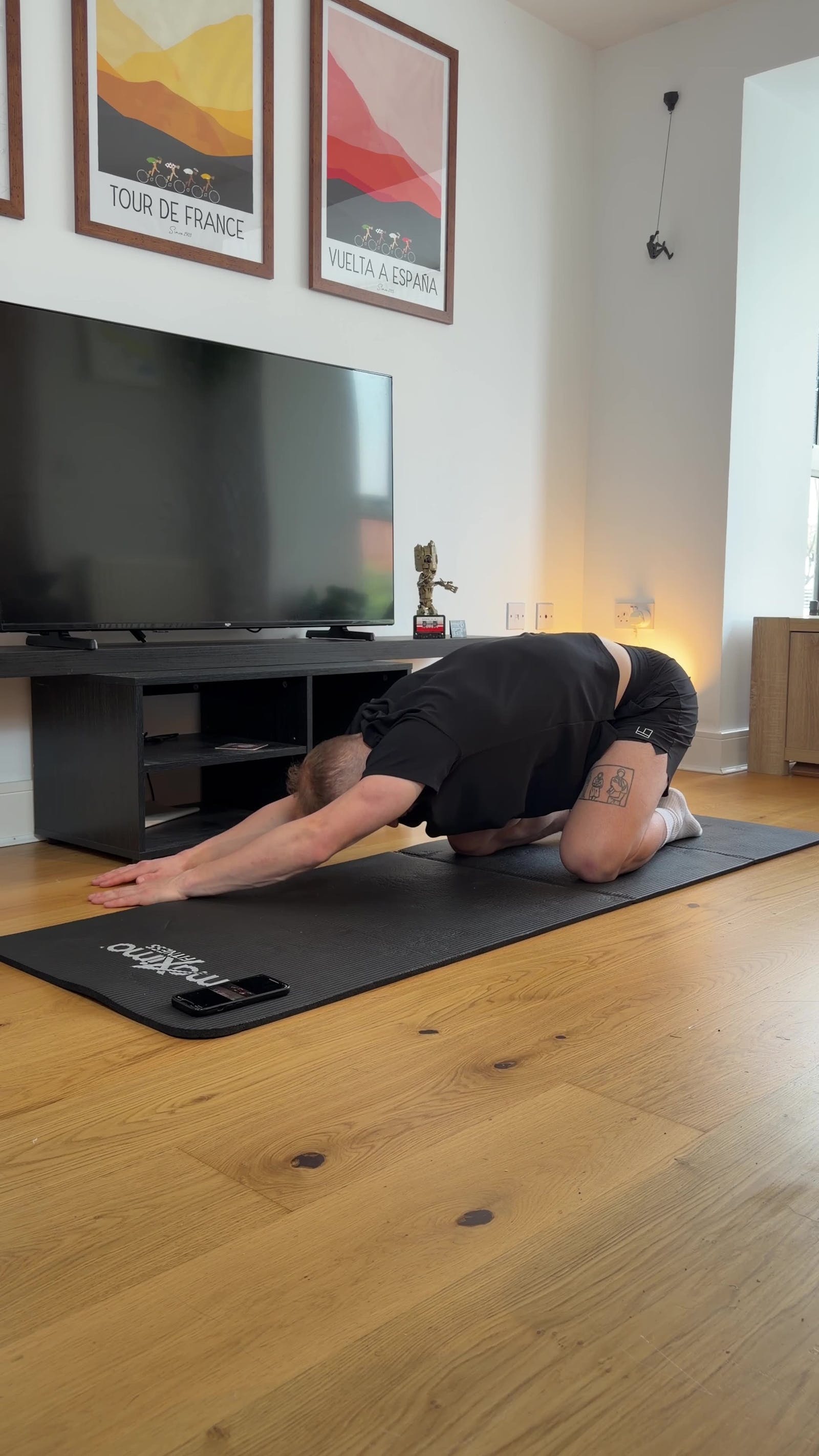
4. Quadruped Sit Back
A more advanced move that stretches the end range of knee bend, the same range you use crouching or picking something up.
Start on hands and knees, hands below shoulders, knees below hips, toes curled under.
Move your hips back toward your heels while walking your hands toward your knees.
Walk your hands forward to return to the start.
5. Step Stretch
Works the knee and ankle together, which matters because a stiff ankle sends its workload straight up the chain.
Stand about 12 inches from a box or step and place one foot on it.
Bend the raised knee forward over the foot.
Stand farther from the step to bias the stretch toward the ankle.
Hold 1 to 2 seconds. Repeat 10 to 20 times per side.
6. Side Sweeper
Opens the inner-leg tissue that limits how freely the knee moves with the hip.
Lie on your back with a strap or belt around one foot.
Slide that leg out to the side, keeping the heel on the floor.
Gently pull the strap to help the leg travel as far as comfortable.
Hold 2 to 3 seconds. Do 4 reps, then switch sides.
7. Hip Mobility Drill
Knees follow hips. Rotating the hips through their range takes pressure off the knee's small rotational capacity.
Sit on the floor with your hands in front of you and knees bent to 90 degrees.
Slowly drop one knee outward toward the floor, letting your torso and other knee follow.
Return to the start and repeat on the other side, 4 reps per side.
Hands on the floor makes it easier; hands reaching to the ceiling makes it harder.
stretches for the muscles that cross the knee
The quads attach to the kneecap, the hamstrings anchor below the joint, and the calves attach above the back of it. When any of them shorten, the knee loses range it never actually lost inside the joint. Hold these stretches around 30 seconds unless noted, and keep everything shy of pain. Since tight calves and stiff ankles travel together, ankle mobility exercises pair well with this group.
8. Quad Stretch
Lengthens the big muscle on the front of the thigh that straightens your leg and loads your kneecap.
Stand with one hand on a table for balance.
Bend one knee, bringing the heel toward your glutes, and grab your foot or ankle.
Gently pull until you feel a stretch along the front of the thigh, and hold.
Release the foot back to the floor.
9. Quad Wall Stretch
A deeper quad and hip flexor stretch using the wall to hold the position for you.
Kneel with your back to a wall and rest one shin up against it.
Step the opposite leg forward into a lunge position.
Hold for 30 seconds, then switch sides.
10. Side-Lying Quad Stretch
A gentler floor version that adds a light dynamic pull instead of one long hold.
Lie on your side and grasp the ankle of your top leg.
Swing the leg backward, assisting the stretch by gently pulling on the ankle.
Hold 2 to 3 seconds, reset forward, and repeat 10 to 12 times.
Roll over and repeat on the other side.
11. Seated Hamstring Stretch
A tight hamstring will not let the leg fully straighten, and full extension is pivotal for how the knee functions.
Sit at the edge of a chair and straighten one leg in front of you, heel on the floor.
Hinge at your hips and lean forward until you feel the back of the thigh.
Hold, then return to the start and switch legs.
12. Standing Hamstring Stretch
Stretches the back of the leg with less strain on the lower back than reaching for your toes.
Stand tall with feet no more than shoulder-width apart.
Extend one leg a few inches in front of you and let the other knee bend slightly.
Hinge at the hips and lower your chest with a straight back, only as far as stays pain-free.
Hold for 30 seconds, stand back up slowly, and switch legs.
13. Toe Touches
The classic hamstring stretch. Range matters less than the slow, honest reach.
Stand with feet close together and slowly bend at the hips, extending your arms down.
Keep the legs straight but never lock the knees.
Reach toward your toes and hold for 30 seconds. Fingers to shins counts; go only as far as comfortable.
14. Strap Hamstring Stretch
Using a strap lets you control the intensity precisely, one short hold at a time.
Lie on your back with both legs flat and a strap around one foot.
Lift that leg with the knee bent to 90 degrees.
Use the strap to straighten the leg toward the ceiling.
Hold 2 to 3 seconds, return, and repeat 10 to 12 times per side.
15. Runner's Hamstring Stretch
Hits the hamstring and the front of the shin in one position.
Start on all fours and stretch one leg out in front of you.
Slowly sit back toward your heel, keeping the front toes pointing up, until you feel the hamstring. Hold 30 seconds.
Then lower the front toes to the ground and hold 30 seconds to stretch the shin.
Switch legs.
16. Calf Stretch
The calves attach above the back of the knee, so tight calves quietly limit how well the leg straightens.
Face a wall with your palms flat against it.
Step back with your target leg.
Press the back heel toward the floor as you move your hips and front knee toward the wall.
Keep the back leg mostly straight throughout.
17. Lying Calf Stretch
A strap version you can scale precisely by raising or lowering the leg.
Lie on your back with one leg raised and a strap around the ball of that foot.
Flex the foot, pulling your toes toward you with the strap's help.
Lift the leg higher for more intensity, lower for less.
Hold 2 to 3 seconds. Repeat 10 times, then switch legs.
strength moves to control your new range
Range you cannot control is range you lose. These moves strengthen the quads, hamstrings, glutes, and calves so the knee tracks well under load, which is what keeps the stretching gains around. Work them in every other day rather than daily, and build reps gradually. If your goal is durability for sport rather than flexibility, our knee injury prevention exercises guide covers that side of the equation.
18. Quad Contraction to Straight-Leg Raise
Teaches the quad to fire in a fully straight leg, the foundation of knee control.
Sit upright on the floor, one knee bent, the other leg straight, arms supporting your posture.
Contract the straight leg's quad, trying to press the back of the knee toward the floor.
Keeping the muscle squeezed and the leg straight, lift the heel, hold 2 to 3 seconds, and lower.
Do 10 to 12 reps per side for 3 sets.
19. Wall Sit
An isometric hold that builds quad endurance without moving the joint at all.
Stand with feet shoulder-width apart, back to a wall.
Slide into a seated squat with your whole back pressed against the wall, knees at roughly 90 degrees, as if sitting on an invisible chair.
Push lightly into the floor through your heels and hold 30 seconds.
Repeat 3 times.
20. Wall Squat
The moving version of the wall sit, and a good place to watch your knee tracking.
Lean against the wall with your feet about 12 inches from it.
Slide down until your knees reach 90 degrees, then move between standing and that squat, back against the wall.
Watch whether the knees drift inward on the way down and keep them tracking over your toes.
Repeat 10 times.
21. Banded Squat
The band tries to pull your knees inward; your job is to refuse. That refusal is knee stability training.
Place a loop resistance band around both thighs and stand with feet shoulder-width apart.
Bend at the knees as if sitting into a very small chair, knees behind the toes and aligned over the shins.
Press outward against the band the entire time so the knees stay tracked.
Engage the glutes, press the feet into the floor, and stand. Do 3 sets of 12 to 15.
22. Forward Lunge
Loads one knee at a time through a real-world range.
Stand with feet together, then step forward with one leg.
Keep the front knee from traveling past the toes.
Lower toward 90 degrees, but only as far as your range allows.
Push the floor away with the front foot to return. Do 10 reps per side.
23. Banded Lunge
Adds band resistance to knee extension, working the leg as it straightens.
Place a loop band above your knees and stand with feet facing forward.
Step one foot backward against the band's resistance, shifting weight onto the back foot while the front foot stays planted.
Straighten the back knee against the band by pressing the back heel toward the floor.
Return to the start. Do 10 reps per side.
24. Step-Ups
Stairs are the test most knees fail first. This is practice.
Stand in front of a step with feet together.
Step up with one foot, lift the back foot to the step, and gently step back down.
Do 10 reps, then lead with the other leg.
For a balance challenge, keep the working leg on the step and tap the floor behind you instead of fully stepping down.
25. Calf Raises
Strong calves absorb impact before it reaches the knee.
Stand with feet together near a wall for balance.
Rise onto your toes, then lower back down.
Rock back on your heels and lift the toes to work the front of the shins.
Repeat 10 times. Progress to single-leg raises when that gets easy.
26. Deadlift
The hip hinge that trains the whole posterior chain to share the load your knees would otherwise take alone.
Stand with feet shoulder-width apart, toes turned slightly out, gaze forward, torso upright, shoulders back.
Hold a weight in front of your body, brace your core, and hinge your hips backward as if tapping a wall behind you.
Slide the weight down the front of your shins, back flat, until the hamstrings feel tight or your spine starts to round.
Push the floor away to rise, keeping the weight close, and finish by squeezing the glutes to drive the hips forward.
Do 3 sets of 10.
balance and stability work
Balance work trains the small corrections that keep the knee aligned when life gets unpredictable: uneven ground, a missed step, a quick change of direction.
27. Lateral Leg Lifts
Strengthens the outer hip muscles that keep the knee from collapsing inward.
Stand with feet together next to a wall, one hand on it for stability.
Flex the opposite foot and raise that leg out to the side, then lower it.
Repeat 10 times, then switch sides.
28. Crab Walk
Banded sidesteps that make the hips stabilize every single step the knee takes.
Place a loop band around both thighs; move it to the calves or ankles for more challenge.
Take a wide stance in a high squat: knees slightly bent, hips back, back neutral.
Holding that position, take sideways steps to the right, then match them back to the left, keeping the trailing leg aligned and stable.
Do 10 steps each way, rest briefly, and repeat for 3 to 5 sets.
29. Single-Leg Balance With Front, Side, and Back Taps
One leg holds steady while the other draws the map. Your knee learns to stay quiet through all of it.
Stand upright with feet together and hips squared forward.
Balance on one leg and lightly tap the other big toe to the ground in front, to the side, then behind you.
Keep cycling the three taps for one minute, then switch legs.
To progress, do the taps standing on a balance board or stability disc.
how to turn these into a knee mobility routine
You do not need a complicated program, just a repeatable order. Warm up first with five minutes of easy movement, a brisk walk or gentle cycling plus a few leg swings, so the tissue is ready before you stretch it. Then layer the groups: a couple of range of motion drills daily, the stretches after activity or in the evening with 30-second holds, the strength moves every other day, and a minute or two of balance work whenever you are already standing around. Foam rolling the quads, hamstrings, and calves before you stretch is an optional extra that helps tight spots release.
Two habits protect your progress. First, manage load: knees take several times your body weight walking and far more on stairs, hills, and squats, so if a knee is cranky, keep moving with low-impact options like walking, cycling, or swimming instead of stacking high-impact volume on top of the irritation. Second, track it: same drills, once a week, note how deep the heel slide goes or how long the wall sit holds. Steady beats heroic. If your warm-up leaves you tired, it stopped being a warm-up. The knee also rarely acts alone, so when you are ready to zoom out, our lower body mobility exercises guide connects the hips, knees, and ankles into one routine.
keep your knees ready for everything you love
Twenty-nine exercises are only useful if you actually do a few of them, most days, for long enough to matter. That is the part pliability handles. Daily Sessions give you a guided routine every day so consistency stops depending on willpower, Build Your Program shapes mobility work around your schedule and the areas that need it, and the mobility assessment shows whether your hips or ankles are quietly feeding your knee trouble. If you are working back from a setback, the Rebuild hub offers gentler, corrective sessions built for exactly that. Start your 7-day free trial on iPhone, iPad, Android, or the web. Your knees carry everything you love doing. Give them five minutes a day back.
Related Reading



Move better in 10 minutes a day.
10,000+ five-star reviews.