


LEARN
pliability

Stiffness has a way of announcing itself at the worst time: at the bottom of a squat, mid-run, or just bending down to tie your shoes. The fix is rarely more stretching alone. It is mobility work, done consistently. This guide collects 35 of the best mobility exercises, grouped by body area with reps and form cues, plus how to fold them into your training and how often to do them.
what is mobility and why it matters
Mobility is a joint's ability to move through its full range of motion with control and stability. Flexibility contributes to it, but mobility adds the strength and motor control to actually use that range: bending to tie your shoes, reaching a high shelf, hitting depth in a squat without your lower back rounding.
It also declines quietly. Muscle mass, bone density, and nervous system speed all trend down with age, and long sitting accelerates the stiffness. The encouraging part: mobility responds to training at any age, and the required dose is small. Think of it as movement snacks: a few focused minutes when you wake up, at lunch, or before bed.
what is mobility training?
Mobility training is targeted work that improves how your joints move. A session might borrow from dynamic stretching, bodyweight strength, yoga, and foam rolling, but the goal is distinct:
Stretching lengthens muscle and soft tissue to improve flexibility. Static holds suit recovery; dynamic stretches suit warm-ups.
Foam rolling relieves tension at specific points using body weight and a roller.
Mobility training addresses the whole system, joints, muscles, tendons, and ligaments, with a high degree of control and coordination, so the nervous system learns the new range too.
Done regularly, mobility drills increase range of motion, relieve chronically tight muscles, support posture and lifting form, improve balance and proprioception, and lower injury risk. When one area stops moving well, the areas above and below it work overtime; that compensation pattern is where breakdown usually starts. Most of the work needs no equipment, though a mat, foam roller, resistance band, and a yoga block cover every exercise below.
flexibility vs. mobility
The two are related but not interchangeable. Flexibility is passive: how far a muscle can lengthen. Mobility is active: how far you can move a joint with control. Someone who can fold forward and touch their toes has flexible hamstrings; whether they can control that same range under load is a mobility question. Training both is the point, and we break the distinction down fully in flexibility vs mobility.
35 mobility exercises for better strength and movement
This list of mobility exercises is grouped by what each drill targets, roughly in the order you might use them: breathing and core control first, then hips, spine, shoulders, and full-body integrators. Run a handful as a warm-up (6 to 12 reps each), or pick the group that matches your stiffest area and work it a few minutes a day. On any exercise, mild stretch is the goal; sharp pain is a stop signal.
breathing and core control
1. Crocodile Breathing
Deep belly breathing regulates the nervous system before training and doubles as practice for proper abdominal bracing. 3 minutes, daily or before a session.
Lie face down, cross your arms in front of you, and rest your forehead on the back of your hands.
Exhale fully until your torso feels empty of air.
Inhale slowly and deeply, filling from your chest down to your tailbone. Your lower back should expand and rise slightly.
2. Single-Leg Supine Leg Raise
A grounded core drill that uses reciprocal inhibition: activating one muscle signals its opposite to relax, which also helps hamstring flexibility. 2 sets of 10. Needs a squat rack pillar or door frame.
Lie on your back with one hip scooted against the pillar, and hike that leg up the frame with the knee locked until you feel a hamstring stretch.
Lift your shoulders slightly and compress your ribcage to switch on your abs.
With the free leg's knee locked, raise it until it aligns with the supported leg, then lower slowly. Add a light weight held behind your head for a challenge.
3. Single-Arm Kettlebell March + Reverse Lunge
The march engages your core and hip flexors; the lunge lengthens the same tissues for a balanced stimulus. 3 sets of 10 or more, one kettlebell.
Rack a kettlebell at your shoulder on one side and brace your core, free arm out for balance.
March in place, lifting each knee to waist height, alternating legs.
Then step backward into reverse lunges, alternating legs. Holding a lighter bell bottoms-up adds a stability challenge.
hip mobility
4. Spider Lunge
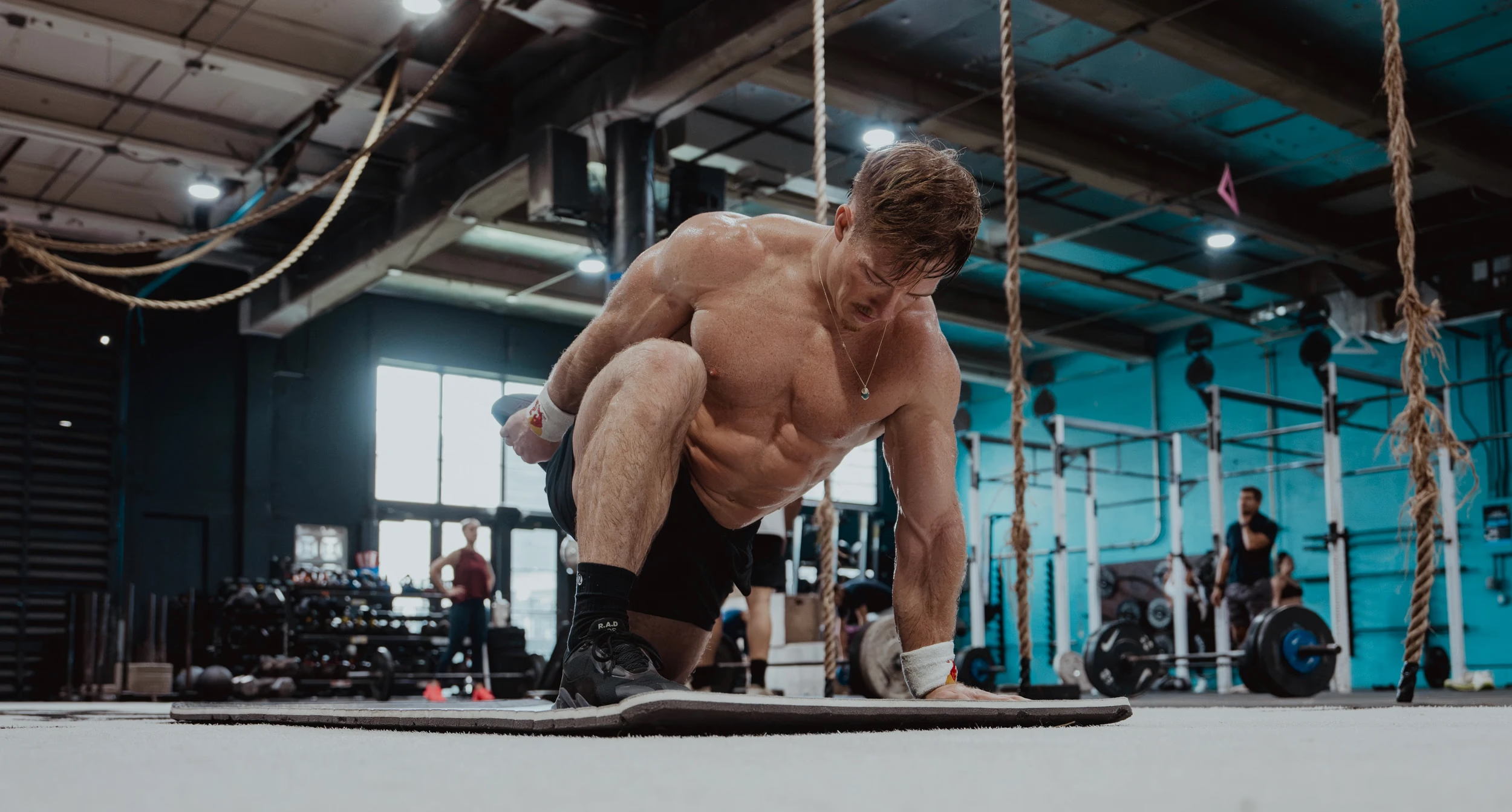
From a plank, bring your right foot outside your right hand.
Push your hips forward and squeeze the glute of the left leg.
Return to plank and repeat on the opposite side.
5. Crescent Lunge
One knee on the ground, other foot in front of you in a lunge.
Push your hips forward and squeeze the glute of the back leg.
For more stretch, raise the arm on the same side as the back leg and lean slightly inward to open the hip further. Pause, then switch sides.
6. World's Greatest Stretch
From a plank, bring your right foot outside your right hand.
Squeeze your left glute and drop your right elbow toward the ground, feeling the stretch along the back of the thigh.
Twist back through center and rotate your torso to reach your right arm straight up, eyes following your hand.
Return the palm to plank and repeat on the other side.
7. Posterior Capsule Stretch
Begin on hands and knees, knees under hips, palms under shoulders.
Cross one foot over the other and lean to the side until you feel the stretch on the outside of your hip.
Return to the start and repeat on the opposite side.
8. Adductor Rocks
Start on all fours, knees in line with hips, palms in line with shoulders.
Extend one leg to the side, foot flat, and rock your hips backward until the stretch lands along your inner thigh and groin.
Return and repeat on the opposite side.
9. Cossack Squat
Stand wider than shoulder-width, toes slightly out, arms straight in front of your chest.
Shift onto your right side, sit back into the hip, and bend the right knee until that thigh is parallel to the floor or deeper, right heel flat.
Keep the left leg fully extended, heel planted, toes pivoting up, chest lifted.
Press through the right foot to stand, then repeat on the other side.
10. 90-90 Stretch
Sit with one leg bent at 90 degrees in front of you, shin parallel to your torso, and the back leg bent 90 degrees behind, knee in line with hip.
Pivot to reverse the shape, lifting your knees and dropping them to the other side.
Brace your core, push through the floor to lift your hips, and squeeze your glutes at the top.
Sit back down with control and repeat on the opposite side.
11. 90/90 Hip Switch
Sit tall, legs slightly wider than hip-width, both knees bent at 90 degrees, heels staying planted.
Rotate your knees from side to side, moving from the hips and keeping your posture upright.
Six reps per side. Holding your arms straight out front adds difficulty.
12. Half Kneeling Adductor Rock
From a half kneeling position, left foot planted in front, right knee down at about 90 degrees, step the left foot out to the side and put your hands on your hips.
Shift your hips and weight toward the left foot, hold 1 to 2 seconds, and return to center.
8 to 12 reps per side, easing a little deeper each rep.
13. Downward Dog Hip Opener
From a plank, push back through your hands and hike your hips into downward dog.
Draw your left knee toward your chest, then lift the leg up and back behind you.
Open from the hip, letting the left foot fall toward your right glute, then reverse to the start. Eight reps, then switch sides.
14. Banded Hip Mobilization
Limited hip extension and internal rotation are two of the most common restrictions in trained athletes; a heavy band addresses both. 3 sets of 30 seconds per leg, using a resistance band and a rack.
Tie a heavy band to a stable structure at about knee height, step one leg into the loop, and hike it up under your glute.
Take a knee with the banded knee down, opposite foot flat in front.
Let the band pull the hip into extension until you feel a strong stretch along the front of the thigh. Twisting the down-leg foot gently toward the opposite side adds internal rotation work.
15. Figure 4 Windshield Wipers
Lie on your back, arms at your sides, left knee bent with the foot flat, right ankle crossed onto the left thigh.
Slowly lower both legs to the left until the left thigh reaches the floor or your point of tolerance. Hold two seconds.
Rotate to the right the same way, hold two seconds, and keep alternating. Eight reps per side, slow and controlled.
lower back and spine
Lower back stiffness touches nearly every daily movement. Keeping the lumbar and thoracic spine mobile, and strong through that motion, pays off everywhere else.
16. Lumbar Windshield Wipers
Lie on your back, knees bent and together, feet flat.
Slowly drop both knees to one side, stopping when your shoulders start to lift.
Pause, return to center, and repeat on the other side.
17. Scorpion
Lie face down, forehead resting on the backs of your hands.
Keeping your torso on the floor, lift your right leg and cross it over the left until the right foot taps the ground.
Pause, return, and alternate sides.
18. Squat with Thoracic Twist
Stand at hip width and lower into a squat.
At the bottom, open your arms wide and twist your torso to the right, reaching the right arm straight up, eyes on your hand.
Come back through center and twist left. Keep alternating.
19. Cat Cow
Start on hands and knees, hands shoulder-width, knees under hips.
Inhale, draw your belly button toward your spine, and curve your lower back; hold 2 to 3 seconds.
Transition slowly to the arched position, looking up, and hold 2 to 3 seconds. Eight reps of each.
20. Torso Twists
Stand shoulder-width, toes forward, hands on hips.
Keep your right leg still and twist your torso to face right, letting the left leg pivot with you.
Alternate sides, 10 reps each.
21. Sciatic Nerve Floss
Useful for runners and skiers who assume they have tight hamstrings when the real limitation is neural. Nerve flossing mobilizes neural tissue with a dynamic stretch. 2 sets of 5. If you have significant nerve pain, tingling, or numbness, see a clinician before trying this.
Stand in a staggered stance, front foot a few inches ahead, only its heel on the ground.
Hinge forward, dropping your head toward the front foot without bending your knees.
As you drop, sweep your arms forward as if scooping the air. The flatter your back, the stronger the stretch.
shoulders and upper back
From lifting overhead to putting on a shirt, daily life runs through the shoulder girdle. These drills train its mobility and the stability to control it.
22. Shoulder CARs
Stand tall and raise one arm straight up, palm facing in.
At the top, turn the palm away from you as far as your mobility allows.
Continue moving the arm through its full circle back to the start. 10 controlled reps per arm.
23. Thoracic Extension on Foam Roller
Lie with a foam roller perpendicular under your mid-back, hands joined behind your head, elbows tucked.
Using the roller as a hinge, extend your upper back to the limit of your mobility.
Hold 3 seconds and return. 10 reps.
24. Thoracic Extension with Hip Lift
Same setup, roller under the upper back, feet flat, hands clasped behind your head.
Lift your hips off the ground, then gently extend your upper back over the roller, only as far as is comfortable.
Hold briefly, that is one rep; do 10, moving the roller to different sections of the upper back.
25. End Range Lift-Offs
Lie chest-down, neck neutral, arms extended overhead in a Y with hands resting on the floor.
Raise both straight arms off the floor.
Hold 3 seconds, lower slowly, and repeat 10 times.
26. Horizontal Ts
Lie face down with arms out to the sides in a T, thumbs up.
Squeeze your shoulder blades and lift your hands off the floor.
Hold 3 seconds, lower, and repeat for 10 reps.
27. External Rotation Lift-Offs
Lie face down, arms in a goal-post position, a yoga block under one elbow.
Rotate that arm up to lift the forearm off the block.
Hold 3 seconds. 10 reps, then move the block to the other arm.
28. Thread the Needle
Begin on all fours.
Reach your right arm up toward the ceiling, eyes following your hand.
Bring it down and thread it between your left hand and left knee, dropping the right shoulder toward the ground. Reverse immediately for the next rep. Six reps per side.
29. Dead Hang
Hanging improves shoulder mobility and gives your spine mild traction, countering the compression of squats and overhead presses. Grip work comes free. 3 holds of 30 seconds on a pull-up bar.
Grab a stable bar with a shoulder-width, overhand grip.
Suspend yourself without swaying and let your shoulders rise toward your ears, lower body still.
A wider grip is easier on the shoulders; straps are fine if grip is the limiter.
30. Kettlebell Windmill
The windmill stretches your posterior chain while your upper back and shoulder girdle contract isometrically to hold a weight overhead. 2 sets of 3 per side.
Hold a kettlebell overhead with one locked arm, feet in a slightly staggered stance.
Slowly tilt your torso to the side, reaching your free hand down toward the floor.
Lower until you touch the floor or feel a strong stretch through hip and lower back, then return. If the overhead arm sways or bends, go lighter.
full body and lower leg
31. Achilles Opener
Stand with feet hip-width apart.
Step your right leg back and slightly bend the left knee, raising both hands overhead in a straight line.
Hold 30 seconds, feeling the stretch through the back of the leg and Achilles, then switch.
32. Sky Squat Reaches
From standing, feet slightly wider than hip-width, lower into a deep squat, heels and forefeet planted.
Reach across with your left hand to hold your right ankle.
Reach your right arm up and away, rotating the torso right, gaze following the arm. Hold two seconds, return to center. Eight reps per side.
33. Downward-Facing Dog
From hands and knees, hands slightly forward of your shoulders, spread your fingers and press your palms down.
Straighten your arms, draw your belly to your spine, and lift your hips up and back into an upside-down V, heels working toward the floor.
Relax your head and neck, gaze at your belly button, and either hold 5 to 10 seconds or pedal your feet heel to toe.
34. Kang Squat
A hinge and a squat in one rep: the good morning loosens the posterior chain, and the squat finish warms up the whole lower body while you practice breathing at the bottom. 3 sets of 5 with an empty barbell, or a PVC pipe if the bar is too much.
Place the bar on your upper back and take your squat stance.
Hinge back into a deep good morning, back flat, thoracic spine extended.
From the hinge, sink your hips and drive your knees forward into the bottom of a deep squat.
Pause, exhale, then shoot your hips up and back to the hinge and stand.
35. Goblet Squat Hold
Hold a moderately heavy object, a kettlebell, a book, even a milk jug, level with your chest.
Slowly lower your hips as deep as you can without pain.
Hold the bottom position for five to 10 seconds, then stand.
how to add mobility exercises to your workout routine
Before training, run a short mobility workout as your warm-up, matched to what you are about to do: hips and ankles before squats, shoulders and thoracic spine before pressing. Keep it dynamic; save long static holds for later.
Train through a full range of motion. Joints stay healthy when they visit their end ranges often.
Superset strength and mobility: use a mobility drill as active rest between strength sets, as long as it does not eat into the recovery you need.
Put passive drills at the end. Warm muscles take to static stretching best. Breathe into each hold rather than just waiting it out.
how often should you do mobility exercises?
Three to five short sessions a week is the working baseline; daily is better if you have a specific restriction to fix. Frequency beats duration: five to 10 focused minutes most days does more than one long session on the weekend, and stacking the work onto training days you already have makes it stick.
Start with one or two body areas, not everything at once. Prioritize form and control over range: a small range done well beats a big range done badly. Progress is gradual, so take simple notes to see it accumulate, and modify or skip anything that causes sharp pain.
mobility exercises by goal and level
Each of these guides goes deeper on one part of this list:
mobility exercises for beginners: head-to-toe moves for your first weeks of mobility work.
upper body mobility exercises: drills for the shoulders, upper back and neck.
functional mobility exercises: moves that carry over to lifting, reaching and climbing stairs.
weighted mobility exercises: loaded drills that build strength at the end of your range.
mobility exercises for athletes: short drills to prepare for training and competition.
turn the list into a mobility and flexibility program
A list gets you started; a program keeps you moving. pliability turns this work into guided video sessions built for athletes and everyday movers: Daily Sessions give you a fresh routine every day, Paths run multi-week progressions for a stubborn area like hips or shoulders, and Build Your Program shapes the plan around your training. Take the mobility assessment to find what is actually restricted, then start with 7 days free on iPhone, iPad, Android, or the web. If you are still comparing options first, our honest roundup of mobility apps covers the field.
Related Reading



Move better in 10 minutes a day.
10,000+ five-star reviews.