


LEARN
pliability

You drop into a hamstring stretch you've done a hundred times, and instead of that familiar pull you get a sharp, pinching jolt. Or you reach overhead and your shoulder catches. When stretching keeps hurting, it's easy to assume you're doing it wrong or that you're too tight to fix. Both assumptions usually lead to stretching harder, which is the wrong move.
Most of the time, pain when stretching is your body giving you information, and learning to read it is what lets athletes move more freely over time instead of tugging at the same tight muscles.

why does stretching hurt, and should you be worried about it?
quick answer: why does stretching hurt?
Stretching hurts when you load the muscle and nervous system with more tension than they're ready to accept, usually by pushing too far, too fast, or into a cold or guarded muscle. A good stretch should feel like moderate, tolerable tension that eases as you hold it.
Sharp, burning, pinching, radiating, or numb and tingly sensations are not signs of a deep stretch. They're a signal to stop. Most stretching pain comes down to intensity, temperature, technique, or an irritated area, and all of those are fixable without forcing anything.
is stretching supposed to hurt?
No, at least not in the way most people mean the word "hurt."
A productive stretch has a recognizable feel. There's a broad sense of tension or gentle pulling through the belly of the muscle, the kind you could hold and breathe into for 20 or 30 seconds while it slowly softens. On a 1-to-10 scale, you're aiming for a 3 to 5, a stretch you'd describe as noticeable but fine, never as grit-your-teeth-and-hold-on.
It shouldn't feel sharp, stabbing, or electric. It shouldn't burn intensely or produce numbness, tingling, or a pins-and-needles trail down a limb, which points to nerve involvement rather than muscle. It also shouldn't be focused in a joint.
A pinch at the front of the hip or deep in the shoulder is usually the joint complaining, not the muscle lengthening. The old "no pain, no gain" line was never meant for flexibility work. Pushing a stretch into real pain doesn't earn you range any faster. It tends to do the opposite, triggering the protective response you're trying to get past.
common reasons stretching hurts
You're pushing too far
The most common culprit is simple overreach. Chasing a deeper position, like trying to slap your palms flat on the floor or forcing your heel down in a calf stretch, drives the tissue past what it's ready to give and turns useful tension into pain. Flexibility responds to patient, repeated exposure, not to one aggressive rep.
Your muscles are cold
A cold muscle is stiff, less elastic, and quicker to complain. That early-morning muscle stiffness usually comes down to temperature rather than a flexibility problem. Rolling out of bed or off your desk chair and dropping straight into a deep static stretch asks tissue to lengthen before any blood flow or warmth has reached it. The same hamstring stretch that pinches at 7 a.m. can feel smooth after ten minutes of easy movement.
You're stretching an irritated or injured area
Stretching pulls on more than muscle. It also loads tendons, nerves, and joint structures. If a hamstring is strained, a shoulder is impinged, or a low back is inflamed, stretching straight into that area can aggravate it rather than relieve it. Pain that sits in one specific spot, especially near a tendon or joint, and that lingers or worsens afterward, is a sign you may be stretching something that needs to settle or be assessed rather than lengthened.
Your nervous system is guarding the movement
Your body has built-in protection against overstretching. When it senses a stretch reaching too far, too fast, it can reflexively tighten the very muscle you're trying to lengthen. That guarding response is there to keep you safe, and forcing through it only turns it up. It's the biggest reason "just push harder" backfires. The harder you shove, the more your nervous system braces against you.
You're holding stretches too aggressively
Yanking into a stretch, bouncing at end range, or white-knuckling a hold for a minute at maximum intensity all provoke pain and guarding. Stretching rewards a slow entry and a relaxed hold far more than intensity. If you're bracing your whole body to stay in a stretch, you've gone too deep.
normal stretching discomfort vs. pain: how to tell the difference

This is the distinction worth memorizing, because it decides whether you keep going or back off.
Normal stretching discomfort feels like:
A broad, mild-to-moderate pulling or tension in the body of the muscle
Sensation that stays steady or eases the longer you hold and breathe
Something you'd rate around 3 to 5 out of 10, noticeable but relaxed
A feeling that fades within seconds once you come out of the stretch
Pain that signals a problem feels like:
Sharp, stabbing, pinching, or electric sensations
Burning, numbness, tingling, or anything that radiates down a limb
Discomfort centered in a joint rather than spread through a muscle
Sensation that worsens the longer you hold, or that lingers and aches afterward
A simple rule of thumb: if the sensation eases as you breathe and settle, you're stretching. If it sharpens, radiates, or lives in a joint, you're straining something, so ease off. When in doubt, come out of the position and reassess instead of testing how much you can tolerate.
how athletes can fix painful stretching
Once you know what's driving the pain, the fixes are fairly practical, and none of them involve gritting your teeth.
Warm up first
Give tissue blood flow before you ask it to lengthen. Five to ten minutes of easy movement, such as a brisk walk, light cardio, or dynamic drills like leg swings and arm circles, makes muscle more pliable and dials down the guarding response. Save deep static holds for after you're warm, or for the end of a session.
Reduce intensity
If a stretch hurts, back off until you find tension without pain, then live there. You'll almost always gain more range from a comfortable 4-out-of-10 stretch held calmly than from a brutal 8 you can barely sit in. Less really is more here.
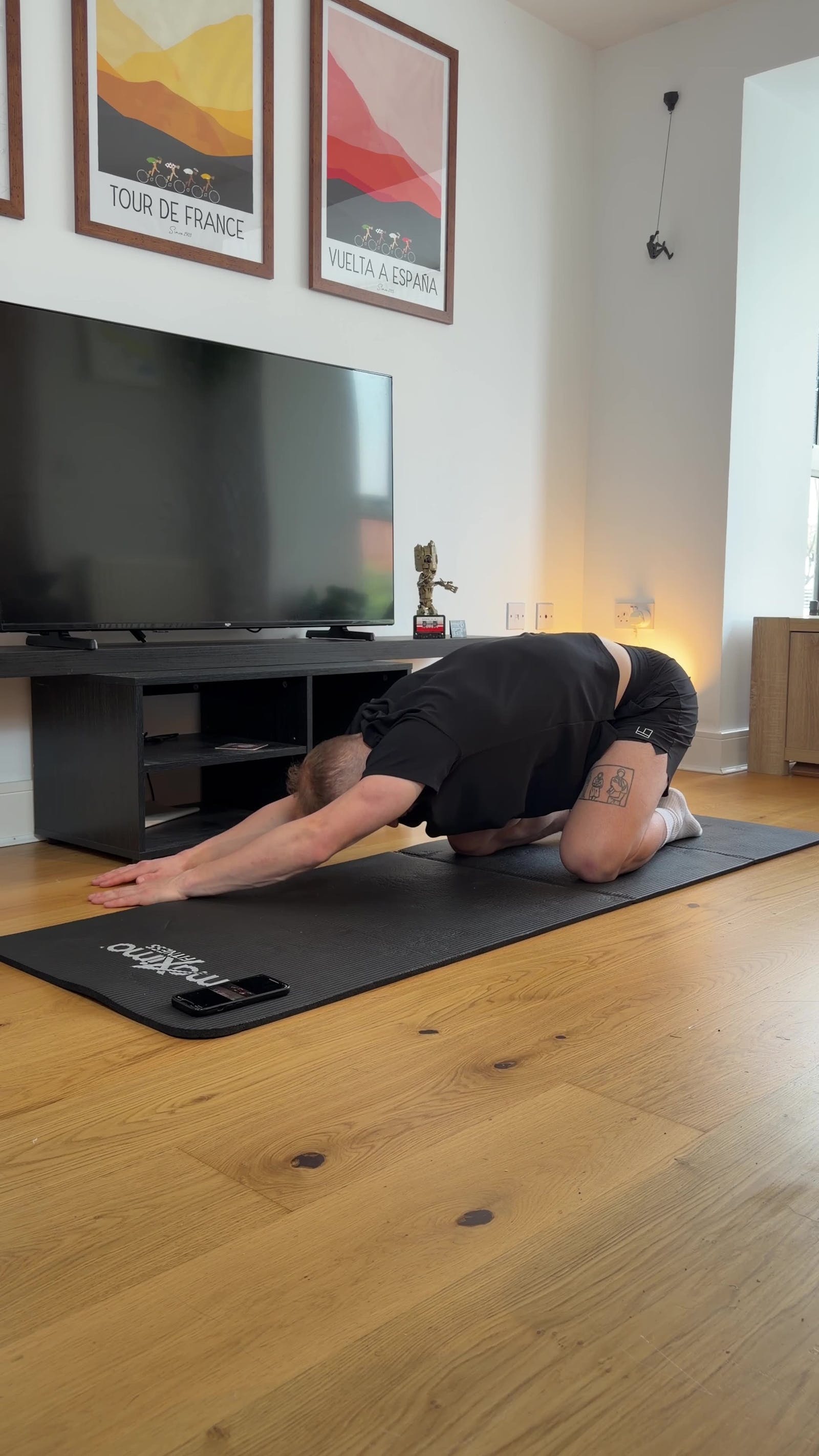
Take a cue from yin yoga
Yin yoga is built around the opposite of forcing, which is why it's worth borrowing from. You ease into a shape, drop the intensity to a mild, tolerable tension, and hold for two to five minutes while you breathe and let the tissue slowly release. Those longer holds work because the intensity is low. You're settling into your edge rather than shoving past it, which keeps the guarding response quiet. That gives you a simple test for any stretch. If a position is calm enough to breathe in for a few minutes, you're doing it well.
If you can't relax into it, you've gone too deep. Gentle, yin-style shapes cover most of the areas athletes get stuck: single leg forward fold, seated straddle, and down dog for the hamstrings and posterior chain; bound angle, half seated frog, and saddle for the hips, groin, and quads; supine twist, thread the needle, and cat-cow for the spine and low back.
Prioritize mobility, not just flexibility
This is where flexibility vs mobility matters. Flexibility is how far a muscle can passively lengthen. Mobility is how well you can actively control movement through a range. You can be flexible and still lack mobility if you can't own the positions you can reach. Chasing raw flexibility often produces range you can't use, while building mobility gives you range you can move through with strength and stability, which is usually what athletes actually need.
Try active stretches
Instead of parking in a long passive hold, move gently in and out of end range under your own control, using moves like controlled leg lowers, active hip openers, and slow overhead reaches. These active mobility exercises respect the nervous system's need to feel in control of a position, so they tend to build usable range with far less pain than aggressive passive stretching. In the pliability app, the "Corrective" and "Warm Up" filters are an easy way to pull up routines built around this kind of active, controlled work.
Strengthen the end range
If a "tight" muscle is really an under-controlled one, strength is the fix. Loading a muscle through its full available range, with work like eccentric hamstring curls, deep controlled lunges, and end-range shoulder drills, teaches your body it's safe there and reduces the protective tightness. Athletes are often surprised that getting stronger in a position removes the tightness that stretching never could.
Be consistent instead of forcing progress
Flexibility and mobility are trained the way strength is, in small, repeated doses over weeks. Ten focused minutes most days beats one punishing session a week. Forcing progress by cranking harder mostly produces soreness and guarding, while consistency produces lasting change.
Stop if pain is sharp, nerve-like, or worsening
Some pain isn't for pushing through. Sharp, electric, numbing, or radiating pain, or anything that intensifies the longer you hold, is your cue to stop rather than to breathe through it. Pushing past these signals is how a minor irritation becomes an injury.
how pliability can support safer, more effective mobility work
Most stretching pain comes from guessing: stretching at random when something feels tight, going too hard because harder feels productive, and never quite knowing whether a muscle needs more length or more control. That guesswork is what leads people to force stretches their bodies aren't ready for.
stretch without pain: try pliability free for 7 days

To avoid pain or injury while stretching, start slowly. If you're just beginning a mobility routine, don't push yourself too hard to improve your flexibility. Instead, ease into the process and allow your body time to adjust.
Focus on gentle stretches and static holds that feel comfortable. After a few days, you can begin to increase the intensity of your stretching routine gradually. If you're feeling pain, especially sharp or intense pain, stop immediately.
If stretching keeps hurting, the answer is usually a smarter plan, not more force. pliability gives you a guided Daily Session built around controlled, productive stretching, plus Paths that target the areas that tend to complain the loudest, like hips and hamstrings. Take the mobility test to see where you're actually restricted, use Build Your Program to shape training around your body and your goals, and lean on the Rebuild hub when you're working around pain. Try it free for 7 days on iPhone, iPad, Android, or on the web.
Related Reading




Move better in 10 minutes a day.
10,000+ five-star reviews.