


LEARN
pliability

When you're knee-deep in training for your next race, the last thing on your mind is stretching and mobility exercises for runners. Neglecting these crucial aspects of training can lead to injury or poor performance on race day. Fortunately, there's a better way to prepare for your next race: incorporating effective mobility exercises for runners into your training routine. Not only do these drills help improve your range of motion, but they also help your muscles recover faster and loosen up before your run. This article will help you improve your running performance and prevent injuries by incorporating practical mobility exercises that enhance your range of motion.
what is a mobility workout?

Mobility plays a crucial role in our workouts, especially if you run. Improving mobility helps runners maintain proper form and avoid injury. When joints lack the range of motion, adjacent tissues, including:
Muscles
Tendons
Ligaments
These tissues compensate to enable movement, which can create imbalances that lead to injuries over time. Mobility workouts for runners help improve performance by keeping the body functioning optimally. These workouts target the muscles and joints to enhance movement, improve running mechanics, and promote a balanced body.
defining a mobility workout
A mobility workout is a targeted routine that improves the function of specific muscles and joints, particularly those affecting athletic performance, such as running. Mobility workouts often include:
Dynamic stretches
Exercises that strengthen tissues to improve range of motion
Mobility Misconception
Often, people conflate mobility work with static stretching, or holding a stretch for several seconds. Mobility training aims to both elongate muscles and increase range of motion, which is a different outcome from flexibility.
Being able to touch your toes does not guarantee good mobility; flexibility and usable, controlled range of motion are different qualities.
mobility vs. flexibility vs. stretching
Static stretching, holding a forward fold, can feel good and result in greater flexibility. The practice rarely mimics the running movement and can cause your muscles to be too relaxed, especially when used as a pre-run warm-up.
Running requires a delicate balance of mobility and strength that over-stretching can counteract. In contrast, dynamic stretching more clearly mimics the actions of running by utilizing movements that will increase the range of motion needed to run safely and effectively. Dynamic stretches include:
Side lunges
Bent-knee leg swings
Unweighted, single-leg deadlifts
the components of a mobility workout
Mobility routines target specific body parts, varying based on individual needs. For example, if you have tight hips, your mobility workout will include exercises that improve the function of the hip joint and surrounding muscles.
To start, perform a few dynamic stretches to warm up the body. Then, complete an appropriate number of repetitions for each mobility exercise. Focus on controlled movements and gradually increase the range of motion with each repetition.
how do mobility exercises help with running?

Mobility impacts running performance. When we think of running performance, we often think of speed and endurance. But mobility, or how well your joints move, also plays a role. Running requires a lot of repetitive motion, and the more efficient you are at this movement, the better.
joint efficiency
Mobility exercises improve the range of motion (ROM) in the joints crucial for running, like the:
Hips
Ankles
Knees
Enhanced mobility can lead to better-running form and efficiency. The better your form, the less energy you waste while running and the less susceptible you are to injury.
injury prevention through mobility work
A huge share of runners are sidelined by injury every year, and most of those are overuse injuries. Considering runners repetitively load their joints more than virtually any other fitness enthusiast, this may not come as a surprise.
Mobility exercises help sustain joint health and the ligaments and tendons that surround them, so think of mobility like a therapeutic exercise to enhance your running longevity. The bottom line: If you want to stay in the fast lane, a mobility routine for runners needs to be part of your routine.
Overuse Injuries
Plantar fasciitis, patellar tendinitis (aka "runner's knee"), shin splints and more. If you've been running for over a year, you've probably experienced some flare-ups.
Overuse injuries, or injuries caused by doing too much too soon, are common in runners not because the activity is inherently dangerous or unhealthy but because beginner runners often underutilize strength and mobility training.
Injury Prevention
A case of runner's high can make it easy to increase mileage or pace too quickly. Beyond safely increasing your mileage, fueling properly, and getting enough sleep, mobility, and strength training may help runners reduce the risk of overuse injury and recover from any injuries they may incur.
Mobility training can help runners determine asymmetries or changes in the body. For some injuries, such as those involving the big toe, mobility may be more significant in the recovery process.
Strength Focus
Rehabbing an injury should almost always improve stability and strength, which is easiest done through strength training. Stretching alone rarely drives long-term improvements in performance or rehab, and research links regular strength training with meaningful gains in running economy.
the role of mobility in injury recovery
If your body is mobile, your joints are moving without any limitation, and the muscles surrounding the joints are strong and under control. In this way, you massively reduce the risk of any running injury. A mobile body is the best injury prevention you can get.
Mobility helps to release any tension or stress accumulated in joints or surrounding muscles and tendons. It just feels so good and gives instant relaxation! Mobility improves efficiency of movement, meaning you can run faster for longer and more easily tackle hills on your route.
the benefits of mobility work for runners
Here are some of the benefits of supplementing your running routine with mobility work:
Better range of motion
Mobility exercises help increase the range of motion of your joints and muscles, which in turn allows for more efficient stride patterns and movements.
Injury Prevention
Tight muscles and restricted joint mobility can easily lead to injury if you overexert yourself. Mobility training:
Helps improve flexibility
Reduces your risk of strains and sprains
Improved Performance
Better mobility can help improve your overall performance. When your joints move more freely and muscles work more efficiently, this helps:
Reduce energy expenditure
Boost your endurance (in combination with the right running plan, of course!)
Faster Recovery
Stretching is one way to speed up recovery after long and challenging runs.
Balance and Coordination
Running requires excellent coordination and balance, especially when training on trails. Mobility exercises help with all this, helping you maintain stability and avoid falls. Consistency is critical for any performance gains you’re hoping to make; mobility training will not only make your training routine more fun and more accessible to follow, but it’ll also help you recover better and be more efficient during your runs.
27 mobility exercises for runners to improve range of motion

Improving range of motion can enhance running performance by reducing stiffness and improving ease of movement. This can help runners run faster and avoid injuries.
1. ankle mobility exercise
Start in a 90-90 kneeling position with the left knee on the mat and right foot forward, both knees bent 90 degrees.
Place the left hand on the mat next to the right heel and the right hand on the right knee. Hinging forward at hips with a flat back, drive the knee forward over the big toe.
Return to the neutral position with the knee over the ankle.
Drive the knee forward over the second toe and back again, working toward the pinky toe, one toe at a time.
Reverse from the pinky toe to the big toe for a total of 10 reps.
Ensure the back stays flat, the hips stay centered, and the heel doesn’t come off the ground throughout.
Repeat on the left side.
This exercise improves ankle mobility, which can help runners achieve better form and speed.
2. hip mobility exercise
Start in a 90-90 kneeling position with the left knee on the mat, right foot forward, arms at sides (rest the knee on a folded towel for added support).
Shift weight forward as you press the hips forward and raise both arms overhead, keeping a straight back. You should feel a stretch in the left hip flexor.
Slowly lower the arms as you return to kneeling.
Do 5 reps.
Repeat on the other side.
This exercise targets the hip flexors, which help with running mechanics.
3. adductor mobility exercise
Start on all fours, knees under hips and shoulders over wrists.
Place a towel under the right knee for support if needed.
Extend the left leg out to the side, planting the foot flat on the ground.
With a flat back and neutral neck, rock back by sending the butt toward the right heel, then rock forward. You should feel a stretch in the inner thighs a.k.a. adductors.
Do 5 reps.
Repeat on the other side.
This exercise improves mobility in the adductor muscles, which help stabilize the groin and pelvis during running.
4. hamstring stretch
Lie faceup with legs extended.
Bend the left knee up to a 45-degree angle, placing hands behind the left thigh.
Extend the left leg straight up toward the ceiling, gently pulling the leg and toes toward you at the top.
Do 5 reps.
Repeat on the right side.
This stretches the hamstrings, which can become tight and restrict movement when running.
5. windmill
Stand with feet wider than hip-width apart and arms extended straight out from sides, at shoulder height.
Hinge at hips and bend the right knee, keeping the left leg straight, and rotate to touch the left fingers to the right toes.
Reach the right hand up toward the ceiling.
Stand back up, arms straight out to sides at shoulder height.
Hinge at hips, bend the left knee, and rotate to touch the right fingers to the left toes as the left hand extends up toward the ceiling.
Continue alternating for 20 total reps (10 reps per side).
This exercise improves mobility in the hips, hamstrings, and groin.
6. figure-four stretch
Lie faceup with knees bent.
Cross the left ankle over the right knee.
Lace fingers behind the left hamstring, then gently pull the right leg toward you to activate the stretch on the left side.
Lower the leg back down to the ground.
Relax, then repeat.
Do 5 reps.
Repeat on the other side.
This exercise stretches the piriformis, a small muscle in the hip that can become tight and restrict movement when running.
7. quadruped to downward dog
Start on all fours, knees under hips and shoulders over wrists.
Tuck toes and lift knees off the ground as you push back through hands to lift hips up and back into downward-facing dog.
Lengthen the spine and relax the neck.
Straighten legs as much as you can without feeling uncomfortable tightness in your hamstrings.
Keeping the back flat, lower back down to all fours.
Repeat.
Do 10 reps.
This movement improves mobility in the spine, hamstrings, and calves.
8. modified brettzel stretch
Lie faceup then bend the right knee to a 90-degree angle.
Rotate slightly to draw the right knee over the left leg until it touches the ground on the outside of the left leg.
Place the left hand on the right knee to hold it in place as you extend the right arm straight out to the right.
Swoop the right arm up overhead and around to meet the left as you stack the shoulders.
Reverse the rainbow motion while keeping the right knee down to the ground to open up the chest.
Do 5 reps.
Repeat on the left side.
This targets the thoracic spine and helps improve rotational mobility.
9. lunge to rotation
Stand with feet hip-width apart.
Step the right foot forward and bend the knees to drop into a lunge.
As the right knee bends, hinge forward at the hips and plant the left hand on the ground.
Rotate the torso to the right as you extend the right arm up toward the ceiling.
Bring the right arm back down to frame the right leg, then stand back up.
Repeat on the left side.
Continue alternating, completing 10 reps total (5 on each side).
This dynamically stretches the hip flexors and improves mobility in the hips and trunk.
10. alternating reverse four-point bridge
Start seated with feet planted and knees bent at a 45-degree angle and hands planted behind hips, fingers pointing away from you.
Lift the hips, engaging the glutes as you open to the right side by extending the right arm up and overhead as you press the hips up.
Lower the hips and hand back down.
Repeat on the left side.
Do 20 total reps (10 on each side).
This exercise improves mobility in the thoracic spine and hips.
11. runner’s stretch
Begin in a full plank position with your hands, wrists, elbows, and shoulder lined up, your body straight from head to feet, and weight distributed between your hands and toes.
Bring your left leg forward so your left foot is on the outside of your left hand.
Adjust until you are in a stable position.
Push your left knee forward while simultaneously stretching your right foot back, pulling in opposite directions.
Take your left arm and stretch it toward the ceiling, turning your torso toward your left with you.
Reach up and hold this position for a couple of seconds.
Return your left hand to its initial position and bring your left foot back to its initial position so you have returned to a full plank.
Repeat on the other side.
Alternate sides and complete 4-6 repetitions.
This targets the hips, groin, and legs to improve mobility for running.
12. goblet squat
The goblet squat is often used to build strength while holding a heavy kettlebell in between your hands. In this case, we will use it specifically for mobility purposes (ankle and hip mobility), focusing on pushing our knees outward as we lower down into position.
Stand tall with your feet a bit wider than hip-width apart and your toes slightly turned out.
Hold your hands to your chest, shoulders back, and chest up.
Bend at the knees and hips as you sit back until your thighs are parallel to the floor.
Using your elbows, slightly push your knees outward.
Extend your knees and hips, pushing yourself back to your initial standing position.
Repeat for 10-12 reps.
13. walking lunges with overhead reach
Walking lunges not only improve your range of motion but also work your stability and coordination. The overhead reach works your shoulder mobility.
Stand tall with your feet shoulder-width apart and reach your arms overhead, elbows by your ears.
Engage your core and take a big step forward with your right foot.
As you take this step, bend both knees until they reach 90 degrees. Your left knee will be just above the ground, and your right thigh will parallel the floor. Be sure your front knee does not pass in front of your toes.
Push off your right foot and walk forward without stopping in the middle, performing a lunge on the other side.
Keep your arms extended overhead throughout the entire number of reps.
Repeat for 8-12 reps.
14. full plank ankle pump
Continuing with ankle work, this mobility exercise will help improve the range of motion in your ankles while promoting good posture and engaging your core.
Begin in a full plank position with your hands, wrists, elbows, and shoulder lined up, your body straight from head to feet, and weight distributed between your hands and toes.
Place your left foot on the back of your right ankle.
Shift your weight forward and backward, using your ankle to redistribute your weight.
Repeat for 8-12 reps.
Repeat on the other side.
15. downward dog walk outs
This yoga-inspired mobility exercise is great for ankle and spine mobility while stretching your calves and hamstrings.
Stand tall with your feet shoulder-width apart, core engaged.
Bring your hands down to the floor and walk them out until you are in a full plank position.
Push your hips up and shift your weight back until you have formed an inverted V position.
Keep your head down between your elbows.
Press your heels into the ground to stretch your calves.
Hold this position for a couple of seconds.
Bring yourself back into your full plank position.
Walk your hands back toward your feet and stand up, returning to your starting position.
Repeat for 8-12 reps.
16. squat to stand
Stand tall with your feet wider than hip-width apart.
Bend at the waist and grab underneath your toes with both hands.
You will likely need to bend your knees to get into this position.
Using your arms, pull yourself into a deep squat position, knees pushing outward and chest up.
Extend your knees, holding your toes, head down, and back slightly arched.
Repeat for 8-12 reps.
17. hip rotation
Lie face up with your knees bent at 90 degrees and lower legs parallel to the floor.
Extend your arms out so you form a T. Keep your shoulder blades on the floor, twist at your hips, and bring your legs down to one side.
Lower your legs down just until the point where your shoulder blade is just about to lift off the ground.
Return to the center, and lower your legs to the other side.
Repeat for 8-12 reps.
18. shoulder blade squeezes
This move mixes a shoulder blade squeeze with a wall-free scapular slide. It helps with posture, since runners tend to round their shoulders.
Kneel on the floor with your back straight and chest proud.
Bend your elbows at 90 degrees, open your chest, and place your elbows at your sides at shoulder height.
Squeeze your shoulder blades together.
In a controlled movement, bring your arms up overhead.
Hold this position for a couple of seconds.
Slowly bring your arms back to their starting position, always keeping your shoulder blades squeezed tightly together.
Repeat for 8-12 reps.
19. cat-cow
Put yourself in a kneeling table-top position with your knees hip-width apart and your hands shoulder-width apart.
As you take a deep breath in, arch your back (cow pose), drop your belly to the floor, and gaze upward.
Breathe out and, as you exhale, pull your belly in and round your back (cat pose).
Hold each pose for a breath or two and repeat five to 10 times.
20. hip circles
This hip mobility exercise helps stabilize muscles around the hip joint.
Lie down on the floor on your back. Leave your left leg on the ground and straight in front of you.
Bend your right leg and gently hold it with your right hand as you move the leg in a clockwise motion.
Do this five times and then switch to a counterclockwise motion for five more circles.
Repeat the same exercise on the other leg.
You can start with small circles and gradually make them bigger. You can also try this exercise standing up.
Hold on to a sturdy chair, table, or wall for support if needed.
21. single-leg step-up
You'll need a sturdy box or step to perform this movement.
Stand in front of your box or step with your feet hip-width apart.
Place one foot onto the box or step and slowly step up. You'll hinge slightly forward at the hips as you step up, but be sure to keep your back straight. Don't use momentum or the back leg to push you up.
Keep the movement controlled, using mostly the glute in your working leg to lift you and your core to stabilize you.
If you'd like, hold a dumbbell or kettlebell in the hand on the same side as your working leg.
Perform 8-10 reps, then switch legs.
22. single-leg calf raises
This one's as simple as it sounds.
Standing on one leg, raise up onto your toes, engaging the calf muscles, and then slowly lower your heel to the starting position.
Perform 10-20 reps, then switch legs.
You should feel this throughout the backside of your standing leg.
To increase the range of motion, you can stand on a box or stool, with the ball of your foot on the platform and your heel off the platform.
When you lower, you'll lower your heel slightly below the platform.
If including weight, hold a dumbbell or kettlebell on the same side as your standing leg.
23. farmer's carry
Carry a kettlebell or two large dumbbells in each hand, arms lowered by your sides.
Walk 5-10 steps forward and then turn around and come back, keeping the upper and lower body aligned, pelvis tucked in a posterior tilt (so that there's no curve in your spine) and core engaged.
24. plank
Starting in the tabletop position, come up onto your hands and feet.
Place your arms parallel and shoulder-width apart, pushing out from the shoulders and engaging the core.
The legs should also be parallel to each other and no further apart than hip width (though for a challenge, you can place them closer together).
Hold for 20-60 seconds.
25. side plank
From the plank position, turn over to one side, allowing the top leg to lie on top of the bottom leg while engaging both legs. Your bottom arm should be perpendicular to your shoulder, with that hand pushing out from the ground while you engage your obliques. Your top arm should be up and perpendicular to the ceiling.
Hold for 20-60 seconds on each side.
To modify, place your bottom knee on the floor.
26. push-ups
From the plank position, lower down until your arms are in or near a 90-degree angle before pushing back up.
Keep your hips in line with your upper body, preventing them from sinking or hiking up.
If you're unable to perform at least 5 controlled reps in good form, lower onto your knees, making sure your hips and core remain in line with your upper legs.
Perform 5-10 reps.
27. finisher: plank rows
In the plank position-and holding a light-to-medium dumbbell in each hand-engage the core while you lift up one dumbbell, stopping when the arm reaches the waist. Your body will slightly adjust its weight to the side with the dumbbell still on the ground, but try not to twist your body.
Lower the dumbbell back down and then perform the same movement on the opposite side.
Perform 5-10 reps per side or, if performing as a finisher, complete as many reps as you can until exhaustion.
should I do mobility exercises before or after running?

Mobility exercises help runners before and after they run. Routine mobility work primes the body for running, improving performance while reducing the risk of injury. After a run, mobility exercises help the body recover, restoring motion to stiff and sore muscles and joints.
the what and why
Mobility is key in the morning. Restoring motion relatively early in the day matters because we lose mobility overnight, both due to a lack of movement and a lack of hydration.
A morning routine jumpstarts the mobility and hydration restoration process so that we are able to fully restore normal motion by day’s end, which is the key to long-term mobility maintenance.
dynamic – not static
A movement-based mobility routine is most useful and functional because it facilitates two key concepts:
Tissue warming
Tissue hydration
Active movements generate heat, which is a crucial part of the tissue mobilization process. Motion also pumps water into the moving tissues.
running specific
A good mobility routine should be running-specific. This implicitly means it should be whole-body, as we run with not only the legs but the arms and trunk too.
traction based
An effective but gentle mobility routine should emphasize traction. This is the concept of not only elongating tissues lengthwise, but trying to distract tissues, namely bones and joints, through generating space between individual structures.
This is the opposite of compression, which is attempting to mobilize tissues by pushing structures together.
progressing to more assertive movements
A good mobility routine will, like a run, begin gently and get progressively more assertive.
moving from passive to active
A quality mobility routine will begin fairly passively, and become increasingly active by recruiting more muscle activation in running-specific motions.
breath-centric
The most useful mobility routines will also emphasize breath. Efficient breathing not only facilitates mobility, it also prepares the cardiopulmonary and nervous systems for optimal function whether that’s on a run right after, or simply diving into your day.
how often should runners do a mobility workout?

Runners can benefit from regular mobility workouts to improve performance and reduce injury risk. How often should you do mobility workouts? The short answer: It depends. A good approach is to incorporate short mobility routines before and after runs, then follow a weekly schedule for more structured mobility workouts.
This is similar to how you might structure your strength training routine. It’s recommended to do a little here and there before each run as a part of your warm-up. If you can spend an additional 10 minutes on a more complex mobility workout on your rest days, why not? You can do this in front of the TV, without any equipment, on a carpet… it’s really that simple!
choose your mobility day
The day you pick for your mobility session will be the same every week; this introduces a sense of consistency and helps you stick to your routine. Choose the day based on your schedule, availability, and preferences. Here are some of the options to help you pick what works best for you:
Rest Day: Doing your mobility workout on a day when you’re not running is a great way to focus on recovery and keep you moving. Some people prefer a complete break of all exercise on rest days; if this is you, opt for a different day.
Before Your Long Run: Scheduling your mobility workout before your long run helps activate your muscles and joints, which, in turn, increases your flexibility and lowers injury risk. Some runners may choose to do a light cardio warm-up before their long run and do their mobility session at a different time.
After Your Long Run: Adding mobility exercises after your run can help the cool-down process, ease muscle tightness, enhance flexibility, and promote recovery. One potential downside is that fatigue from the run might diminish the energy and concentration needed for an effective mobility routine.
the perfect, no-equipment mobility routine for runners

get the ankles moving with this dynamic calf stretch
The dynamic calf stretch increases ankle mobility. A large share of running injuries occur at the ankles and feet, so they need to be a major mobility focus.
Begin standing with your feet side-by-side.
Maintain good posture with your shoulders over your hips as you move your right foot back about two feet, keeping your toes facing forward.
Keep both heels on the ground. If the heel on your trailing leg doesn’t reach the floor, move your back foot a bit closer to your front foot. Now, you are ready to move. The only movement will be the knee of your trailing leg.
Slowly move back and forth between bending and straightening your back knee, while keeping your heel on the ground. You should feel a gentle pull shifting between your calf and Achilles area with each repetition.
Repeat 10 times
Perform on the other side.
If you feel pain, pinching, or locking in the front of your ankle, do not push through it. That might be a sign of a medical issue for which you should see an orthopedic doctor.
increase mobility in your big toe with bent-knee calf raises
Bent-knee calf raises increase mobility in your big toe. While this area is often overlooked, it provides much of your balance and push-off power.
Begin with your feet side by side and your knees slightly bent. Bending the knees allows more motion at your toes.
Complete 10 calf raises in this position.
improve hip and knee mobility with knees to chest
Knees top the list of running injuries. And just like ankles, they need mobility work, too. Knees to chest helps increase hip and knee mobility, with an added bonus of standing leg stability.
Begin standing with your feet directly under your sit bones. Keep your posture upright throughout the entire exercise.
Fully straighten your left knee and engage your left glutes to create a strong supporting leg.
Actively bring your right knee as close as possible to your chest and give it a one-second hug.
Bring your right leg down, then repeat the process on the other side.
Alternate sides so each side gets 10 reps.
work on coordination with air squats
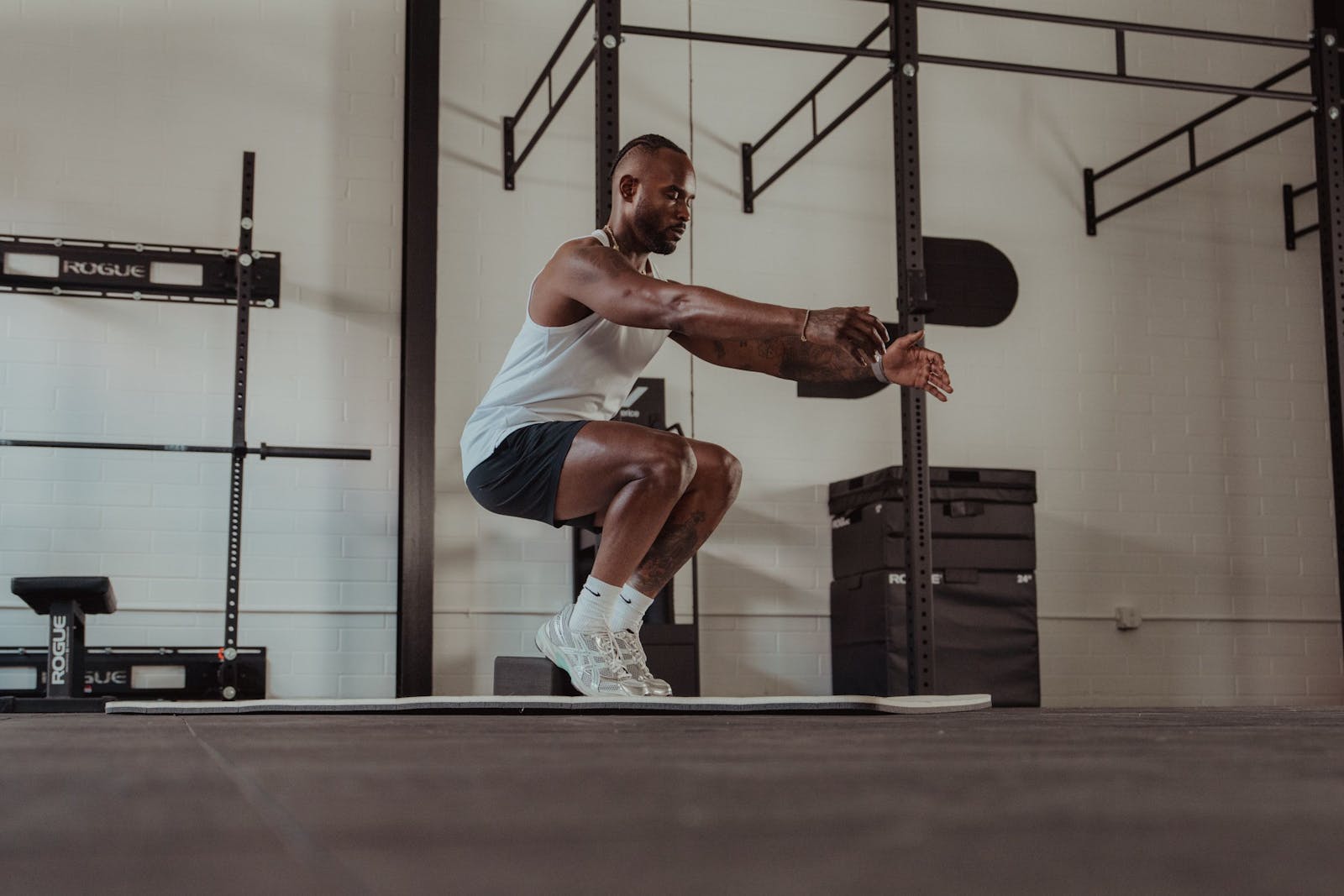
Air squats teach your hip, knee, and ankle mobility to work in coordination. Coordination is an essential performance and injury-prevention skill.
Begin standing with your feet at about shoulder width.
Turn your toes outward about 45 degrees. Keep your knees in line with your toes throughout the movement, as opposed to letting them cave inward.
Descend into a squat by hinging at your hips, then sending them down and back. Allow your arms to come forward, as this can increase the depth of motion.
Go as low as you can while maintaining a flat back and heel contact with the floor.
At the bottom of the movement, squeeze your glutes to return to your standing position.
Repeat for 10 reps.
target knee mobility with butt kickers
Butt kickers increase knee mobility, with an added bonus of standing leg stability. Kneecap tracking problems cause a meaningful share of running injuries, which makes butt kickers a top-of-mind risk reduction drill.
Begin standing with your feet directly under your sit bones. Keep your posture upright throughout the entire exercise.
Fully straighten your left knee and engage your left glutes to create a strong supporting leg.
Actively bring your right foot back and up toward your right glute, catching it and holding it for a second with your right hand.
Try to keep your knees close together.
Bring your right leg down, then repeat the process on the other side.
Alternate sides so each side gets 10 reps.
increase hip, trunk, and shoulder mobility with side bends
Side bends increase hip, trunk, and shoulder mobility. Tension in the trunk muscles often limits hip and knee mobility, which makes trunk mobility essential.
Begin in a wide stance with your toes forward and your arms straight out to the side. Your feet will be directly under your elbows.
Place your right hand on your right hip.
Reach your left arm up in the air so your arm is next to your ear.
Bend sideways toward the right while keeping your abs tight. Allow your hips to shift to the left.
Return to standing, then repeat on the other side.
Alternate sides so each side gets 10 reps.
improve overall mobility with torso twists
Torso twists increase toe, ankle, hip, and trunk mobility simultaneously. This coordination helps your shoulders and lat muscles contribute to your running speed.
Begin in a wide stance with your toes forward and your arms straight out to the side. Your feet will be directly under your elbows.
Keep your right leg stationary as you twist your torso to face the right side of the room.
During the twist, come up to the ball of your left foot so your entire left leg can pivot toward the right as the torso moves.
Alternate sides so each side gets 10 reps.
tips for incorporating mobility training into your routine

start with the basics
Before jumping into advanced mobility exercises, begin with basic range of motion exercises. These will help to get your body warmed up and ready for more intense training. Basic mobility exercises for runners include hip circles, leg swings, and ankle pumps, to name a few.
warm up with dynamic movement
Dynamic warm-ups are a great way to get your body ready for your run. They help to increase your heart rate and improve your range of motion. Dynamic warm-ups incorporate movement, rather than static stretching, which can actually hinder performance if done prior to activity.
Some dynamic movements to include prior to your run are:
Walking lunges
High knees
Butt kicks
Carioca
target key areas
When incorporating mobility exercises into your routine, focus on the major muscle groups used in running. This includes the:
Hips
Shoulders
Core
Improving mobility in these areas can help you:
Run more efficiently
Reduce your risk of injury
include myofascial release
Myofascial release is a great way to reduce muscle soreness and improve range of motion. You can use a foam roller or lacrosse ball for myofascial release. This technique helps to relieve tension in the muscles and fascia to improve mobility.
stretch it out
Incorporate stretching into your routine at least three times per week. Aim to hold each stretch for at least 30 seconds. Static stretching is especially effective for improving flexibility and mobility after a workout when the muscles are warm.
running stretches: the best runner stretches for after your run
Mobility drills prepare you to run; static running stretches help you recover afterward. Flexibility for runners builds the same way mobility does, through consistency, so treat these running flexibility exercises as the closing chapter of each run rather than an optional extra. Ease into each stretch instead of bouncing or forcing it, never push to the point of pain, hold each position for up to 30 seconds, and repeat once or twice per side. Together, these stretches for leg muscles cover the areas running loads hardest.
lying hamstring stretch
Targets: Hamstrings
Lie on your back with both legs straight.
Bend one knee and pull it toward your chest.
Straighten the leg as much as you can without pain, keeping the other leg flat on the floor.
Loop a non-stretching band or cord around the foot to assist. You should feel the stretch along the back of your thigh.
This releases tension in the hamstrings after the repeated hip extension of a run.
straight-leg calf stretch
Targets: Calves
Stand facing a wall.
Place your left foot forward with the knee bent and your right leg straight back.
Press your right heel into the floor and lean forward until you feel a stretch in your calf, then switch sides.
To reach the lower calf and soleus, bend both knees slightly and lean back while keeping your heels down.
standing quadriceps stretch
Targets: Quadriceps
Stand on one leg and bend the knee of your opposite leg, grasping your ankle with the same-side hand.
Pull the heel toward your glutes, keeping your body straight and flexing your foot to maximize the stretch.
Use a wall for balance if needed, then switch sides.
Restoring quad length after a run supports knee drive and healthy kneecap tracking.
lying glute stretch
Targets: Glutes
Lie on your back with your knees bent and feet flat on the floor.
Place the ankle of one leg on the opposite knee.
Grasp the thigh of your bottom leg and pull both legs toward your chest. You will feel the stretch around the side of your buttocks.
This eases the deep hip rotators that stabilize every stride.
kneeling hip flexor stretch
Targets: Rectus femoris, psoas
Kneel on one knee and place the other foot forward.
Keep your pelvis and back steady and shift forward while squeezing your glutes and hamstrings.
If comfortable, gently pull the back heel toward your buttocks for a deeper stretch, then switch sides.
Lengthening the hip flexors after a run counters the shortened position they hold during each stride and while sitting.
groin stretch
Targets: Groin and adductors
Sit on the floor and place the soles of your feet together, letting your knees drop out to the sides.
To intensify the stretch, bring your feet closer to your body.
Supple adductors keep the pelvis stable and protect against groin strains on uneven terrain.
build your running mobility routine with pliability | 7 days free
Consistency is what turns mobility exercises for runners into faster recovery and fewer injuries, and pliability is built to keep you consistent. Daily Sessions serve up a fresh guided routine every day, Paths let you spend focused weeks on the hips, ankles, and hamstrings that running punishes most, and Build Your Program shapes a plan around your mileage and schedule. The mobility assessment shows where your movement is restricted, so your work targets what actually limits your stride. Try pliability free for 7 days on iPhone, iPad, Android, or the web, and make mobility the easiest part of your training to stick to.
Related Reading



Move better in 10 minutes a day.
10,000+ five-star reviews.