


LEARN
pliability

A drop jump is a plyometric exercise where you step off an elevated platform, typically 12 to 42 inches, land with both feet, and explode upward into a maximal vertical jump within minimal ground contact time. It's one of the most effective ways to build reactive strength: the ability to absorb force rapidly and redirect it explosively, a skill traditional strength training doesn't build on its own. Squat numbers can climb for months without your first step getting any faster, because that requires a different stimulus, one that trains the nervous system to produce maximal force in minimal time.
Drop jumps train this by harnessing the stretch-shortening cycle: your tendons and connective tissues compress like springs during landing, storing mechanical energy that releases during takeoff, while the rapid stretch also triggers additional motor units that stay dormant during slower movements. That entire cascade happens in under 250 milliseconds of ground contact. Sports scientists measure the result with the reactive strength index (RSI), jump height divided by ground contact time, but the number alone can hide how you got there. Two athletes can post identical RSI scores through very different strategies: one absorbing force with spring-like efficiency, the other landing stiff and muscling back up through slower concentric strength. The efficient version is what transfers: it improves any movement requiring quick force after an eccentric load, the slowing down before a cut, the ground contact during a sprint, the absorption before a countermovement, and athletes who build it show faster sprint times and quicker change-of-direction because they burn less metabolic energy per ground contact.
drop jumps vs. depth jumps
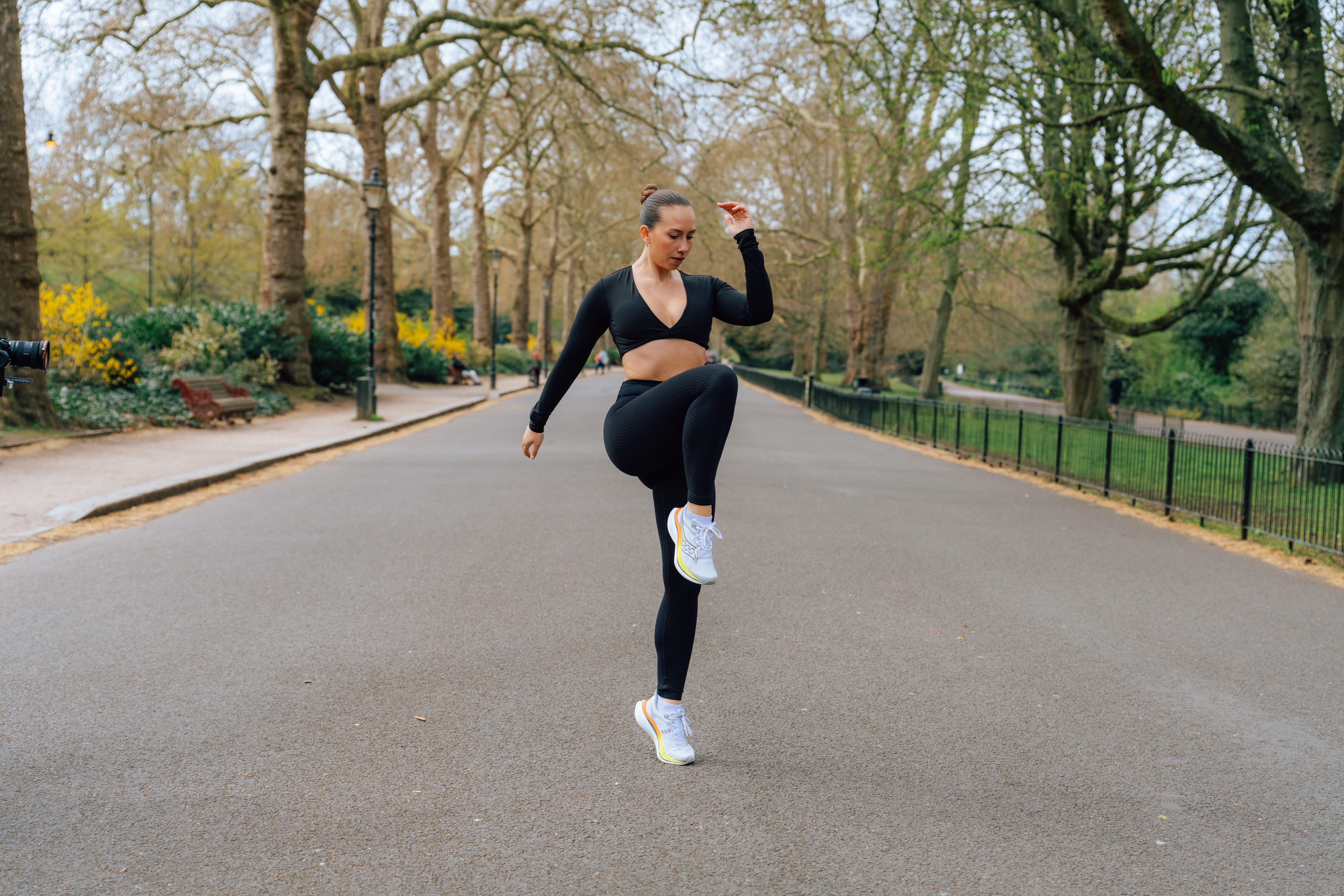
Drop jumps and depth jumps look alike but train different qualities, and confusing them means training the wrong one for your sport.
Exercise Type | Primary Focus | Ground Contact Time | Main Benefit |
|---|---|---|---|
Drop Jumps | Reactive stiffness | Under 250ms | Speed and reactivity |
Depth Jumps | Force production | Over 300ms | Maximum power output |
A sprinter using depth jumps trains power that arrives too late for competition; a volleyball player doing drop jumps never learns to generate the force a block or attack requires. Drop jumps build tendon stiffness and reflex potentiation for efficient bouncing; depth jumps build eccentric strength and rate of force development across a longer time domain for deliberate, powerful movement. Both use the stretch-shortening cycle but load different parts of the force-velocity curve, one makes you springy, the other explosive, and neither works without proper preparation: without adequate mobility and tissue readiness, both can overload joints and tendons faster than they adapt.
key benefits of drop and depth jump training

Many athletes assume bigger squats yield faster sprints or higher jumps, but without reactive plyometric work that strength stays confined to the weight room. The primary benefit is neural adaptation: your body learns to recruit muscle fibers faster and more efficiently than strength training alone develops, converting force into speed in the milliseconds that matter.
Faster acceleration off the line: drop jumps train your lower body to stiffen on contact and redirect force instantly, at ground contact times similar to sprinting (under 100ms). A drop height around 30 centimeters builds this without excessive joint stress.
Higher vertical jumps: depth jumps teach the Achilles tendon, patellar tendon, and fascia to act like springs. A longer 300+ millisecond ground contact allows more force production, which shows up as measurable gains in block jump height and attacking power.
Better cutting performance: soccer, football, and combat sports demand quick stopping and re-acceleration. Drop jumps train your ankle, knee, and hip to stabilize under load in fractions of a second, reducing energy leakage through direction changes.
Rate of force development: training your nervous system to recruit muscle fibers faster carries over to Olympic lifts, throws, and any movement demanding peak force in a narrow time window.
how to program drop jumps and depth jumps
Beginners should start with box heights of 15 to 30 centimeters and focus on control, not power: land softly on the ball of the foot with a slight knee bend, keep the torso upright without knee valgus collapse, and hit five consecutive reps with identical form before adding height. Advanced athletes can progress to 20 to 60 centimeters for drop jumps and up to 75 centimeters for depth jumps, but only after showing consistent technique under fatigue, increasing height by 10-centimeter increments every two to three weeks, not every session. Beginners should perform 2 to 3 sets of 8 to 10 reps twice weekly; advanced athletes can handle 4 to 5 sets of 5 to 8 reps, three times weekly, with 48 to 72 hours between sessions to support nervous system recovery.
Ground contact time tells you whether you're doing the exercise right. Past 250 milliseconds on a drop jump, you've lost the reactive quality and turned it into a slow-motion hop; film your landings and check, since what feels explosive often looks slow on review. Watch for the mistakes that load joints instead of muscles: stiff-kneed landings, knee valgus collapse (the knee caving inward, which stresses the ACL and meniscus), and heel-heavy landings that prevent the Achilles from rebounding, turning plyometric exercises into joint-pounding ones.
Sprinters should do drop jumps on acceleration-development days, after the warm-up but before high-intensity sprint work: three sets of six reps from a 30-centimeter box, focused on sub-200ms ground contacts. Contrast training pairs depth jumps with heavy squats: three depth jumps from 60 centimeters, rest 30 seconds, then a set of three back squats at 85% of one-rep max, using the jumps to prime high-threshold motor units before the squat set. Team-sport athletes can use depth jumps in vertical power sessions, four sets of five reps from 50 centimeters, after strength work but before conditioning, with full recovery between sets. If fatigue is compromising your landing mechanics, you're too tired to train power safely, and ankle and hip mobility determine whether you can reach the positions that make plyometrics effective in the first place.
train more explosive movement with better mobility and recovery
Drop jumps and depth jumps load the Achilles tendon, patellar tendon, and plantar fascia with forces exceeding five times bodyweight in under 250 milliseconds. Without adequate recovery between sessions, stiffness builds, range of motion drops, and the landing that felt controlled on Tuesday turns rigid by Friday. Restricted ankle dorsiflexion or tight hip flexors limit how well you load the stretch-shortening cycle: if your ankle can't reach the range it needs, force gets absorbed elsewhere, usually the knee or lower back, and your reactive strength suffers.
pliability builds that preparation into guided video sessions: Daily Sessions give you a fresh routine each day, Paths run a multi-week progression for building ankle and hip range, and Build Your Program shapes a plan around your training load. Take the mobility assessment, which uses body scanning to find your specific restrictions, so your sessions target the ankle stiffness or hip tightness actually compromising your landing mechanics instead of guessing. Start with 7 days free on iPhone, iPad, Android, or the web.
Related Reading





Move better in 10 minutes a day.
10,000+ five-star reviews.