


LEARN
pliability

Running is one of the most accessible and effective ways to improve your fitness. But as any runner knows, it can also be frustrating. You might have a great route planned, only to have your run derailed by cramps, tight muscles, or an injury flare-up. Fortunately, you can take steps to avoid these issues, starting with warm up exercises before running. This article will teach you how to warm up before lifting properly, so you can start every run feeling energized, avoid cramps and injuries, and perform at your best from the very first step. pliability's mobility app offers a great solution to help you achieve these goals. With guided routines and videos, pliability takes the guesswork out of warming up before you run, so you can get on with your workout and avoid any potential setbacks.
why warm up before running?
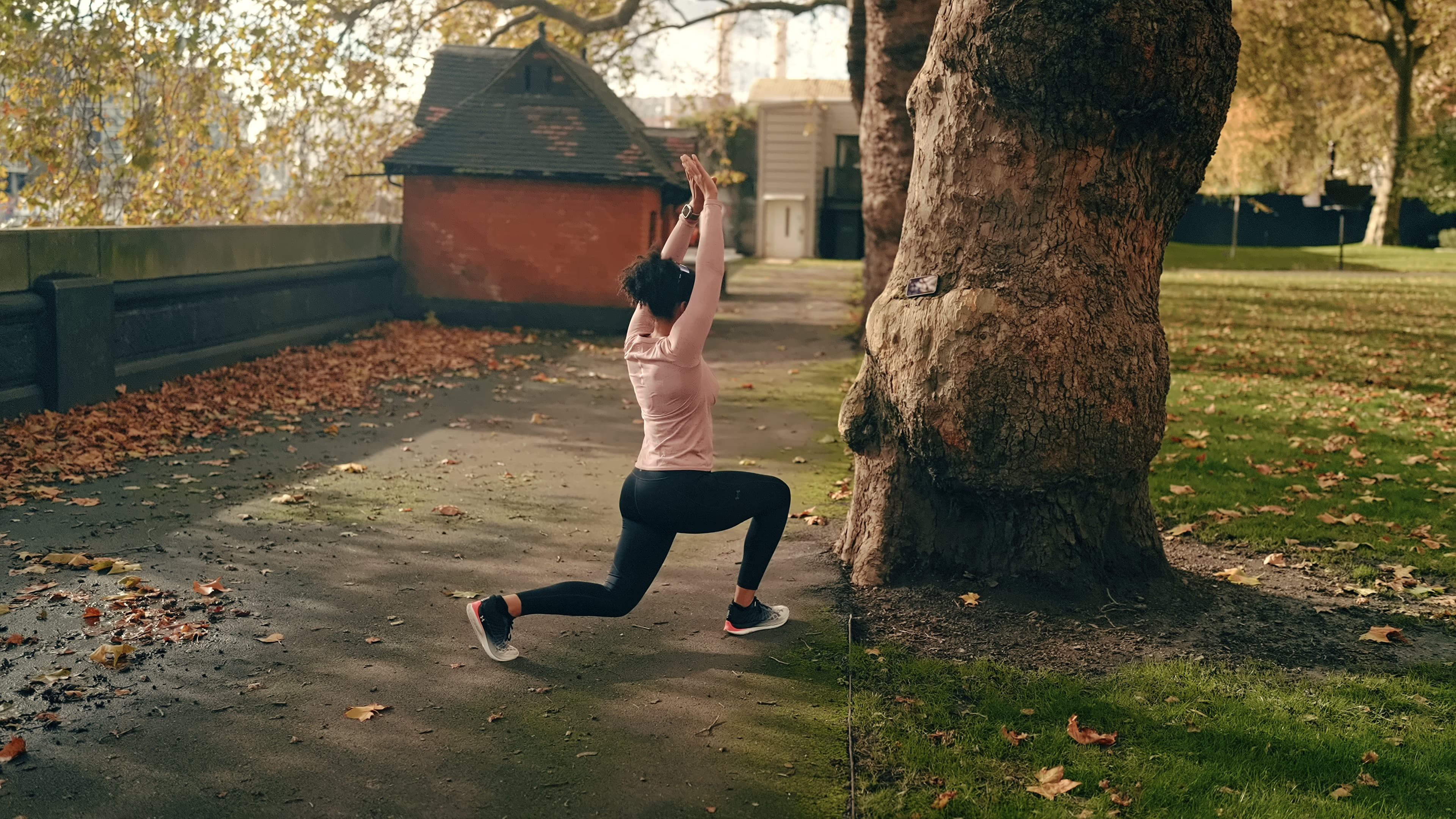
Warming up before a run gets your body ready for what's to come. Even 10 minutes of focused work with bodyweight movements can offer real benefits: it warms up your muscles, helps you mentally prepare, and supports recovery afterward. Even so, most runners skip it. For the time-squeezed, a warm-up can feel like an unnecessary luxury when one of running's great appeals is its simplicity: put on shoes, open the front door, and go.
what the research says about warm-ups and performance
A meta-analysis of 32 high-quality studies found that a warm-up was shown to improve performance in 79% of the examined data points. So if you have a challenging speed workout or an endurance run planned, warming up will help you maximize your effort. Warming up before a run also appears to reduce next-day muscle soreness compared to skipping it or only cooling down afterward.
Not all warm-ups are equal, either. A few easy minutes of cycling keeps blood moving to the bigger muscles in your legs while also giving your hamstrings and quads a dynamic stretch and response movement that a light jog alone doesn't provide.
warm-ups help prevent injury
Muscle injuries are among the most common issues seen in sports medicine clinics, and a thorough warm-up is one of your best defenses. Research on warm-up timing suggests the benefit is greatest when you warm up close to when you actually start your workout, rather than well beforehand.
warm-ups improve running technique
Specific warm-up drills, like A-skips and high knees, help your body relearn proper running technique before you hit the pavement, so your form stays on point throughout every mile, which also helps prevent injury. Warming up this way essentially lets you rehearse and restore skills you've already been practicing, whether or not you're a competitive athlete.
what should a runner's warm-up look like?
Broadly speaking, runners should do a dynamic warm-up rather than static stretches: non-static movements performed in sequence, such as hopping or leg swings.
how long should a warm-up last?
Warming up for just 10 minutes may work about as well as a session lasting 20 minutes or more. Research comparing the two protocols in endurance runners found no meaningful differences in velocity, heart rate, oxygen intake, or perceived exertion. You can cut that time further if needed: even five minutes of dynamic stretching can help prevent injury. As we age, muscle elasticity decreases, so warming up properly becomes even more important for expanding range of motion and counteracting that natural decline.
19 effective warm-up exercises before running

1. leg swings: loosen up your lower body
Leg swings help loosen up your lower body, improving your flexibility and mobility in your muscles and joints. They also challenge your balance.
Stand parallel to a wall. A railing or chair will work too, anything you can use for support.
Swing your outside leg forward and backward, maintaining your balance as much as possible and only using the wall for light support. Keep your core engaged and control the swing. You should feel like you're going right to the edge of your stretch.
Repeat on the opposite leg.
Turn to face the wall, stepping back about half an arm's length.
With both hands on the wall, swing one leg side to side just in front of your body.
Repeat on the opposite leg.
2. standing hip openers: get those hips ready for action
Runners often complain about tight hips, but an adequate running warm-up can gently prepare your hips for the work ahead. You may need a chair or countertop nearby for balance, especially if you're new to this pre-run warm-up.
Stand with your feet hip-width apart and arms out to your sides.
Shift your weight onto your left leg. Engage your glutes and quads to stay balanced.
Lift your right knee up and externally rotate it to the right side of your body. Your right knee should be in line with your right hip on the right side.
Continue the rotation by bringing your right knee behind you and eventually right below your right hip.
Repeat the movement for 30 seconds, then switch directions for 30 seconds, bringing your right leg behind you first.
Repeat on the opposite leg.
Muscles worked: Hip flexors, groin, glutes
3. deep squat rotation: loosen up your spine
Your spine gets some of the benefits of a running warm-up with this exercise. If you can't get into a super-deep yogi squat, that's okay; instead, focus on keeping your weight in your heels and your chest up. You can also put a rolled-up towel or yoga mat beneath your heels as an extra assist.
Stand with your feet wider than hips-width apart.
Bend your knees and lower into a squat, keeping your chest up, shoulders back, and back flat. Your hands are in front of your chest.
At the bottom of your squat, place your left hand on the ground and rotate your upper body and spine to the right.
Reach your right hand toward the ceiling, keeping it stacked over your right shoulder.
Hold for a few seconds, then bring your right hand down and extend your left hand toward the ceiling.
Hold for a few seconds, then bring both hands back to the starting position.
Drive your feet into the ground to come to standing.
4. single-leg hip bridge: activate your glutes
Nothing fires up the glutes quite like a single-leg hip bridge. All too often, our glute muscles can get lazy and disengaged even while we're running. A hip bridge activates the glute muscles and primes them for movement.
Lie on your back with knees bent and feet flat on the floor.
Your arms are long at your sides.
Lift your left foot and drive your left knee into your chest.
Driving your right foot into the floor, bridge your hips up and fully extend them, creating a long line from your shoulders to your knees.
Hold and squeeze for a few seconds. Make sure your hips are square and in line with each other; one hip shouldn't be significantly higher than the other.
Slowly and with control, lower your hips. Briefly tap your hips to the floor, then drive up again for another rep.
Repeat for 30 seconds, then switch legs.
Muscles worked: Glutes, hamstrings, lower back
5. clamshell with a hip bridge: target your hips and glutes
This exercise targets your hips and glutes, making it a must for your pre-run warm-up. Want to increase the challenge? Add a mini-loop just above your knees, or hold a lightweight on your top leg.
Lie on your side, using your forearm or hand to support your head. Your hips should be in line with your shoulders, with your knees bent at a 45-degree angle slightly in front. Your lower forearm is flat on the ground, and your top hand can rest lightly on the ground for support.
On an exhale, squeeze your glutes and lift your bottom hip off the ground as if you're doing a side plank. Your hips should be in line with your shoulders.
Simultaneously, open your knees, keeping your feet glued together at the ankles. You should feel this in your hip abductors. Throughout this move, focus on keeping your pelvis slightly tucked forward to keep your back flat and prevent it from arching.
Hold for a few seconds and squeeze.
In one smooth, controlled motion, bring your knees back together and lower your bottom hip to the ground. Briefly tap your hip to the ground, then repeat.
Repeat for 30 seconds, then switch sides.
6. high knees: get your heart rate up
Not only do high knees get your heart rate up, but they also activate your core, which is responsible for keeping you upright during your run. Pro tip: get your arms involved for an extra burst of power.
Stand with your feet hip-width apart and arms loose at your sides.
Lift your left knee up, driving it toward your chest. Simultaneously swing your right arm forward with the elbow bent at a 90-degree angle.
Lower your left leg back to the ground and immediately lift your right knee up, driving it toward your chest. Simultaneously swing your left arm forward with the elbow bent at a 90-degree angle.
Once you feel coordinated, increase your speed until you're running in place. Aim to get your knees at or above hip-level.
7. A-skips: get skipping again
Yup, your favorite playground activity is back as a running warm-up exercise. These are similar to high knees, but with a different rhythm. If you don't have room to skip, such as if you're running indoors, you can do this drill in place.
Stand with your feet hip-width apart and arms loose at your sides.
Lift your left knee up toward your chest while driving your right arm forward and up.
As your left knee reaches its highest point, extend your right leg down so it's completely straight.
Land on your left foot and immediately drive your right knee up toward your chest. Simultaneously swing your left arm forward and up.
As your right knee reaches its highest point, extend your left leg down so it's completely straight.
Continue alternating, keeping a skipping rhythm as you increase the pace.
8. jogging in place: start slow
Before you go full throttle, spend a couple of minutes jogging at a slow, steady pace. Prioritize good running form, even if it feels more comfortable to loosen up a bit first.
Keep your shoulders stacked above your hips, with your shoulders back and leaning forward slightly.
Arms are bent at a 90-degree angle with hands cupped loosely.
9. leg crossover + scorpion: loosen up your back and hips
Lie face-up, legs straight, and arms out.
Lift the right leg and cross the body, tapping the foot on the floor.
Return to start; repeat on the other side.
After 30 seconds, flip over to lie facedown and repeat.
Continue for 30 seconds.
10. arm circles: stretch your upper body
Stand with feet shoulder-width apart and lift arms out to shoulder height, palms down.
Make small circles; after 30 seconds, switch direction.
Continue for another 30 seconds.
11. inch worm: wake up your core
From standing, bend forward at the waist to touch your toes, then walk hands out to a plank.
Hold for two seconds, then walk your feet to meet your hands.
Roll up to the starting position.
Repeat for one minute.
12. mountain climbers: activate your core
In a pushup position, stay flat by engaging the core.
Bring each knee to your chest while running in place.
This warm-up also helps to build abdominal muscles.
13. forward and side lunges: get your legs ready for action
Standing up, take a step forward with one foot and lunge into a 90-degree angle.
Repeat with the other leg.
Lunges help build muscles in the thighs and glutes.
14. dead bug: activate your core for better running
Wake up your muscles to run with a strong, healthy posture. It'll boost your speed, lighten the load on your lower back, and help keep your lower body happy. This exercise gets your core warmed up while prepping your opposite arm and leg swings.
Lie face-up on the floor with your arms and legs in the air. You can bend your knees if it feels best.
Press your lower back against the floor. You should feel your core working. Keep this back position throughout the entire exercise.
Extend one leg in front of you and the opposite arm behind you toward the floor as far as is comfortable while keeping your lower back against the floor.
Pause, then squeeze your core to raise your arm and leg back toward the ceiling.
Repeat with the opposite arm and leg.
That's one rep.
15. side squat: get your outer hips ready for running
Running is all about moving forward. But it's sideways movements that work your side glutes, which play a big role in keeping your hips, knees, and even ankles happy. This multitasking exercise gets them moving while also mobilizing your hips, knees, and ankles.
Stand tall with your feet about double shoulder-width apart.
Brace your core to slightly tuck your tailbone and make sure you're not arching through your lower back.
Push your hips back behind you and bend one knee to lower your torso to that side as far as is comfortable or until your thigh is parallel with the floor.
Pause, then slowly push through the heel of your bent leg to return to the wide stance. Your feet stay in place throughout the exercise.
Repeat on the opposite side.
That's one rep.
16. shoulder squeeze: activate your upper back for better running
Your upper back muscles play a surprisingly significant role in running. They keep your arms swinging and your shoulders braced, and they make breathing easier. Keeping those upper-back muscles engaged lets your lungs take in more air with every breath.
Stand with your feet together, elbows bent, and hands by your shoulders.
Brace your core.
Resisting the urge to arch through your back or rock your torso, squeeze your shoulder blades down and together as hard as you can. You should feel your muscles working and being stretched simultaneously.
Hold the squeeze for a couple of seconds, then release.
That's one rep.
17. reverse lunge with overhead reach: get your glutes and quads ready for action
A dynamic warm-up move, this exercise gets your quads, glutes, and hamstrings working together, opens up your chest, and provides a gentle stretch for your hip flexors. If you go from sitting at a desk all day to working out, this dynamic stretch can feel great before a run.
Stand tall with your feet about hip-width apart and your arms at your sides.
Brace your core.
Without arching through your lower back, step one foot behind you and lower into a lunge.
Don't cock your hips; make sure the front of both hips face forward. You should feel a stretch in your back leg's hip.
At the same time, scoop your arms in front of you, then up toward the ceiling.
Pause, then press through your front heel to step your back foot forward.
Lower your arms. Repeat on the opposite side. That's one rep.
18. quad + piriformis walk: get your glutes and quads ready for action
Grab one foot behind you, pull toward your glutes.
Release, step forward; switch legs.
After 30 seconds, cradle the right leg at the ankle and knee, pull up to the chest. Release, step forward; switch legs.
Repeat for 30 seconds.
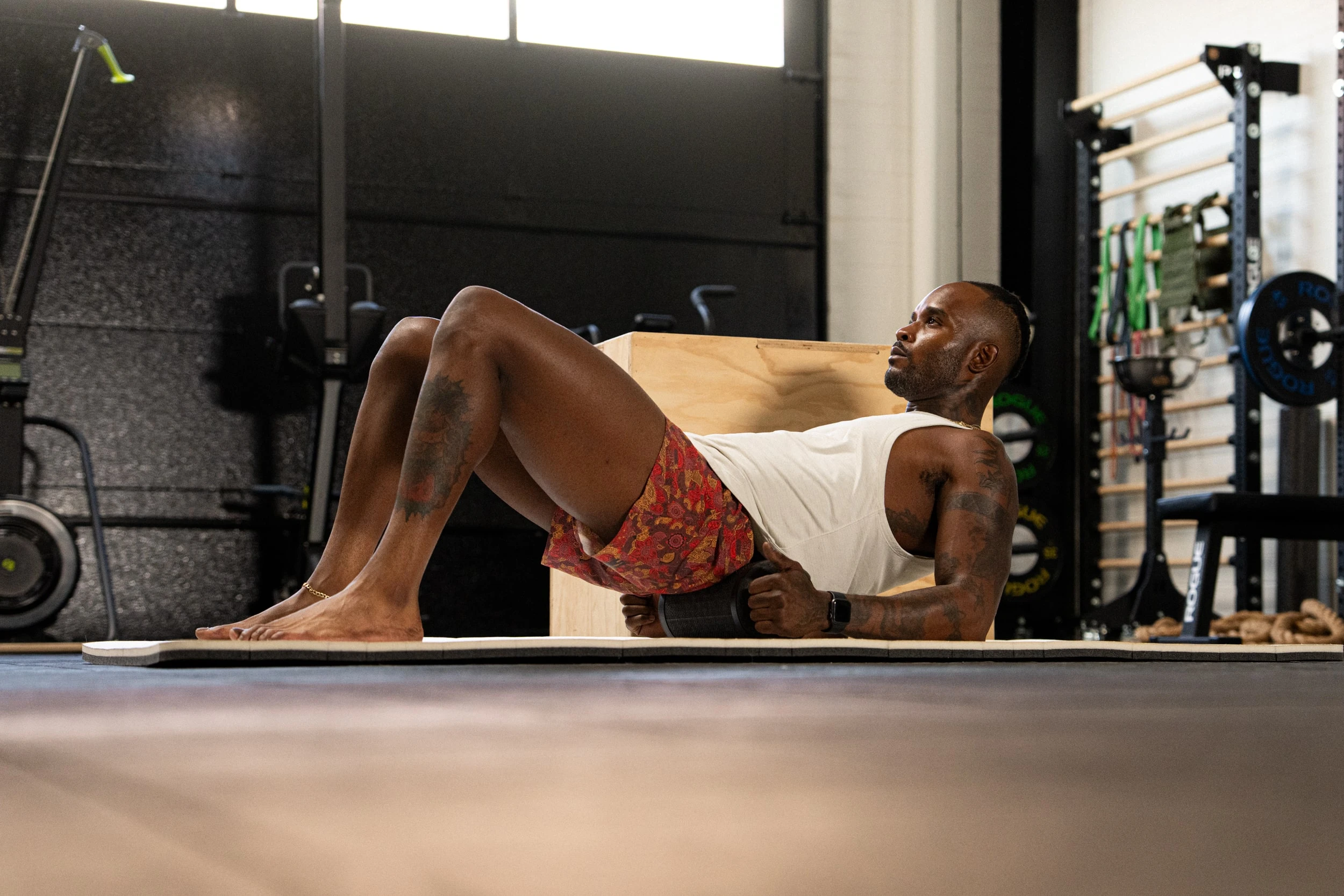
19. foam rolling: get your muscles ready for action
Another option is to incorporate a foam roller into your warm-up. Foam rolling can increase blood flow to the muscles, improve range of motion, and reduce inflammation. The key is to do it before exercise rather than after: rolling out beforehand can prepare the body for more intense activity, and since blood flow improves, the benefit reaches nerves and joints as well as muscles.
how long should I warm up before running?

For a successful pre-run warm-up, you want to raise your heart rate and loosen your muscles. Exactly how long that takes varies based on your needs, but as a general rule, a five to 10-minute warm-up that works all major muscle groups should be enough.
adjust your warm-up to match the run
The duration, intensity, and type of exercises done in a warm-up often depend on what type of run or race you're doing. If you're just running a mile on a track during your lunch hour, the warm-up can consist of five minutes of dynamic stretches, including moves such as lunges, squats, and a couple of Nordic hamstring exercises, followed by five minutes of easy jogging before increasing to your usual pace.
tailoring warm-ups for specific running workouts
For speedwork, which involves building power through sprinting, it's better to prep your body with drills that involve some type of jumping, such as high knees, skipping, skaters, and bum kicks. For a long run or marathon, your easy pace jog should be at least five minutes, accompanied by more dynamic stretches and a few minutes of vertical jumping. Those abrupt jumps help with mental preparation as well as physical prep, shaking out any jitters before you take your first step.
what to do when you have an injury
Warming up is vital in general, but it's even more essential when you have any kind of injury. There are situations where you shouldn't run at all, such as if you have a stress fracture or experience sharp pain when you run. Other issues may actually benefit from some exercise; running has been shown to help with pain from conditions like knee osteoarthritis, and light aerobic exercise can support mood in the weeks after certain injuries. Regardless, if you're feeling any abnormal discomfort, check with your doctor or physiotherapist.
Once your doctor has cleared you to run, that's the time to focus on longer warm-ups, and in some cases you can alternate between warm-up moves and running. If you have any hesitations about a specific warm-up, clear it with your doctor or physiotherapist first. Listen to your body, and if it feels like you didn't warm up enough, you're probably right.
warm up smarter with pliability
Reading through 19 warm-up moves is a great start, but a body that's actually ready to run comes from doing this consistently, not once. pliability's Daily Sessions give you a new guided mobility routine every day, and Paths string sessions together into a structured progression, whether your goal is fewer nagging aches or faster splits. Take the mobility assessment to see where you're tightest, then use Build Your Program to build a warm-up around those areas. If you're working around an existing injury, the Rebuild hub offers programming built for that.
Try pliability free for 7 days on iPhone, iPad, or Android.
Related Reading






Move better in 10 minutes a day.
10,000+ five-star reviews.