


LEARN
pliability

Stiff hips on the first tee. A backswing that stops short of where it used to. A lower back that starts talking by the twelfth hole. None of that means your golf is winding down. It means the tissue around your swing needs more deliberate care than it did at 35, and the payoff is bigger than any new driver. The right golf stretches restore the rotation, hip mobility, and balance your swing is built on; for golfers over 50, they are the highest-return practice time on the schedule. This guide covers the 20 best golf stretches for seniors and how to run them before, after, and between rounds, applying our best stretching exercises principles to what the course asks of you.
One distinction: this page is the stretching half of the job, lengthening what decades of rounds have tightened. The strength and stability half, glute bridges, planks, bird dogs, lives in our golf mobility exercises guide. Do both and your swing gets range it can actually control.
why stretching matters more for golfers over 50
Up to 54 percent of golf injuries are back-related. The swing drives high rotational and compressive force through the lumbar spine, and when the hips and mid-back are stiff, the lower back absorbs motion it was never designed to handle. So the fix for most golf back pain starts above and below the back itself: restore rotation to the hips and thoracic spine, and the lumbar spine stops doing everyone else's job.
Age raises the stakes. Tissues stiffen, old injuries and long hours in fixed positions shorten muscles, circulation to tight areas declines, and joints slowly give up range they are not asked to use. Stretching reverses the pattern: it lengthens tissue, feeds blood flow where it is needed, and keeps joints moving through fuller, safer ranges.
It also makes you better, not just safer. More hip extension, thoracic rotation, and shoulder mobility means a fuller turn and cleaner sequencing, hips leading, torso following, arms delivering the club. That is where clubhead speed comes from without swinging harder. And if you walk 18 three times a week, you cover more ground than most gym members ever do. That volume deserves an athlete's recovery, because that is what you are.
the 20 best golf stretches for seniors
Ground rules first. Mild tension is the goal and sharp pain is a stop sign. Unless noted, hold each stretch 20 to 30 seconds per side and repeat 2 to 3 times, breathing steadily the whole way. The list runs in three purpose groups: rotation, the upper body, and the lower-body power base.
free the coil: spine and rotation
1. Cat Cow
The spine's wake-up call. It mobilizes the whole back and eases the stiffness that rounds your posture at address.
Start on hands and knees in tabletop.
Inhale and arch your back, lifting head and tailbone.
Exhale and round your back, tucking chin and tailbone.
Move with your breath for 1 to 2 minutes.
2. Seated Torso Rotation
Builds the thoracic rotation that lets your shoulders turn against stable hips, the separation every repeatable swing depends on.
Sit on a chair with feet flat on the floor.
Cross your arms over your chest and slowly twist to one side, hips facing forward.
Hold 20 to 30 seconds each way, 2 to 3 times per side.
3. Thoracic Rotation with Breathing
The fastest way to lengthen a backswing. Pairing rotation with breath adds range in the mid-back while the lower back stays quiet.
Sit tall or lie on your side and place one hand behind your head.
Inhale and let the ribs expand on the side you will rotate toward.
Exhale and slowly rotate the upper back, keeping hips and lower back steady.
Do 6 to 10 controlled rotations per side.
4. Golfer's Rotation
The most swing-specific stretch on the list. It grooves the coil pattern itself while sparing the lower back from overwork.
Rest a club or pole across your upper traps with an extra-wide grip.
Keep the chest tall and shoulders relaxed.
Twist slowly to one side as if taking an unhurried backswing, pressing the bottom hand into the club to deepen the turn.
Return to center and alternate sides for 45 to 60 seconds.
5. Wide Stance Rotation
Teaches the hips and spine to rotate together while the hamstrings lengthen.
Stand wide, toes forward, arms out to the sides.
Hinge at the hips and twist so one hand reaches toward the opposite foot, knees slightly bent.
Come back up and alternate sides for 45 to 60 seconds, only as far as your flexibility allows.
6. Seated Spinal Twist
Adds end-range rotation with leverage you control, so the turn comes from the spine instead of a compensating hip.
Sit with legs extended, then bend one knee and place that foot outside the opposite knee.
Twist your torso toward the bent knee, using the opposite arm for gentle leverage.
Hold 20 to 30 seconds per side.
7. Supine Lower Twist
Releases the lower back and glutes after a full round and restores the rotation your follow-through borrows.
Lie on your back and draw one knee toward your chest.
Let the knee fall across your body to the opposite side, rolling onto that hip.
Extend your arms out wide and, if comfortable, look over the opposite shoulder.
Hold 45 to 60 seconds per side, with a pillow under the knee if it does not reach the floor.
the top of the backswing: shoulders, chest, and wrists
8. Cross-Body Shoulder Stretch
More shoulder range means a smoother backswing and follow-through with less strain in the upper back.
Stand with feet shoulder-width apart.
Extend one arm across your chest, elbow straight.
Use the opposite hand to press the arm gently closer.
Hold 20 to 30 seconds per arm, 2 to 3 times.
9. Chest Opener
Years of sitting close the chest and steal your turn. Opening it restores posture and a complete backswing.
Stand tall, feet shoulder-width apart.
Clasp your hands behind your back and slowly lift your arms, chest up.
Hold 20 to 30 seconds, breathing calmly, and repeat as needed.
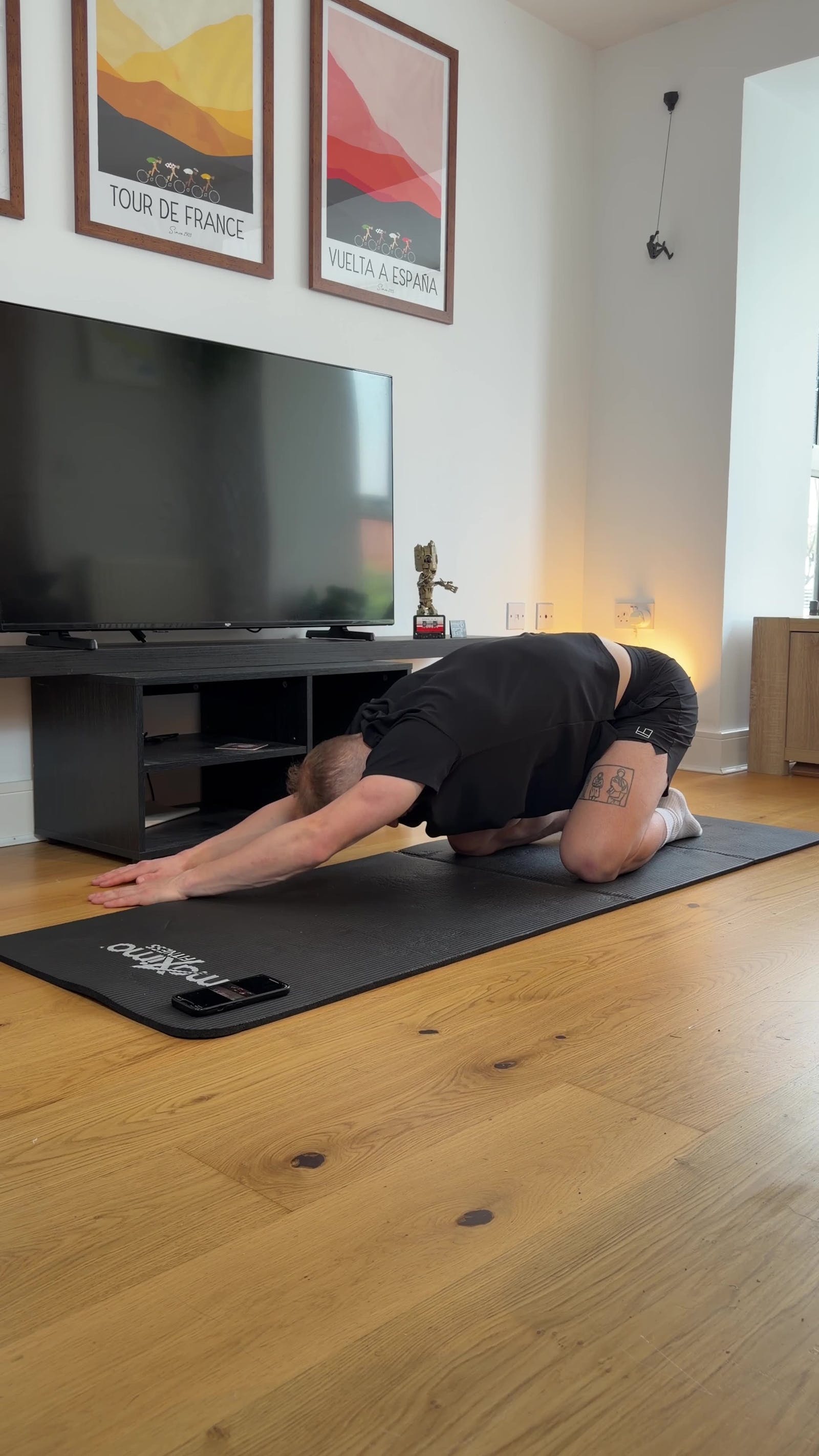
10. Lifted Child's Pose with a Chair
A supported stretch for the mid-back and lats that opens the chest without asking anything of the knees or shoulders.
Kneel facing a chair and place your hands flat on the seat.
Walk the knees back, spread them wide with toes touching, and sit toward your heels.
Bow forward, letting the chest sink between the arms, and hold 45 to 60 seconds.
Bring the knees closer for more upper-body focus.
11. Wrist Flexor and Extensor Stretch
Supple wrists mean a comfortable grip and better club control through impact and release.
Extend one arm, palm up, and gently pull the fingers back with the other hand. Hold 20 to 30 seconds.
Turn the palm down and gently press the back of the hand toward you. Hold 20 to 30 seconds.
Switch arms and repeat 2 to 3 times per side.
12. Incline Push-Up
The one strength move in the list: it supports club speed without the overhead strain that aggravates older shoulders.
Place your hands on a sturdy elevated surface like a bench or table.
Walk your feet back until your body forms a straight line from head to heels.
Lower your chest toward the surface, then press back up.
Start with 8 to 15 controlled reps; a higher surface makes it easier, feet further back makes it harder.
the power base: hips and legs
13. Leg Swings
A dynamic opener for the hips and hamstrings, best used before you play.
Hold a cart, railing, or club for balance.
Swing one leg front to back 10 times, staying tall and controlled.
Swing the same leg side to side 10 times, then switch legs.
14. Kneeling Hip Flexor Stretch
Tight hip flexors are the quiet tax on distance. Restoring hip extension lets the lower body generate power instead of the lumbar spine.
Kneel with one knee down and the other foot forward at roughly 90 degrees.
Keep your back tall and gently push the hips forward.
Feel the stretch at the front of the kneeling-side hip.
Hold 20 to 30 seconds per side, 2 to 3 times.
15. High Lunge
Opens the hip flexors while the glutes work, which is exactly the combination your swing uses to drive through the ground.
Take a split stance, front foot flat, back foot on the ball.
Bend the front knee and let the back hip press forward.
Hold 30 to 45 seconds per side, reducing depth or standing taller if you need to.
16. Standing Quadriceps Stretch
Flexible quads keep the knees comfortable and weight transfer smooth from address to finish.
Stand next to a chair or wall for support.
Bend one knee and bring the heel toward your glutes, holding the ankle.
Pull gently until the front thigh lengthens.
Hold 20 to 30 seconds per leg, 2 to 3 times.
17. Lean-Back Quad Stretch
A deeper, floor-based quad and hip option when the standing version stops being enough.
Kneel and sit back onto your heels; that alone may be plenty.
For more, place your hands behind you and lean back onto them until the front of the thighs stretch.
Hold 45 to 60 seconds, with a cushion between glutes and heels to soften the intensity.
18. Standing Hamstring Stretch
Long hamstrings allow a deeper hip hinge, which protects the lower back and keeps your posture tall through the ball.
Place one foot on a low step, leg straight.
Keep the back flat and hinge forward from the hips.
Reach toward the toes without rounding the lower back.
Hold 20 to 30 seconds per leg, 2 to 3 times.
19. Seated Forward Bend
Maintains hamstring and lower-back flexibility together, the pair that decides whether your address posture survives 18 holes.
Sit with legs extended in front of you.
Hinge from the hips and reach toward the toes, back flat, no bouncing.
Hold 20 to 30 seconds, using a towel or strap around the feet if the toes are out of reach.
20. Calf Stretch
Mobile calves and ankles are the foundation of balance and weight shift, especially on uneven lies.
Face a wall with your hands on it for support.
Step one foot back, heel down, back leg straight.
Press the hips forward until the calf lengthens.
Hold 20 to 30 seconds per leg, 2 to 3 times.
how to turn them into a golf stretching routine
Twenty stretches is a menu, not an assignment. What changes your golf is running the right handful at the right times, consistently.
before the round: a 10-minute warm-up
Keep the pre-round work dynamic and rhythmic so you arrive at the first tee warm rather than sleepy. A simple sequence:
Minutes 0 to 2: brisk walk or marching to raise your heart rate.
Minutes 2 to 5: leg swings, walking lunges with a torso twist, and shallow squats.
Minutes 5 to 8: golfer's rotations, thoracic rotations with breathing, and shoulder circles.
Minutes 8 to 10: practice swings at 50 to 75 percent speed, focused on rhythm and sequencing.
Deep static holds belong after play, not before it. For a fuller warm-up menu, see our guide to pre golf stretches.
after golf: the stretches that pay off tomorrow
Post-round is when the slow, long holds do their best work, releasing what 18 holes loaded up. Go straight to the kneeling hip flexor stretch, standing hamstring stretch, supine lower twist, and chest opener, 20 to 30 seconds per side with steady breath. The same sequence works as a daily routine on days you do not play. If tight hips are your particular sticking point, and for most golfers over 50 they are, our hip stretches for golf guide goes deeper.
the 10 best stretches for golf when time is short
If you keep only ten, keep coverage: cat cow, seated torso rotation, thoracic rotation with breathing, golfer's rotation, supine lower twist, cross-body shoulder stretch, chest opener, kneeling hip flexor stretch, standing hamstring stretch, and the calf stretch. That set touches every link in the swing in about ten minutes.
stretching exercises for golfers over 60: modifications and add-ons
Every stretch above works at any age. Past 60, the smart move is to adapt them rather than skip them, and to add the balance and light strength work that keeps the adapted versions progressing.
how to make any stretch senior-friendly
Use support: a chair, wall, railing, or a club planted like a cane steadies leg swings, quad stretches, and anything single-leg.
Go seated: most of the list converts. Do cat cow by arching and rounding while sitting tall, forward bends from the edge of a chair reaching toward the shins, and golfer's rotations or shoulder work from a bench or the golf cart.
Shrink the range: start small and let the range grow over weeks. A shallower squat in rotation drills, a higher foot on the thigh in hip stretches, and a partial hinge all still count.
Pad and assist: a cushion under the knees softens kneeling stretches, and a towel or strap bridges the gap when hands cannot reach feet or clasp behind the back.
Clear the medical flags first: if you have osteoporosis, a joint replacement, or recent surgery, follow your clinician's guidelines before adding new stretches, and avoid bouncing or forcing any joint past a comfortable range.
a daily home routine for senior golfers
On days you do not play, this short sequence keeps the key areas moving. Run it five to seven days a week, slowly, with a chair or wall nearby for balance:
Thoracic rotation on a chair: sit upright, club across the shoulders, rotate left and right 8 times each side.
Hip flexor lunge with reach: kneel on one knee, tuck the pelvis, reach the arms overhead, and lean gently forward for 20 to 30 seconds per side.
Seated hamstring stretch with a strap: sit tall, loop a strap around the foot, hinge from the hips, and hold 20 to 30 seconds per leg.
Standing calf raise and hold: rise onto the toes, pause 3 seconds at the top, lower slowly, 10 to 15 reps.
Shoulder band pull-aparts: arms straight with a light band, squeeze the shoulder blades together, 12 to 15 reps.
Glute bridge: lie on your back, feet flat, lift the hips and squeeze, 10 to 15 reps with a 5-second hold at the top.
the best exercises for golfers over 60 beyond stretching
Two additions protect the gains. First, balance: stand on one foot while making slow shoulder turns, 20 to 30 seconds per side, or walk heel to toe for 10 to 15 steps with a chair nearby. Better balance lowers fall risk and steadies your swing on uneven lies. Second, low-load strength twice a week: chair squats, counter push-ups, standing band rows, and calf raises, two sets each at a controlled tempo. Our golf mobility exercises guide linked above covers that strength and stability lane in full.
yoga for golfers over 60
If you would rather follow a gentle yoga practice than a stretch list, you are covering much of the same ground: cat cow, child's pose, seated spinal twist, and seated forward bend all come straight from yoga. Favor slow, supported classes over heated or power formats, use blocks and straps freely, and apply the same modifications as above, seated versions, smaller ranges, and no forced end positions.
progress safely, and know when to get help
Range you have been losing for years does not return in a weekend, but it does return. Work toward longer holds and deeper positions over weeks, not days, and let pain be the referee: mild stretch discomfort is fine, sharp pain is not. Three to five short sessions a week beats one heroic one, so anchor the work to something you already do: morning coffee, the range bucket, the drive home. Track progress with simple checks: seated turn distance, distance to your toes.
A word on speed training: weighted clubs and overspeed drills are popular, and for golfers with stiff rotation, limited hip mobility, or shaky single-leg balance they add injury risk before they add yards. Build the mobility base first and treat speed work as the final layer, not the first fix.
And some problems are not a stretching project. If persistent low back pain, sharp joint pain, or numbness limits your movement, see a physical therapist or sports medicine clinician before you keep loading it.
play today, play for life with pliability golf
You could run this list from a printout taped inside the garage, and plenty of golfers do. Or you could have it guided, sequenced, and progressed for you. pliability's golf routines turn the stretches above into short follow-along videos: dynamic prep before the round, deep release after it, and off-day sessions that keep the gains. Daily Sessions make the habit nearly automatic, Build Your Program builds a plan around your tightest areas, and the mobility assessment shows where your swing is losing range so you know what to work on first. Start your 7-day free trial on iPhone, iPad, Android, or the web. The golfers still walking 18 at 80 are not the ones who swung the hardest. They are the ones who kept the body that could.
Related Reading


Move better in 10 minutes a day.
10,000+ five-star reviews.