


LEARN
pliability

Pulling on your socks should not be the hardest part of your morning. But that is where lost range shows up first: hips that will not fold, hamstrings that pull, a low back that complains when you reach for the floor. A daily stretching routine for men does not need to be long or complicated to reverse it. Ten to fifteen consistent minutes a day restores flexibility, takes the edge off post-training soreness, and keeps you moving well for decades, not just seasons.
Below are the 20 stretches worth building that routine around, grouped by body region so you can work the full body or zero in on your stiffest areas, plus a realistic plan for making the habit stick. And if your range is a long way from where you want it, our guide to how to get flexible fast covers how quickly you can expect progress.
why daily stretching matters for men
The case is practical, not cosmetic. Before training, dynamic stretching eases muscles into work and improves balance and stability, so movement costs less effort. Afterward, stretching increases blood flow that carries nutrients to recovering tissue, which means less soreness and more quality sessions in a week. Harvard Health makes the longevity argument too: muscles that keep their length let joints move through their full range, and joints that move fully take less wear over the years.
There are quieter benefits. Chronically shortened muscles pull the shoulders and upper back into a slouch; consistent stretching restores alignment and can walk back rounding that has already set in. And slow, deep holds release built-up tension and calm the nervous system, which is why a few minutes on the floor at night often does as much for your head as for your hamstrings.
the 20 best stretches for a full-body daily routine
The routine is grouped by region: hips and lower body first, because that is where most men are tightest, then spine and back, then chest, shoulders, and neck. Hold each static stretch for 30 to 60 seconds per side and keep breathing slowly through it. Mild discomfort is normal; sharp pain is a stop signal. You do not need all 20 every day: pick six to eight, rotate regions, and cover the full body across the week.
hips and lower body
1. Low Lunge
The first stop for tight hips. Beyond the hip flexors, it works the glutes and encourages a taller spine and better posture.
Kneel tall on the ground.
Step one foot forward and lower your hips toward the floor until you feel the stretch along the front of the back hip.
Hold, then switch sides.
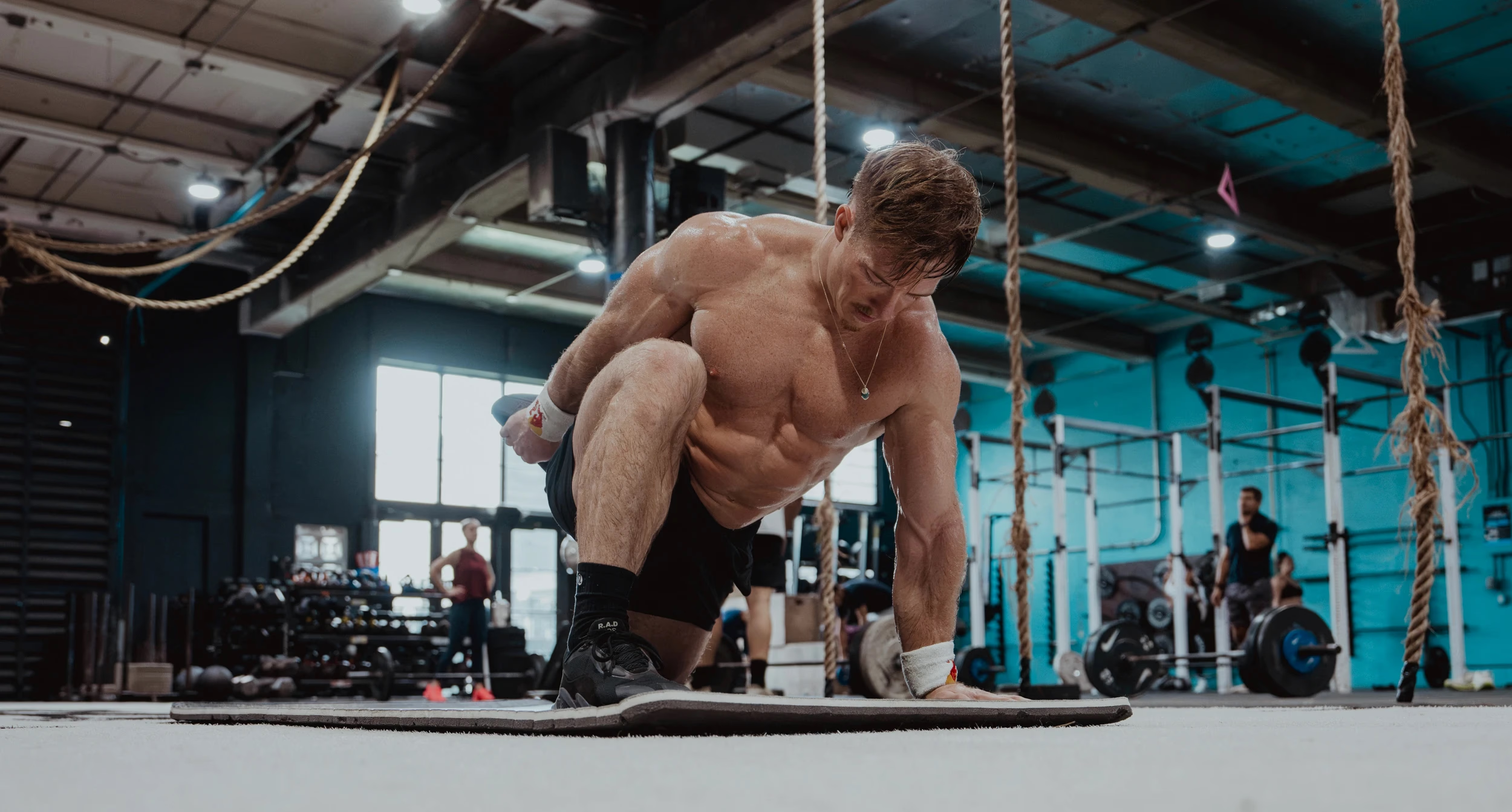
2. Elevated Kneeling Lunge
Elevating the back foot turns the lunge into a serious quad stretch and adds instability that your core has to counteract.
From a kneeling lunge, prop the foot of your back leg on a bench or box.
Engage your core and glutes and push your hips forward.
For a deeper stretch, reach back for the elevated foot with both hands.
3. Half Kneeling Hamstring Stretch
Our go-to for hamstring tightness, and worth keeping in the rotation if your lower back complains. It builds trunk stability as a bonus.
Kneel on one knee and extend the other leg straight, heel on the floor.
Pull the toes of the extended leg back toward your shin.
Keeping your back straight, drop your chest toward the extended knee.
4. Pigeon Pose
A popular hip opener for good reason: one position reaches the outer hip, groin, piriformis, and psoas while the extended leg gets a hip flexor stretch.
From seated, bend your right knee and rotate the leg so the shin rests flat on the floor, right foot in front of your left hip.
Extend your left leg behind you.
Lower your hips toward the ground, then fold your torso toward the floor. Switch sides.
5. Standing Quad Stretch
The classic quad stretch, with one honest caveat built in.
Stand next to a wall or high table for balance.
Raise your right heel toward your glutes and hold the ankle with your right hand.
Keep your back straight and hips tucked under you.
If you cannot hold the position without sticking your butt out, your quads and hips are too tight for this one. Skip it and build up with the kneeling lunges first.
6. Hamstring Hinge
An active hamstring stretch that doubles as practice for the hip hinge behind every deadlift and kettlebell swing.
Stand with feet shoulder-width apart, hinge forward from the waist, and touch the floor, bending your knees as needed.
With a straight back, walk your hands forward until your legs can straighten.
Slowly walk your hands back toward your feet, feeling the hamstrings load, then forward again to relax them. Repeat.
7. Standing Hamstring and Calf Stretch
Covers the whole back line of the lower leg in one hold.
From standing, step one foot slightly forward with the toes up off the ground.
Bend at the hips with a straight back and lean toward the floor.
Let the back leg bend while the front leg stays straight. Grab the front foot if you can reach it.
Hold, then switch sides.
8. Sideways Lunge
Opens the hip flexors, adductors, and groin, the muscles that limit lateral movement.
Stand with your legs about double shoulder-width apart, feet forward or slightly out.
Keeping your back straight, shift your weight to one side.
Move your feet wider to deepen the stretch. Hold, then switch sides.
9. Forward Fold
A full posterior-chain reset for the erectors, glutes, hamstrings, and calves, and a natural way to close the lower-body block.
Stand with your feet under your hips, bend your knees slightly, and hinge your torso toward the floor.
Let your hands and head hang, tuck your chin, relax your shoulders, and lengthen your spine.
Deepen the fold a little with each exhale.
To finish, bend your knees and slowly roll back up to standing.
spine and back
10. Cat-Cow
Wakes up the spine segment by segment, from the neck down through the erectors.
Start on all fours.
Inhale, lift your head toward the ceiling, and let your belly drop so your back arches.
Exhale, lower your head, and round your spine toward the ceiling. Move slowly between the two.
11. Knees to Chest
A gentle lower-back release you can do first thing in the morning or last thing at night.
Lie on your back and pull both knees to your chest, holding the outside of each knee.
Round your back and lift your head slightly off the ground.
Rock gently back and forth for up to 60 seconds.
12. Lower Body Twist
Targets the erectors, obliques, and glutes with a slow rotation that most stiff backs love.
Lie on your back with knees bent, feet flat, and arms out to the sides.
Bring your knees to your chest, then drop them to the right, letting your hips follow.
Turn your head and torso to the left and hold.
Return to center and repeat on the other side.
13. Twisted Cross
A deep twist that opens the chest and shoulders while releasing tension along the spine and improving spinal rotation.
Lie face down with your arms out in a T shape.
Crawl your right hand a couple of inches above shoulder height and slide your left arm under your chest.
Press through the left arm and reach your left leg over the right, aiming to place the foot flat on the floor.
If that comes easily, keep rotating until both feet are flat. Switch sides.
14. Thread the Needle
We swear by this one for upper-back and shoulder stiffness. The twist opens the chest and releases tension between the shoulder blades.
Start on all fours with your hips stacked over your knees.
Keeping hips and knees where they are, walk your hands forward to a comfortable stretch.
Slide your right arm, palm up, along the floor under your left arm, letting your shoulder and temple rest down. Switch sides.
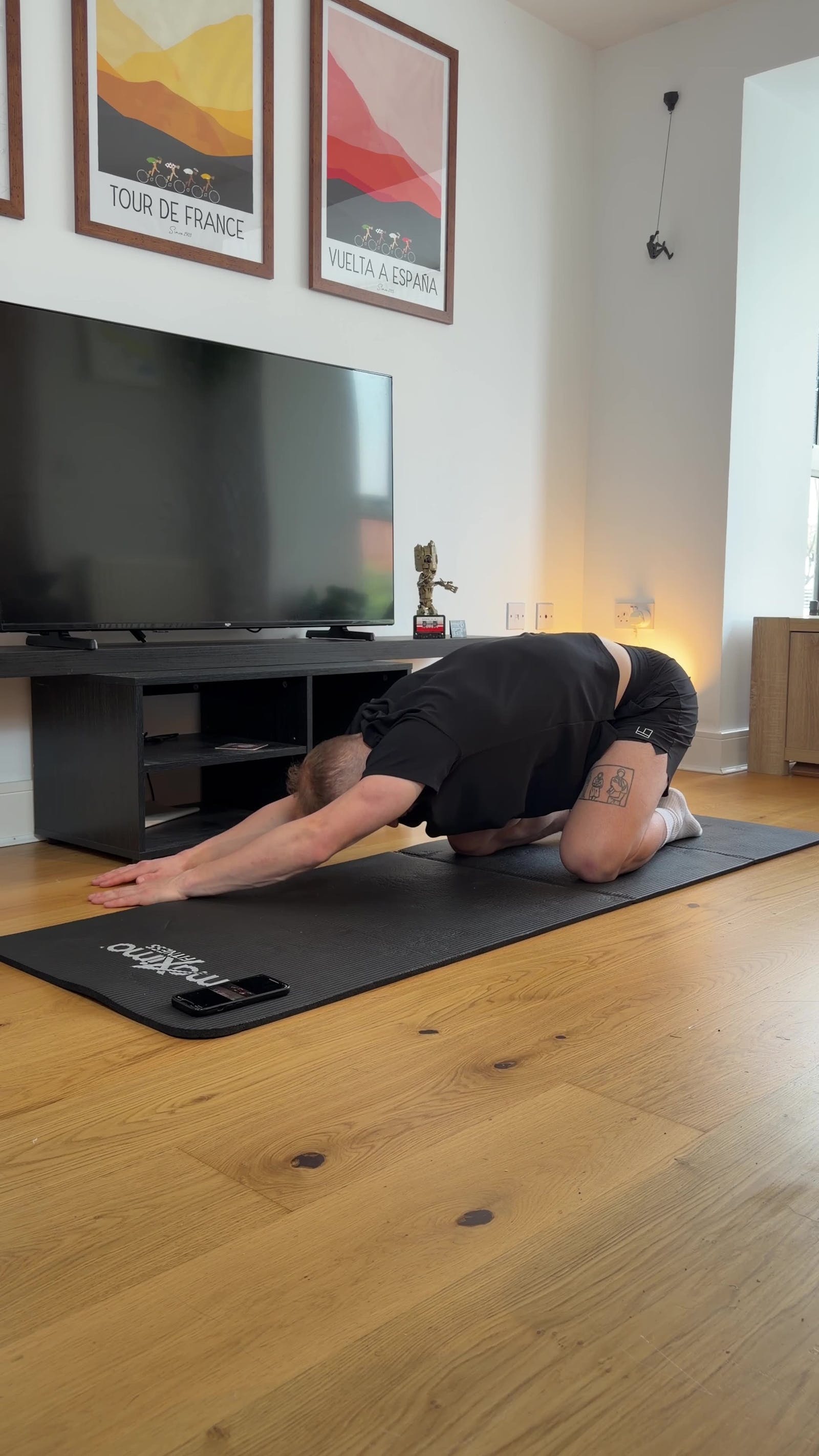
15. Child's Pose
One hold that reaches the traps, lats, erectors, obliques, glutes, and hip flexors. Use it to finish the spine block or the whole routine.
Kneel with your legs about hip-width apart and sit back on your heels.
Lower your torso, keeping your glutes on your heels, and rest your forehead on the floor if you can.
Extend your arms forward, palms down, and let your whole body relax.
chest, shoulders, and neck
16. Doorway Stretch
The simplest counter to a day spent hunched at a desk or a heavy pressing block. Targets the pecs.
Stand in a doorway with each arm raised to the side and bent 90 degrees, palms and forearms against the frame.
Step forward with one foot until you feel the stretch across your chest.
17. Chest Opener
Uses a towel or rope to stretch the pecs, lats, and biceps through a bigger range than the doorway allows.
Grab a rope or rolled-up towel at either end.
Standing with feet hip-width apart, raise it overhead on straight arms.
Bend your elbows and bring it down behind your shoulder blades, pressing your elbows back and chest forward.
18. Upward Facing Dog
Opens the pecs and deltoids while stretching the whole front of the trunk.
Lie on your stomach with your legs extended behind you.
Place your hands beneath your shoulders, palms flat.
Press into the ground, raise your chest off the floor, and lift your gaze toward the ceiling.
19. Shoulder Stretch
A full circuit for the shoulder girdle: deltoids, rhomboids, traps, and lats in one sequence.
Clasp your hands with fingers interlaced, rotate your palms to face away from you, and press them overhead on straight arms.
Reach as high as you can, letting your shoulders rise, then press them down.
Bend your elbows and cup the back of your head with your palms.
Press your elbows back for a gentle chest stretch, then bring them together in front of your head to shift the stretch into the upper back.
20. Head Rolls
A slow finisher for the neck: levator scapulae, traps, and the deep muscles that stiffen up from screens and stress.
Sit or stand tall with your head facing forward.
Drop your chin to your chest and trace a slow circle: up one side, toward the sky, and back to center.
Reverse direction.
how to make a daily stretching routine stick
Consistency beats heroics. Ten focused minutes every day will change how you move faster than an hour on Sundays, and the easiest way to stay consistent is to anchor stretching to something you already do.
Pick morning or night. A short flow after waking loosens the stiffness that builds overnight and sets you up for the day. If mornings are chaos, stretch before bed instead; the slow holds help you wind down and sleep better. Starting from zero? Our morning stretching routine for beginners is a gentler on-ramp.
Bracket your workouts. Spend about ten minutes before training on dynamic movements for the muscles you are about to use, and another ten afterward on static holds to cool down and kick-start recovery. The two types do different jobs, and we break down when to use each in dynamic vs static stretching.
Keep the kit minimal. A yoga mat makes floor work comfortable, a resistance band helps you reach positions your current range will not, and a foam roller pairs well with stretching before or after a session. None of it is required to start.
Get eyes on your form when something hurts. If you are working around pain or one stubbornly stiff area, have a coach, trainer, or clinician check your setup. Good guidance lowers injury risk and gets you to the right stretches for your goal much faster than guessing.
turn the 20 stretches into a daily habit
Knowing the stretches is the easy half. Doing them tomorrow, and the day after, is what actually changes how you move. pliability is built for that part: Daily Sessions serve a fresh guided routine every day so you never have to program your own, Paths progress you toward a specific goal like hip mobility over a few weeks, and Build Your Program shapes the plan around your training. Take the mobility assessment to see which of these areas is actually holding you back, then start with pliability's stretching program, free for 7 days on iPhone, iPad, Android, or the web.
Related Reading



Move better in 10 minutes a day.
10,000+ five-star reviews.