


LEARN
pliability

Limited ankle mobility can lead to poor performance in workouts and cause painful, inefficient movement. If your ankle lacks the range of motion it needs to bend deeply, you may struggle to perform squats and lunges correctly, which can lead to injuries and get in the way of your fitness goals. The ankle mobility test assesses how well your ankle moves to determine whether you have healthy or limited ankle mobility. This article walks you through how to perform the ankle mobility assessment, how to improve your ankle mobility if yours is limited, and how that connects to How to Measure Flexibility.
pliability's mobility app can help you reach your goals by giving you access to targeted warmups, workouts, and recovery routines designed to improve ankle mobility.
what is ankle mobility and why is it important?

Ankle mobility refers to the ability of the ankle joint to move freely through its range of motion, especially in dorsiflexion (when the foot moves upward toward the shin). Ankle mobility is crucial because it:
Affects overall movement mechanics, balance, and athletic performance.
Helps prevent injuries such as sprains, strains, and Achilles tendonitis.
When the ankle joint isn't moving properly, it can cause problems all the way up the kinetic chain. Irregularities at the ankle are linked to overuse injuries like runner's knee, IT band syndrome, and Achilles tendinopathy.
mobility defined
Flexibility is about soft tissue, your muscles, tendons, and ligaments. Mobility, on the other hand, is about a joint's range of motion and its ability to function properly.
Mobility = Strength + Flexibility
Ankle mobility refers to whether that combination of strength and flexibility exists in your ankle. When someone has good ankle mobility, the muscle tissue, ligaments, tendons, and fascia surrounding the ankle joint aren't tight and are able to move the way they should.
Good ankle mobility means being able to move the ankle joint through its full range of motion. Limited ankle mobility means that range of motion is restricted, and people in that camp may experience pain in other parts of the body as a result.
what you need to know about ankle mobility
Ankle mobility refers to the ability of the ankle to move freely through its range of motion. The ankle proper is a singular joint that connects the two leg bones, the tibia and the fibula, to the ankle bone, called the talus. It primarily moves in one direction: up and down.
When your foot points upward, that's dorsiflexion; when it points down, that's plantar flexion. A separate joint just below the ankle, the subtalar joint, is responsible for moving your foot side to side, known as pronation and supination.
Ankle Compensation
These joints function as a unit, but this article focuses on the mobility of the ankle joint itself. A normal gait requires at least 10 to 15 degrees of dorsiflexion. Most people have 30 to 35 degrees of plantar flexion available, though that type of motion is far less of a concern for runners.
If the ankle joint isn't moving properly, hitting at least that minimum 10-degree dorsiflexion, something else has to compensate for it, and irregularities at the ankle can cause problems all the way up the kinetic chain. That may mean overuse injuries like:
Runner's knee
IT band syndrome
Achilles tendinopathy
Compensatory Movement
If one ankle isn't moving properly, you won't be able to push off and create as much force with that side while running. That forces your knee and low back to absorb more stress, and it also requires the opposite side to do more work to keep you moving forward, which can lead to overworked calves or hip flexors on that other side.
why many people's ankle mobility goes bad
We sit a lot. Most people simply aren't moving enough. Between sitting at work, during meals, while watching favorite shows, and during the commute, the body doesn't get much varied movement, and even people who move often tend to repeat the same patterns rather than move in varied ways.
Long-distance runners and indoor cycling enthusiasts may move frequently but repeatedly in the same plane of motion (the sagittal plane).
The problem: Both sets of people aren't moving their ankles through their full range of motion. As the saying goes: use it or lose it.
Another common culprit of limited ankle mobility is scar tissue from old injuries like ankle sprains. Limited ankle dorsiflexion is a commonly reported issue after ankle sprains that never fully rehabbed.
Ankle Instability
When the ankle ligaments, especially those on the outside of the ankle, aren't mechanically strong because of sprains that never fully healed, that can also impact ankle stability. Ankle instability occurs when, instead of moving like a hinge up and down as intended, the ankle loses that stability and can roll.
Ankle instability is one of the most common injuries reported among runners. Less acute types of damage, like the excessive force from running downhill, can cause issues too.
Even general inflammation can inhibit the ankle's range of motion. Without flushing that out before a run, the joint ends up trying to function when it isn't warmed up and fluid yet, which is one more reason a proper warmup matters. Footwear choices don't help either.
Footwear Impact
Most day-to-day shoes and sneakers have too high a heel, often around a 12-millimeter heel lift, which keeps the foot in a slightly plantar-flexed position all day long. That means the muscles along the bottom of the feet stay slightly shortened for hours at a time.
Over time, that affects the ability to lengthen the muscles responsible for bringing the ankle into a dorsiflexed position. Heavily cushioned shoes add to the problem: they're comfortable, but they take over the supportive job that the muscles in the feet and ankles should be doing, and with nothing else to do, those muscles become underused.
Muscle Weakening
And when those muscles aren't working, they weaken over time. Previous injuries, other bodily imbalances, age, and diet can also affect ankle mobility.
the importance of ankle mobility for injury prevention
Good Ankle Mobility = Injury Prevention
If ankle mobility is limited enough, it can impact walking gait. When gait gets thrown off, a chain reaction happens up the body, increasing the risk of injury elsewhere. Hip and knee injuries are common in people with limited ankle mobility.
Without adequate mobility, the ankle stops acting like an ankle, which forces the knee or hip to compensate and act like one instead. This can lead to overuse injuries in those joints, including:
Plantar fasciitis
Achilles tendinopathy
Shin splints
Patellofemoral pain
Knee injuries
Pulled lower back muscles
Movement Performance
Good ankle mobility is vital for performance beyond injury prevention. It's essential for safely executing exercise movement patterns like the hinge and squat.
Consider The Back Squat
For you to sit back deep into a squat, your knee needs to be able to track over your toes. This requires adequate ankle mobility. Without that mobility, the best-case scenario is to shortchange your squat depth, shortchanging the movement's glute, quad, hamstring, and midline-strengthening potential.
The worst-case scenario is that you try to squat lower, can't do that with good form, and force your knees or hips to act as ankles, which increases your risk of injury over time.
how to do an ankle mobility test

Testing ankle mobility is crucial for assessing range of motion and identifying any restrictions. Limited ankle mobility can:
Affect general movement patterns
Increase your risk of injury
While the most thorough way to check your ankle mobility is a full assessment by a physical therapist, you can try some at-home assessments yourself.
dorsiflexion mobility test: the knee to wall test
To quickly screen for ankle dorsiflexion mobility, try using the knee-to-wall test.
Here's How To Do It
Stand barefoot with your foot flat and about a thumb's width away from a wall.
Drive your knee forward and try to touch your knee to the wall without lifting your heel or turning your foot outwards.
If you can't touch the wall, move your foot closer. If you can, move your foot back.
Your ankle dorsiflexion range is the distance between your big toe and the wall. A distance of less than about 4 inches (10 centimeters) may indicate limited ankle dorsiflexion mobility. Take note if you notice any pain or discomfort during this screen and bring it up to your physical therapist, especially if you have had a previous injury that you never fully rehabbed.
half-kneeling dorsiflexion test: a reliable measure of ankle mobility
This is a well-established test used often in research to assess ankle mobility, and it's reliable enough that you don't need a trained specialist to administer it.
Here's How To Do It
Find a wall and kneel close to it with your shoes off.
Use a tape measure and place your big toe 5 inches from the wall.
From this position, push your knee forward, attempting to touch the wall with your knee. Your heel must stay in contact with the ground.
Movement Checklist
PASS
The knee can touch the wall at 5 or more inch distance
Heels remain firmly planted
Knees aligned with feet
No pain noted
FAIL
Knee unable to touch wall at 5 inch distance
Heels pull off from ground
Knees collapsed inwards (valgus collapse) to touch wall
Pain noted
Did you have checkmarks in the "pass" column? If you could touch your knee to the wall at a distance of 5 inches while keeping your knee in line with your foot, you would show adequate mobility in the ankle.
If you had any checks in the "fail" column for this screen, you have a dorsiflexion mobility restriction. This restriction could be either a soft tissue restriction, a joint mobility problem, or both.
plantarflexion mobility test: the seated heel sit
To quickly screen for ankle plantarflexion mobility, perform a Seated Heel Sit.
Here's How To Do It
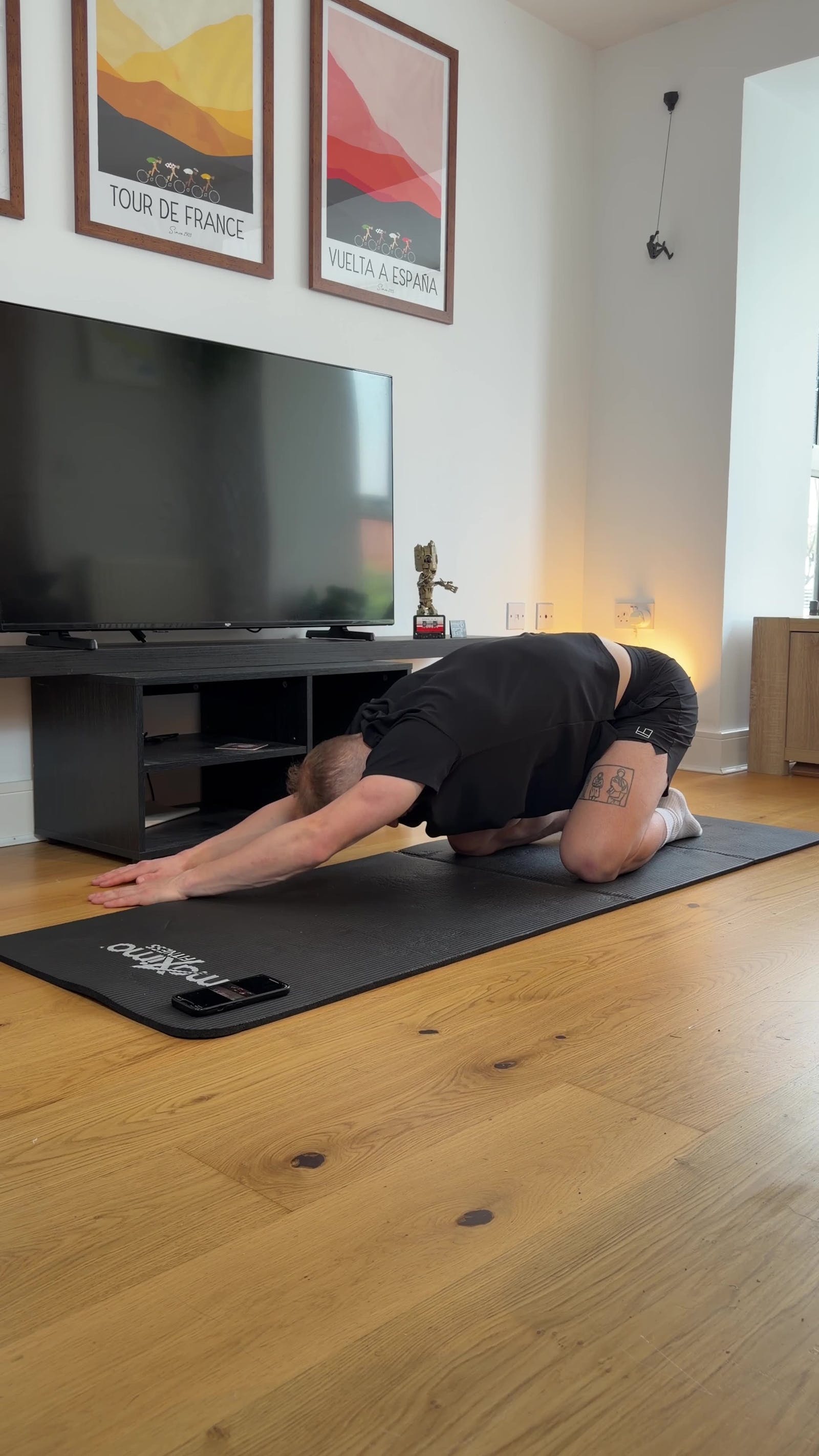
Initiate the movement by going on all fours with your knees together and ankles pointed.
Begin to sit back on your heels with your hands still on the ground while keeping your heels together.
Try to sit back with your torso vertical over your hips, attempting to close off any space between your ankles and the floor.
If you can't sit back all the way, use your hands for more support. If you can sit upright, perform with your heels closer together.
Ankle Dorsiflexion
If you can't close the distance between your ankles and the floor, this may indicate limited ankle plantar flexion. You should be able to sit with your torso vertical and your glutes sitting on your heels with minimal discomfort.
One thing to consider about this ankle mobility test is whether your knees have enough range of motion to access this position. If you find your knees feeling stiff as you sit back, try sitting back with a pillow tucked into the crease of your knee. This will create a cushion while moving your ankle through its full range of motion.
ankle mobility in motion: squats
If you've got access to sand or another surface you can draw in, kneel with your feet behind you and try to draw a big circle with your big toe on each side. You can gauge the range of motion just by looking at the size of the circle.
The smaller it is, the more work is needed on that range of motion. Comparing one side to the other also shows if, and where, one ankle is more limited than the other.
Squat Screen
Since limited dorsiflexion can impact several functional movement patterns, basic strength training exercises like squats can be great screening tests for ankle mobility issues.
Picture doing a squat.
As you send your hips back (as if you're sitting back into an invisible chair) and bend your knees, you want to drop below a 90-degree knee bend.
Move your knees forward over your feet, and keep your heels planted on the floor.
Dorsiflexion Deficit
If you're limited in any of those areas, that's a red flag that your ankle lacks the dorsiflexion you need to run your strongest.
ankle mobility in motion: lunges
A lunge is another easy test. Here's how to figure out your degree of dorsiflexion:
Use a tape measure with centimeters and place it perpendicular to a wall.
Face the wall and lunge forward so your knee touches the wall.
Move the foot back until the knee only makes slight contact with the wall while the foot remains flat on the ground.
That's your point of maximal dorsiflexion.
It's time for some math: each centimeter corresponds to approximately 3.6 degrees of ankle dorsiflexion.
The major takeaway here: The less you can bend your knee forward over your foot, the more limited the range of motion in your ankle.
weight-bearing lunge test
Get into a kneeling lunge position next to a wall with your front toes placed about five inches away (you can use the width of your hand as a basic guide).
Lean forward to lunge toward the wall.
Try to touch the wall with your knee while keeping your front heel on the floor.
Adjust your stance closer or further away from the wall so your knee hits the wall at the end of its range of motion.
Keeping your toes at least five inches away from the wall while your knee touches it is considered a normal range of motion. If you struggle to get there, it's a sign that you might want to add more ankle mobility exercises to your routine.
20 stretch and strength moves for ankle mobility

1. ankle plantar flexion
Sit down on the floor.
Bend one leg at the knee while the other leg is straight out in front of you on the floor.
Loop a resistance band around the ball of your flexed foot on the floor, and hold it with your hands.
Start by pointing your toes slowly forward and then return to a flexed position, releasing the tension.
Repeat on each foot three times for a total of 40 seconds.
2. ankle circles
Ankle circles help flush out inflammation in the ankle joint, warming it up properly before a run.
How To Do It
Sit down on the floor.
Bend one leg at the knee with the other straight out in front of you on the floor.
Put a rolled-up towel under the front ankle.
Turn your front foot slowly in circles, alternating clockwise and counterclockwise directions. Be careful to move only your foot and not your leg.
Repeat on each foot three times for a total of 40 seconds.
3. toe-heel walks
Walk for 30 seconds while standing on your toes.
Then, walk for 30 seconds while standing on your heels.
Repeat three times.
4. supported isometric squat
Holding onto a squat rack or pole, stand with your feet hip-width apart, toes pointed slightly out.
Bend at your knees to squat down as low as you can until you feel a restriction in the ankle.
Hang out in that position for about 30 seconds.
Press your feet into the ground to come back up to standing.
Repeat two to three times.
5. straight-knee calf stretch
Stand facing a wall, about a foot or two away.
Place the leg you want to stretch about a foot behind your other leg.
With your hands on the wall, lean forward from the hips, bending only the front knee until the back calf muscle feels a stretch.
Keep that back heel on the floor and the back knee straight the entire time.
Hold for about 30 seconds, switch legs, then repeat.
6. bent-knee soleus stretch
Stand facing a wall, about a foot or two away.
Place the leg you want to stretch about a foot behind your other leg.
With your hands on the wall, bend both knees until the soleus, the lower muscle of the back calf, feels stretched.
Continue to keep that back heel on the floor the entire time.
Hold for about 30 seconds, switch legs, then repeat.
7. eccentric-focused calf raises
Calf or heel raises are commonly used to help improve ankle joint dorsiflexion range of motion.
How To Do It
Standing on the edge of a step or another elevated platform, lift your heels to rise up onto both feet' metatarsals (the ball of your foot).
Lift one foot off the step.
Slowly lower on the other leg for about three to five seconds, until that heel is dipping below the edge of the step.
Start with one or two sets of 10 reps on each leg, working up to three sets of 15 reps.
8. forward bound
Dynamic movements are one of the best ways to warm up before a run. This move is less about performing an explosive movement and more about working that quick ankle flexion, just like what's needed in a running gait.
How To Do It
Start in an athletic stance.
Shift bodyweight to one side, then jump forward, driving the knee of the opposite side you're jumping off of up, and land softly on the other foot in a slight squat.
Push off with that leg and land back on your starting leg.
Continue alternating for 30 seconds. Do 3 sets.
9. calf stretch
This stretch targets the gastrocnemius and soleus muscles, which make up the calf. Regularly stretching the calf muscles is a well-supported way to help increase ankle dorsiflexion.
How To Do It
Stand facing a wall or a steady chair with your arms straight.
Step left leg forward, knee bent, foot flat on the floor, and extend right leg straight back, heel flat on the floor. Keep the right leg straight.
Lean into the wall until you feel the stretch in the right calf. Hold for 30 seconds.
Then bend the right leg at the knee and hold for 30 seconds.
Switch legs. Do 3 sets. If your calves are tight, perform this stretch daily and up to 3 times daily.
10. kettlebell calf smash
If you can physically do it, try pulling your toes up toward the sky while keeping your ankle planted. Do you feel a stretch in your calf muscle? Unless you have excellent ankle mobility, you probably do.
The calf muscle is one of the muscle groups that affects ankle mobility. If it's super tight, the ankle will be limited in its ability to dorsiflex, which is why relieving calf muscle tightness is an important part of improving ankle mobility.
How To Do It
Sit with legs extended in front of you and a kettlebell positioned handle-up next to one leg.
Lift your leg and rest your calf on the kettlebell handle, just above your Achilles tendon (a few inches above your ankle).
Think about pressing your calf down into the handle to increase the pressure.
Rock the muscle from side to side and up and down, massaging it on the handle.
For even more pressure, cross your other ankle on top of this one.
After a few rocks in every direction, shift the kettlebell another 2 inches up your calf and repeat.
Work your way up your entire calf before repeating on the other leg.
Note: The kettlebell's handle may be too intense if your calf muscles are super tight. Try flopping the bell onto its side and using the rounded portion instead. You can also use a foam roller.
11. half-kneeling active stretch
Seeing real improvements in ankle mobility requires working on both dorsiflexion and plantarflexion. As an end-range isometric stretch, this exercise does just that.
How To Do It
Start in a half-kneeling position, with the heel and toes of your front foot on the floor and knee positioned directly over the ankle.
Brace your midline. Keeping the front heel on the floor, let the front knee track over the front middle toe.
Continue shifting your knee forward until you feel a stretch at the back of your ankle.
From this position, think about pressing down on the gas pedal of a car, hard, contracting the muscles in your lower leg. Hold for 10 seconds.
Relax. Keeping your front heel on the floor, consider pulling your foot off the gas pedal. Hold this stretch for 10 seconds before relaxing again.
That's 1 rep. Repeat for 3 total reps per side.
Note: The first few times you try this exercise, it may feel like a lot, and that's normal. It gets easier over time. If you need to come out of the stretch, relax and do some ankle circles, that's fine, but otherwise plan to do the reps back-to-back-to-back.
12. active heel-sitting stretch
A better name for this stretch might be heinie-to-heel hell. It's a little weird, but it works.
How To Do It
Start in a tall kneeling position, with the tops of your feet kissing the floor. Sit your bum back until your cheeks are sitting on your heels.
Press the tops of your feet into the floor (it's normal for this to be uncomfortable). Hold for 10 seconds. Relax.
While squeezing your calf muscles as hard as you can, pretend to peel the tops of your feet off the floor. Hold for 10 seconds. Relax.
That's 1 rep. Repeat for 3 total reps.
This exercise is really felt in the back of the calves. If cramping starts, relax and get out of the position. The cramp is a sign that the muscles surrounding the ankle aren't yet able to contract and relax well.
13. single leg balance
Stand on a flat surface with your feet shoulder-width apart. If necessary, support yourself with a chair or a wall nearby.
Holding your arms out to your sides, stand on one foot.
Do this daily, and try to increase the number of seconds you can keep steady on each leg.
When you're able to balance on one foot for 60 seconds, try the following variations:
Balance with your eyes closed
Balance with your arms at your sides
Balance standing on an unstable surface, such as a pillow, a folded towel, or a balance disc.
Do 1 or 2 repetitions.
Daily Balance
You can also incorporate this exercise into your daily routine. Try standing on one foot while you brush your teeth or wait in line.
14. standing heel lifts
Stand with your feet about shoulder-width apart. If you need support, have a chair or the wall nearby.
Lift your heels off the floor so that you're standing on the balls of your feet.
Slowly lower your heels to the floor. Control is vital for strengthening your muscles.
Do 2 or 3 sets of 10 lifts each.
You can add resistance to this exercise by holding free weights while you lift your heels.
You can also work this exercise into your daily routine, such as washing dishes.
15. toe raises and heel drops on a step
This move is more challenging than the heel lift on the floor because it flexes the ankle more.
Stand on the bottom step with your weight on the balls of your feet and your heels hanging off the step.
Use a banister for support if you need it.
Raise up onto your toes and then slowly lower your feet, with your heels dropping below the step level.
Do 2 or 3 sets of 10 lifts each, every other day.
You can add resistance by holding weights while you do toe raises.
16. lunges (static)
Lunges help strengthen your ankles and improve your balance. There are many types of lunges. Take it easy to start and work up to more difficult versions. Begin with a static lunge or doing lunges in place.
Start with one foot in front of the other, with your toes facing forward.
Keep your back straight.
Bend your back knee down so that it almost touches the floor.
Then push yourself up again.
Repeat 10 times, and do 2 sets.
Try varying the static lunge and your leading leg. Take three steps between lunges, and alternate your forward leg.
17. walking lunge
The walking lunge is more challenging. It works your core and lower body. When first trying this move, you should have a trainer or exercise professional correct your form.
Step forward with one leg, and bend that knee at a 90-degree angle.
At the same time, lower the back knee to the ground. Your thigh should be almost parallel to the ground.
Hold the position for a few seconds.
Then take a step forward with your back leg, and repeat the lunge, leading with this leg.
Work up to 10 lunges per leg.
18. ankle jumps
Stand straight with your hands on your hips.
Jump up straight without bending your knees.
Flex your ankles and pull up your toes while you're in the jump (dorsiflex).
Extend your ankles back just before you touch the floor.
Push the balls of your feet explosively into the floor, then jump again. Keep your feet on the floor for as little time as possible.
Start with a few repetitions per set and do two or three sets. Then, work up to 25 repetitions per set.
19. resisted ankle dorsiflexion with miniband resistance
Tie a miniband around a heavy kettlebell and position it in front of a bench with your foot inside the loop. This exercise is effective because you can perform active dorsiflexion against the resistance or hold long-duration isometric holds. Work through ankle plantarflexion as well, to move through a fuller range of motion.
20. leg hops
Double Leg Hops
Stand straight with your arms at your sides.
Jump up straight, raising your arms as you lift.
Repeat 10 times.
Single Leg Hops
Stand straight with your arms at your sides.
Jump up straight on one leg, raising your arms as you lift.
Repeat 10 times.
You can also do double-leg and single-leg hops, moving from side to side, backward, and forward.
build better ankle mobility with pliability
If this ankle mobility assessment flagged a restriction, pliability's app is built to help you close that gap. Inside, you'll find Daily Sessions targeting ankle and calf mobility, structured Paths that progress your range of motion over time, and Build Your Program tools for building a routine around your own restrictions. If you're working back from a stiff or previously injured ankle, the Rebuild hub is designed specifically for that kind of recovery work, and you can revisit this mobility assessment anytime to track how your range of motion is changing.
Start your 7-day free trial on iPhone, iPad, Android, or the web, and put a plan behind what you just tested.
Related Reading





Move better in 10 minutes a day.
10,000+ five-star reviews.