


LEARN
pliability

How flexible are you, really? The honest answer is that it depends: on the joint, on your age and genetics, and on how much you move day to day. There's no single number that applies to everyone, which is why the most useful thing you can do is test yourself against a few concrete benchmarks rather than guess. Below are eight simple self-tests, covering your squat, hips, hamstrings, shoulders, ankles, and more, that will tell you where you actually stand today. Poor flexibility can affect your athletic performance and daily life, making it difficult to move without stiffness and discomfort, but it responds well to targeted stretching once you know where you're tight. For a deeper look at tracking your numbers over time, see how to measure flexibility accurately.
One resource that can help is pliability's mobility app, which offers structured routines to help you reach your goals and get back to doing what you love, whether that's everyday activities or sports.
8 self-tests to find out if you need to stretch

Inflexibility makes life difficult. Simple movements like getting out of bed or bending down to tie your shoes can become uncomfortable and even painful. Over time, insufficient flexibility can increase your risk of injury, especially during exercise or athletic activity. Assessing your flexibility can help you identify problematic areas so you can get back to doing the things you love.
how flexible should you be?
You should be flexible enough to achieve:
A deep squat with proper form
A 90 degree bend at the hips with a flat back and relatively straight knees
A full range of motion lunge
A full overhead reach without arching your back
Full knee flexion with your ankles flat on the floor
Otherwise, you put yourself at risk of muscle strains and injuries whenever you do any type of exercise. Let's see how many you can do.
1. are you flexible enough for squats?
Everyone should be able to perform a squat. It is the second most fundamental human movement pattern after walking. If you cannot perform a squat correctly, you will have a lot of trouble taking care of yourself.
You are flexible enough to squat if you can flex your hips into a strong, stable position while maintaining a neutral spine.
2. are your hamstrings tight?
The hip hinge is another pattern you must master. It is very similar to a squat, but it measures your hamstring and hip flexibility together. Touching your toes is a good way to measure your hamstring flexibility, but it goes beyond just being able to touch your toes.
3. are your hips flexible?
Another demonstration of adequate lower body flexibility is the ability to separate your hips and get into a lunge pattern. The lunge shows that you have appropriate hip extension and side-to-side separation.
4. how flexible are your shoulders?
Adequate shoulder flexibility is paramount to maintaining a normal, healthy shoulder joint. This is particularly true for individuals who play overhead sports such as baseball or tennis. We determine shoulder flexibility by examining one's ability to raise one's arms directly over one's head.
5. are your ankles flexible?
A large portion of the population has tight calves. Tight calves are detrimental to your fitness because they limit your ankle flexibility. You're probably wondering what your ankles have to do with anything.
Your ankles are involved in everything. Your body is one machine. If one part breaks down or doesn't function properly, it causes a chain reaction and forces other parts to compensate.
6. sit and reach
Developed in the 1950s, this classic test of flexibility in the hamstrings and lower back has several variations. Here's a DIY version from the YMCA that requires only a yardstick and masking tape.
7. zipper
This test of shoulder flexibility measures how closely you can bring your hands together behind your back. You need a tape measure or ruler and an assistant.
8. sitting-rising
This test, developed by a Brazilian doctor, has received attention as a tool to predict mortality risk in middle-aged and older people. Research suggests it can also indicate flexibility, as well as strength and balance, in people of all ages. No equipment is required, but you need sufficient space and a surface that's not slippery.
There's no need to get perfect scores on these tests, though if you do, that's great. Instead, use the results to track improvements in flexibility over time. That way, you can tell whether all those shoulder stretches or Cobra poses are paying off.
what determines how flexible you are?

Flexibility is an intrinsic property of body tissues that determines the range of motion achievable without injury at a joint or group of joints. That's according to a definition developed by kinesiologists at Dalhousie University and presented at the 13th International Conference on Biomechanics in Sports. They note that, beyond muscles and connective tissue, how a person's skeletal structures fit together is a key factor in determining flexibility.
Individual differences in natural flexibility can be quite large, and genetics plays a significant role. Traits like the structure of your joints, the length of your muscle fibers, and the suppleness of your connective tissues are all influenced by what you inherit, which is part of why some people are simply born more flexible than others.
why do I get stiffer with age?
We naturally lose some flexibility with age. This decrease happens as the tendons and ligaments that make up our connective tissues lose elasticity over time. Tendons connect the bones of a joint to the muscles that move it, while ligaments surround and support that joint, limiting the ways it can move.
Collagen and elastin are two proteins essential for preserving the elasticity of connective tissue. Collagen production declines with age, and the collagen that remains stiffens and becomes more brittle.
Other age-related joint changes can affect flexibility too, such as cartilage wear and tear and sarcopenia, or age-related muscle loss. This combination is why younger people are generally more flexible than older adults.
why are children and women more flexible than others?
Other factors, including sex, also affect flexibility. The female sex hormone estrogen increases the amount of collagen in connective tissue, which generally makes women's tendons and ligaments more elastic and flexible than men's, according to a 2019 study in the journal Revista Paulista de Pediatria.
Hypermobility disorders, which typically have a genetic cause and alter the connective tissues, also affect flexibility, in that people with these conditions show an excessive range of motion in their joints.
how does stretching improve flexibility?
Physical activity matters just as much as biology. A sedentary lifestyle tends to produce stiffness and a reduced range of motion.
Flexibility can be improved through changes in physical activity, such as adopting a consistent stretching routine. The American College of Sports Medicine recommends stretching at least two to three days a week, preferably daily.
In the Short Term
Stretching lengthens the muscle-tendon unit attached to a joint during and shortly after a stretch. It helps counteract stiffness that may have arisen from sitting in a static position.
In the Longer Term
On the order of weeks, regular stretching is thought to improve range of motion by increasing one's tolerance levels to stretching, according to a commentary published in the International Journal of Sports Physical Therapy (IJSPT).
Also known as the sensory theory for increasing muscle extensibility, this idea suggests that the increased extensibility, or stretchiness, of muscles observed immediately after a stretching session, or after several weeks of regular stretching, is largely due to changes in sensation.
diverse stretching techniques for enhanced flexibility
The IJSPT commentary says all types of stretching can increase flexibility. This includes three different types of stretching:
Static stretching: involves extending a muscle to its limit and holding that position in stillness.
Dynamic stretching: requires active movement while extending a joint through its full range of motion.
Pre-contraction stretching: involves contracting the muscle being stretched, or its antagonist (the one that opposes its action), before stretching.
There's also evidence that eccentric contractions, during which a muscle contracts as it's lengthened, like when lowering a bicep curl, can help increase flexibility. Low-impact exercises like yoga and pilates also engage these different stretching modes and thus improve one's range of motion.
so you want to be more flexible? here's how to get started

If you want to increase your overall flexibility, it's best to incorporate a combination of breath work, static stretching, and dynamic stretching. Adding strength training can further improve both your flexibility and mobility.
This may seem like a big time commitment, but even ten minutes a few times a week can make a difference. If you already have an exercise routine, try adding a short session of breath work and dynamic stretching before a workout and static stretching afterward. Consider making stretching part of your morning or bedtime routine.
how to maximize your training
Remember these factors to get the most out of your flexibility training. To start, aim for three days a week of flexibility training. A ten to fifteen-minute session that combines breath work, static stretching, and dynamic stretching will be efficient and manageable.
Hold or perform each stretch for fifteen to thirty seconds. Relax and repeat. Perform dynamic stretches before strength training and cool down with static stretches after. Static stretching is typically safer and more effective when performed on warm muscles.
breath work: the unsung hero of flexibility training
Proper breathing is an integral part of all exercise, especially stretching. The foundation of breath work is diaphragmatic breathing, which is intended to teach you how to breathe more effectively and with less energy. It also engages and strengthens your diaphragm and core muscles. If your diaphragm and core aren't strong, stretching and strength training will be more difficult.
diaphragmatic breathing
Mastering diaphragmatic breath is a significant first step to getting in tune with your body and increasing flexibility.
How to:
Stand or sit in a chair.
Place your hands on either side of your rib cage.
Inhale through your nose, filling your lungs with air and feeling your rib cage expand.
Begin to exhale through your mouth, engaging your core and pelvic floor muscles as you push the air out.
seated inhale and exhale
Build on diaphragmatic breath by adding movement with your arms.
How to:
Sit cross-legged with your arms down at your side.
Inhale and bring your arms up overhead.
Exhale and return your arms to start.
seated side-to-side stretch
Build on diaphragmatic breath again and stretch your torso with a side-to-side stretch.
How to:
Sit cross-legged with your arms down at your side.
Inhale and bring your right arm up over your head to the left, stretching your right side.
Exhale and return to start.
Inhale and repeat with your left arm.
cat-cow
This yoga move stretches your spine and core and opens your chest.
How to:
Start on all fours with your wrists stacked under your shoulders and your knees under your hips.
Inhale and arch your back, turning your face toward the sky and allowing your stomach to drop toward the ground.
Exhale and round your back, allowing your head to drop and feeling the stretch.
Turn your face toward the sky, allowing your stomach to drop toward the ground.
lying twist
Focusing on your breath in the lying twist will allow you to sink deeper into the stretch.
How to:
Lie on your back on the ground.
Bring your arms out to form a T and twist your lower body to the right side, bending your left leg and allowing your left knee to rest on the ground.
Keeping your shoulders on the floor, turn your head to the left.
On each exhale, allow your body to relax slightly deeper into the stretch.
static stretches
One great way to improve flexibility is static stretching, which involves coming into a stretch and holding it without movement for a certain period of time. Even adding static stretching to your routine on its own can make a powerful difference in how your body feels.
There are a few things to keep in mind while performing static stretches:
Warm up beforehand: Spend five to ten minutes on a low-intensity warmup, such as walking, to get your muscles warm before diving into a static stretch routine. Stretching cold muscles can increase your chances of injury.
Don't bounce: While it may be tempting to go up and down quickly in the stretch to go deeper, this can risk muscle injury. Instead, hold at the point of tension for fifteen to thirty seconds, then relax and repeat.
Don't push too far: Stretch to the point of tension, then stop there. Overexerting can cause injury.
Remember your breath: Be aware of your inhale and exhale pattern, practicing diaphragmatic breathing whenever possible.
forward fold
A basic Forward Fold will stretch the entire back side of your body, including your calves, hamstrings, glutes, and spine.
How to:
With your feet close together, bend forward at your hips, bringing your head to your knees and your hands on or toward the ground.
Without locking your knees, lengthen your legs as much as possible.
If needed, bend your knees slightly to allow your hands to touch the ground.
You can also place a yoga block or other prop before you and allow your hands to rest there.
seated torso stretch
This move, also called the seated pretzel stretch, will lengthen your spine and stretch your glutes.
How to:
Sit on the ground with your right leg extended, your left leg crossed over your right, and your left foot on the floor.
Twist your torso toward the left, using your right hand against your left thigh for resistance.
Breathe into the stretch, allowing a deeper twist on each exhale.
figure-four
Release tight hips and glutes with a figure-four stretch. You can also perform this stretch while standing, though it requires more balance. Stay on the ground until you're comfortable.
How to:
Lie on your back with your knees bent and feet flat on the ground.
Bring your right ankle to your left knee, allowing your right leg to rest and be bent.
Placing your hands on the back of your left leg, gently pull your left leg toward your chest, feeling a stretch in the right hip and glute.
Repeat on the other leg.
kneeling hip flexor stretch
If you sit most of the day, tight hip flexors are your nemesis. Stretch this area at the front of your hip to ensure mobility for the long haul.
How to:
Assume a lunge position with your right leg forward, ensuring your right knee is over your right foot.
Allow your left knee to rest on the floor.
Place both hands on your right leg for support and keep your back straight.
Gently lean backward until you feel resistance, holding here to feel the stretch.
Repeat on the other leg.
neck rotation
It's important not to neglect the head and neck area when stretching. From "text neck" to a bad night's sleep, prolonged unnatural positioning can leave you feeling sore and out of alignment.
How to:
Place your right hand on the top left of your head, comfortably seated or standing.
Tilt your head to the right, allowing your left hand to gently deepen the stretch you feel along the left side of your neck.
Repeat on the other side.
chest stretch
Another culprit for sitting all day is a tight chest. When your shoulders naturally round forward, your chest takes the brunt of it, so a good opening stretch will help you keep standing tall.
How to:
Stand with your feet together.
Clasp your hands, with arms extended, together behind your back.
Begin to raise your arms up and bend forward at your waist, feeling the stretch in your chest.
dynamic stretches
Another way to increase flexibility and mobility is to incorporate dynamic stretching, a movement-based type of stretching. Instead of coming into a position and holding it, a dynamic stretch puts the muscles and joints through a full range of motion.
This is an excellent warmup before several different activities. To reap the benefits, perform this sequence of five dynamic stretches, each for thirty seconds.
front swings
This move loosens up your hips.
How to:
Position yourself next to a wall or other stable surface, allowing your hand to reach out for balance.
Begin to gently swing your outside leg front and back, aiming to swing your leg as high as it will go.
Repeat on the other leg.
side swings
Like front swings, side swings loosen up your hips by working in a different plane of motion.
How to:
Position yourself near a wall or other stable surface, but this time, face it and put your hands against it for support.
Give yourself enough clearance, and when you're ready, begin swinging your right leg out to your side and back in.
Aim to go as high as you can.
Repeat on the other leg.
lunge with a twist
Adding a gentle trunk rotation to your reverse lunge will allow for a nice stretch in the torso.
How to:
Step back into a reverse lunge with your right leg, allowing your torso to twist over your left thigh.
Come back to start.
Repeat with the left leg.
arm circles
Loosen up your shoulders and upper back with arm circles. You'll want to go both ways with the circles. You might find that one is easier than the other, which is okay and to be expected.
How to:
Stand with your feet shoulder-width apart and your arms down at your sides.
With straight arms, lift your arms in front of you, then back behind your head, aiming to draw a circle with your fingertips.
Keep your arms straight the whole time, and stick as close to your ears as possible.
Repeat, going the opposite way with your arms.
high knees
Whether you step your high knees or keep one foot off the ground throughout, this move will pump blood to your lower limbs while stretching your glutes, hips, and knee joints.
How to:
Stand with your feet shoulder-width apart.
Drive one knee up and bring your foot back down to the ground.
Immediately drive the other knee up, and repeat.
strength training for flexibility
Although you may think of stretching as the way to increase flexibility and mobility, strength training can improve both when done with proper form and a full range of motion. Stick with foundational movements, like the five below, and focus on form to give your muscles the best workout.
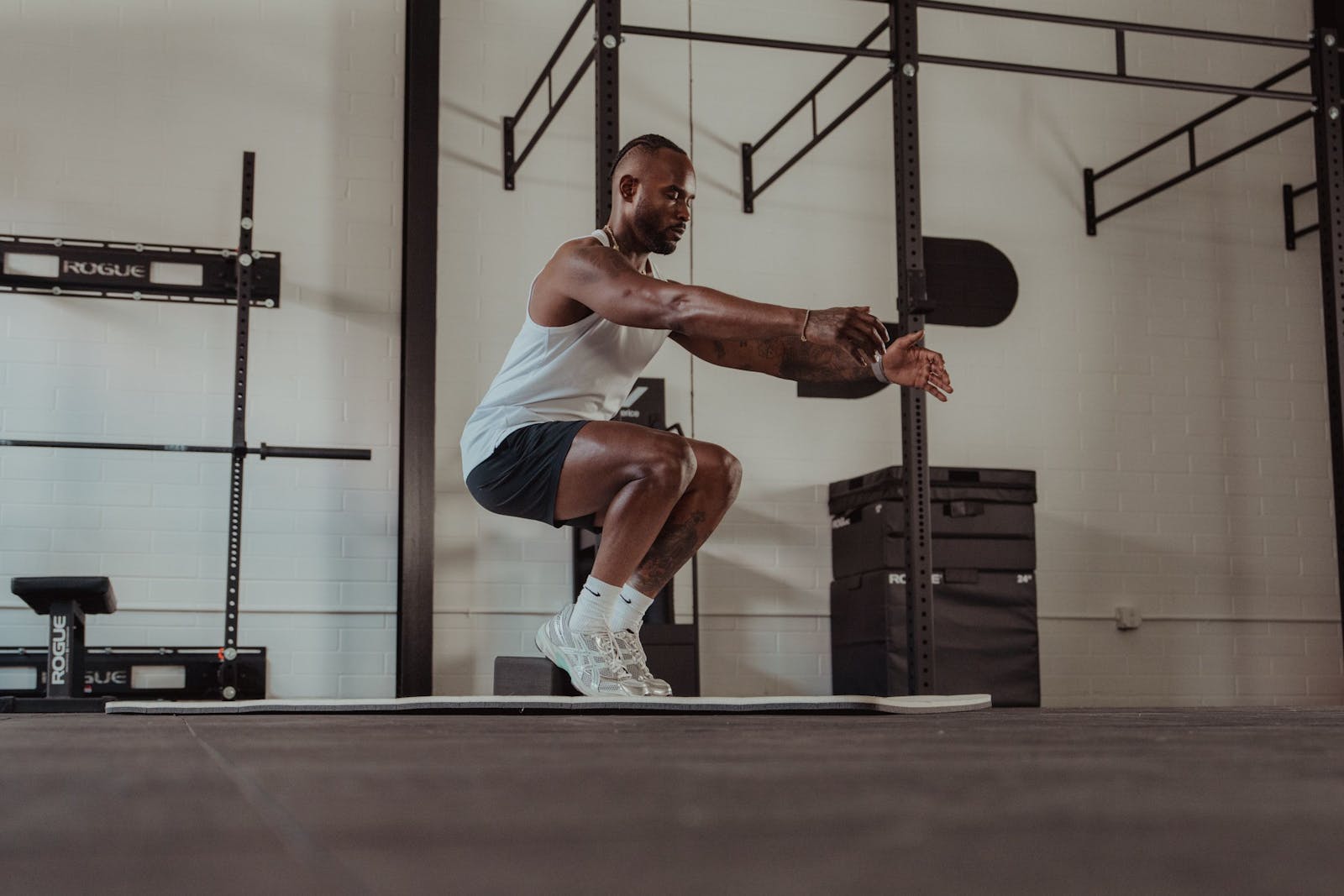
squat
One of the holy grail exercises, a squat will get your lower body in tip-top shape.
How to:
Stand with your feet slightly wider than shoulder-width apart and toes pointed slightly out.
Begin to sit back in the hips, then bend your knees to lower yourself down, almost as if you were going to sit in a chair.
Allow your arms to come out in front of you comfortably, and ensure your knees don't fall in.
Stop when your thighs are parallel to the ground, then return to the starting position.
lunge with back bend
Add a gentle back bend to your lunge to further engage and stretch your torso.
How to:
Stand with your feet shoulder-width apart and your arms down at your sides.
Lunge forward with your right leg, keeping your right knee over your right ankle.
Bring your arms straight above your head and gently lean back, feeling a stretch in your core and hip flexors.
Hold here for five to ten seconds, then return to start.
Alternate legs for the desired number of reps.
single-leg deadlift
With this move, stretch and strengthen the posterior chain, or the back of your body.
How to:
Stand with your feet shoulder-width apart and your arms down at your sides.
Inhale and bend forward at your hips, allowing your right leg to come out behind you.
Allow for a soft left knee, and ensure that your hips stay square to the ground.
Repeat for the desired number of reps, then switch legs.
dumbbell chest press
Stretch and strengthen your chest with a dumbbell chest press.
Lie with your back on a bench and a dumbbell in each hand at chest level.
Push the dumbbells up over your chest, ending with your arms directly over your shoulders at the top.
Pause here, then release the dumbbells back to your chest, feeling the stretch at the bottom of the range of motion.
common mistakes to watch for
With all stretching, you must listen to your body. If you start to feel pain or significant discomfort, stop immediately. You could risk a muscle strain or even a tear. Stretch just to the point of tension and hold there. With consistent practice, you'll ease into your flexibility in no time.
improve your flexibility with our mobility app today | get 7 days for free on any platform

pliability brings a performance-oriented approach to mobility and flexibility training. Inside the app, you'll find Daily Sessions to help you stay consistent, structured Paths that guide you toward a specific goal, and Build Your Program if you'd rather put together a routine around your own priorities. Start with our mobility test to see where you're tight right now, and use the Rebuild hub if you're working around an injury or nagging pain.
Improve flexibility
Aid recovery
Reduce pain
Enhance range of motion
pliability also provides daily-updated custom mobility programs for those looking to optimize their health and fitness, along with a body-scan feature to help pinpoint mobility issues. If pain or limited range of motion is holding you back, pliability is built to complement your existing routine and help you move better.
Sign up today for 7 days free, on iPhone, iPad, Android, or on our website, and put these self-tests into practice with a mobility app built to improve flexibility, aid recovery, reduce pain, and enhance range of motion.
Related Reading


Move better in 10 minutes a day.
10,000+ five-star reviews.