


LEARN
pliability

Have you ever noticed your body feeling stiff and achy after sitting too long or performing repetitive tasks? This discomfort typically results from a lack of mobility and flexibility, which can contribute to injury, limit physical performance, and hinder daily activities. A mobility stretching routine can help improve joint health, flexibility, and range of motion to alleviate this discomfort and help you move better. This article will provide valuable insights to help you achieve your goals, such as How to Get Flexible Fast and range of motion quickly and safely with an efficient, easy-to-follow routine.
pliability’s mobility app is a valuable tool for reaching your objectives. With a library of over 100 routines and 800+ videos, you can easily find a mobility stretching routine that fits your needs, goals, and schedule.
what are mobility stretches?

Mobility exercises target specific joints and the surrounding areas to improve the range of motion and function. Improving mobility enhances athletic performance and reduces injury risk. Also called “mobility work,” these exercises help to warm up stiff joints before physical activity and enhance the quality of movement so you can avoid injuries like muscle strains that occur when your body doesn’t work properly.
mobility routine benefits
If you’re a runner who keeps up with everything experts recommend to prevent injury, you’ve likely heard about a form of movement called “mobility exercises.” Even if mobility is a new term to you, it’s something sports medicine doctors, physical therapists, and any providers focusing on movement have long emphasized as important. And it’s not just for runners, but all athletes or anyone who moves their body and hopes to stay strong and injury-free.
understanding the importance of mobility exercises for joint health
Mobility exercises (sometimes called “mobility work”) are designed to increase the range of motion of a joint, says Samantha Smith, MD, a Yale Medicine primary care sports medicine specialist. “The joints are the points of motion in our body. Any time we move, we don’t want a limitation because of a stiff joint. This can happen for many reasons, including inflammation of the joint or just because we haven’t been using it, which could cause the soft tissues around it to tighten,” Dr. Smith explains. “A muscle injury or tightness can also affect the joints. Likewise, if the ligaments aren’t being used, they can become less pliable.”
Dr. Smith adds that everyone can relate to waking up in the morning and feeling stiff or tight. “And you can feel the difference between that and how you feel after your body is warmed up from exercise, where you have more freedom of movement,” she says. “That is the goal of mobility work to give your joints that freedom instead of having them be a source of restriction and to potentially prevent muscle strains and joint soreness.”
do mobility exercises include stretching?
A full-body stretching routine can help you unfold and improve body alignment. But what exactly is stretching? It helps to understand how your body works. All muscles shorten and lengthen when they are being used. Stretching a muscle temporarily relaxes it and allows it to lengthen. If you were to look at a muscle under a microscope, you’d see striated fibers called sarcomeres, which are the basic building blocks of muscles. Each sarcomere comprises two types of filaments or proteins:
Actin (which is thin)
Myosin (which is thick)
During a muscle contraction, these filaments slide against each other, while little cross-bridges between the filaments enable the muscle to contract and lengthen. Of course, all this takes energy and happens without you even realizing it, but that’s the general process. It’s a microscopic dance between proteins every time you move.
While the jury is still out there about the actual effectiveness of stretching, one thing is for sure: it feels good! Stretching first thing in the morning or after a long day in a slouched position can temporarily reduce aches and pains related to bad posture and is exactly what your body needs to relax.
Dr. Smith explains that mobility work can include yoga and stretching both static and dynamic. “If you think of dynamic stretching as something you do to prepare your body for a run, then static stretching is about increasing the length of a specific muscle group because it might be tight,” she says. “Mobility exercises, Dr. Smith adds, can be done before a run, after a run, or on a rest day. You can think of them as a form of recovery,” she says. "Perform mobility work in addition to your usual routine, rather than having it replace a warm-up or cooldown."
is mobility the same as flexibility?
While mobility and flexibility are related, there is a key difference, Dr. Smith says. “One way to think about it is that mobility is specific to joints, and flexibility is specific to joints and muscles. Someone can have great hip mobility, for example, but not have the muscle flexibility to do a split,” she says.
5-minute full body mobility stretching routine

This five-minute routine can relieve stress and improve flexibility. Here's a detailed breakdown of the movements and how to perform them well.
neck stretch
Before you do anything, relax your shoulders. Did you feel them just drop a little? Chances are, you’re hunching your shoulders up throughout the day, storing stress and tension in your upper trapezius muscles, which you didn’t even know you were using. To stretch the upper traps and leave your neck feeling looser, begin by placing one hand over the opposite side of your head.
Slowly and carefully draw your right ear to your right shoulder, using your right hand to overpress the left side gently.
Keep your face forward.
Hold for 30 seconds.
Repeat on the other side.
cat cow (60 seconds)
The first stretch exercise will loosen up the spine and back muscles in preparation for our next exercises. This is especially helpful in the morning after we’ve been lying in bed for several hours.
To perform it:
Get onto all fours, knees under your hips, and hands under your shoulders. From here, gently round your back up towards the ceiling.
Imagine as if someone was pulling your mid-back with a rope.
As you do this, take a deep breath while tucking your head down.
Exhale as you reverse this motion by curving your back the opposite way while lifting your head.
Based on lab research by a back pain expert, Dr. Stuart McGill, he found that just seven to eight cycles of this are needed for the most benefit. When done slowly and controlled, this should take about a minute. Need help nailing down this motion? Try placing a band around your mid-back. This will help pull your spine into the bottom position. It will then give you the resistance and sensory feedback you may need to learn how to round your spine upwards properly.
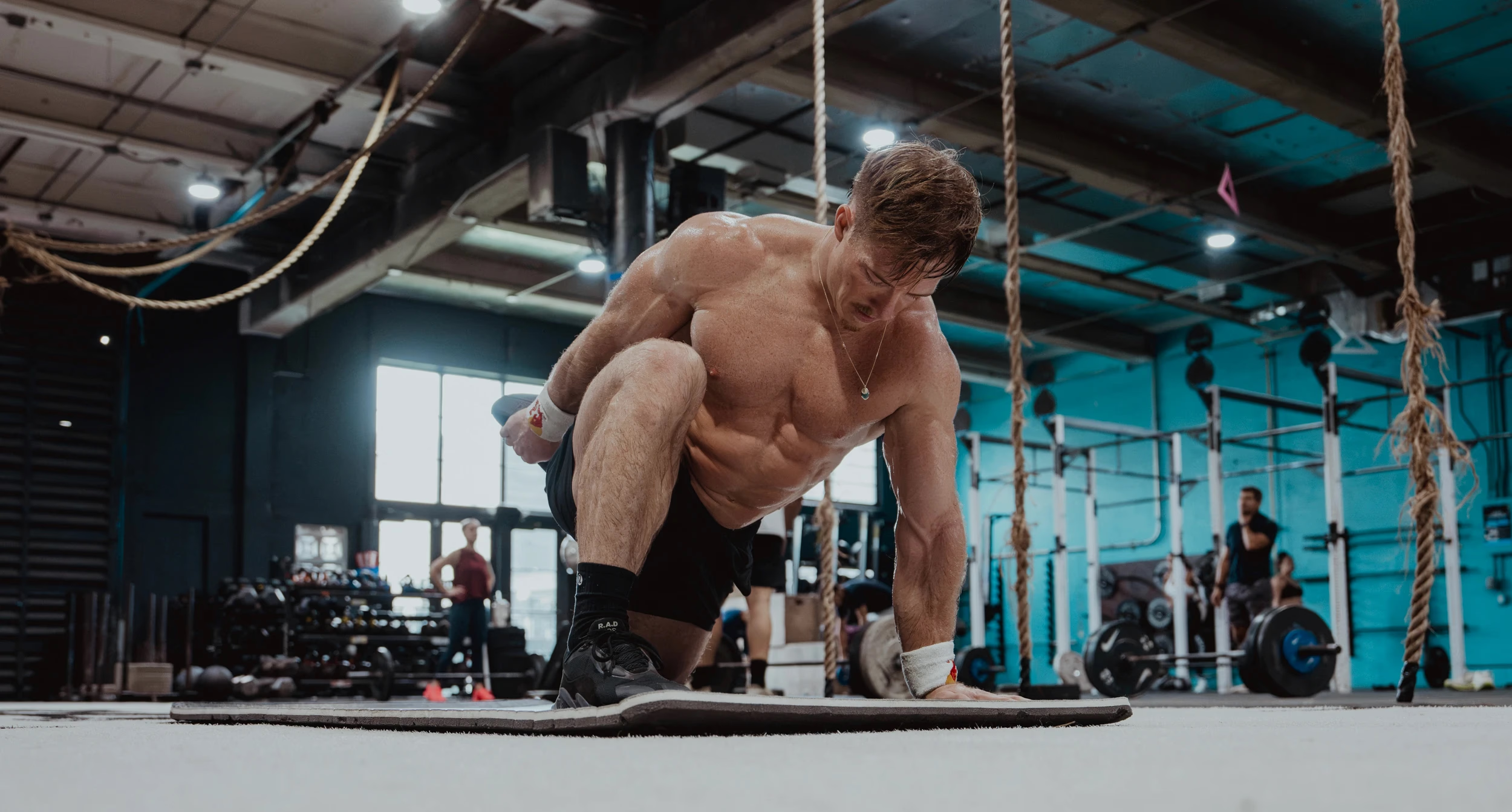
world's greatest stretch (30 seconds per side)
The next stretch exercise, the “World’s Greatest Stretch,” will be the most effective way to simultaneously hit all the key problem areas. This stretch has three parts to it:
Lunge
Get into a plank position with your hands under your shoulders and feet together.
From here, lunge forward by bringing your right foot up as high as possible (ideally next to your right hand).
As you do this, you should feel a deep stretch in the groin muscles of your front leg and the hip flexors of your back leg.
Take your right hand and place it on your knee.
Push your knee out and back, then forward and back a few times to loosen up the hips and ankles.
Drop
We'll deepen the stretch even more in the second part of the stretch. You can do so by:
You are dropping your right elbow as far towards the ground as possible while rotating your upper body towards the ground.
As you do this, try to keep your right knee pushed out rather than letting it collapse inwards.
Reach
For part three, we will really open up the mid and upper back. To do so:
Rotate your upper body to the right and reach your right arm as far overhead as possible.
Try to keep your back leg as straight as possible as you do so.
Reach back down
Repeat this for five reps, or about 30 seconds, before switching to the next side
How To Regress The Exercise
This is quite a difficult stretch exercise. To make it easier, you can keep your leg bent or your knee on the ground and work towards straightening it more and more over time. Don’t be discouraged if you can only reach so far here and there in the beginning. Just stay consistent with it, and it’ll improve very quickly.
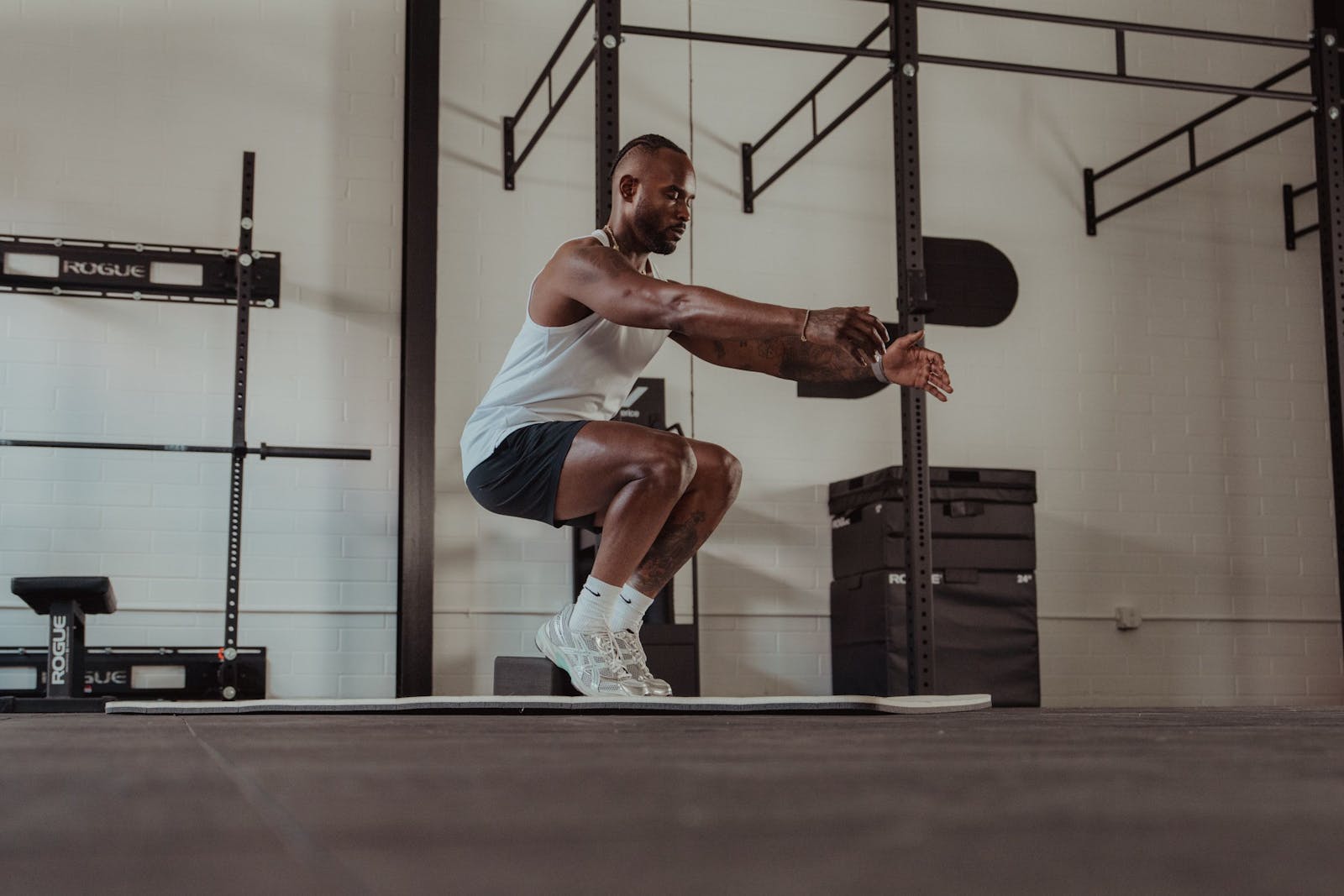
Asian squat (30 seconds hold, 30 seconds rock side to side)
We will do what you’ll just call the Asian squat. But with a few modifications to open up the hips and ankles:
Get a rolled-up towel and place your heels on it.
From here, using a squat stance that's typically just outside shoulder-width, squat down to however deep is comfortable for you.
Keep your chest up, and try to keep your heels down.
If your heels come up, roll up the towel to make it even thicker. Otherwise, it's fine if you have to keep your heels up.
From here, place your arms on the inside of your legs.
Use your elbows to push your knees out.
Sit in this position for 30 seconds. You should feel a deep stretch in your groin and the muscles around your ankles.
In a rush to get to work? You can have breakfast while you’re at it.
For 30 seconds, move side to side to stretch out each ankle one at a time.
Avoid collapsing your knees and pointing your feet too far outward as you do this. Doing these takes the stretch away from the ankles.
Keep your feet angled out at about 30-45 degrees max.
Keep each knee in line with the outside of your toes.
How To Progress The Exercise
There are a couple of ways to progress this stretch exercise. In the beginning, if you struggle with ankle mobility, you may need a lot of heel elevation to get into a deep squat comfortably. Over time, try to use less and less heel elevation. See if you can eventually get to using no elevation at all.
At the bottom position, to open up the hips even more, you’ll first just push your knees out with your arms straight ahead. Once that gets easy, try to place your hands together in a prayer position. Once that gets easy, place your hands together into fists. Each progression will open up your hips more and more by spreading out the distance between your elbows.
half-kneeling thoracic rotations (30 seconds)
We will focus on mobilizing the upper back with rotation and opening the chest. Here's how to do this stretch exercise:
Get into a half-kneeling position with your right leg bent as close to the wall as possible and your left leg planted forward in a lunge position.
Place both arms directly in front of you, with your right arm making contact with the wall.
From here, push your right hand into the wall as you rotate your upper body to the left, trying to reach your left arm to the other side.
As you do this, avoid rotating at your hips and try to rotate only the upper body.
Return to the starting position
Repeat for 30 seconds before switching sides.
To make it easier when starting, try moving your planted leg away from the wall and rotating as far as you can without rotating your hips. Try moving your leg closer to the wall and rotating further as this improves. Once you can get that down, you can progress it even further to open up the chest and shoulders by sliding your hand against the wall as if drawing a half-moon.
wall slides (60 seconds)
Now that we’ve loosened up your upper back, we will temporarily have the mobility to activate better and strengthen some of the smaller, weakened muscles in the back. Strengthening these muscles will help you maintain these mobility improvements in the long term. The exercise we’ll use to do so is wall slides.
To perform it:
Stand with your back against a wall and contract your abs to flatten your lower back on the wall.
Slide your arms up and down the wall.
Place your feet further away from the wall to make this stretch exercise easier when starting.
Over time, try to get your feet closer and closer to the wall while trying your best to keep your lower back flat against the wall.
When done properly, you should feel a few muscles in your mid-back light up as you raise your arms.
Can’t you initially keep your arms in contact with the wall all the way through? Or you can’t slide your arms up very high at all? That’s all perfectly fine. Just focus on improving this over time.
full 5-minute daily mobility routine
Here are the stretch exercises in your 5-minute daily mobility routine:
Cat Cow (60 Seconds)
World's Greatest Stretch (30 Seconds Per Side)
Asian Squat (30 Seconds Hold, 30 Seconds Rock Side To Side)
Half-Kneeling Thoracic Rotations (30 Seconds)
Wall Slides
Focus on doing as many high-quality reps as possible within the 1 minute you have for each stretch exercise.
22 more mobility stretches to build out your routine
The five-minute routine above covers the essentials, but on days when you have more time, or when one area needs extra attention, you can swap in stretches from this region-by-region menu. Pick two or three for a trouble spot and add them to the end of your routine.
stretches for neck mobility
Whether you spend your day sitting at a desk or on your feet, poor posture habits are easy to pick up, particularly if you spend a lot of time looking down at a digital device or work surface. That posture puts your spine in cervical flexion, which causes the neck muscles to tighten. Over time it can get very painful, and it can become a repetitive cycle of pain and not holding your neck upright because it hurts. Try these neck stretches to counteract the damage of this daily wear and tear.
1. Seated Upper- and Mid-Back Stretch
Muscles and Joints Targeted:
This stretch targets the upper back, mid-back, and neck.
How to:
Sit in a chair with your feet firmly on the ground.
Bend forward and grab the front of the chair legs, crossing your arms.
Slowly tuck your chin, and arch your middle and upper trunk to round your back. You should feel a stretch in your mid to upper back.
Hold for 20 to 30 seconds.
2. Isometric Neck Rotation
Muscles and Joints Targeted:
This stretch targets the neck muscles and improves neck mobility.
How to:
While standing or sitting up straight, place your right palm on your right cheek.
Push your palm against your right cheek as if you are trying to rotate your head to the left; at the same time, keep turning your head to the right.
Hold this resistance for 3 to 6 seconds. Then, remove your hand and rotate your head to the right as far as possible. Stop when you feel a gentle stretch on the left side of your neck.
Switch sides and repeat. This is one rep.
Perform two to three reps.
shoulder mobility exercises
Tight shoulders often accompany a stiff neck. But promoting flexibility and mobility in your shoulders isn't as simple as stretching a single muscle. There are at least 17 muscles involved in what might appear to be simple shoulder-specific tasks like washing your hair or lifting a heavy grocery bag. Your rotator cuff alone comprises four different muscles. To prevent injury in your shoulder muscle group, try these shoulder stretches.
3. Triceps Stretch
Muscles and Joints Targeted:
The triceps stretch targets the triceps and shoulder to improve flexibility.
How to:
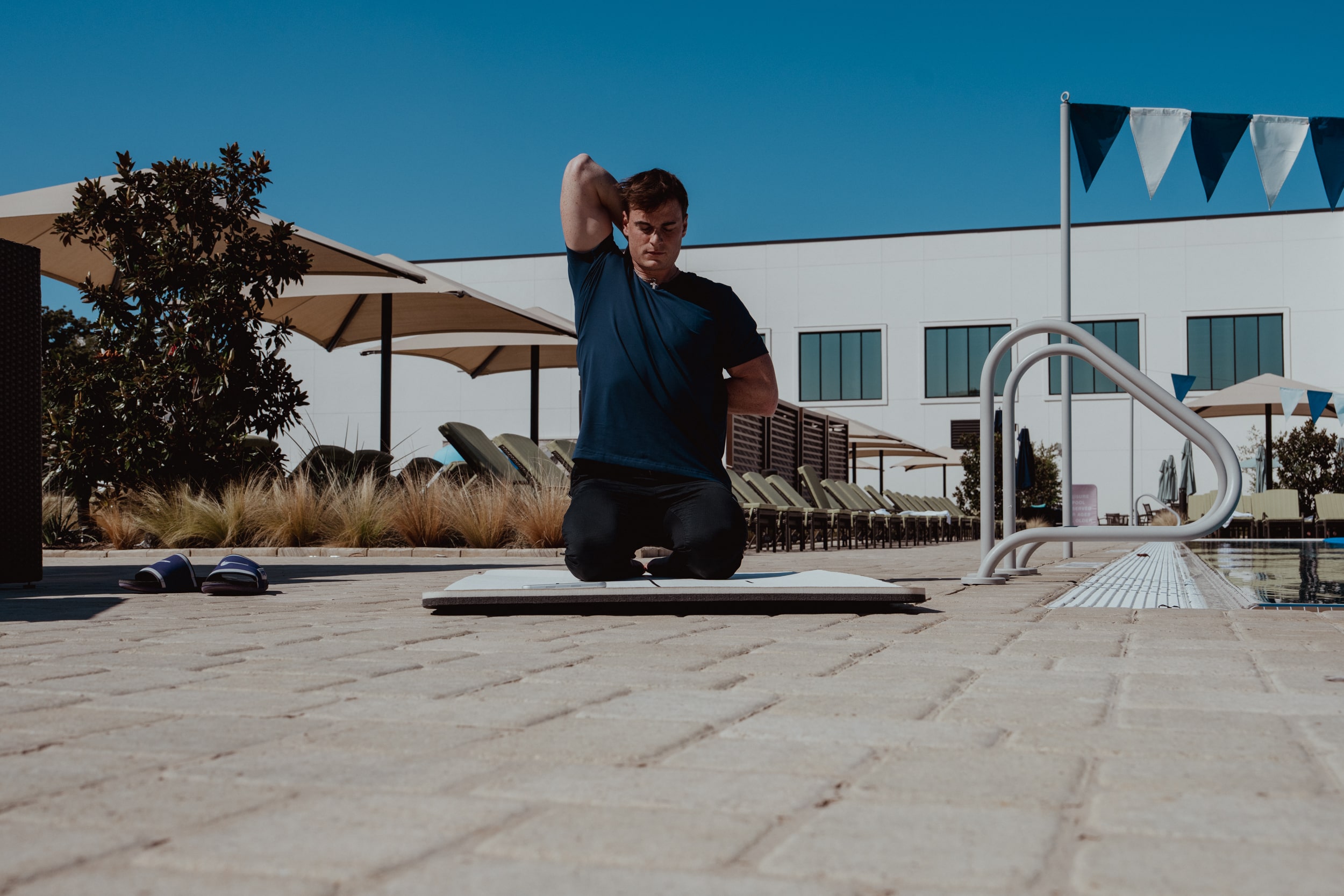
Stand with your chin tucked in and raise your right arm straight up.
Bend your right elbow and place your right palm behind your head.
Place your left hand on your right elbow and pull toward the left. Stop when you feel a stretch in your right triceps.
Hold for 30 to 60 seconds. Keep your chin tucked in.
Switch sides and repeat.
4. Thread the Needle
Muscles and Joints Targeted:
This stretch targets the shoulders and upper back.
How to:
Place a foam roller on the ground to your left, parallel with your body, and get on all fours with hands under shoulders, knees bent, and hips under.
Keep your chin tucked in, back straight, and shoulder blades pulled together.
Reach your right arm under the left arm and onto the foam roller, palm up.
Roll your right arm and shoulder through. Pause, reverse the movement and then raise your right arm up and back to open your chest. Then return to start. This is one rep.
Perform two reps. Switch sides and repeat.
core mobility exercises
Core strength gets most of the attention, but core mobility matters just as much. It's key for any activity that involves rotation through your midsection, from pickleball to picking up a heavy bag of groceries. Adequate mobility in this area lowers your risk of injury during these activities and can also reduce back pain.
5. Forward Reacher
Muscles and Joints Targeted:
The forward reacher stretch targets the entire back and improves mobility and flexibility of the spine.
How to:
Sit on a flat stool or chair with your legs in front of you and knees relaxed.
Tuck your chin toward your chest and reach forward and down as far as you can.
Hold 2–3 seconds. Sit up and reset.
Repeat 10–12 times.
6. Side Reacher
Muscles and Joints Targeted:
Side reachers improve mobility in the spine and target the obliques.
How to:
Stand with feet hip-width apart, one hand behind your head and the other flat against your thigh.
Bend at the hip, reaching your straight arm down towards the floor. Hold for 2 seconds and return to neutral. This is one rep.
Repeat the stretch for a total of 10 reps on each side.
7. Twist and Dipper
Muscles and Joints Targeted:
This stretch targets the spine and improves mobility in the thoracic region.
How to:
Sit with your spine straight and feet shoulder-width apart. Interlace your hands and put them behind your head.
Twist as far as you can toward the right and then drop toward the floor. Drop your left elbow (which is pointing forward) toward the floor so it drops outside your left knee.
Hold 2–3 seconds and return to neutral; repeat 6–8 times.
Then switch sides and repeat.
8. 90/90 Hip Switch
Muscles and Joints Targeted:
The 90/90 hip switch stretch targets the hips and improves internal and external rotation of the hip joint.
How to:
Sit up straight with your legs slightly wider than hip-width apart and both knees bent at 90-degrees.
Keep your heels on the floor (in the same position) and rotate your knees from side to side. (For an added challenge, hold your arms straight before you.)
Maintain an upright posture as you move your knees, focusing on movement from the hips. Complete 6 reps on each side.
low back mobility exercises
A healthy spine is a key part of a healthy lifestyle. It acts as a central anchor for movements like walking and standing, and it transmits force between your upper and lower body. In other words, the mobility of your lower back is important for just about every activity you do. Something as simple as sitting all day can cause problems, and prolonged periods of inactivity aren't good for the body.
9. Bird Dog
Muscles and Joints Targeted: The bird dog exercise targets the low back, glutes, and core muscles to improve stability and coordination.
How to:
Begin on your hands and knees, with your knees directly under your hips and your hands under your shoulders. Your back should be neutral, and your neck should be parallel to the floor.
Engage your abs, then lift and extend one arm and the opposite leg, keeping your core stable. The goal is to reach the leg and the arm away from each other, not to lift the limbs high.
Return to start and repeat with the opposite arm and leg. This is one rep.
Repeat for 10–12 reps.
The key: Making sure your abdominals stay engaged and activated throughout the movement.
10. Supine Glute Stretch
Muscles and Joints Targeted:
This stretch targets the glutes and low back.
How to:
Lie on your back with both legs flat on the floor.
Lift one leg toward your chest so the knee travels toward the shoulder on the same side and the ankle travels toward the opposite side. Assist by gently pulling with the hands around the lower leg, shin toward the chest.
Hold 2–3 seconds, then return to start.
Repeat 10–12 times on each side.
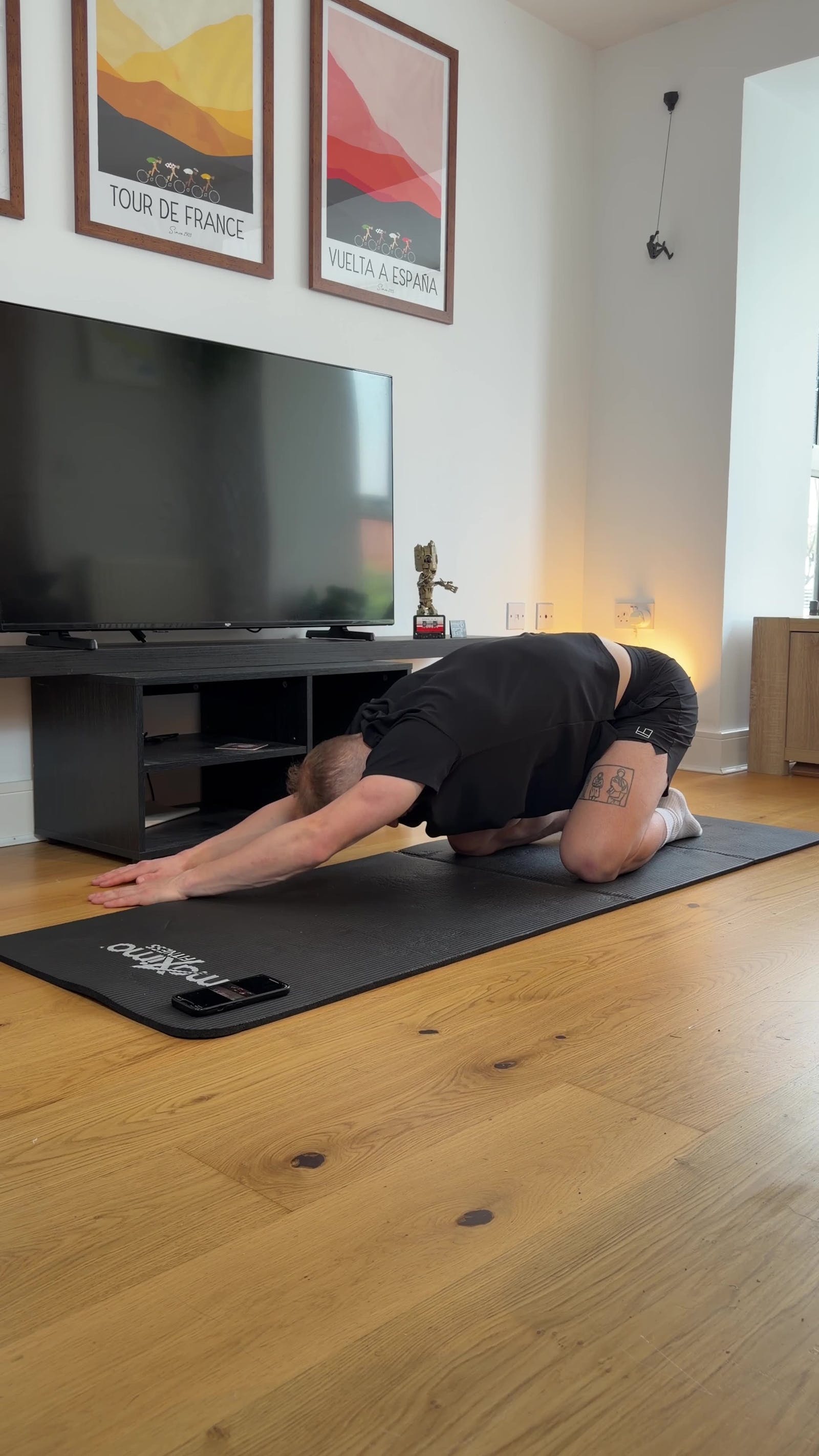
11. Child's Pose with Side Stretch
Muscles and Joints Targeted:
This stretch targets the low back and hips to improve mobility and flexibility.
How to:
Start on all fours and push your hips back so your buttocks rest on your heels.
Reach forward with your hands and hold the stretch for 10 breaths.
Reach to one side with both hands and hold the stretch for 10 breaths. Then, reach to the other side and hold the stretch for 10 breaths.
hip mobility exercises
Sitting is also hard on the hips. Sit for long enough and you get what's called adaptive shortening, where the muscle becomes progressively tighter. If your hip flexors get tight enough, they can begin bothering their neighbors, the spine and femurs, which can trigger back pain. Do these hip flexor stretches regularly to keep these key muscles long and limber.
12. Kneeling Hip Flexor Stretch
Muscles and Joints Targeted:
The kneeling hip flexor stretch targets the hip flexors.
How to:
Place a pillow or folded yoga mat on the floor to cushion your knees, about a foot away from a chair (or couch or wall).
Get into a kneeling position, with your right knee on the pillow and the top of your right foot on the chair. Step your left foot forward and bend at the knee to create a 90-degree angle with your left leg. Lean forward several inches.
In this position, squeeze your right glute. You should feel a stretch at the top of your thigh.
Hold for 30 to 90 seconds.
Switch sides and repeat.
Tip: Move your back knee closer to the chair for a deeper stretch. For an easier stretch, rest your back foot on the ground.
13. Twisted Triangle Hip Stretch
Muscles and Joints Targeted:
This stretch targets the hips and improves mobility and flexibility.
How to:
Sitting in a chair, bend your leg and place your ankle on the opposite knee.
Rotate your knee up toward your chest, and then down toward the floor.
Hold for two seconds and return to start.
Repeat 10 times on each side.
14. Kneeling Hip Flexor Stretch with Rotation
Muscles and Joints Targeted:
This stretch targets the hip flexors and improves mobility.
How to:
Kneel on your right knee with your left leg forward and bent at 90 degrees. For balance, place your hands on your hips.
Contract your glutes to flatten your lower back and transfer your weight forward to increase the stretch in the front of your right leg.
Then, cross your arms over your chest and turn your torso and upper body to the left.
Keep your glutes slightly contracted to avoid tilting your pelvis forward. Hold for 30–60 seconds.
Now, turn your torso and upper body to the right. Again, keep your glutes slightly contracted to avoid tilting your pelvis forward. Hold for 30–60 seconds.
Switch legs and repeat.
15. Downward Dog Hip Opener
Muscles and Joints Targeted:
The downward dog hip opener targets the hips and improves mobility.
How to:
Come into a plank position to start with your shoulders stacked over your wrists and hands.
Push back from your hands and hike your hips up to bring yourself into a downward dog position.
Bend your left knee towards your chest, then lift your left leg up and back behind you.
Open up from your hip, letting your left foot fall towards your right glute. Reverse the movement to return to the starting position. Repeat on the other side.
That's one rep. Complete eight reps.
16. Half Kneeling Adductor Rock
Muscles and Joints Targeted:
This stretch targets the inner thigh (adductor) muscles and improves hip mobility.
How to:
Start in a half-kneeling position, with your left leg in front of you, knee bent, and foot planted on the ground. Your right knee rests on the ground either directly beneath your torso or slightly behind you, with an approximately 90-degree bend.
Step your left foot out to the left and place your hands on your hips. Shift your hips toward the left and weight onto your left foot.
Hold this position for 1-2 seconds before returning to the center.
Repeat 8-12 times on this side. With each repetition, try to shift the hips a bit deeper into the range.
Return to the starting position and repeat on the opposite side.
knee mobility exercises
Knee stability is particularly important for preventing injury. To check yours, do a squat in front of a mirror: your knees should track directly over your toes. If they flail inward or outward during squats, or you often lose balance doing lunges, your knee stability muscles could use some work. That usually means the joint and the muscles surrounding it aren't strong enough to fully support the move, and poor form and overcompensation take over instead. Try these knee mobility exercises to build strength and prevent injury while you work out.
17. Wall Squats
Muscles and Joints Targeted:
Wall squats target the quads, hamstrings, and glutes to improve lower body strength and stability.
How to:
Stand about 12 inches away from a wall, facing away, feet hip-width apart.
Lean against the wall so your butt and shoulders are both touching and your back is straight.
Squat down, keeping your back against the wall, until your knees are at a 90-degree angle. Note whether your knees are moving in as you lower down. Aim to keep your knees tracking directly over the toes.
Return to standing, squeezing your glutes.
Repeat 10–12 times.
18. Single Leg Balance + Front, Side, Back Tap
Muscles and Joints Targeted:
This exercise improves knee stability by challenging balance.
How to:
Stand upright with feet together and hips aligned forward.
Balance on one standing leg and extend the other leg, lightly touching your big toe to the ground, first forward, then to your side, then behind you. Continue tapping the three points for one minute.
Repeat on the other side.
To progress this move, stand on an uneven surface (like a balance board or stability disc) and try to balance yourself as you tap the three points.
19. Banded Lunge
Muscles and Joints Targeted:
The banded lunge targets the glutes and improves lower body strength and stability.
How to:
Place a loop resistance band around both legs, positioning it above your knees, and stand comfortably with your feet facing forward.
Step backward with one foot against the band's resistance by shifting your weight onto the back foot while keeping the front foot in contact with the floor.
Straighten the back knee and extend it against the band's resistance by pressing your back heel into the floor (or as close as you can comfortably get). Then, return to start.
Repeat 10 times.
Return on the other side.
ankle mobility exercises
Ankle function is a key part of any lower body activity: walking, running, rollerskating, you name it. Ankle dysfunction can travel up the kinetic chain and contribute to pain in the knees, hips, and low back, and can eventually affect your posture. The ankle should be strong enough to properly absorb shock from walking, running, or jumping so your other joints don't have to absorb that shock instead.
Compared to other major joints in the body, the ankle is unusually mobile, which also makes it particularly subject to injury. Try these ankle exercises to promote ankle stability and prevent injuries that could derail your wellness goals.
20. Ankle Angler
Muscles and Joints Targeted:
The ankle angler exercise improves ankle mobility.
How to:
Start lying on your back. Wrap a strap around one foot, holding both ends, and lift it so your leg is perpendicular to the floor.
Keeping your leg straight, use the strap to help roll your ankle inward. Hold for 2 seconds and return to neutral.
Repeat 10 times on each leg.
21. Ankle In
Muscles and Joints Targeted:
This exercise targets the ankle to improve mobility.
How to:
Start seated on the floor in a cross-legged position.
Lift one knee, so your foot is flat on the floor before you.
With both hands around your foot, rotate it so that your big toe points toward the ceiling and your pinky toe points toward the floor. Hold for 2 seconds. Return to neutral.
Repeat 10 times with each foot.
22. Ankle Out
Muscles and Joints Targeted:
This exercise targets the ankle to improve mobility.
How to:
Start seated on the floor in a cross-legged position.
Lift one knee, so your foot is flat on the floor before you.
With both hands around your foot, rotate it so that your big toe points toward the floor and your pinky toe points toward the ceiling. Hold for 2 seconds. Return to neutral.
Repeat 10 times with each foot.
when you have more time: a 19-minute full-body mobility exercise routine

On days when five minutes isn't enough, this longer mobility exercise routine gives you a complete warm-up, circuit, and cool-down in under 20 minutes. It works well as a standalone session on rest days or as extended preparation before a hard workout.
warm-up: dynamic stretching (5 minutes)
Dynamic stretching warms the body and gets the blood flowing to the muscles used in your mobility routine.
Arm Circles: Stand with your feet hip-width apart and extend your arms to the sides. Make small circles with your arms, gradually increasing the size for 1 minute.
Leg Swings: Hold a sturdy support and swing one leg forward and backward, then side to side for one minute. Repeat with the other leg.
Torso Twists: Stand with your feet shoulder-width apart and gently twist your torso from side to side for 1 minute.
Neck Circles: Carefully rotate your neck in a circular motion, clockwise and counterclockwise, 30 seconds in each direction.
the 9-minute full-body mobility circuit
This circuit targets different areas of your body with simple yet effective exercises. Practice each movement for 1 minute before moving to the next one.
Upper Body Movements
Shoulder Rolls: Stand with your arms relaxed at your sides and roll your shoulders forward and backward.
Arm Swings: Extend your arms straight before you and swing them backward and forward.
Neck Tilts: Tilt your head to the left and right, stretching your neck muscles.
Core and Back Movements
Cat-Cow Stretch: On the floor on your hands and knees, arch your back upward (cat) and then arch it downward (cow). Repeat slowly with the breath.
Plank Twists: Start in a plank position and rotate your hips to one side and then to the other.
Child's Pose: Kneel on the floor with big toes together and knees wide. Sit back on the heels and stretch the arms forward for a gentle back and shoulder stretch.
Lower Body Movements
Hip Circles: Stand with hands on the hips and rotate the hips in a circular motion.
Ankle Circles: Sit on the floor with legs extended and rotate ankles in both directions.
Toe Touches: While standing, bend at the waist and reach for the toes to stretch the hamstrings.
cool-down: static stretching and breathing (5 minutes)
After the circuit, take 5 minutes to cool down with static stretching and deep breathing:
Quad Stretch: Stand and gently pull one heel toward the glutes to stretch the quadriceps. Repeat on the other side.
Hamstring Stretch: Sit on the floor with one leg extended and the other bent. Reach for the toes to stretch your hamstrings. Repeat on the other side.
Calf Stretch: Stand facing a wall, place one foot behind you, and press the heel into the ground to stretch the calf muscle. Repeat on the other side.
Deep Breathing: Finish with a few moments of deep breathing to relax both body and mind. Inhale deeply through your nose, hold for a moment, and exhale slowly through your mouth.
six tips for safe, effective stretches

1. warm up: the unsung hero of flexibility
Muscles stretch more quickly when they are warm. This makes warming up before flexibility work crucial for both safety and effectiveness. You can warm up for flexibility work with any light aerobic activity that gets your heart rate up and increases blood flow to your muscles.
For example, try marching in place or taking a brisk walk for five to 10 minutes. Dynamic stretching or “mobilitywork” can also help you prepare for your flexibility routine. A few minutes of these movements, which gently take your muscles through a range of motion, can prepare you for static stretching. You can also use warm heat packs or take a warm shower to help get your muscles ready for stretching.
2. find your edge, then back off
To gain flexibility, you need to stretch the muscles to the point of discomfort. However, finding your edge and backing off is crucial to avoid injury. Stretching should never be painful. If you feel any pain, ease off the stretch until you feel comfortable. Reset your position and try again. Over time, you will improve your flexibility and be able to stretch further with less discomfort.
3. use proper form and focus on the target muscle
Good form is essential for stretching just like it is for strength training. Pay attention to your posture during flexibility exercises, particularly sitting or lying on the floor. Good form translates to better gains in flexibility and less likelihood of injury when stretching tight muscles.
Another tip for safe stretching is to focus on the muscle being stretched. You may notice that one side of your body is often tighter than the other. Work on balancing this over time.
4. breathe easy
Breathing is an important part of any flexibility routine. You should breathe comfortably while stretching or use yoga breathing. Whatever you do, don’t hold your breath while you are holding a stretch. As you breathe in and out, your body will relax, and you can increase your range of motion.
5. stretch often for best results
You’ll make the best gains in flexibility if you stretch frequently daily or on as many days of the week as possible. At the very least, aim to do stretches two or three times a week. Stretching dos and don'ts To ensure you always stretch safely, consult the dos and don’ts listed below, and you will get the most out of your stretching.
6. stretching dos
Ensure that the muscles being stretched are thoroughly warmed up
Stretch at the end of your training session
Relax
Breathe easily
Hold each stretch for a minimum of 30 seconds
Follow an all-over body program for stretching to avoid postural imbalances
Follow correct technique
Avoid pain; stretching should never be painful
7. stretching don'ts
Try and stretch cold muscles; it’s a recipe for injury
Stretch before your warm-up or workout
Bounce or rock whilst holding a stretch; you could overstretch and cause an injury
Hold a stretch for just a few seconds
Hold your breath
Focus on just leg stretches, or just upper body stretches
improve your flexibility with our mobility app today | get 7 days for free on any platform
pliability can help people recover from:
Injuries
Surgeries
Chronic pain
The mobility routines are designed to improve flexibility and range of motion, helping the body move better and alleviate discomfort. If you’re feeling limited by pain or your ability to move, pliability aims to complement your fitness routine and help you move better.
Related Reading



Move better in 10 minutes a day.
10,000+ five-star reviews.