


LEARN
pliability

Every athlete faces obstacles when working to improve their performance. Whether training for a specific event or gearing up for the next competitive season, it's common to feel stuck or frustrated as you work to break through your barriers. The good news is that you can develop a plan to gain measurable improvements that translate to your sport, and strength training for athletes is a critical component. If you're wondering how to increase athleticism, it starts with building a solid foundation of strength, power, and endurance tailored to your sport. This article will help you get started with an athlete-focused approach to building a strength training plan that improves your performance and helps you reach your goals.
what is strength training for athletes?

Strength training for athletes is a continually evolving discipline, as coaches seek evidence-based methods to enhance athletic performance. At its core, athletic training focuses on developing physical attributes that directly impact performance on the field, such as strength, power, and endurance.
The foundational concept of progressive overload, famously illustrated by the ancient Greek athlete Milo of Croton, remains central today. Milo's legendary ability to carry a growing calf daily, eventually lifting a full-grown bull, symbolizes the gradual increase in resistance that builds strength over time.
modern tools for an old principle
Modern strength training builds on this principle with a deeper understanding of human physiology, biomechanics, and recovery. To develop functional strength specific to an athlete's sport, today's programs use barbells, dumbbells, machines, and cables. As training science evolves, so must coaches; continual education is essential to reaching peak performance.
how does strength training improve athletic performance?
Athletes can improve at their sport in two different ways. The first is increasing proficiency in the sport itself, which falls under motor learning and skill acquisition; gaining skill usually comes from playing more and practicing technique. The second is increasing your underlying strength qualities. There are five of them: cardiovascular endurance, muscular strength, muscular endurance, flexibility, and body composition.
what is strength training, really?
Strength training, or resistance exercise, is any exercise designed to make you stronger using progressive overload, adding more weight, resistance, or repetitions over time. Lifting free weights is probably the best-known form of resistance exercise, but it also includes machines, bodyweight movements, and resistance bands. During a strength training session, your central nervous system and muscle fibers are stimulated and fatigued; as you recover from that fatigue, your strength and fitness levels slowly improve. Repeated sessions compound into increased strength and power over time.
what to expect when you start
Different people start at different strength levels, and where you start compared to others doesn't matter, since the healthiest mindset is to compete against yourself. The beginning of your training is exciting: rapid strength gains can be expected for at least a few months, sometimes a year or longer. As long as you don't get injured or interfere with recovery, by not sleeping enough or eating too little, nearly any training method can add strength and muscle early on.
Build Your Base First
That doesn't mean you should pick any random training method. Think of your first few months as the time to lay a foundation for the rest of your strength training career, a period to educate yourself mentally and physically and prepare your body for long-term success. Since you'll get stronger with nearly any method initially, the wisest approach is to start with straightforward training methods and train your entire body, without neglecting any movement or muscle group. The same concepts apply if you've trained before but taken a few months or longer off.
Linear Progression, and Its Limits
For most people, it's possible to add weight to the bar at every session for at least a few months, sometimes even a full year after starting. This is known as linear progression, the simplest form of training progression: you add the same amount of weight at the same interval for as long as possible. But linear progression has to stop at some point. If you start squatting 55 pounds and add five pounds every week, you might be squatting 315 pounds on your first training anniversary, but the odds of squatting 575 pounds after two years are low, because the human body has limits. At some point you'll need a different mode of progression. The best approach is to ride linear progression and simple training methods as long as they work, then introduce variation once they stop, the point where you've graduated from beginner to novice.
benefits of strength training for athletes
1. Lowers Your Injury Risk
Recreational athletes and professionals alike are likely to have suffered a sports-related injury at some point, and sports injuries in general are nearly impossible to avoid entirely. Research has shown that a strength training program can meaningfully reduce both the risk and severity of injuries you suffer during sports.
Resistance training puts a load on your joints, which reforms your bones over time, increasing bone density and decreasing the risk of bone injury. Your tendons and ligaments get stronger, more flexible, and less prone to strains and tears. Your muscles also work as a team: running, for example, works your hamstrings, quadriceps, calves, and abdominal muscles together, and an undertrained muscle group in that chain raises your injury risk in the sport overall. A comprehensive strength program that trains your whole body is essential to safe workouts; if you have any doubt about how to begin or the correct form to use, a personal trainer can show you the ropes, since safe strength training matters just as much as safe sports play.
2. Builds Explosive Power
Humans generally have two types of muscle fibers. Slow-twitch muscles are built for endurance: they're the first to contract during activity and take considerable effort to fatigue, and they're used heavily by cyclists and distance runners. Fast-twitch muscles work differently, producing short bursts of energy and fatiguing much more quickly, though they have some endurance capability too.
You can shift the composition of your muscle fibers to some extent, and developing your fast-twitch fibers gives you the extra power you need for something like a push to the finish line. A personal trainer can tailor a strength program to your sport to help build that specific power.
3. Teaches You Muscle Mechanics
You push your muscles hard when you're on the field, but doing it the right way matters, since misusing your muscles can cause injury or at least strain and fatigue. Strength training teaches you the ins and outs of muscle mechanics: muscles work in pairs, and for every contraction of one muscle, an opposing muscle is relaxing. Understanding how your muscles work together can improve your performance while you play.
Strength training doesn't just teach your muscles mechanics, it teaches your brain as well. When you work out or play a sport, your brain is naturally wired to activate your strongest muscles first, even though the strongest muscle isn't always the right one for the job. Strength training improves coordination and communication between your brain and your muscle groups, which adds up to a smoother, more efficient performance on the field.
4. Supports Long-Term Health
Strength training is excellent for athletes: it builds endurance, boosts power, and trains your brain. It should come as no surprise that it also benefits your long-term health more broadly. Strength training increases your resting metabolic rate: three pounds of new muscle can meaningfully bump your metabolism, which today means a fitter, leaner, more athletic you, and over time translates to a lower risk of type II diabetes, heart disease, and other serious conditions. It also increases bone density, which reduces your risk of serious injury now and can make you less prone to conditions like osteoarthritis and osteoporosis later in life. Regular strength training is also linked to improved heart health, including favorable changes in cholesterol levels.
5. Makes You a Well-Rounded Athlete
A certain stigma has attached itself to strength training over the years: the idea that resistance training leads to a lack of flexibility, unwanted bulk, a compromised immune system, or gets lumped in with steroid use. Don't be fooled: strength training is practical for every athlete, regardless of ability. It should be incremental and is safest when overseen by a certified trainer, but done right, it can make you a better, more well-rounded athlete. It adds power to your punch, your kick, or your swing, and working with a trainer can also improve your flexibility alongside your strength, teaching you to use your muscles more efficiently while you play, including that final push to the finish line.
four components of a strength training program

structuring a training cycle
A sound strength training program isn't just a bunch of exercises thrown together in the hope of improving performance. There must be structure and progression so you can build on your strengths and weaknesses over time. A training cycle typically consists of different phases, each with its own goal, and phases differ from athlete to athlete depending on age, goals, and available time frame. Each phase plays a role in developing overall strength and power.
Phase 1: Structural Balance
This phase focuses on identifying and correcting existing muscle imbalances through exercises that target weaker or underactive muscle groups. Doing so improves overall stability and reduces the risk of injury as you progress into more advanced training phases. It's crucial to perform movements that engage stabilizing muscles with proper form and technique; emphasizing unilateral exercises helps build balanced strength across both sides of the body, and core stability work further supports the foundation you'll build on in later phases.
Phase 2: Hypertrophy
In this phase, athletes focus on increasing muscle size and strength through higher-volume training, using moderate to heavy loads for 8-12 repetitions per set. Gradually increasing the workload over time encourages muscles to adapt and grow stronger and larger. Athletes in this phase should prioritize compound exercises like squats, deadlifts, bench presses, and rows, which engage multiple muscle groups at once and promote overall muscular development.
Phase 3: Eccentric and Isometric Strength
Developing eccentric and isometric strength is crucial for improving performance and preventing injuries. Eccentric strength involves controlling a muscle while it lengthens, which helps develop power and agility. Isometric strength focuses on holding a static position, enhancing stability and control during dynamic movements. Exercises that target both can improve overall strength and resilience, build muscle endurance, and help prevent injury by strengthening tendons and ligaments. Athletes who focus on this kind of training can expect improved speed, explosive power, and better control during rapid changes in direction.
Phase 4: Speed, Strength, and Plyometrics
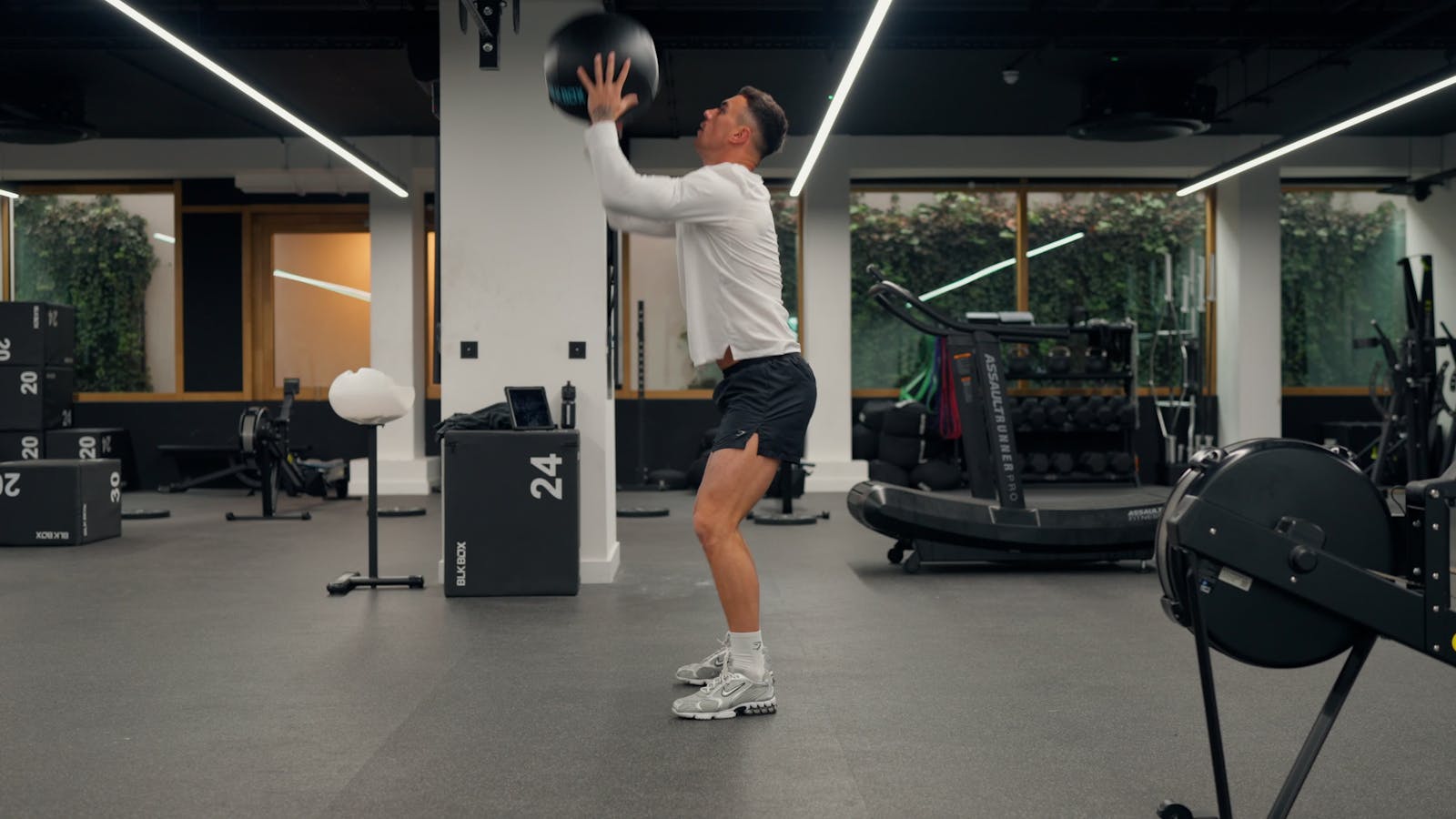
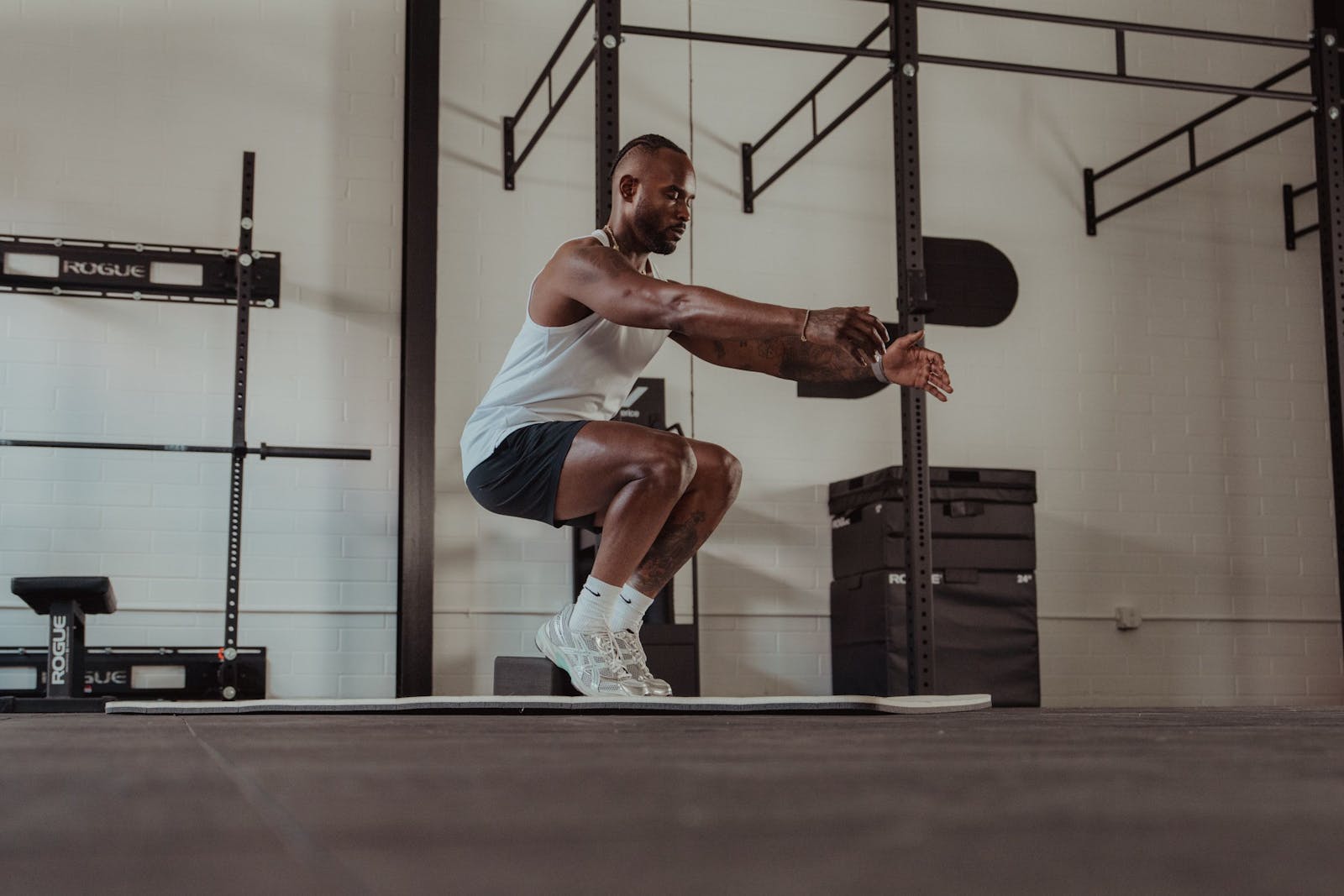
In this phase, athletes hone speed and strength to elevate performance through plyometrics. Jump squats, box jumps, and medicine ball throws build explosive power, since plyometric exercises target fast-twitch muscle fibers for rapid force generation. Agility ladder and cone drills add coordination and balance on top of that, both crucial across most sports. These dynamic movements optimize muscular power and help reduce injury risk by reinforcing ligaments and tendons against sudden impacts. Incorporating plyometrics alongside traditional strength training rounds out a comprehensive approach to peak physical performance.
15 essential strength training exercises for athletes

1. box jumps
Box jumps develop power through the lower-limb extensor muscles.
To perform the exercise:
Stand tall with a box (40 to 60 cm high) in front of you, feet hip-width apart and arms by your sides.
Bend the knees and immediately move back up.
Jump onto the box as explosively as possible.
Land gently on both feet and extend your hips and knees on top.
Step down and repeat for three sets of five to eight repetitions.
Prioritize quality of technique and form on every jump.
Box jumps are demanding, so perform them at the beginning of your workout.
2. abduction
Abduction exercises target the gluteus medius, a muscle crucial for stabilizing the pelvis during running and other athletic movements. Improved strength and control here can improve performance and reduce injury risk.
To perform the exercise:
Use a stretch loop or elastic band.
Wrap it around your thighs or lower legs (more demanding).
Shift your weight to one leg and stand stable while extending the other leg to the side.
Do two sets of 12 repetitions for each leg.
3. Bulgarian split squats
Bulgarian split squats are effective for developing lower-body strength and power, one leg at a time.
To perform the exercise:
Stand in a lunge position.
Rest the rear leg on a box behind you.
Lower your body by bending the front leg to about a 90-degree knee angle, then slowly stand back up.
Use a kettlebell, two dumbbells, or a barbell to add weight.
Bulgarian split squats also improve balance and coordination. Keep your front knee tracking straight rather than shifting side to side as you go down and up.
4. pull-ups
Pull-ups build upper body strength, especially through the back, arms, and shoulders, all important across nearly every sport.
To perform the exercise:
Begin with your hands shoulder-width apart, hanging from a bar with your arms fully extended.
Pull yourself toward the bar until your chin clears it.
Lower yourself slowly and repeat.
If you can't yet complete a full pull-up, use resistance bands for assistance.
5. squats
Squats are among the best exercises for building lower-body strength and power, targeting the quadriceps, hamstrings, and glutes.
To perform the exercise:
Rest a barbell across your upper back and shoulders.
Squat down as far as you comfortably can, maintaining a stable spine.
Push back up.
Keep the barbell over your mid-foot with pressure distributed evenly across your sole.
Watch your knees; they shouldn't cave inward.
6. push-ups
Push-ups build upper body strength, especially through the chest, shoulders, and triceps, and engage the core for stability crucial to athletic performance.
To perform the exercise:
Start with your hands shoulder-width apart, underneath your shoulders.
Lower your chest to the ground and push back up.
Keep your body stable and avoid letting your lower back sag.
If a full push-up on the ground is too difficult, use a box or table to elevate your hands.
7. step-ups
Step-ups build strength and power for sports involving running and jumping, targeting the quadriceps and glutes while promoting balance and coordination.
To perform the exercise:
Step onto a box about the height of your knee.
Stand up straight and step back down.
Repeat 8-12 times for each leg.
Use two dumbbells or a barbell to add weight.
Keep your pelvis level and focus on your glutes and quads as you step up.
8. deadlifts
Deadlifts strengthen the quadriceps, hamstrings, and glutes, and also challenge your upper body stability.
To perform the exercise:
Stand behind a barbell on the floor, feet hip-width apart, bar over the center of your feet.
Bend your hips and knees to grip the bar.
Keep your chest up and hips back, standing stable on both feet, and brace your core to keep your lower back neutral.
Pull the bar close to your shins, extending your knees and hips simultaneously and explosively.
Push through your heels, lift the barbell straight up, and drive your hips forward as you lift, keeping your arms straight; the lift comes from your legs, not your arms.
Hold the top position for two seconds.
Return the bar to the floor by flexing your hips and knees slowly.
If you're new to this lift, perform three sets of 10-12 reps with a light weight, then progress by adding weight and reducing to three sets of 6-8 reps. If you're uncertain about your form, work with a sports therapist or strength coach.
9. heel raises
Heel raises, or calf raises, build strength and resilience in the calf muscles. Strong calves improve performance and reduce injury risk.
To perform the exercise:
Stand on a box or stair with your feet hip-width apart.
Raise your heels while keeping your knees straight.
Slowly lower your heels below the edge of the box.
Rhythm: one second up, three seconds down. Use two dumbbells to add weight.
10. Romanian deadlifts
A variation of the traditional deadlift, the Romanian deadlift focuses more on the hamstrings and less on the quads, making it excellent for building the strength and power athletes need for sudden stops, cutting, and pivoting.
To perform the exercise:
Grip the bar shoulder-width apart, pinch your shoulder blades together, and keep your chest up.
Lower the bar down to your shins by moving your hips backward and leaning your upper body forward, keeping the bar close to your body.
Bring your hamstrings to a full stretch.
Return to the starting position by driving your hips forward.
Keep your lower back fixed throughout.
11. barbell row
The barbell row builds upper body strength, especially through the back. Strengthening the upper back can help improve posture and stability for better athletic performance.
To perform the exercise:
Grip the bar shoulder-width apart and bend your upper body forward, close to horizontal.
Slightly bend your knees and hips.
Hold your spine neutral and brace your core.
Pull the barbell to your belly button, squeezing your shoulder blades together.
Slowly extend your arms and repeat.
Keep your upper body and legs stable throughout.
12. single-leg hip thrust
The single-leg hip thrust builds glute strength and power. Strong glutes improve athletic performance and help reduce injury risk.
To perform the exercise:
Lie with your shoulders on a box or bench.
Raise one leg straight in the air and keep the other foot on the ground, ankle underneath the knee.
Lift your pelvis until your shoulders, pelvis, and knees form a straight line.
Lower your pelvis back down and repeat.
13. bench press
The bench press targets the chest, shoulders, and triceps, and is crucial for developing upper body strength and power.
To perform the exercise:
Lie on a bench with feet flat on the floor and your back slightly arched.
Grip the barbell with hands slightly wider than shoulder-width.
Lower the barbell to your chest, elbows at roughly 45 degrees.
Press the barbell back up to the starting position.
Variations: incline bench press, decline bench press, dumbbell bench press.
14. lunges
Lunges target the quadriceps, hamstrings, glutes, and core, building balance, stability, and unilateral strength.
To perform the exercise:
Stand with feet hip-width apart.
Step forward with one leg and lower your body until both knees are bent to roughly 90 degrees.
Push through your front heel to return to the starting position.
Alternate legs.
Variations: walking lunges, reverse lunges, Bulgarian split squats.
15. planks and core work
Planks are a core-strengthening exercise that engage the shoulders, glutes, and back, and are crucial for developing core stability and strength.
To perform the exercise:
Start in a push-up position with your weight resting on your forearms.
Keep your body straight from head to heels, engaging your core.
Hold the position as long as you can while maintaining proper form.
Variations: side planks, plank with leg lift, plank with shoulder taps.
building strength vs. building muscle vs. other movement patterns

While strength, muscle hypertrophy, and movement efficiency (power) are related, they're distinct training outcomes with their own adaptations. Strength is the measurable force your muscles can produce. Hypertrophy is an increase in muscle size. Power, or movement efficiency, is performing actions effectively with minimal wasted energy. Improving one area often benefits the others, but each requires different training methods. Strength training enhances both strength and lean muscle mass together, a synergistic effect: building strength supports muscle growth, and more muscle mass can in turn make strength gains more accessible.
size vs. strength: the muscle-building myth
Hypertrophy-specific training typically involves higher volume, shorter rest intervals, and targeted intensity techniques designed to stimulate muscle fiber adaptation. Gaining strength is essential for muscle growth, but it isn't sufficient on its own; training volume, intensity, and nutrition all play a critical role. It's also a misconception that training for size means sacrificing strength: bodybuilders may prioritize hypertrophy techniques over maximal lifts, but they still build significant strength through volume and intensity, even using different methods than a traditional strength program. Understanding the distinction between neural and muscular adaptations can help you set informed, practical training goals.
central nervous system vs. muscular adaptations
All strength training relies on two adaptation pathways: central nervous system (CNS) adaptation and muscle fiber adaptation. Lower-volume training emphasizes neural efficiency while higher-volume training targets muscular growth, but both processes are always at play to some degree. CNS adaptations show up as improved coordination, muscle recruitment, and movement efficiency. As you practice lifts with proper form, your brain and body get better at executing them, which increases strength even with lighter weights, reflecting your body's improved ability to generate force and stabilize itself during complex movements. That's why mastering technique matters at every level, from beginner to elite.
How Neural and Muscular Gains Work Together
Muscle fiber adaptations happen when training creates mechanical tension or damage in the muscle, triggering hormonal and cellular responses that lead to hypertrophy. As your muscles grow, they support greater force output, amplifying the effect of your neural gains. Together, these adaptations are synergistic: neurological improvements change how you use your muscles, and larger, stronger muscles improve your performance. For most athletes, the most effective long-term strategy trains both systems in balance, built primarily around the five fundamental movement patterns.
the five human movements
Training equipment, individual muscle groups, and even specific lifts are secondary to your overall movement patterns. Focusing primarily on fundamental compound movements is the key to developing your body's full strength potential, while still leaving room to target particular muscle groups and lifts as needed. The five human movements most important for strength training are:
Push: upper-body pressing movements, including overhead presses, dips, push-ups, and bench press variations
Pull: upper-body pulling movements, including rows, pull-ups, and chin-ups
Squat: all variants
Hinge: any compound movement that generates force by changing the angle of the trunk through hip extension, including deadlifts, swings, cleans, and snatches
Loaded carry: walking while carrying weight, such as farmer's walks, suitcase carries, waiter walks, and rack carries, plus related options like carrying irregular objects, rucking, or hiking with a pack
Each of these movement patterns has dozens, even hundreds, of variations you could spend years exploring. The best approach is to start with basic versions before moving to obscure variants; you'll get better results early on that way, and can bring in lesser-known variations later to introduce novelty and keep progressing. Balancing the different movement types across your training program matters just as much as the exercises themselves.
what about other movement patterns?
Most strength training focuses on the five fundamental patterns above, but exercises outside these categories, like assisted or isolation movements, can still be meaningful in a well-rounded program. Primal movements like sprinting, swimming, climbing, crawling, and grappling offer their own benefits, even though they may not directly contribute to strength development through resistance training.
A Sixth Category: Ground Work
Some coaches propose a sixth category, ground work, covering movements like Turkish get-ups and tumbling. These exercises build coordination, resilience, and fall prevention, which makes them especially valuable as you age. Ground work fits well into warm-ups, active rest periods, or supplementary sessions. The key across all of this is balance: a program that supports strength, function, and long-term durability across every movement pattern.
train smarter with pliability
Strength training builds the force production; mobility is what lets you access it through a full range of motion and recover well enough to keep training consistently. pliability's mobility assessment shows you where you're restricted, and your Daily Sessions and Paths can target those areas so tight hips or a stiff upper back aren't capping your squat or your bench. If you're coming back from a setback, the Rebuild hub offers structured programs to help you return to training safely, and Build Your Program lets you build mobility work around your existing strength program.
Sign up for a 7-day free trial on iPhone, iPad, Android, or on our website to improve flexibility, aid recovery, reduce pain, and enhance your range of motion.
Related Reading




Move better in 10 minutes a day.
10,000+ five-star reviews.