


LEARN
pliability

If you’ve ever spent hours sitting at your desk, you know how stiff and achy you can feel after standing up. Your hips might be tight, your back could hurt, and your neck may feel stuck in one position. These sensations can be uncomfortable and distracting and may worsen over time. If this sounds familiar to you, you’re not alone. Most people who work desk jobs experience some discomfort due to sitting. But the good news is that you can incorporate effective stretches into your routine for people who sit all day to relieve your pain. In this article, we’ll teach you valuable seated stretches to help you feel more energized, improve your overall well-being, and take less time to recover after sitting for prolonged periods.
what are the risks of sitting too much?

Sitting is a major health risk that you can avoid. Americans are notorious for being sedentary compared to the rest of the world. The large majority of Americans sit all day at their jobs, making it difficult to meet the minimum physical activity requirements daily.
Sitting for long periods will not only increase your risk of becoming overweight, but too much sitting can have adverse effects on your:
Health
Mobility
Posture
side effects of too much sitting
According to the Bureau of Labor Statistics, the average American works an average of 8.8 hours per day, commutes an average of 26.9 minutes, and watches television an average of 5 hours: that’s over 14 hours of sitting every day! Unfortunately, your body won’t let this much sitting go unnoticed.
Understanding the Health Risks of Prolonged Sitting: From Metabolic Syndrome to Cardiovascular Disease
What are the risks of sitting too much? You use less energy when you sit than when you stand or move.
Research has linked sitting for long periods with several health concerns. They include obesity and a cluster of conditions (increased blood pressure, high blood sugar, excess body fat around the waist, and unhealthy cholesterol levels) that make up metabolic syndrome. Too much sitting overall and prolonged periods of sitting also seem to increase the risk of death from cardiovascular disease and cancer.
How Physical Activity Can Offset the Health Risks of Prolonged Sitting
Any extended sitting, such as at a desk, behind a wheel, or in front of a screen, can be harmful.
Researchers analyzed 13 studies of sitting time and activity levels. They found that those who sat for more than eight hours a day with no physical activity had a risk of dying similar to that posed by obesity and smoking. Unlike other studies, this data analysis from more than 1 million people found that 60 to 75 minutes of moderate physical activity daily countered the effects of too much sitting. Other studies have found that sitting time contributes little to the risk of death for most active people.
Simple Strategies to Reduce Sitting Time and Stay Active Throughout the Day
Research shows that less sitting and more movement contribute to better health. Start by simply standing rather than sitting when you can, or find ways to walk while you work.
For example:
Take a break from sitting every 30 minutes.
Stand while talking on the phone or watching television.
Try a standing desk, or improvise with a high table or counter if you work at a desk.
Walk with your colleagues for meetings rather than sitting in a conference room.
Position your work surface above a treadmill, with a computer screen and keyboard on a stand or a specialized treadmill-ready vertical desk, so you can be in motion throughout the day.
The Benefits of Incorporating Movement Into Your Day: From Energy Boosts to Mental Well-Being
The impact of movement, even leisurely movement, can be profound. For starters, you'll burn more calories. This might lead to weight loss and increased energy. Physical activity helps maintain muscle tone, your ability to move, and your mental well-being, especially as you age.
getting started with stretches for people who sit all day
Whether you have 15 minutes or a full hour to spare, try incorporating the following moves into your exercise routine. If you're a beginner (or just strapped for time), start by setting a timer for 15 minutes and try to get through as many exercises as you can (10 to 15 reps each) with as little rest as possible in between.
As you advance, challenge yourself by adding more time to the clock, making more moves to your routine, and reducing your rest time.
21 best stretches for people who sit all day

1. hip flexor stretch: your go-to for tension relief
This is hands down one of the best stretches for sitting all day. It’s simple, extremely effective, and it feels great!
Here’s how to do it:
Kneel on your right knee and place your left foot flat on the floor before you.
Shift your weight slightly forward so your back leg is extended behind you. Remember to keep your left knee and ankle vertically aligned.
Keeping your chest up and slightly pulled back, push your hips forward while keeping your feet firm on the ground.
You should feel a stretch in the front of your right hip.
For an even deeper stretch, lift your right hand straight above your head and reach backward and to the left with your head facing up.
Squeeze your butt and hold the stretch for 30 seconds to 1-2 minutes.
Switch sides and repeat.
Why you need it:
Your hips are responsible for articulating major movement patterns like sitting and standing through flexion and extension. When you sit, your hips are in constant flexion, meaning the muscles in your hips (the iliacus and psoas major) are contracted for an extended period of time.
Constant hip flexion can cause these muscles to tighten which places excessive pressure on your joints. This can result in hip pain and restricted range of motion.
2. cat-cow: the ultimate spine stretch
Holy cat-cow, what an incredible stretch! The cat-cow is the ultimate spine stretch that releases tension in the neck, shoulders, and in the upper and lower back. It even helps stretch your abs, hips, and chest.
Here’s how to do it:
Begin in the tabletop position with your wrists and shoulders aligned, your knees and hips aligned, and your weight distributed evenly through your limbs.
From here, you will ease into the cat position by tucking your chin to your chest, arching your back, and pulling your pelvis inward. This pose should resemble an angry cat.
Next, you’ll move into the cow position by pushing your belly towards the floor while lifting your hips and head high to create a U-shape with your back.
Slowly inhale and exhale between the two movements and hold each pose for about 10 seconds.
Why you need it:
Sitting upright for long periods will add immense pressure on your spine as time goes on. This stretch gives your intervertebral discs much-needed space and room to breathe and increases your back and neck flexibility.
3. sphinx / cobra: elongate your body
The sphinx and cobra stretch aim to elongate your body by stretching the back, chest, abdomen, and hips. This stretch opens the lungs, stimulates the abdominal organs, and improves digestion.
Here’s how to do it:
For those with limited back and abdominal mobility, the sphinx stretch is where it’s at.
Lay on your stomach and place your hands in front of you with your elbows directly under your shoulders.
Keep your hips pressed into the ground, open your shoulders and chest, and keep your head neutral.
If your back is more mobile, you can enter the cobra stretch by pressing into your hands and lifting your elbows off the floor. Remember to keep your head in a neutral position and your chest and shoulders open!
Why you need it:
Sitting for extended periods can tighten the hip flexors and upper and lower back. It also constricts the abdominal organs and creates tension in the shoulders. Performing the sphinx or cobra stretch temporarily places your body in an opposing position and opens up the front of your body.
4. shoulder/ chest opener: boost your posture
If you sit at a computer all day, this simple workplace exercise can quickly transform your posture.
Here’s how to do it:
Stand beside the outer corner of a wall or doorway with your arm at a 90-degree angle.
Place your hand onto the wall or doorway, palm out, with your fingers pointing behind you and your thumb up.
Keeping the 90-degree angle in your arm, gently lean forward to create a stretch across the front of your chest, through your biceps, and in the back of your shoulder.
Hold the stretch for 30 seconds to one minute and switch sides.
Why you need it:
Over time, typing on a keyboard can cause the muscles in your chest to contract, forcing your shoulders to round forward. Rounded shoulders can cause pain and weakness in the upper back, tightness in the chest and shoulders, and causes a postural imbalance called thoracic kyphosis (a condition commonly known as “hunchback”).
5. figure 4 stretch: open up your hips
This stretch can be completed either standing or sitting. It’s up to you. The steps below describe the seated version, but the same process applies standing.
Here’s how to do it:
Sit at the edge of a chair and cross your right ankle over your left knee.
Your leg should resemble the number 4.
Keep your weight evenly distributed on both butt cheeks, sit up straight, create as much space between each vertebra as possible, and slowly lean forward without bending your back.
You should feel a stretch in your right glute as you lean forward. At the farthest point of your stretch, shift your stretch toward the right knee for an even deeper stretch.
Hold this stretch for 30 seconds to one minute and repeat on the other side.
Why you need it:
There’s a muscle deep in your glutes called the piriformis. This muscle is behind your gluteus maximus and runs diagonally from the lower spine to the upper surface of your femur, with the sciatic nerve running beneath it and through the muscle.
Prolonged sitting can cause atrophy (muscle loss) and tightness in the piriformis and add extra pressure to the sciatic nerve, which can cause lower back pain.
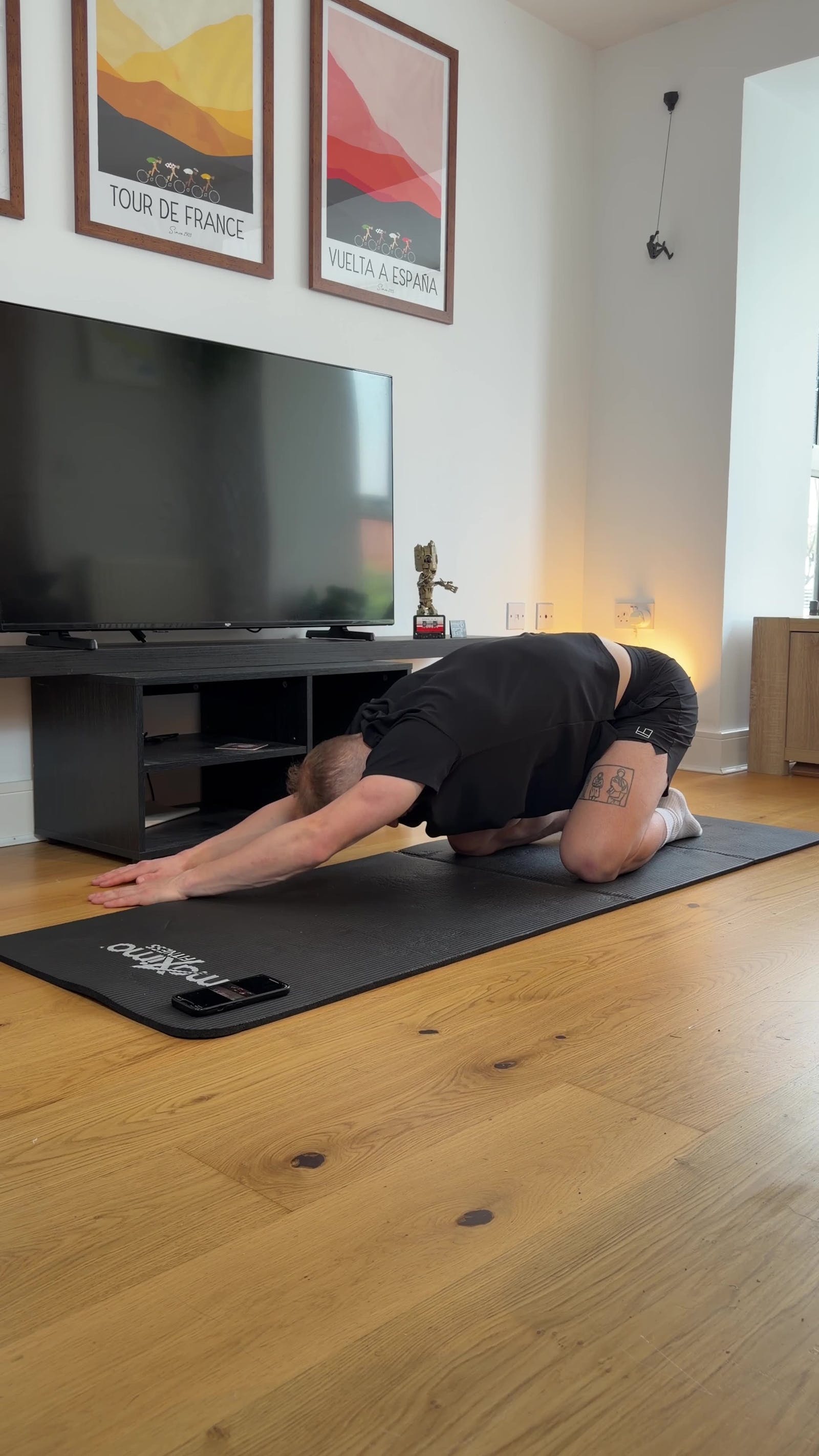
6. child’s pose: a calm and relaxing stretch
Despite its name, this stretch isn’t only for children. This stretch is not only beneficial for improving shoulder mobility, but it’s also calm and relaxing.
Here’s how to do it:
Start by kneeling on the ground with your knees slightly apart.
Fold your body forward and reach your arms as far in front of you as possible. Press your chest toward the floor with your palms facing down and your back flat.
You should feel your upper back, back, and hips stretch.
Hold the stretch for 30 seconds to one to three minutes while taking deep breaths.
Why you need it:
The child’s pose lengthens your spine and stretches the latissimus dorsi. This muscle, also known as the lats, is the largest in your back and will benefit significantly from this stretch. Similarly, this stretch helps to loosen up the hips and groin area, increase circulation and blood flow, and improve the range of motion in the chest and shoulders.
7. neck stretch (2-ways): release neck tension
Sitting at a computer can trigger a lot of tension in the neck. These stretches for sitting all day can be done quickly and easily at your computer but have a huge payoff.
Here’s how to do it:
Start by making a fist with your right hand. Keep your thumb tucked into your fist, and keep your head neutral.
Place your right arm behind your lower back and your left hand over your head and onto your right temple.
From here, use your left arm to gently tilt your head to the left, creating a stretch along the right side of your neck. Keep your gaze forward (do not look up).
Hold this stretch for 30 seconds and then return your head to a neutral position. For the second part of this stretch, turn your head a quarter turn to the left.
Place your left hand at the top of your head from the front and gently pull your head down, guiding your forehead toward your chest. You should now feel a stretch on the back-right part of your neck. Hold this stretch for 30 seconds, and repeat both stretches on the other side.
Why you need it:
The sternocleidomastoid muscle is one of the largest muscles in your neck. It is primarily responsible for rotating the head to the opposite side and flexion of the neck (looking up). Sitting for long periods can add tension to this muscle, which can cause neck pain and restricted mobility.
Similarly, excess tension of the muscles on the back of your neck called the trapezius muscles (also known as traps), can cause tension headaches.
8. upper trap stretch: relieve tension and pain
The trapezius or trap muscle stabilizes your spine and helps you move your upper body. It starts at the base of the neck and extends from your shoulders to the middle of your back. Poor posture can tighten the traps. Try this upper trap stretch for relief.
Here’s how to do it:
Sit or stand tall with your arms at your sides.
Reach your right arm overhead, placing your palm on the left side of your head.
Gently drop your right ear to your right shoulder, feeling a stretch along the left side of your neck and upper back. For a deeper stretch, let your left shoulder drop.
Hold for 10-30 seconds. Then, switch sides
Repeat 2-3 times on each side.
9. shoulder rolls: release tightness and tension
Your neck and shoulders can be very tense as you type, text, and scroll on your devices. Shoulder rolls boost blood flow and release neck, shoulder, and upper back tension.
Here’s how to do it:
Stand with your back straight, shoulders back, and arms at your sides.
Shrug your shoulders toward your ears, then rotate them back, down, and forward in a circular motion.
Keep rotating your shoulders for 10-30 seconds.
Switch directions and repeat for 10-30 seconds.
10. overhead side reach: stretch your lats and obliques
The overhead side reach mainly stretches the latissimus dorsi muscles in your upper back and the obliques on the sides of your torso.
Here’s how to do it:
Stand with your arms at your sides and your feet hip-width apart.
Raise your right arm, extending it straight overhead.
Keep your right arm extended as you lean to the left.
Hold for 5 seconds, feeling the stretch along your right side.
Return to standing and repeat on the other side.
Repeat 5-10 times on both sides.
11. forward fold: stretch your back and hamstrings
Forward folds stretch your back body muscles, especially the lower back and hamstrings at the back of your thighs.
Here’s how to do it:
Stand with your feet hip-width apart and knees slightly bent.
Raise your arms overhead and slowly bend forward at the hips.
Keep bending forward to bring your hands as close to your toes as possible.
Let your weight fall forward, leaning into the balls of your feet and letting your head and shoulders hang.
Hold for 10-15 seconds, feeling the stretch along your lower back and hamstrings.
12. glute bridge: activate your glutes and hips
For the lower-body exercises, your goal is to achieve as much hip extension as possible. Hip extension is the opposite of what happens when you are sitting (hip flexion), and the glute bridge is the perfect way to start counteracting that. Keep your hips neutral (engage your core), and work the muscles of the hips and legs.
How to Do It:
Lying on your back with your knees bent to about 45 degrees, engage your core so that you are posteriorly tilting your hips. The lower back is flat on the floor.
Keeping your feet hip-width apart, drive through your heels as you contract your glutes and push your hips off the ground.
You should be in a straight line from the shoulders through the hips to the knees, all while keeping your lower back from arching.
Lower your hips with control and repeat for eight to 10 reps.
13. seated figure four: stretch your hips and lower back
The seated figure four exercise stretches your lower back, hips, and glutes. It helps ease lower back pain from sciatica.
How to Do It:
Sit upright in a chair with your feet flat on the floor.
Cross your right leg over your left, placing your ankle on your left thigh.
Lean forward, bringing your chest toward your right leg. You should feel a stretch in your right hip and glutes.
Hold for 10-30 seconds.
Then, switch sides.
14. spinal twist: reset your posture
Sliding your hips forward in your chair or sitting in a slumped position can strain your back significantly. A spinal twist can help to relieve tension across the entire back and reset your posture.
How to Do It:
With your feet flat on the floor, contract your abs and rotate your upper body toward the right.
To help deepen the stretch, place your left hand on the outside of your right knee and your right hand on the armrest or seatback.
Only twist as far as you feel comfortable. Even a tiny rotation can make a big difference.
Hold this stretch for 15 to 30 seconds, then repeat on the other side.
15. back extension: counteract slumped posture
Your back can take a beating when sitting slumped forward or when reclining backward. A seated back extension can help to ease tension while opening your chest and shoulders.
How to Do It:
Scoot back in your chair with your back resting comfortably against the backrest.
Place the palms of your hands at the back of your neck.
Lean over your backrest, keeping your elbows wide until you feel a gentle stretch across your back and chest.
Hold this stretch for 10 to 15 seconds.
16. chest stretch: undo the hunch
Most of us spend the day hunched forward, so stretching the pectoral muscles is crucial. Skip this one if you have shoulder problems.
Here’s how to do it:
Stand or sit tall with your feet shoulder-width apart.
Move your arms behind you and lace your fingers together if you can.
Straighten your arms and gently lift your hands a few inches until you feel a stretch across your chest.
Hold for 10 to 30 seconds and repeat 5 to 10 times.
17. upper back stretch: open up between the shoulder blades
This move stretches the muscles between the shoulder blades, along with the traps and shoulders.
Here’s how to do it:
From a seated or standing position, stretch your arms straight out and rotate your hands so your palms face each other.
Cross your arms so your palms are pressed together and clasp your fingers. If twisting the arms doesn't feel good, simply lace your fingers together.
Contract your abs and round your back, reaching away with your arms as you relax your head down, as if curving up and over an imaginary ball.
Hold the stretch for 10 to 30 seconds.
18. one arm hug: reach the back of your shoulder
Place one arm across your body onto the back of your opposite shoulder. Use your other arm to press back on the elbow for a deeper stretch; you should feel it along the outside of your arm and shoulder. Hold for 30 seconds and repeat 2-3 times on each arm.
19. forearm and wrist stretch: protect your typing muscles
You may not realize how tight your forearms get from typing until you stretch them. This one helps prevent hand and wrist pain from forming.
Here’s how to do it:
Press your palms together in front of your chest in a prayer position and hold for 15 seconds, then press the backs of your hands together with your fingers pointing down and hold for another 15 seconds.
Extend one arm in front of you, palm up, and use the other hand to gently pull the fingers down toward the floor until you feel a stretch in the forearm.
Repeat the motion with your palm facing down, then switch arms.
Hold each position for 10 to 30 seconds.
20. inner thigh stretch: release the hips and groin
Inner thigh stretches are essential for the hips and groin, opening the hips and removing tightness and tension in the lower body.
Here’s how to do it:
While seated, take your legs wide with your toes pointed out, and lean forward with your elbows on your thighs.
Keep your back straight and your abs contracted.
Gently press forward, using your elbows to push your thighs out, until you feel a stretch in your inner thighs.
Hold for 10 to 30 seconds and repeat as many times as you like.
21. ankle circles: revive circulation in your legs
Simple but effective for reviving circulation in your legs after long stretches of sitting (it's a favorite for long-haul flights, too). While seated, lift one leg so it's horizontal to the floor and slowly rotate the foot at the ankle. Reverse the direction, then repeat on the other foot.
how well does stretching counter the effects of all-day sitting?

Stretching won't counter all the harmful effects of prolonged sitting. But it can help, especially when combined with other exercises.
Static and dynamic stretching may:
Boost blood flow
Reduce back, neck, shoulder, and hip muscle pain and stiffness
Increase flexibility and range of motion
Correct posture
Lower the risk of injury
Improve functional and athletic performance
Help you relax
Research shows that taking active breaks throughout the day is a great way to break up long bouts of sitting. One review found that taking active breaks during the workday may reduce musculoskeletal pain, lessen fatigue, and boost mood. Those breaks included activities such as stretching, walking, and doing strengthening exercises.
how short movement breaks can counteract the risks of a sedentary workday
Regular exercise and movement throughout the day are best to prevent or reduce the harmful effects of inactivity. A large-scale study found that people who sit all day at work have a higher risk of all-cause mortality. But, according to the researchers, adding 15 to 30 minutes of daily physical activity can lower that risk.
You can start small and work up to the recommended 150 minutes of moderate cardio per week. Try taking 5-minute breaks every 30 to 60 minutes during your workday. You can use that time to stand up, stretch, walk, or do strengthening exercises. These movement breaks can go a long way toward better health. And they might help you stay focused when you return to your desk.
desk exercises beyond stretching: strength and cardio micro-movements
Stretching relieves the tension sitting creates, but pairing it with a few strength and cardio exercises you can do while sitting at your desk (or standing right next to it) keeps your muscles active between meetings. Pick two or three of these and rotate them through your movement breaks.
chair squats
Weakened glutes and tight hip flexors from sitting too much can lead to numbness and pain in the buttocks, hips, and lower back. Stand in front of your chair with your feet shoulder-width apart, bend your knees and drive your hips back as if you were about to sit down, stop just above the seat, then slowly rise back up. Aim for 10 reps.
desk planks and pushups
Place your hands shoulder-width apart on the edge of your desk and walk your feet back until your body forms a straight line from shoulders to feet. Hold for 30 seconds with your core and glutes tight for a plank, or bend your elbows to 90 degrees and press back up for pushups, aiming for 10 reps. Beginners can use a wall instead of a desk.
triceps dips
Sit at the edge of a sturdy chair with your palms flat on the seat, fingers facing away from you, heels on the ground with your legs straight in front of you. Lower yourself, keeping your body close to the chair, until your upper arms are almost parallel to the ground, then press back up. Aim for at least 10 reps.
seated leg extensions
Sit with your back straight and your thighs parallel to the ground. Slowly extend your right leg with your foot flexed, raising it as high as you can without pain and without locking the knee, then lower it back down. Do 10 on each side; ankle weights kept near your desk make it harder as you get stronger.
chair calf raises
Sit up straight with your back unsupported and your feet shoulder-width apart. Slowly raise your heels as if coming onto your tiptoes, hold, then lower them back to the ground. Do 10 reps, and as you get stronger, do them standing behind your chair.
desk donkey kicks
Place your hands on the edge of your desk with your legs slightly bent and tilt your torso forward so your chest is parallel to the floor. Push your hips back, bend your right leg to 90 degrees, and press your heel toward the ceiling before lowering it back down. Do at least 10 reps on each side.
isometric squeezes
Isometrics involve contracting one muscle group at a time, and nobody around you will know you're doing them. Squeeze your glutes as hard as you can and hold for three to 10 seconds, press your palms together in front of your chest to work your chest and arms, or push your knees outward against your palms for the lower body. Work up to three sets of 10 holds per muscle group.
jog in place
Sixty seconds of jogging in place raises your heart rate and shakes off grogginess, often more effectively than another coffee. If you'd rather stay seated, "run" in your chair by moving your legs and arms as if you were jogging, or tap your toes in an alternating pattern; bringing your knees up higher gives better results.
how to run a workplace stretching program
The stretches above also work as the backbone of a workplace stretching program: a structured routine that builds stretching into the workday for a whole team rather than leaving it to individual willpower. Programs like this are common in physically demanding industries such as construction, manufacturing, and healthcare, but desk-heavy offices benefit from the same structure. The pieces that make a program stick:
Pre-shift or morning stretching: A few minutes before the workday starts to prepare the body for the day's tasks.
Scheduled stretch breaks: Short, recurring breaks of 5 to 10 minutes, at least 2 to 3 days per week, rather than occasional long sessions.
Group sessions: Stretching together, ideally led by someone trained in proper technique, adds accountability and tends to lift workplace morale.
Tailored routines: Match the stretches to what people actually do all day. A desk team needs hips, spine, neck, and wrists more than anything else.
Education and easy participation: Teach why and how to stretch, not just when, so people can stretch safely on their own, and keep participation voluntary; the programs that last are the ones people enjoy.
One honest caveat: stretching alone has not been shown to meaningfully reduce workplace injuries, so treat a stretching program as one piece of a broader ergonomics effort, alongside good workstation setup, movement breaks, and sensible job design, rather than a fix by itself. For rollout, a printable one-page version of the stretching exercises above, with pictures, makes an easy PDF reference to post in the breakroom or share with your team.
improve your flexibility with our mobility app today | get 7 days for free on any platform
Sitting all day can lead to a slew of health issues, including:
Weight gain
Poor posture
Increased risk of heart disease
Prolonged sitting can weaken glute muscles and reduce flexibility, making it difficult to perform everyday tasks. For athletes, sitting can negatively impact performance by reducing mobility, since less flexibility increases the risk of injury and limits power output. Tight hip flexors, for example, can reduce the effectiveness of a golfer’s swing.
pliability builds the stretches above into guided Daily Sessions, so your desk-day mobility work is a routine instead of something you have to remember to do. Take the mobility assessment to find which areas sitting has tightened the most, then follow a personalized Path built around what it finds. Build Your Program lets you combine hip flexor, spine, and shoulder stretches into a routine that fits your workday, and the Rebuild hub has structured programs if sitting has left you with a recurring problem area.
Start a 7-day free trial of pliability on iPhone, iPad, Android, or the web.
Related Reading



Move better in 10 minutes a day.
10,000+ five-star reviews.