


LEARN
pliability

That nagging tightness between the shoulder blades affects millions of people, turning simple movements like twisting in a chair into uncomfortable reminders of restricted mobility. Mid back stiffness often develops from poor posture, muscle imbalances, or prolonged sitting, creating tension in the thoracic spine that can impact daily activities. Understanding the root causes helps identify the most effective approaches to restore comfort and movement.
Targeted exercises and stretches can effectively address the underlying factors contributing to upper back tension. Personalized routines that focus on releasing tight muscles and improving range of motion offer a practical path toward relief.
why does mid back stiffness happen in the first place?

Your mid-back locks up because it's compensating for movement restrictions elsewhere in your body. The thoracic spine is designed for rotation and extension, but when your hips won't move, your shoulders round forward, or your neck can't stabilize your head, your mid-back steps in as an emergency brake. It holds you upright in positions it was never meant to sustain for hours at a time. Your mid-back stiffness usually isn't the real problem: it's your body's protective response to dysfunction elsewhere, and the compensation patterns tend to resolve once you address the root cause. Your body finds the path of least resistance when systems that should work together stop communicating properly, and this compensation cascade creates a domino effect, with your mid-back absorbing the cost of poor movement patterns throughout your kinetic chain. Treating only the mid-back stiffness without addressing the underlying restrictions tends to give temporary relief at best, since the problem keeps coming back until the root cause is handled.
how your body reacts when you lean forward at a desk
Your workday starts with your head in a neutral position. Within thirty minutes, it drifts forward an inch or two to see your screen more clearly, and that small shift triggers a cascade your body runs automatically: your shoulders roll forward to follow your head, your chest muscles tighten to hold the position, your upper back muscles stretch and weaken as they lengthen, and your mid-back contracts hard, trying to keep your upper body from collapsing forward onto the desk.
Back pain of some kind is extremely common, and a lot of it traces back to exactly this kind of compensatory pattern becoming permanent. Your body adapts to what you do most often: if you sit hunched for eight hours a day, that becomes your body's new normal. By hour three, your mid-back muscles are working continuously, even though they're not built for that kind of endurance. These rotation muscles are designed for short bursts of activity when you twist or turn, yet they end up functioning as postural stabilizers, a role they're not well suited for.
how slouching restricts rib movement
Your thoracic spine connects directly to twelve pairs of ribs. When you slouch forward, your rib cage collapses into an exhaled position; try it yourself by slumping forward as if staring at your phone, then taking a deep breath. You can't fully expand your lungs because your ribs are mechanically restricted. When your ribs can't move through their full range, your mid-back works overtime to help you breathe, since every breath requires your thoracic spine to extend slightly and lift the rib cage. If the ribs are stuck, the mid-back muscles contract harder to force that movement. Over an eight-hour workday, that adds up to thousands of extra breaths' worth of unnecessary work for those muscles.
Your rib cage also needs to rotate when you twist your torso, and if it can't, your mid-back compensates by increasing muscle tension to stabilize the area. The stiffness between your shoulder blades is often your body protecting restricted ribs from moving in ways they can no longer handle safely.
what happens to your hips when you sit all day
Your hip flexors shorten when you sit. After several hours, they pull your pelvis into an anterior tilt, forcing your lower back to arch more, and your mid-back then extends backward to balance that arch and keep you upright. This creates a kind of seesaw effect: tight hip flexors pull one end down, forcing your mid-back to compensate by lifting the other end, and the muscles between your shoulder blades work constantly to maintain that balance until they're worn out by the afternoon.
Most stretching routines focus on the area that hurts: doorway stretches and foam rolling provide only temporary relief because you're loosening muscles that are already working too hard while ignoring the hip flexors that created the problem in the first place. It's a bit like bailing water from a boat without plugging the leak.
what happens when your neck muscles can't support your head properly
Your head weighs about 10 to 12 pounds, and small muscles deep in your neck, called the deep cervical flexors, are supposed to hold it in position. When your head moves forward, these muscles tire quickly, and your mid-back becomes the backup system, working to keep your head from pulling your entire upper body forward. As a rough rule of thumb, every inch your head moves forward from neutral adds meaningfully more load your spine has to manage, so a head that's drifted a few inches forward by mid-afternoon can leave your mid-back carrying a surprising amount of extra weight. The deep neck muscles need specific retraining to handle their designed load; until that happens, your mid-back continues serving as an emergency stabilizer, which is why the stiffness keeps coming back.
muscle tightness vs. mobility restriction
Muscle tightness feels like tension you can stretch away. Mobility restriction feels like hitting a wall when you try to move. If you can touch your toes easily but your mid-back feels locked up, you likely have a movement pattern problem, not a flexibility problem. Your thoracic spine should rotate roughly 35 degrees in each direction, but after hours of sitting, that can drop closer to 15 degrees, and your body gradually loses access to the range it stops using. This isn't a loss of flexibility in the traditional sense where muscles get shorter; it's your nervous system reducing access to ranges it perceives as unnecessary or unsafe, similar to a trail through the woods that disappears when nobody walks it.
This is why stretching alone often doesn't solve the problem. You're stuck in a limited movement pattern and need to relearn how to rotate, extend, and stabilize through your thoracic spine while your hips and neck do their part properly. Targeted mobility routines that retrain these patterns tend to work better than random stretching, since the goal is rebuilding coordination between your hips, mid-back, and neck rather than just temporarily loosening tight muscles.
when compensation becomes a bigger problem
Mid-back stiffness is a signal that multiple systems have stopped working together: hips that have lost mobility, shoulders that have drifted out of position, a neck that has stopped stabilizing the head, and ribs that have forgotten how to move. The stiffness itself is the symptom, not the disease; your mid-back is protecting you from injury when other areas can't handle their share of the work, a mechanism built for short-term emergencies, not eight-hour workdays repeated for years.
Sharp pain when breathing deeply, difficulty turning to look over your shoulder, or visible hunching are signs that compensation has gone beyond simple muscle fatigue into affecting how your rib cage, spine, and shoulder girdle work together. Left alone, these patterns tend to become more entrenched over time, with stiffness eventually turning into chronic pain. The good news is that these patterns follow fairly predictable pathways, which means they can also be interrupted and reversed.
the real causes of mid back stiffness most people miss

Mid-back stiffness develops when your body loses the ability to spread movement properly across multiple joints. Your thoracic spine becomes a structural bottleneck when the surrounding areas stop contributing to rotation, extension, and stabilization, which is exactly why stretching only the painful area tends to give temporary relief at best. The real problem usually isn't that your mid-back muscles are tight, it's that other areas have stopped doing their job, forcing the thoracic spine to compensate beyond its natural capacity.
prolonged sitting and thoracic spine positioning
When you sit at a desk for long stretches, your upper back gets stuck in a bent-forward position, which gradually reduces its ability to rotate and bend backward. After several hours in the same position, your nervous system starts to treat the bent-forward posture as normal: the muscles that straighten your back weaken from disuse, while the muscles that keep you bent forward tighten from constant use. Spend 40 to 50 hours a week in that position and you're systematically training your thoracic spine to lose range of motion, which rewires how your nervous system controls your mid-back and makes a limited range feel normal while full extension starts to feel foreign.
The problem shows up when you try to move differently. Reaching overhead for something on a high shelf requires thoracic extension your spine hasn't used in days, and your mid-back muscles tighten to protect you because your nervous system reads that unfamiliar range as risky. The stiffness you feel is essentially your body saying it doesn't trust that movement anymore.
shoulder and neck mobility loss
When your shoulders lose the ability to move freely, your mid-back tries to create movement by extending its own range beyond what it's designed to handle. Your shoulder joint should allow close to a full 180 degrees of overhead motion; if tight chest and front-shoulder muscles cut that down significantly, your thoracic spine tries to make up the difference by extending and rotating more than it should. This compensation happens automatically, since your nervous system routes movement through the path of least resistance, and your thoracic spine ends up running constantly like a backup generator for systems that should be carrying their own load.
The same pattern shows up with neck restrictions. When the deep neck muscles fatigue and stop stabilizing the head properly, the mid-back increases tension to prevent the upper body from collapsing forward, creating a chronic, low-level contraction between the shoulder blades that never fully releases. This can happen even in people who are otherwise strong and active: solid strength in the big movers doesn't guarantee that the smaller stabilizer muscles are coordinating properly with them, and when they're not, the mid-back ends up compensating for a movement pattern problem rather than a strength deficit.
why most people have limited thoracic rotation
Most people rarely move their thoracic spine through its full rotational capacity. It should rotate around 35 degrees in each direction, but typical daily activities like sitting at a desk, driving, and looking at your phone use only a fraction of that. Over time, tissues adapt to the limited range by getting stiffer in the positions you're not using. This isn't a loss of flexibility in the traditional sense; your muscles aren't necessarily shorter, the restriction comes from your nervous system reducing access to ranges it perceives as unnecessary or unsafe. If you haven't rotated fully to one side in months, your brain starts treating that movement as something to avoid, and the neural pathways controlling it become less efficient.
Extension follows the same pattern: your thoracic spine needs to extend when you reach overhead, arch backward, or take a full breath, and if you spend most of the day flexed forward, you lose the motor control for smooth extension. Athletes with heavy, repetitive training loads face a version of this too. Sports like hockey or rowing can lock the thoracic spine into sport-specific positions, so a hockey player might have excellent rotational power in one direction but real stiffness rotating the other way or extending backward.
how your rib cage affects breathing mechanics
Your rib cage should expand in three dimensions with each breath: forward, sideways, and backward. Shallow chest breathing, common during focused work or stress, reduces this mostly to forward movement. Over time, the small joints connecting your ribs to your thoracic spine lose mobility, and the rib cage ends up operating in a limited range, which directly limits mid-back movement, since the thoracic spine and rib cage work together as a single unit. This restriction becomes self-reinforcing: limited rib mobility makes deep breathing harder, which leads to shallower breathing, which further restricts rib movement, and the mid-back muscles tighten to stabilize the area, reducing movement even more. What starts as a breathing pattern issue can become a structural mobility restriction that persists even when you're not actively breathing shallowly. Working on breathing patterns and rib movement alongside regular stretching tends to produce better results than focusing on the mid-back area alone.
what proper thoracic spine function looks like
A properly working mid-back lets you rotate smoothly in both directions without catching or discomfort, roughly 35 degrees to each side while keeping your hips still. If you feel restriction well before that range, or one side rotates noticeably less than the other, your thoracic spine has lost functional capacity. Good posture should also feel easy rather than something you have to think about constantly; if maintaining it feels effortful, your mid-back is probably compensating for tightness or immobility somewhere else.
You can check your breathing mechanics directly: place your hands on the sides of your rib cage and take a deep breath. You should feel the ribs expand outward against your hands, not just the chest rising forward. If the ribs don't move laterally, the thoracic spine has mechanical restrictions limiting both breathing and movement. Pain-free upper body movement, reaching overhead, twisting to look behind you, and bending backward without discomfort between the shoulder blades, is the goal. Everyone feels stiff after sitting for hours, but a healthy spine regains mobility quickly with movement; chronic restriction means the body has essentially forgotten how to access certain ranges, no matter how much you move around.
how to fix mid back stiffness and restore mobility

Restoring mid-back mobility is more about retraining movement patterns than loosening tight muscles. Your thoracic spine has adapted to restricted ranges because your nervous system stopped trusting certain movements, and consistent mobility work teaches your body to access and control the ranges it's been avoiding. The goal is to rebuild coordination between your spine, ribs, shoulders, and hips so your mid-back stops compensating for restrictions elsewhere. Focus on controlled movement through your available range rather than forcing into restricted positions; the thoracic spine tends to respond better to frequent, gentle mobility work than to aggressive stretching sessions.
thoracic mobility exercises that restore extension and rotation
Your thoracic spine needs regular practice moving through rotation and extension to maintain these capabilities. These active movements retrain the motor patterns controlling your mid-back.
Cat-Cow Pose
Cat-Cow Pose rebuilds the connection between forward and backward bending through continuous, controlled movement. Start on your hands and knees with wrists under shoulders and knees under hips. Inhale as you drop your stomach toward the ground, lifting your head and tailbone into cow pose, pushing your chest forward, and spreading your shoulder blades apart. Exhale as you reverse the movement, arching your back upward like a cat while tucking your pelvis and dropping your head toward the floor. Move continuously between these two positions for 30 to 60 seconds, letting each breath guide the movement.
Thread the Needle
Thread the Needle combines rotation with gentle loading to restore rotational capacity. Begin on hands and knees. Inhale and lift your left hand toward the ceiling, rotating your torso to the left with your eyes following your hand. Exhale and thread your left arm through the space between your right hand and right knee, lowering your left shoulder and head toward the floor if your range allows. Hold this rotated position for 20 to 30 seconds, breathing normally. Return to the starting position and repeat on the opposite side for 2 to 3 rounds each. Sustained, gentle pressure that feels safe tends to work better than forcing deeper rotation.
Seated Twist
Seated Twist restores spinal rotation while maintaining length and straightness, preventing the compression that occurs when twisting forward. Sit in a chair with feet flat on the floor and knees bent at 90 degrees. Pull your shoulders back and down to lengthen your spine. Place your left hand on the outside of your right knee and your right hand behind you on the chair for support. Inhale to lengthen your spine, then exhale as you slowly rotate your upper body to the right. The rotation should originate from your mid-back, not from pulling with your arm. Hold for 20 to 30 seconds, deepening the twist gently with each exhale rather than forcing it. Return to center and repeat on the opposite side.
Cobra Pose
Cobra Pose rebuilds extension capacity by engaging the muscles that pull your spine backward, counteracting the forward flexion that dominates most of your day. Lie on your stomach with your legs extended and the tops of your feet flat on the floor. Place your hands underneath your shoulders, palms down. Inhale and engage your back muscles to lift your chest off the ground; most of the lift should come from your back muscles, not from pushing with your arms. To test this, lift your hands slightly off the ground while maintaining the lifted chest position; if you collapse immediately, you're relying too much on arm strength. Hold for 2 full breath cycles, then lower back down. Repeat 2 more times, keeping your lower ribs in contact with the floor.
Wall Angels
Wall Angels improve extension through repetition rather than static holds. Stand with your back against a wall. If you cannot maintain contact between the wall and your lower back, mid-back, and head simultaneously, step forward slightly and bend your knees. Place the back of your hands and forearms against the wall with your elbows bent at approximately 90 degrees. Slowly slide your hands up the wall while keeping contact; most people lose contact around shoulder height, and that's your current limit. Slide back down to the starting position, complete 10 to 12 repetitions, then rest. Repeat this sequence 4 to 5 times throughout the day. Frequent repetition teaches your nervous system that the movement is safe, gradually expanding your accessible range without triggering protective stiffness.
movement breaks that prevent thoracic spine restriction
Your thoracic spine locks into flexion during extended sitting, and movement breaks interrupt this pattern before it becomes entrenched. Set a timer for every 45 to 60 minutes; when it goes off, stand and perform 5 to 10 repetitions of a simple extension movement: clasp your hands behind your lower back and gently arch backward, lifting your chest toward the ceiling, holding for 3 seconds before returning to neutral. Frequency matters more than duration: a couple of minutes every hour tends to produce better results than one long session at the end of the day, since you're preventing restriction from building up rather than trying to undo eight hours of locked flexion all at once.
Breathing resets help too, since moving the rib cage directly affects the upper back. Sit or stand tall and place your hands on the sides of your rib cage, then take a slow, deep breath through your nose, focusing on expanding the ribs outward into your hands rather than lifting the chest forward. Hold for 2 seconds, then exhale slowly through your mouth, and repeat 5 times. It takes less than a couple of minutes but helps interrupt the shallow breathing pattern that restricts rib and spine movement.
integrated mobility routines that address multiple systems
Your body doesn't move in separate parts: shoulder mobility affects your thoracic spine, hip mobility affects your lumbar spine which affects your thoracic spine, and breathing mechanics affect your rib cage which affects your thoracic spine too. Addressing these systems together tends to produce faster, more lasting results than targeting the mid-back alone.
Passive Backbend
Passive Backbend lets your thoracic spine relax into extension without muscular effort, giving your nervous system time to get comfortable with a range it's been avoiding. Roll up a blanket, towel, or yoga mat (thickness determines intensity), place it horizontally on the floor, and lie back so it rests against the bottom of your shoulder blades. If your neck feels strained, let your head rest on the floor or on a folded blanket, with your arms resting at your sides or extended overhead. Stay here for at least 3 minutes, ideally 5 to 10, giving your nervous system time to recognize the position as safe.
Bridge Pose
Bridge Pose restores extension through your entire spine while engaging your glutes and hamstrings, creating a coordinated movement pattern that keeps your mid-back from having to compensate. Lie on your back with knees bent and feet flat, hip-width apart, heels near your glutes. Press through your heels to lift your pelvis toward the ceiling, rolling up vertebra by vertebra until your body forms a straight line from shoulders to knees. Hold for 10 to 30 seconds, squeezing your glutes throughout; if you feel this entirely in your lower back, your glutes aren't doing their share and your back is compensating. Lower slowly, vertebra by vertebra, and repeat 3 to 5 times.
Superman
Superman strengthens the back extensors while promoting extension patterns, addressing both the strength and motor-control sides of mid-back stiffness. Lie on your stomach with arms and legs extended, forehead on the floor, and neck neutral. Engage your glutes and back muscles to lift your arms and legs a few inches off the ground simultaneously, keeping your gaze on the floor. Hold for 3 to 5 breaths, then lower, and repeat 4 to 5 times. The lift doesn't need to be dramatic; even a few inches engages the muscles responsible for spinal extension.
why consistency matters more than duration
Your nervous system adapts to what you practice most often. A single 90-minute mobility session once a week teaches your body that full range of motion is the exception, not the rule; 10 minutes daily teaches your body that these movements are a normal, everyday part of life. The adaptation happens at the level of the brain, which builds stronger neural pathways for movements you repeat consistently. After a couple of weeks of daily thoracic rotation work, that movement typically starts to feel easier to access, and protective stiffness eases because the brain no longer treats it as risky. Give it a couple of months and the expanded range tends to become the new baseline.
This is also why stiffness often comes back the day after a single stretching session: muscle tissue can adapt fairly quickly, but the motor control patterns that actually govern the movement take a lot longer to change. Stretching feels good immediately because you've temporarily lengthened the tissue without yet changing the underlying motor pattern, so the old pattern reasserts itself by the next day. Consistent mobility work is what changes both the tissue and the nervous system's control over the new range.
fix your mid-back stiffness with a guided mobility routine | try pliability free for 7 days
Mid-back stiffness from sitting for long periods, training, or desk work typically stems from limited thoracic mobility rather than tight muscles alone. pliability is a mobility app built for performance-oriented individuals and athletes: run a Daily Session or a Path to work on thoracic, shoulder, and hip mobility together, use Build Your Program to fit it around your training or desk schedule, and take the in-app mobility assessment to see exactly where you're most restricted. If you're working around pain or an injury, the Rebuild hub is built for that.
Sign up today for 7 days free on iPhone, iPad, Android, or the web to start improving your mid-back mobility and overall movement quality.
Related Reading


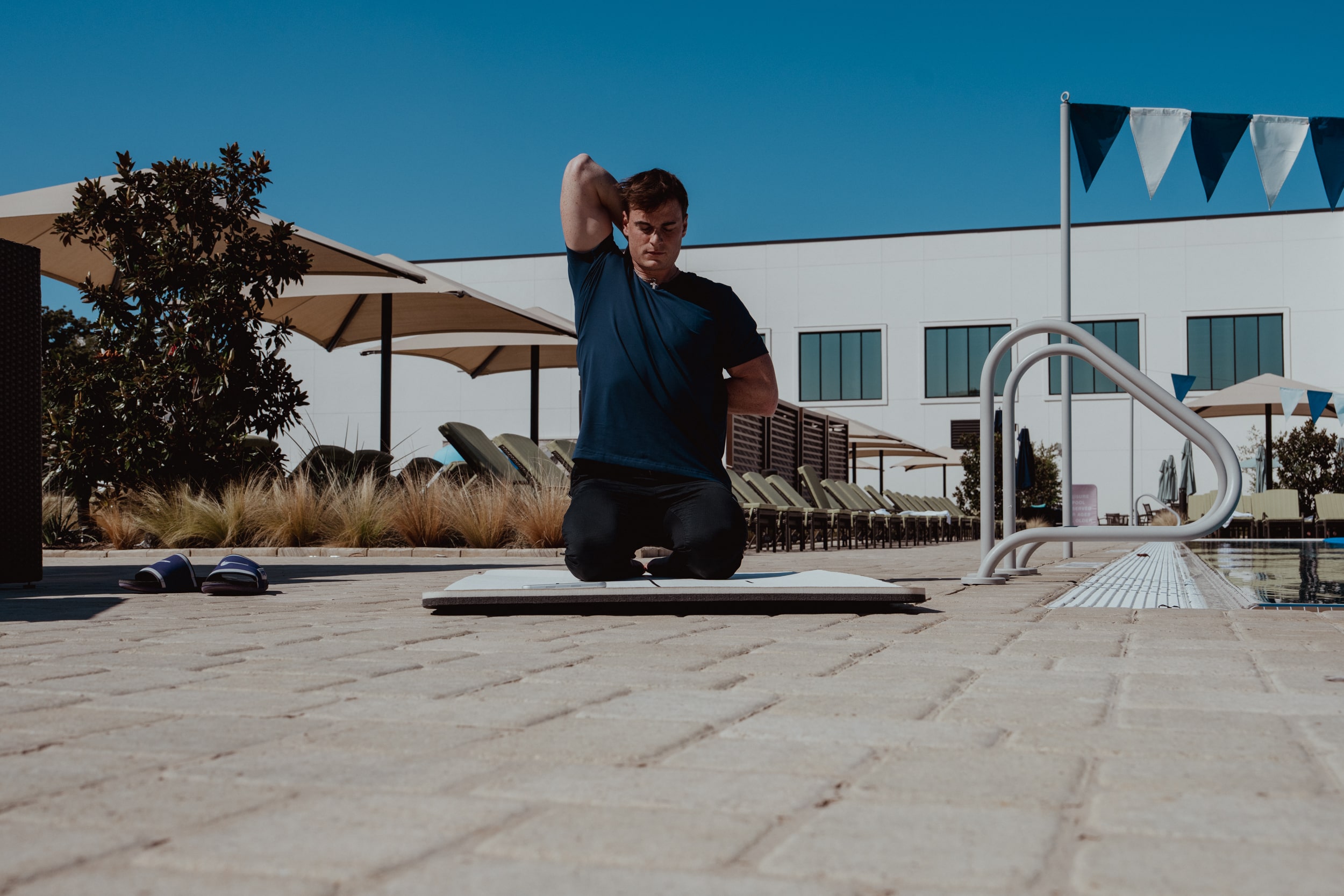

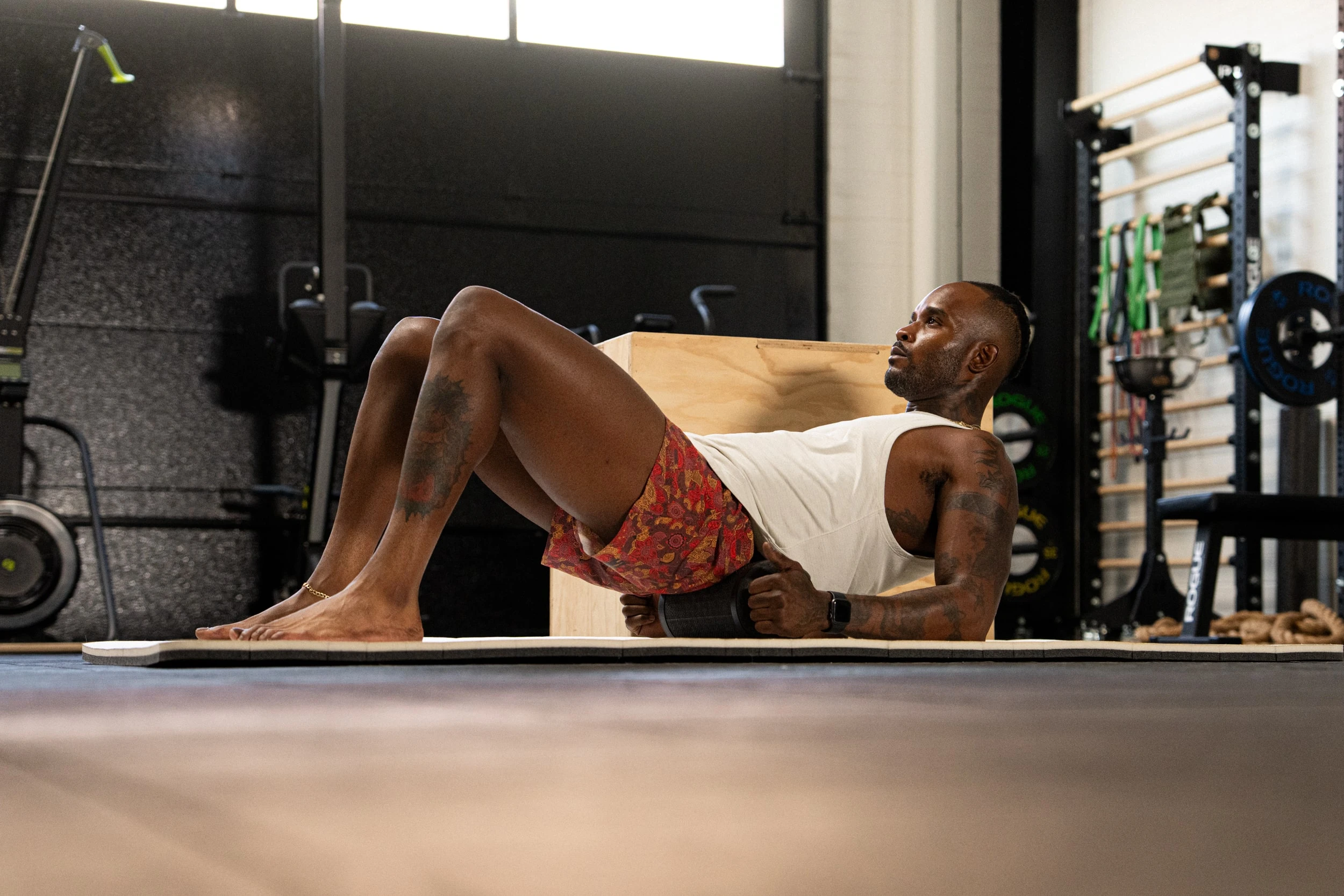


Move better in 10 minutes a day.
10,000+ five-star reviews.