


LEARN
pliability

Reaching for a coffee mug or lifting groceries can become frustrating when left arm stiffness makes simple movements uncomfortable. This tightness can disrupt daily activities from getting dressed to typing at work, often appearing without warning or obvious cause. Understanding the common reasons behind arm stiffness helps identify effective relief strategies.
Multiple factors contribute to left arm stiffness, including poor posture, repetitive strain, muscle tension, and joint restrictions. Targeted approaches that address these root causes can restore smooth, pain-free movement.
why left arm stiffness isn't just "normal aging"

Most people dismiss mild left arm stiffness as a normal part of aging or sleeping in a bad position, but this overlooks mechanical problems that can worsen over time. Stiffness often signals posture imbalances, nerve compression, overuse patterns, or muscle tension that won't resolve on its own. In some cases, it can indicate a cardiovascular issue that needs immediate attention.
Warning: Left arm stiffness combined with chest discomfort, shortness of breath, or unusual fatigue calls for immediate medical evaluation, since these can be early warning signs of heart problems. Nerve compression and muscle imbalances, on the other hand, typically do not resolve with time alone and tend to worsen without some kind of intervention.
the cardiovascular concern vs. the mechanical reality
If you're at high risk of heart issues, left-arm discomfort naturally raises concern. Most left arm pain, however, stems from mechanical causes with specific patterns: gradual onset over weeks or months, grinding or popping in joints during movement, and pain that shifts with position or activity. Cardiovascular symptoms, by contrast, appear suddenly, feel crushing or radiating, and don't improve with rest or stretching. Arthritis-related stiffness is also common as people age, and it's frequently mistaken for an inevitable part of getting older rather than a treatable condition.
overuse injuries develop faster than you think
Rotator cuff tears, tennis elbow, and shoulder bursitis can develop from a single weekend of yard work or an afternoon playing catch. These conditions arise from repetitive arm movements without first preparing the muscles and tendons, and pain often emerges hours or days later, which makes it difficult to connect the discomfort to the activity that caused it.
hidden nerve tension patterns
Stiffness in your left arm often stems from problems distant from the pain site. Weakness in your lower traps can force your neck and shoulder muscles to work harder, creating tension that spreads down your arm. Brachial plexus irritation and thoracic outlet syndrome can also compress nerves, causing burning sensations, tingling fingers, or electrical sensations that people often ignore until symptoms worsen.
You can also have severe muscle stiffness for a long time without feeling much pain, only noticing the restriction when someone points out a difference between your two arms, or when the stiffness starts creating referred tension elsewhere, like the neck or upper back. Understanding what happens inside your arm when stiffness takes hold changes how you approach it.
the mechanisms behind left arm stiffness

Left arm stiffness involves a few specific mechanical changes: muscle fibers shorten and resist lengthening, fascia becomes denser and less flexible, or nerves get squeezed by surrounding structures. Identifying which of these pathways is driving your stiffness helps you treat the root cause rather than just the symptom.
muscle strain creates localized fiber damage
A muscle strain occurs when individual fibers tear from sudden force or sustained overload. The microscopic damage triggers an inflammatory response that floods the area with fluid and protective chemicals, causing swelling that restricts how far the muscle can stretch, which creates tightness for days after the injury. The body also guards the damaged area by keeping surrounding muscles contracted, which spreads stiffness beyond the original injury site.
tendon inflammation follows repetitive stress
Tendons have a limited blood supply, which makes them slow to heal once irritated. Repetitive motions such as typing, throwing, or lifting create friction as the tendon slides through its sheath. According to the American Academy of Orthopaedic Surgeons, tendinitis develops when collagen fibers fray and swell, reducing the tendon's ability to transmit force smoothly from muscle to bone. This shows up as a tight, burning sensation near the elbow or shoulder that worsens with specific movements and doesn't improve with rest alone.
nerve compression can create radiating arm pain
Cervical radiculopathy occurs when a nerve root leaving the cervical spine is pinched by a herniated disc or bone spur. The compressed nerve interrupts normal signal transmission, creating referred pain, tingling, or tightness along the nerve's pathway into the arm. If the root cause is nerve compression or chronic tendon inflammation, stretching the arm alone usually will not resolve the issue; it often takes a combination of nerve glides, joint mobilization, and muscle activation work targeted at the actual source.
reduced blood flow can feel like stiffness too
Poor circulation in the upper extremities can also limit the oxygen-rich blood reaching your arm muscles. When blood flow drops below what normal muscle metabolism needs, you can experience cramping, heaviness, or tightness during activity and sometimes at rest. The muscles aren't damaged in this case, they're under-supplied, which creates a different kind of tightness than a mechanical injury: one that feels like persistent fatigue and sometimes comes with coolness or color changes in the skin.
how to reduce left arm stiffness with a simple routine

Establish your baseline before stretching or adjusting anything: test how far you can reach overhead, behind your back, and across your chest without pain. Rate your stiffness on a scale of 1 to 10 each morning for three days to identify patterns linked to sleep position, activity, or time of day.
Assessment Type | What to Test | Notes |
|---|---|---|
Overhead Reach | Maximum arm extension above the head | Stop at the first sign of discomfort |
Behind Back | How far the hand reaches up the spine | Note the dominant vs. non-dominant differences |
Cross-Chest | Arm stretch across the body | Hold for 5 seconds to assess range |
Record a video of yourself reaching overhead with both arms, noting the height and smoothness of each side. Measure the distance between your fingertips when you clasp hands behind your back, one arm reaching over the shoulder and one from below, and write down these numbers with the date. Without a reference point, you can't tell whether your routine is working.
build your daily mobility sequence
Address the three layers causing restriction: nerve mobility, joint capsule tightness, and muscle tension. Start with nerve glides, gently moving your arm through positions that slide the brachial plexus without aggressive stretching. Follow with shoulder circles in both directions, 10 repetitions each, to lubricate the joint capsule. Finish with targeted stretches for the biceps, triceps, and chest, holding each for 20 to 30 seconds without bouncing.
Five focused minutes daily tends to work better than 30 random minutes twice a week, because the nervous system adapts through consistent, repeated exposure to end-range positions rather than occasional bursts of intensity. Mix in posture-focused adjustments and light strength work for the stabilizing muscles once you can move more freely, and track measurable progress each week to confirm the routine is working.
before you begin: safety guidelines
Stretching can work against you when done incorrectly. Move slowly and stop at mild tension, never pain. Sharp discomfort or tingling indicates potential nerve or tissue irritation. Warm up with light arm circles or shoulder rolls if you're stiff, since cold muscles tear more easily. Keep breathing steadily and shoulders down, away from your ears. If a stretch feels too hard, reduce the range or skip it until your baseline mobility improves.
cross-body shoulder stretch
This stretch targets the rear deltoid and rotator cuff muscles, which tighten from repetitive forward reaching during typing, driving, or lifting. Tightness here restricts shoulder rotation and creates that locked feeling when reaching across your body or behind your back.
Stand or sit upright. Raise your left arm straight in front of you at shoulder height. Grasp your left elbow with your right hand and gently pull the arm across your chest toward your right shoulder. Keep both shoulders level and relaxed; you should feel the stretch across the back of your left shoulder and upper back, not in the front of the shoulder or neck. Hold for 20 to 30 seconds and repeat two to three times, especially after prolonged sitting or forward arm use. Experiment with pulling the arm slightly upward or downward until you find the angle that releases the most tension.
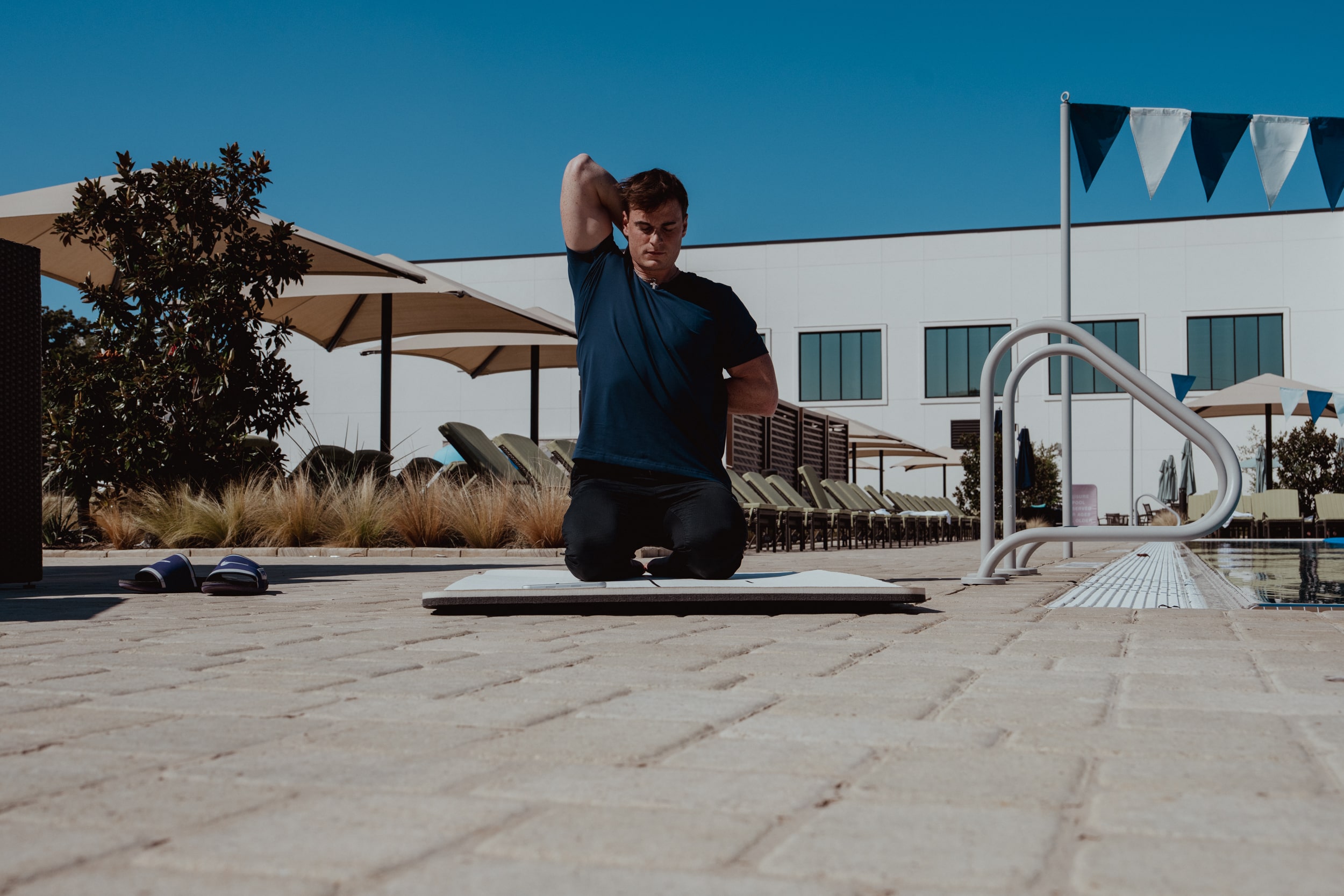
overhead triceps stretch
Tight triceps and lats restrict overhead mobility and pull the shoulder joint forward, contributing to rounded posture. This stretch opens both muscle groups and improves your ability to lift your arm without compensating through your lower back or neck.
Lift your left arm overhead and bend your elbow so your left hand drops behind your upper back between your shoulder blades. Use your right hand to apply gentle downward pressure on your left elbow to deepen the stretch. Keep your ribs tucked and core engaged to prevent your lower back from arching. Hold for 20 to 30 seconds per side. Standing tall with a neutral spine makes this stretch work better and protects your lower back; if you can't reach your hand down your back without leaning, use a smaller range of motion and keep your torso upright.
doorway chest stretch
Desk work, phone use, and carrying objects in front of your body tighten the chest muscles, pulling your shoulders forward. This stretch counteracts that forward pull by opening the front of your shoulders and chest.
Stand in a doorway and place both forearms on the door frame at 90-degree angles, with elbows at shoulder height. Step one foot forward and lean gently until you feel a stretch across your chest and front shoulders. Keep your neck neutral and hold for 20 to 30 seconds. Move your elbows slightly higher or lower on the frame to target different chest muscles: the higher position stretches the lower chest, the lower position targets the upper chest and front deltoids.
wall shoulder stretch
This stretch improves shoulder rotation and reduces stiffness in the deltoid and lat muscles, helping with tightness that restricts overhead and cross-body reaching.
Stand sideways next to a wall. Extend your left arm and place your palm flat against the wall at shoulder height, with your elbow straight. Slowly rotate your torso away from the wall while keeping your hand in place. You should feel a stretch along the side of your shoulder and into your upper back. Hold for 20 to 30 seconds per side. Think "down and back" with your shoulders to keep the stretch in your deltoid, not your neck; if you feel neck tension, lower your arm or reduce rotation depth.
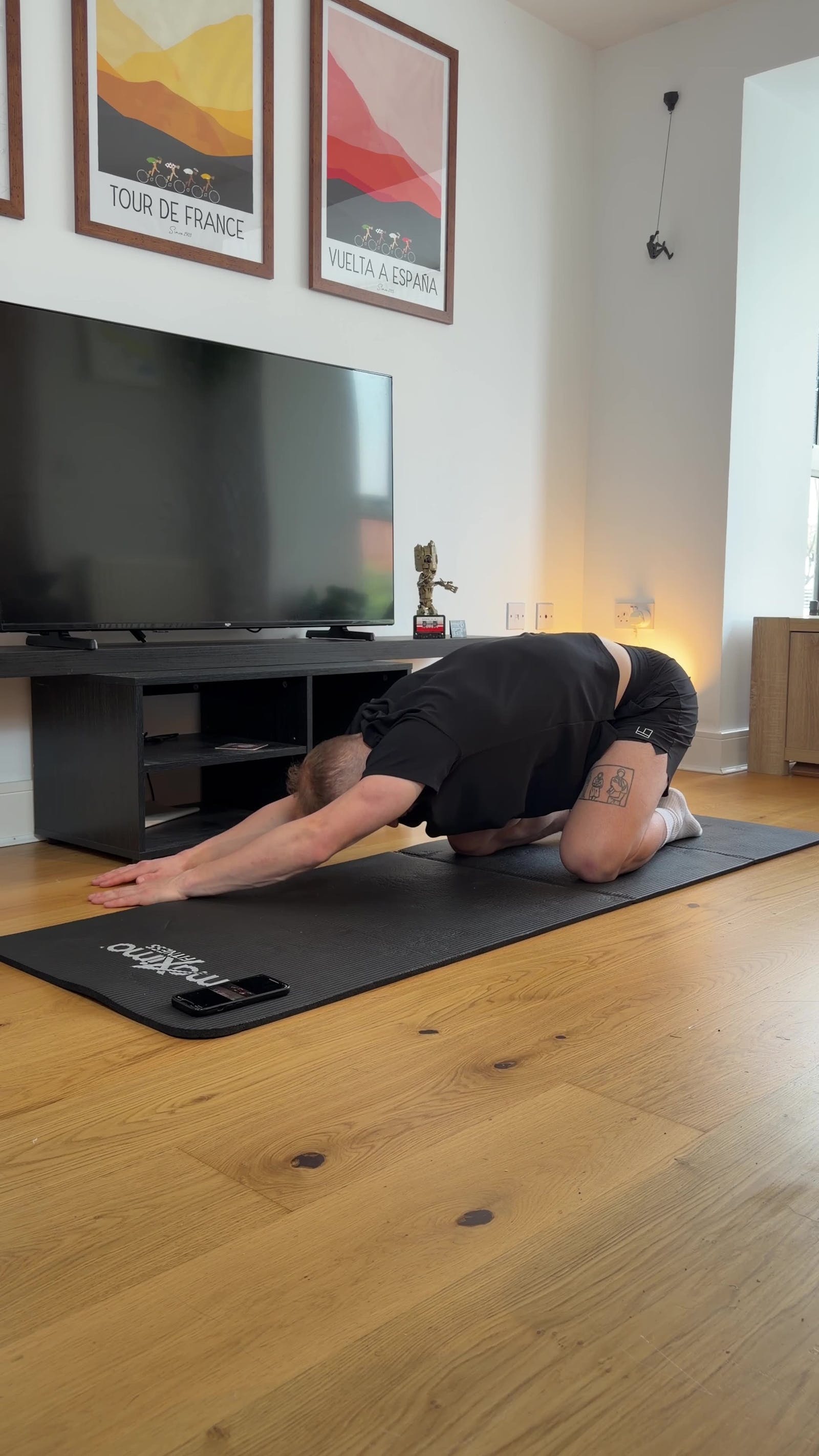
child's pose with arm reach
This gentle stretch lengthens the lats and upper back, relieving tension from stress, poor posture, or prolonged sitting while decompressing the spine.
Begin in a tabletop position on your hands and knees. Sit back onto your heels and walk your hands forward until your chest lowers toward the floor. Relax your shoulders and let your forehead rest on the ground if comfortable. Hold for 20 to 30 seconds. To target one side more specifically, shift your hands slightly to the left to intensify the stretch on your right lat, then switch sides.
wrist flexor stretch
Wrist flexors tighten from typing, gripping weights, or repetitive hand tasks, creating tension that radiates up the forearm into the elbow.
Extend your left arm forward with your palm facing up. Use your right hand to gently pull your left fingers back toward your body, keeping your left elbow straight. Hold for 20 to 25 seconds. Turn your wrist slightly outward or inward until you find the angle that creates the best stretch; the feeling should be a gentle pull along the inside of your forearm, not sharp pain in your wrist joint.
wrist extensor stretch
This stretch targets the wrist extensor muscles on top of the forearm, which are used in lifting, computer work, and gripping. Tight wrist extensors can contribute to elbow discomfort and forearm fatigue.
Extend your left arm forward with your palm facing down. Use your right hand to gently pull your left fingers downward and slightly inward toward your body. Hold for 20 to 25 seconds. Keep your shoulder relaxed and avoid shrugging; if tension creeps into your shoulder or neck, lower your arm slightly.
behind-the-back shoulder stretch
This stretch opens the front of your shoulders and biceps, which tighten from carrying, lifting, and the forward-leaning posture of desk work. Clasping your hands behind your back reverses the rounding of your shoulders.
Stand tall with your feet hip-width apart. Clasp your hands behind your back, palms facing each other. Straighten your arms and lift them gently away from your body, keeping your chest open and shoulders pulled back. Hold for 20 to 30 seconds. If you can't clasp your hands together, hold a towel or strap between them and gradually work toward bringing your hands closer.
dynamic arm circles
This dynamic movement increases blood flow, warms the shoulder muscles, and improves joint lubrication, preparing your rotator cuff for smoother movement patterns.
Stand with your feet shoulder-width apart and extend both arms out to your sides at shoulder height. Make small forward circles for 20 to 30 seconds, then reverse direction for another 20 to 30 seconds, gradually increasing the circle size as comfort allows. Keep your core engaged to maintain control; if you feel clicking or discomfort, reduce the circle size or reassess your shoulder position.
strengthen the muscles that hold the correction
Stretching tight muscles without strengthening the weak stabilizers around them tends to give only temporary relief. If your left shoulder rounds forward more than your right, your chest and front-shoulder muscles are likely overpowering the muscles between your shoulder blades. Add scapular retraction work: squeeze your shoulder blades together for 5-second holds, 10 repetitions, twice daily, to rebalance the forces pulling on the shoulder joint.
sleep position and desk setup
Your sleep position can worsen daytime imbalances. Sleeping on your left side with your arm pinned under your body cuts off blood flow and compresses the brachial plexus. Place a pillow between your arms to keep your shoulders neutral, or sleep on your back with a small rolled towel under your neck to maintain your cervical curve.
A desk setup that forces your left arm into sustained internal rotation and forward reach adds to the problem. Raise your monitor so the top third of the screen sits at eye level to prevent forward head posture, and position your keyboard close enough that your elbows stay bent around 90 degrees with your upper arms hanging naturally from your shoulders. Every 30 minutes or so, stand and do a handful of overhead reaches to interrupt the strain cycle before it builds.
heat, cold, and timeline for progress
Cold, stiff tissue resists lengthening, so applying a heating pad to your shoulder and upper arm for 5 minutes before stretching can make the work more comfortable and effective. Use cold therapy instead for the first 48 hours if your arm feels hot, swollen, or the stiffness appeared suddenly after an injury, then switch to heat and mobility work.
Every seven days, repeat your baseline assessments: overhead reach height, behind-the-back clasp distance, and morning stiffness rating. Look for small gains, a few more degrees of shoulder flexion, an extra vertebra reached when clasping behind your back, or a drop from a 7/10 stiffness rating to a 5/10. These changes tend to build gradually over several weeks rather than overnight, so don't judge the routine by how it feels on any single day.
when to seek professional help
If you follow a structured routine for 3 weeks without measurable improvement in range or a reduction in stiffness ratings, the restriction may involve joint capsule adhesions, nerve entrapment, or a structural issue that needs manual therapy. Persistent numbness, tingling that worsens with specific neck positions, or weakness when gripping suggest cervical radiculopathy that won't improve through stretching alone. Pain that wakes you at night or prevents lifting your arm above shoulder height also warrants a closer look to rule out a rotator cuff tear or labral damage. Self-directed mobility work handles most stiffness cases, but knowing when you've reached its limits prevents months of frustration spent stretching a problem that needs a different kind of intervention.
improve your flexibility with our mobility app today | get 7 days for free on any platform
If you spend hours at a desk, on your phone, or lifting weights, left arm stiffness can quietly slow you down and affect your posture. pliability is a mobility app built to help: take the in-app mobility assessment to find where you're tightest, follow a Daily Session or a Path built around shoulder and upper-body mobility, and use Build Your Program to fold it into your week. If you're working around pain or a past injury, the Rebuild hub is built for that.
Sign up today for 7 days free on iPhone, iPad, Android, or the web to track your range of motion and build lasting relief from stiffness.
Related Reading









Move better in 10 minutes a day.
10,000+ five-star reviews.