


LEARN
pliability

Back pain can be debilitating, but it doesn't have to be a normal part of life. Many people experience back pain that can interfere with daily activities and quality of life due to poor flexibility and mobility. If you can relate, you may wonder how to reduce the risk of back pain before it becomes severe. This article will answer that question and offer valuable insights to help you move freely and comfortably without back pain by incorporating flexibility exercises that improve mobility, reduce stiffness, and prevent future discomfort.
how can flexibility training reduce the risk of back pain?

Flexibility training improves spinal health by reducing tension in the muscles surrounding the spine and improving mobility. These benefits can help alleviate and prevent back pain.
Low back pain is among the most commonly reported health problems in America, and a large share of people can expect to consult their physician about it at some point in their lifetime. Despite its prevalence, low back pain is difficult to define. Some consider it actual nociception perceived in the lumbar region.
challenges in defining low back pain: perspectives and variability
Others only consider it relevant if it worries the patient sufficiently to seek care or causes a functional impairment in their activities of daily living. Producing a definition of low back pain is beyond the scope of this work. We recognize that it has different meanings to different people, both patients and physicians, which can make it challenging to quantify. A panel of back pain experts convened in 2008 to examine this problem directly.
They identified heterogeneity in the definition of back pain. They agreed on:
A minimal and optimal definition
Considering the severity
Site
Duration of symptoms
Functional limitations
Prevalence estimates vary among different populations, ranging from 12% to 38%.
flexibility training to reduce back pain and improve muscle function
Flexibility and muscle-strengthening exercises are core features of many physical training programs.
Guidelines from the UK Department of Health indicate that everyone should include flexibility and muscular strength activities at least twice weekly.
Canadian guidelines recommend that people participate in flexibility exercises four to seven times per week and muscle-strengthening activities two to four times per week.
US guidelines also recommend muscle-strengthening exercises at least twice a week and suggest using flexibility exercises, such as stretching.
Note that this does not count towards meeting the 150-minute-per-week physical activity target.
weak muscles, back pain, and how stretching helps
Weak back and abdominal muscles can cause or worsen low back pain. That's why stretching and strengthening your back and abdominal muscles is essential not only for treating low back pain but also for helping to prevent its recurrence.
Key Muscle Groups for Back Pain Prevention: Strengthening & Stretching Strategies
A stretching and strengthening regimen should target the following:
Back
Abdominal
Buttock muscles
Intense abdominal or flexor muscles and strong extensor muscles, which run the entire back length, help maintain an upright posture.
Strengthening the buttock muscles, which help support the back during walking, standing, and sitting, and the two iliopsoas muscles, which run from the lower spine to the hips, is good for the back. The muscles of the upper legs also need to be strong and flexible because when they are weak and tight, they can strain the supporting structures of the back.
stretching to improve mobility and joint function
A stretching program can help bring alignment to the joints of your:
Shoulders
Hips
Knees
Ankles
When the body is aligned correctly, mobility is increased, and inflammation of the joints is reduced.
how stretching reduces chronic pain
Inflammation is one of the most common causes of chronic pain. Reducing inflammation of joints and ligaments can significantly reduce the severity of pain.
Consistent stretching can improve the range of motion and help relieve:
Stiffness and muscle aches
Prevent injuries
Improve structural problems
preventing chronic pain with flexibility training
Improved range of motion generally means you do not have to stress your body as much to carry out regular tasks, reducing the risk of injury. Since injury and structural issues are major chronic pain risk factors, preventing these issues can help keep chronic pain at bay.
Besides increased flexibility, stretching helps improve:
Circulation and blood flow
Relieve stress
Increase oxygen flow
Enhance coordination
reducing stress to alleviate chronic pain
Stress can trigger the release of chemicals that promote inflammation, so reducing stress can go a long way toward staving off chronic pain flare-ups. Improved blood and oxygen flow boosts your body's healing abilities. This, along with better coordination, can decrease the risk of sustaining injuries that could result in chronic pain.
flexibility training benefits everyone
Flexibility is not just for athletes, it is essential to a healthy lifestyle. Stretching is a valuable component of a treatment plan for anyone plagued by back problems.
Supple, well-stretched muscles are less prone to injury, while less flexible muscles and connective tissues restrict joint mobility, increasing the likelihood of sprains and strains.
how to get started with flexibility training
Stretch regularly but gently, without bouncing, which can cause tissue injury. If you aren't used to stretching, start by holding a stretch for a short time and gradually build up to roughly 30-second stretches over time.
12 essential flexibility exercises for lower back pain relief

1. standing lumbar extension: stretch your back to relieve pain
The standing lumbar extension stretches the muscles in your lower back.
To perform the stretch:
In a standing position with your feet about shoulder-width apart, place your hands on your lower back, fingers pointing down.
Bend your body backward at the waist, supporting your trunk with your hands, and keep your knees straight.
Hold the position for 5 to 10 seconds, then return to standing.
Repeat as needed.
Modification:
Perform the stretch with your back against a countertop for support.
2. supine bridge: strengthen your core and back muscles
The supine bridge engages your back, hips, and core muscles.
To perform the exercise:
Lie on your back with your arms at your sides, your legs bent at the knees, and your feet flat on the floor.
Tighten your abdomen and glutes.
Slowly lift your hips off the floor while keeping your back straight.
After a brief pause, lower your butt back down to the floor.
Do 10 repetitions.
Modifications:
Place a bolster or pillow in the crevice behind your knees for an easier version. Instead of pushing up with your feet, push up from the back of your knees. This reduces the range of motion and makes the exercise less strenuous.
3. bird dog: improve your core stability and balance
The bird dog exercise targets your core, back, and pelvic muscles to improve stability.
To perform the exercise:
Get down on all fours, with your hands on the floor directly under both shoulders and your knees under your hips.
Keep your head aligned with your spine and lift your right arm forward and left leg straight behind you until they're parallel to the floor.
Pause, then return to the starting position.
Repeat with the left arm and the right leg.
Keep your abdominal muscles tight, your back flat, and your hips level throughout the exercise.
Do 10 repetitions on each side.
Modifications: Lean forward over a bed with your feet on the ground and hands on the bed instead of having both on the floor.
4. cat-camel: increase spinal flexibility
The cat-camel exercise helps increase flexibility in your spine.
To perform the exercise:
Start on all fours, with your hands on the floor under your shoulders and your knees under your hips.
Tuck your chin toward your chest and slowly round your back toward the ceiling.
Pause for a few seconds, then slowly draw your shoulders away from your ears, relax your back, and arch your neck slightly while gazing ahead.
Return to the starting position.
Do 10 repetitions.
Modifications:
To complete the exercise, plant your feet on the ground and lean forward over a bed or couch-height surface.
5. double knee-to-chest stretch: loosen tight lower back muscles
The double knee-to-chest stretch helps relieve tightness in the lower back.
To perform the stretch:
Lie on your back with both legs bent and your feet flat on the floor.
Lift your feet off the floor and pull both knees toward your chest.
Hug your knees with your arms.
Hold this position for 20 to 30 seconds while keeping your back relaxed against the floor.
Release and repeat a few times.
Modifications:
Pull in one knee at a time for a less strenuous stretch that will work the same muscles. If you have trouble bringing your knee up, hook a towel or small strap behind the knee to pull it toward you.
6. supine twist: stretch your lower back and hips
The supine twist stretches the lower back and hips.
To perform the stretch:
Lie on your back with your knees bent and your feet flat on the floor.
Keeping your shoulders flat on the floor, let your knees slowly roll to the right side of your body.
Pause for five seconds, then slowly return your knees to the starting position.
Then, let your knees roll to the left side of your body; pause for five seconds, then return to the starting position.
Repeat several times on each side.
Modifications:
Instead of dropping your knees to the ground, try lowering them about half the way to the floor.
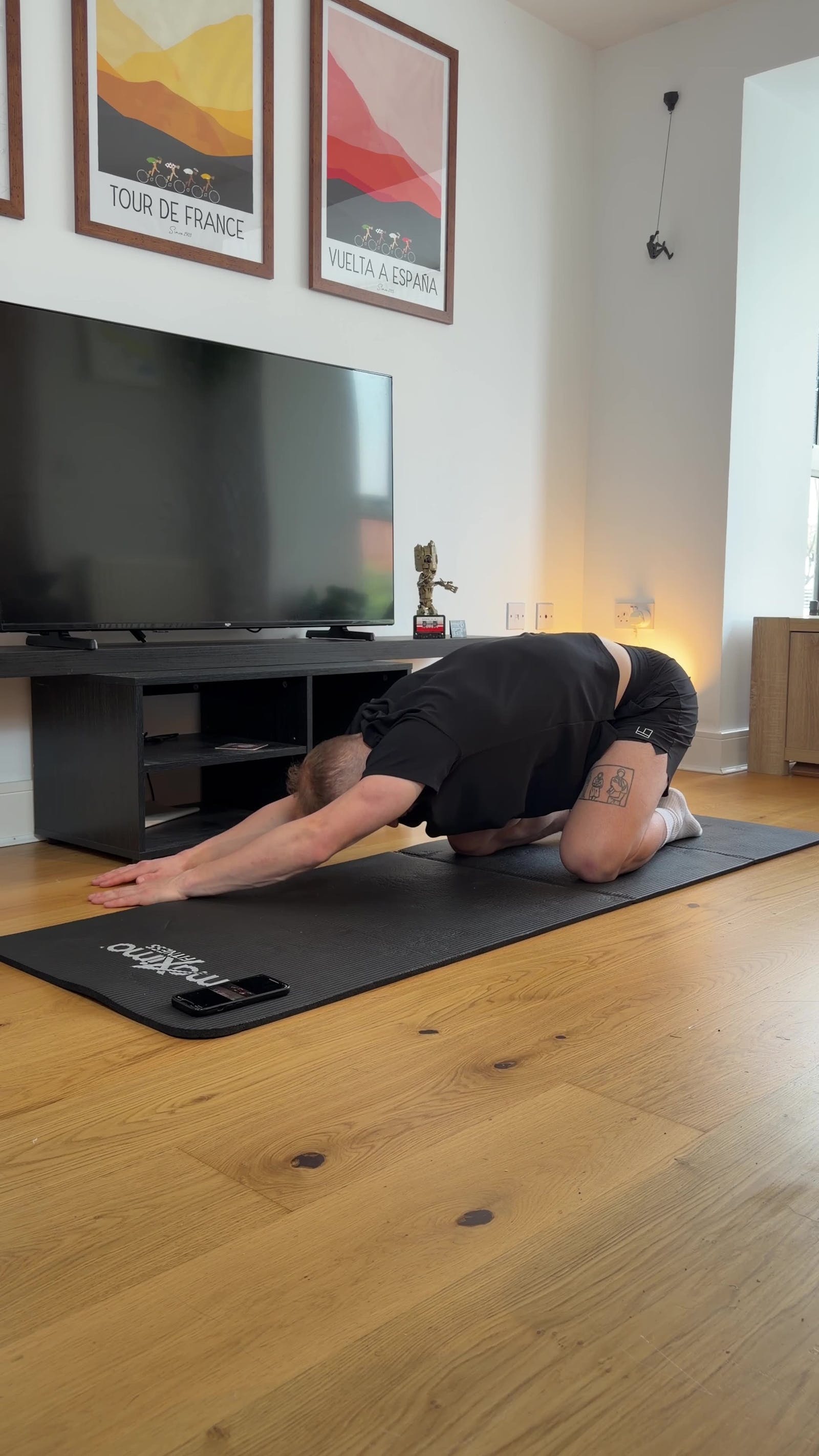
7. child's pose: gently stretch your back and hips
Child's pose is a gentle yoga pose that stretches the back and hips.
To get into the pose:
Start on your hands and knees.
Push your butt back onto your heels with your knees apart.
Lower your upper body between your knees, stretch your arms along the floor above your head, and place your forehead on or near the floor.
Hold this position for 20 to 30 seconds.
Modifications:
Get into a half-kneeling position with your hands on the bed or a couch-height surface.
8. cobra stretch: increase flexibility in your spine
The cobra stretch, also known as cobra pose or Bhujangasana in yoga, increases flexibility in your spine and can help relieve back pain.
To perform the stretch:
Begin by lying on your stomach.
Keep your legs close together, and place your palms below your shoulders with your elbows alongside your body.
As you breathe, gently lift your upper body and abdomen while pressing your lower abdomen and toes into the floor.
Modification:
Keep your forearms and palms flat on the floor to avoid overstretching. Alternatively, you can stretch on a bed instead of the floor or stand with your body facing a wall.
9. knee-to-chest stretch: relieve tension in your lower back
The knee-to-chest stretch helps relieve tension in your lower back.
To perform the stretch:
Lie on your back with both knees bent.
Pull one knee toward your chest and hold it for 5 to 10 seconds.
Return to the starting position.
Repeat with the other leg.
Do this 5 to 10 times with each leg.
10. pelvic tilts: strengthen your abdominal muscles
Pelvic tilts target your abdominal muscles to help stabilize and support your spine.
To perform the exercise:
Lie on your back with both knees bent and your feet on the floor.
Gently flatten your lower back to the floor, hold for 5 to 10 seconds, then relax.
Do this 5 to 10 times.
11. knee cradle: stretch your hips and lower back
The knee cradle targets your hip and lower back muscles.
To perform the stretch:
Lie on your back with your legs straight out.
Bend your right knee and rotate your hip so the lower leg crosses your chest, pointing to the left. You should feel this stretch in your thigh.
Hold for 5 to 10 seconds, then return to the starting position.
Do this 5 times with each leg.
12. bridge: strengthen your back and hip muscles
The bridge exercise targets your glutes, back, and core.
To perform the exercise:
Lie on your back with both knees bent and your feet on the floor.
Gently raise your buttocks off the floor 4 to 6 inches, hold for 5 seconds.
Return to the starting position.
Do this 5 to 10 times.
build these into a routine you'll actually keep
Pick three or four of the stretches above that match where you feel tightest, and run through them most days rather than saving them for when your back already hurts. Pair them with the strengthening work, since flexibility alone doesn't hold up without the muscles to support the range of motion you're building.
pliability turns this into a guided routine: Daily Sessions give you a fresh mobility session built around what's tight that day, and Paths run a multi-week progression if your back needs sustained work. Take the mobility assessment to find your specific restrictions before you start. Start with 7 days free on iPhone, iPad, Android, or the web.
Related Reading




Move better in 10 minutes a day.
10,000+ five-star reviews.